

 Back
Back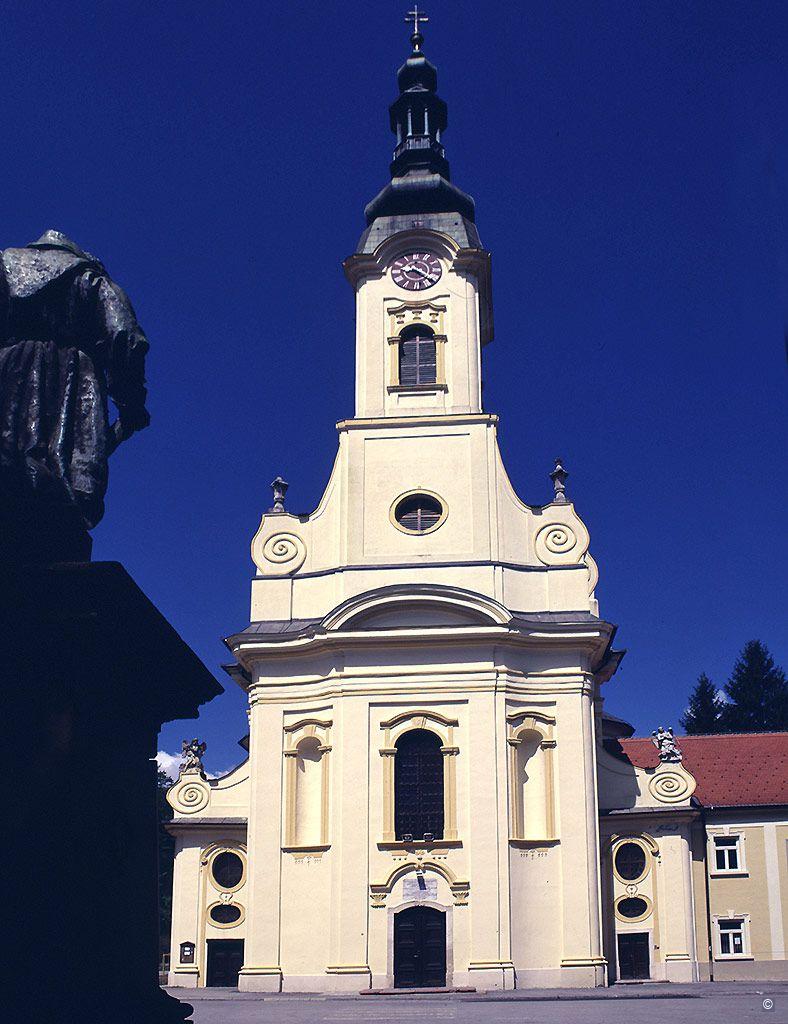
 Add to My Collection
Name of Monument:
Cathedral of St. Theresa, Požega
Also known as:
Katedrala sv. Terezije
Location:
Požega, Slavonia, Croatia
Trg Svete Terezije 1
Požega
T : +385 34 290 300
Požega Diocese, Trg sv. Trojstva 18 (Responsible Institution)
Date:
1756–1763
Artists:
Unknown
Denomination / Type of monument:
Religious, Baroque centralised longitudinal church
Patron(s):
Bishop of Zagreb Franjo Thauzy; Požega Chapter and Parish of St. Theresa
History:
The foundation of the parish and construction of the Parish Church of St. Theresa have direct links to historical events of the mid-18th century. After liberation from the Ottomans and the simultaneous rise in the political importance of Požega, the Bishop of Zagreb, Franjo Thauzy, chose Požega as the centre of religious life in Slavonia. The Bishop founded a branch of the Zagreb chapter there in 1752, and from 1756 until 1763, oversaw construction of the Parish Church of St. Theresa. This act, supported by Queen Maria Theresia, heralded in many ways the foundation of the See of Požega in 1997 and the elevation of the church to cathedral status.
Description:
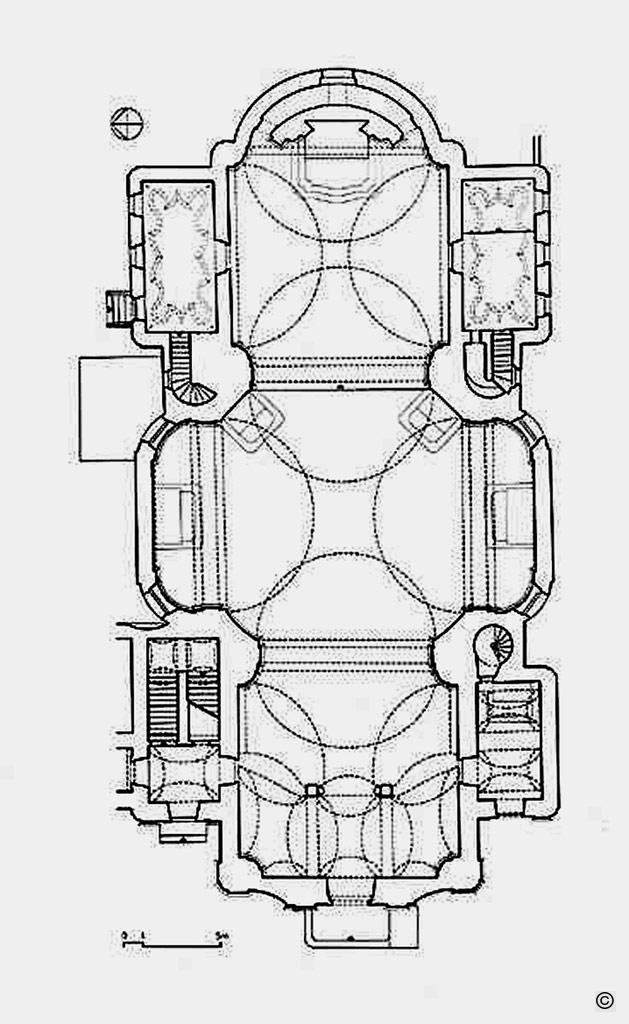
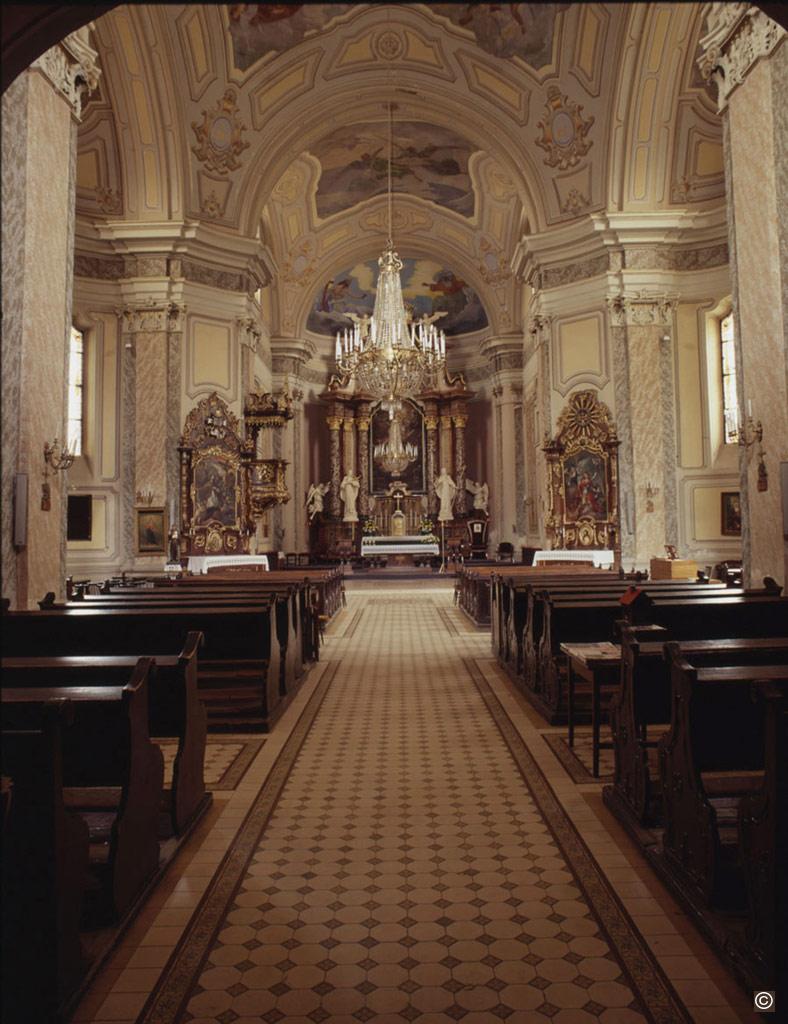
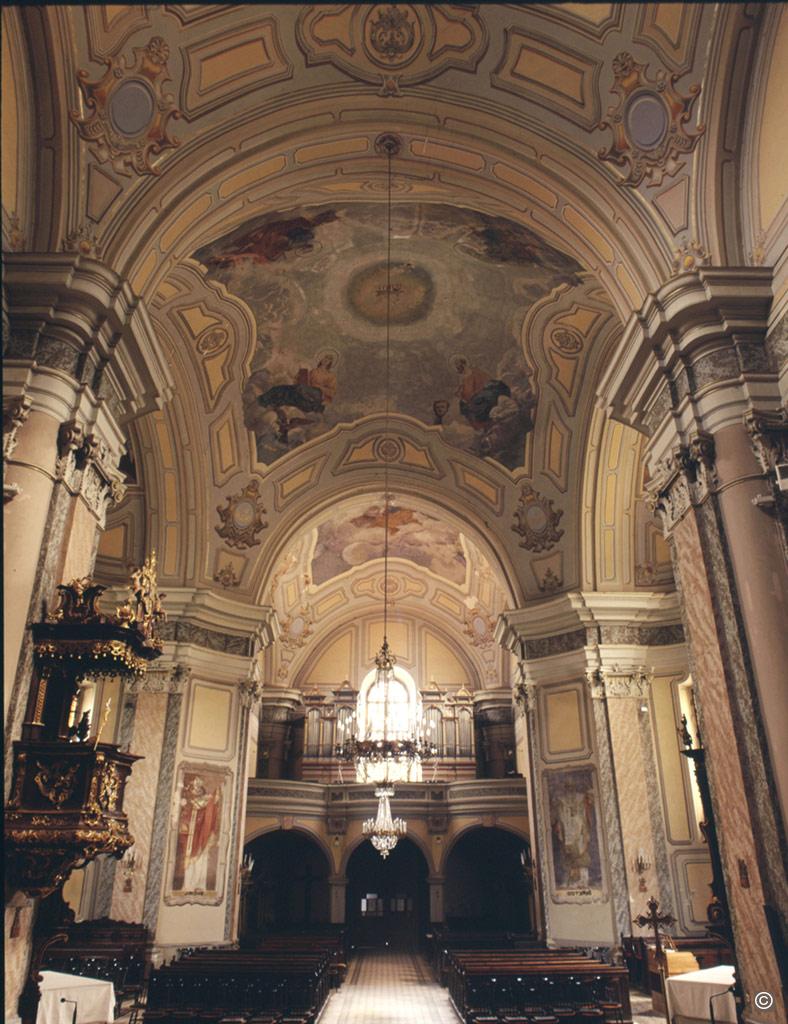
The dignity of the person who commissioned the church mirrors the organisation of volume and space marked as it is by a Baroque synthesis of longitudinal and central space. The internal space is divided into three wide, square bays with baldachin ceilings: the first is used as an entry space with a choir; the second is the central part of the nave and the third the sanctuary, finished with a segmental apse. The centralisation, achieved by rounded chapels squeezed in along the central bay and with the introduction of a transversal axis, made the dynamics of the space possible. The accent on the central bay, seeming somewhat larger in the ground plan, was formed by oblique angles in the framework of what are otherwise convex-concave columns with composite pilasters. The organisation of the interior space reflects the composition of the church's volume, the main stamp of which is the central bell tower incorporated into the facade. Effective buttresses in the form of double volutes support the expression of this bold and original construction. With these features of volume and space – to which one should add the distinctive architectural mouldings – the church tells of a knowledgeable architect trained in the Late Baroque architectural circle of Styria and Vienna. Comparable examples of religious architecture in this area are seen in the work of Viennese architect, Franz Anton Pilgram. In terms of the façade and architectural moulding, there are parallels in the quatrefoil churches of the Styrian architect, Josef Hoffer. With its inventiveness, expressed in the hybrid application of Late Baroque, Rococo and Classicist features, this church marks an innovation in Croatian Baroque architecture.
View Short DescriptionThe Cathedral of St. Theresa, Požega takes on the one hand an innovative architectural approach, while on the other it is a curious blend of influences from Styria and Vienna. That this eclectic mix occurred in Slavonia was thanks to the Diocese of Zagreb. The longitudinal interior was centralised in a typically Late Baroque manner with the placement of rounded side chapels on the transversal axis, while the elegant, incorporated bell tower is an effective accent on the imposing exterior. In some of the plastic details, the presence of the Rococo is discernable, while the overall harmoniousness of the space heralds Classicism.
How Monument was dated:
Documents and stylistic features.
Special features
Plan of the Cathedral of St. Theresa, Požega
1756
Unknown artist
Late Baroque longitudinal, centralised type with curved lateral chapels
positioned on a transversal axe.
View of the Sanctuary
Cathedral of St. Theresa
1756–1763
Unknown
Late Baroque synthesis of a longitudinal and central space.
View of the Choir
Cathedral of St. Theresa
1756–1763
Unknown artist
Interior with square bays of baldachin vaults.
Selected bibliography:
Horvat, A., (ed) “Barok u kontinentalnoj Hrvatskoj” in Barok u Hrvatskoj, Zagreb, 1982, pp. 1–38.
Horvat-Levaj, K., Katedrala sv. Terezije u Požegi, in Radovi Instituta za povijest umjetnosti 28, 2004, pp. 208–231.
Citation of this web page:
Katarina Horvat-Levaj "Cathedral of St. Theresa, Požega" in "Discover Baroque Art", Museum With No Frontiers, 2026.
https://baroqueart.museumwnf.org/database_item.php?id=monument;BAR;hr;Mon11;17;en
Prepared by: Katarina Horvat-LevajKatarina Horvat-Levaj
SURNAME: Horvat-Levaj
NAME: Katerina
AFFILIATION: Institute of Art History, Zagreb
TITLE: PhD, Scientific Consultant
CV:
Katerina Horvat-Levaj graduated with a BA in Art History and Archaeology in 1981 from the University of Zagreb (Faculty of Philosophy, Department of Art History). In 1985 she obtained her MA and in 1988 she was awarded a scholarship at the University of Padua. In 1995 she defended her Doctorate at Zagreb University on Representative Residential Architecture of the Baroque in Dubrovnik. Since 1982, she has been employed at the Institute of Art History in Zagreb, and is presently a Senior Research Associate. Katarina also teaches at the University of Split. At the University of Zagreb she participates at doctoral level in the Faculty of Croatian Studies and the faculties of Architecture and Philosophy.
Translation by: Graham McMaster
Translation copyedited by: Mandi GomezMandi Gomez
Amanda Gomez is a freelance copy-editor and proofreader working in London. She studied Art History and Literature at Essex University (1986–89) and received her MA (Area Studies Africa: Art, Literature, African Thought) from SOAS in 1990. She worked as an editorial assistant for the independent publisher Bellew Publishing (1991–94) and studied at Bookhouse and the London College of Printing on day release. She was publications officer at the Museum of London until 2000 and then took a role at Art Books International, where she worked on projects for independent publishers and arts institutions that included MWNF’s English-language editions of the books series Islamic Art in the Mediterranean. She was part of the editorial team for further MWNF iterations: Discover Islamic Art in the Mediterranean Virtual Museum and the illustrated volume Discover Islamic Art in the Mediterranean.
True to its ethos of connecting people through the arts, MWNF has provided Amanda with valuable opportunities for discovery and learning, increased her editorial experience, and connected her with publishers and institutions all over the world. More recently, the projects she has worked on include MWNF’s Sharing History Virtual Museum and Exhibition series, Vitra Design Museum’s Victor Papanek and Objects of Desire, and Haus der Kulturen der Welt’s online publication 2 or 3 Tigers and its volume Race, Nation, Class.
MWNF Working Number: HR 21