

 Back
Back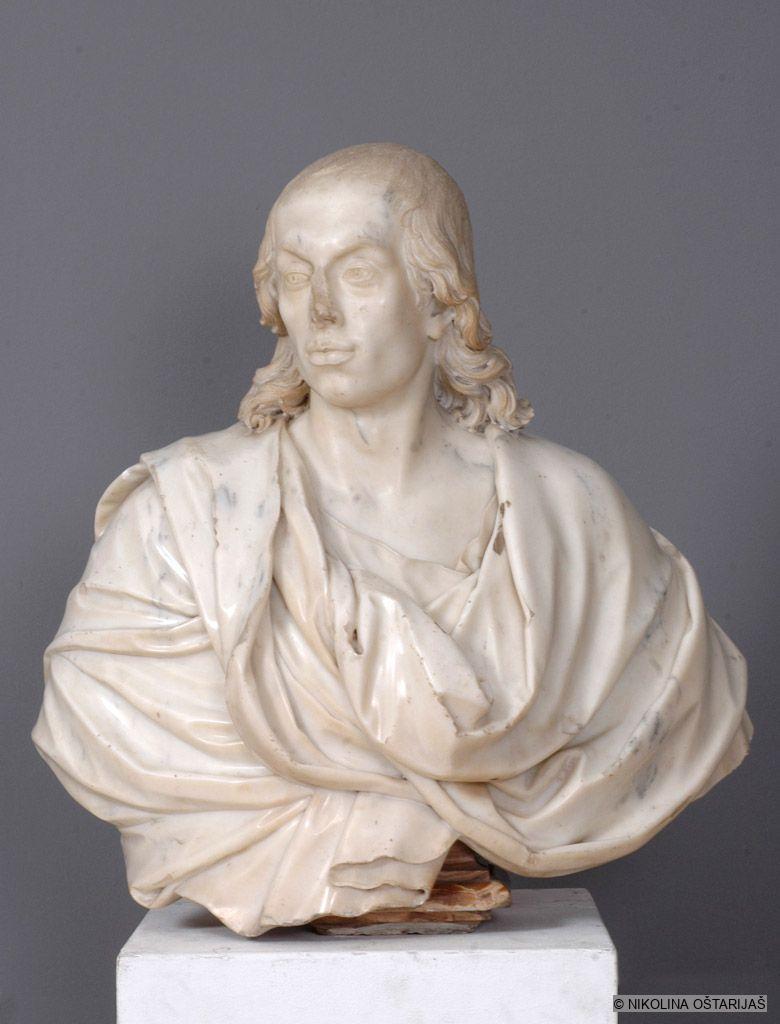
 Add to My Collection
Name of Object:
Prince Livio Odescalchi
Location:
Ilok, Slavonia, Croatia
Holding Museum:
City Museum, Ilok
Original Owner:
The Odescalchi family, owners of Ilok Manor
Date of Object:
Last quarter of the 17th century
Artist(s) / Craftsperson(s):
Pierre-Etienne Monnot (1657, Orchamp-Vennes (Doubs), France-1733, Rome)
Museum Inventory Number:
K-4
Material(s) / Technique(s):
Marble
Dimensions:
H: 82 cm
Provenance:
Artworks including Prince Livio Odescalchi were moved to the newly formed Ilok City Museum in 1952, which transferred to Odescalchi Manor in 1968.
Type of object:
Bust
Place of production:
Rome
Description:
Prince Livio Odescalchi (1652–1713) belonged to the influential Italian Odescalchi family, a family that throughout history produced important bishops, cardinals and Pope Innocent XI.
Emperor Leopold I Habsburg, in gratitude for the great financial aid granted him by Pope Innocent XI to meet the costs of the war against the Ottoman Turks, named his nephew Livio Duke of Srijem and granted him the Ilok estate as a fief and many other privileges. Livio himself had excelled in the battle to defend Vienna in 1683.
He was a great collector and decorated his residences with fine artworks. He was also a patron of the arts.
The marble Prince Livio Odescalchi by the Roman sculptor of French origin, Pierre-Etienne Monnot, is an outstanding work with realistic emphasis on individuality. Dramatic tension is achieved through the expression of the head turned to the right, and by the rich drapery enveloping the body falling in heavy semicircular folds.
Monnot often worked for the Odescalchi family. He was an excellent master with a fine technique and a strong and characteristic expression reminiscent of Bernini.
The marble Prince Livio Odescalchi by the Roman sculptor of French origin, Pierre-Etienne Monnot, shows Prince Livio Odescalchi, a member of the influential Italian family that throughout history produced important bishops, cardinals and Pope Innocent XI. The sculpture shows the influence of Bernini. Livio Odescalchi had links to Ilok and Slavonia by way of the deed of gift he received from Leopold I Habsburg, granting him the Ilok estate and surrounding lands and other privileges for merit in wars against the Ottomans.
How date and origin were established:
Information about the work is due to the research of the Italian art historian, A. Bachi, an expert in Roman Baroque sculpture.
How Object was obtained:
Up until World War II, the Odescalchis owned Ilok Manor. As state property, it had several different uses but after refurbishment in 1968, it became a museum and this bust and other objects from the Odescalchi estate became part of the new permanent collection.
Selected bibliography:
Baričević, D., Tisućugodišnja skulptura u Hrvatskoj (A Thousand Years of Sculpture in Croatia), Zagreb, 1991.
Bachi, A., Scultura del '600 a Roma, Milan, 1996.
Citation of this web page:
Nela Tarbuk "Prince Livio Odescalchi" in "Discover Baroque Art", Museum With No Frontiers, 2026.
https://baroqueart.museumwnf.org/database_item.php?id=object;BAR;hr;Mus11_A;35;en
Prepared by: Nela Tarbuk Nela Tarbuk
SURNAME: Tarbuk
NAME: Nela
AFFILIATION: Museum of Arts and Crafts, Zagreb, Croatia
TITLE: Museum Counsellor, Head of the Sacral Sculpture, Ivory and Musical
Instrument Collections
CV:
Nela Tarbuk was awarded her BA in Art History and Comparative Literature from Zagreb University (Faculty of Philosophy). As head of the Museum if Arts and Craft’s Sculpture, Ivory and Musical Instruments collections, she has curated several exhibitions and written many articles. Her special research interests focus on sacral furniture. Exhibition catalogues include Culture of the Paulines in Croatia (1989), Jesuit Heritage in Croatia (1992), Peace and Virtue (2000), Hidden Treasures (2005) and Musical Instruments from the Holdings of the Museum of Arts and Crafts (2007).
Translation by: Nikolina Jovanović
Translation copyedited by: Mandi GomezMandi Gomez
Amanda Gomez is a freelance copy-editor and proofreader working in London. She studied Art History and Literature at Essex University (1986–89) and received her MA (Area Studies Africa: Art, Literature, African Thought) from SOAS in 1990. She worked as an editorial assistant for the independent publisher Bellew Publishing (1991–94) and studied at Bookhouse and the London College of Printing on day release. She was publications officer at the Museum of London until 2000 and then took a role at Art Books International, where she worked on projects for independent publishers and arts institutions that included MWNF’s English-language editions of the books series Islamic Art in the Mediterranean. She was part of the editorial team for further MWNF iterations: Discover Islamic Art in the Mediterranean Virtual Museum and the illustrated volume Discover Islamic Art in the Mediterranean.
True to its ethos of connecting people through the arts, MWNF has provided Amanda with valuable opportunities for discovery and learning, increased her editorial experience, and connected her with publishers and institutions all over the world. More recently, the projects she has worked on include MWNF’s Sharing History Virtual Museum and Exhibition series, Vitra Design Museum’s Victor Papanek and Objects of Desire, and Haus der Kulturen der Welt’s online publication 2 or 3 Tigers and its volume Race, Nation, Class.
MWNF Working Number: HR 35