

 Back
Back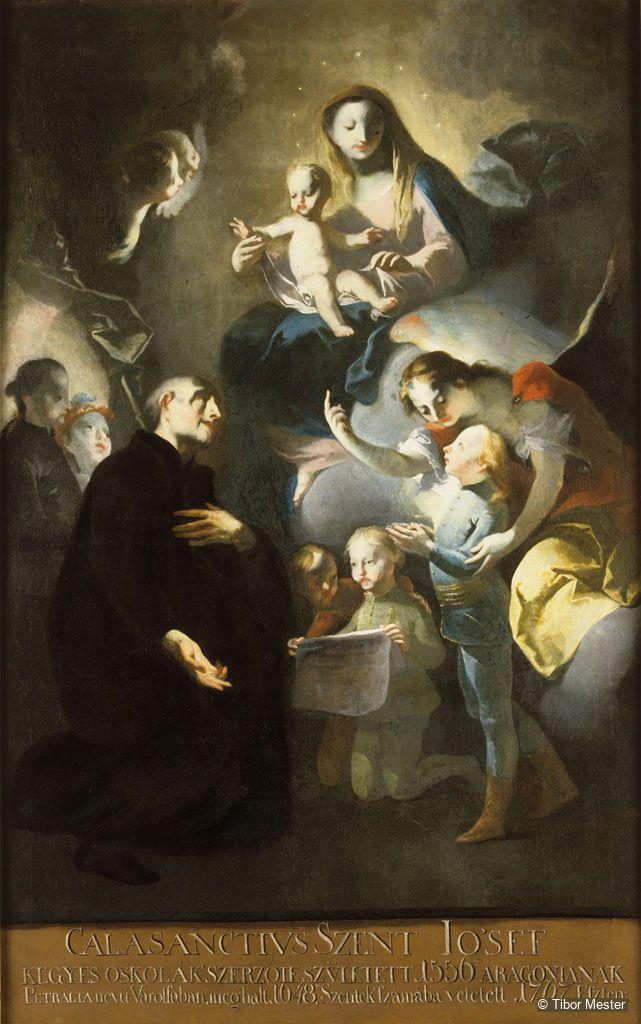
Name of Object:
St. Joseph Calasanctius before the Virgin with Hungarian Pupils
Location:
Budapest, Közép-Magyarország / Central Hungary, Hungary
Holding Museum:
Hungarian National Gallery (on loan from the Kuny Domokos Museum, Tata)
 About Hungarian National Gallery (on loan from the Kuny Domokos Museum, Tata), Budapest
Original Owner:
Piarist House, Tata
Date of Object:
1767
Artist(s) / Craftsperson(s):
Felix Ivo Leicher (1727, Bílovec-1812, Vienna)
Museum Inventory Number:
55.47
Material(s) / Technique(s):
Oil on canvas
Dimensions:
H: 201 cm; w: 126 cm
Workshop / Movement:
Workshop of Franz Anton Maulbertsch
Provenance:
Piarist House, Tata; from the Piarist Convent in Tata
Type of object:
Painting
Period of activity:
Late Baroque
Place of production:
Vienna / Tata
Description:
Felix Ivo Leicher arrived in Vienna from the Silesian town, Bílovec, with the support of the Piarist Fathers. He enrolled as a pupil at the Academy of Fine Arts in Vienna (his presence is documented from 1751) and won second prize in the academic competition of 1754, which made him a supported member of the Academy known as Schutzverwandte. He worked for a long time with Franz Anton Maulbertsch who remained a lifelong friend. His compositions, loose modelling, effective lighting and the ability to portray characteristic types undoubtedly betray the influences and ideas of Maulbertsch, although Leicher's approach is softer, weaker and without the expressive power, dramatic vitality or pictorial virtuosity of his master.
Allegedly, a burgher of Tata commissioned this picture in Vienna for the Tata Piarists in 1767. Leicher worked in Vienna and was a pupil and protégé of the Piarists for whom he carried out a lot of work, undertaking several altarpieces on which he represented St. Joseph of Calasanctius (1556–1648) the founder of the Piarist order, who was canonised in 1767. In the main, these pictures refer to the educational activity of the order, depicting the saint with a circle of students as he recommends them to the patronage of Mary and the Infant Jesus whose figures appear among the clouds. This is the theme of the devout Tata painting St. Joseph Calasanctius before the Virgin with Hungarian Pupils depicting boys, dressed in contemporary Hungarian fashion, accompanied by St. Joseph and their guardian angel. The light, which draws the viewer's eye upwards, together with the expressive gestures and the sweet mild faces, call to mind the art of Leicher's master, Franz Anton Maulbertsch. The Tata picture is one of Leicher's most harmonious. He repeated this theme, in a larger format and different composition, in the Piarist Church of Brezno and paintings for altarpieces in the Piarist churches of Mikulov, Benešov and Nagykároly (Carei).
A pupil of Franz Anton Maulbertsch, Felix Ivo Leicher worked on several altarpieces in Hungary (Vác, Martonvásár, and Besztercebánya (Banská Bystrica). The subject of this painting, commissioned by a burgher of Tata in Vienna for the Tata Piarists in 1767, is especially popular in Hungary because of its representation of children.
How date and origin were established:
by stylistic analysis and historical data
How Object was obtained:
From the Piarist convent in Tata
Selected bibliography:
Barokk művészet Közép-Európában. Utak és találkozások (Crossroads: Baroque Art in Central Europe) exhibition catalogue, (ed. G. Galavics), Budapest, 1993, pp. 252–255.
Citation of this web page:
Anna Jávor "St. Joseph Calasanctius before the Virgin with Hungarian Pupils" in "Discover Baroque Art", Museum With No Frontiers, 2026.
https://baroqueart.museumwnf.org/database_item.php?id=object;BAR;hu;Mus11;14;en
Prepared by: Anna Jávor
Copyedited by: Terézia BardiTerézia Bardi
SURNAME: Bardi
NAME: Terézia Anna
AFFILIATION: National Trust of Monuments for Hungary
TITLE: Art Historian, Vice Director for Research at The National Trust of
Monuments for Hungary; MWNF DBA local co-ordinator (Hungary), author
and copy-editor
CV:
Terézia Bardi, Vice Director for Research at the National Trust of Monuments for Hungary since 2004, was awarded her MA in History and History of Art at the Eötvös Loránd University in Budapest. After a period of fellowships mainly in Italy, Terézia gained her PhD from the Faculty of Art History at the same university for her thesis Presentation and Representation – the European Reception of the Liberation of Buda in 1686: Feast and Public Opinion. Her main fields of research are 17th-and18th-century Baroque and Rococo: the spectacles, festival decorations and associated iconography – including theatre productions of the period – and interior decoration of historic houses. Since 1988, she has edited a number of art historical books that include some on Oriental art and architecture. She is MWNF DBA’s local (Hungarian) co-ordinator, author and copy-editor.
Translation by: Tamás Sajó
Translation copyedited by: Mandi GomezMandi Gomez
Amanda Gomez is a freelance copy-editor and proofreader working in London. She studied Art History and Literature at Essex University (1986–89) and received her MA (Area Studies Africa: Art, Literature, African Thought) from SOAS in 1990. She worked as an editorial assistant for the independent publisher Bellew Publishing (1991–94) and studied at Bookhouse and the London College of Printing on day release. She was publications officer at the Museum of London until 2000 and then took a role at Art Books International, where she worked on projects for independent publishers and arts institutions that included MWNF’s English-language editions of the books series Islamic Art in the Mediterranean. She was part of the editorial team for further MWNF iterations: Discover Islamic Art in the Mediterranean Virtual Museum and the illustrated volume Discover Islamic Art in the Mediterranean.
True to its ethos of connecting people through the arts, MWNF has provided Amanda with valuable opportunities for discovery and learning, increased her editorial experience, and connected her with publishers and institutions all over the world. More recently, the projects she has worked on include MWNF’s Sharing History Virtual Museum and Exhibition series, Vitra Design Museum’s Victor Papanek and Objects of Desire, and Haus der Kulturen der Welt’s online publication 2 or 3 Tigers and its volume Race, Nation, Class.
MWNF Working Number: HU 14
RELATED CONTENT
On display in
Exhibition(s)
MWNF Galleries
PaintingsDownload
As PDF (including images) As Word (text only)