

 Back
Back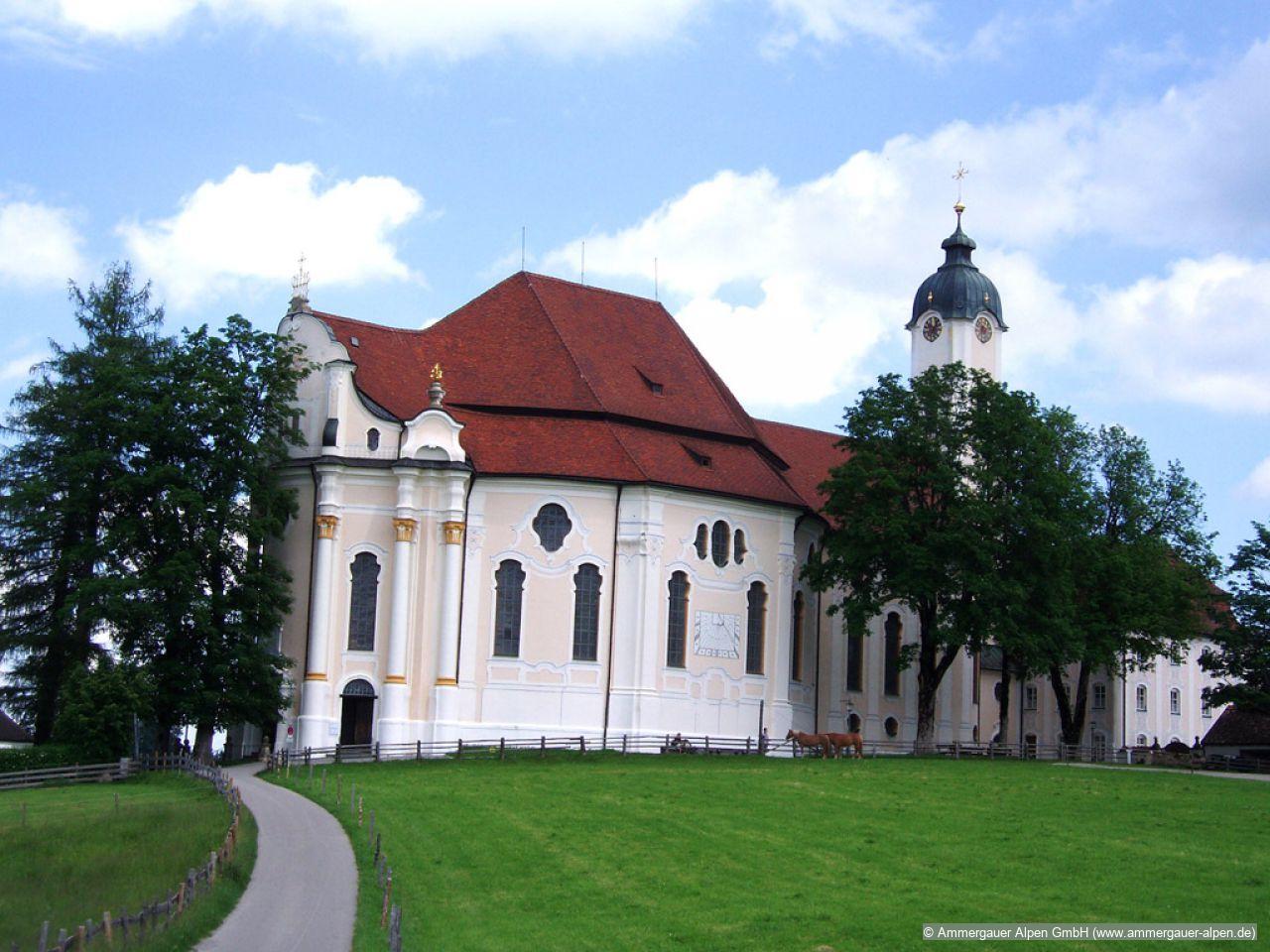




 Add to My Collection
Name of Monument:
Pilgrimage Church of the Scourged Saviour "in der Wies" ("in the meadow")
Also known as:
Wieskirche
Location:
Steingaden-Wies, Upper Bavaria, Germany
Date:
1745–49: chancel and priory building;
1750–54: lay church;
1756/57: side altars and organ
Artists:
Architecture, stucco, and high altar: Dominikus Zimmermann (1685–1766);Stucco design and ceiling frescoes: Johann Baptist Zimmermann (1680–1758);High altarpiece: Balthasar Augustin Albrecht (1687–1765);Transept altars: Dominikus Bergmüller of Türkheim (1707–73);Sculptures in the chancel: Ägid Verhelst (1696–1749);Sculptures in the lay church: Franz Anton Sturm (1690–1757)
Denomination / Type of monument:
Ecclesiastical architecture (pilgrimage church)
Patron(s):
Marian Mayr (gov. 1745–72) Abbot of the Premonstratensian Abbey of Steingaden
History:
The reason for construction was a miraculous weeping of a processional statue embodying the Scourged Saviour, which is supposed to have taken place in the seclusion of Wies on 14 June 1738. As a result, the nearby Premonstratensian Abbey of Steingaden built a Chapel of Mercy which soon became too small because of the increased flux of pilgrims. Therefore, the architect and stuccoer Dominikus Zimmermann was commissioned to construct a spacious church. After the laying of the foundation stone on 10 July 1746, construction was staged in two phases. The first phase, up to 1749, was the chancel building, alone also functioning as a new Chapel of Mercy, together with the abutting priory building. Next was the lay church, designed as a central building, which was able to be consecrated on 1 September 1754.
Description:
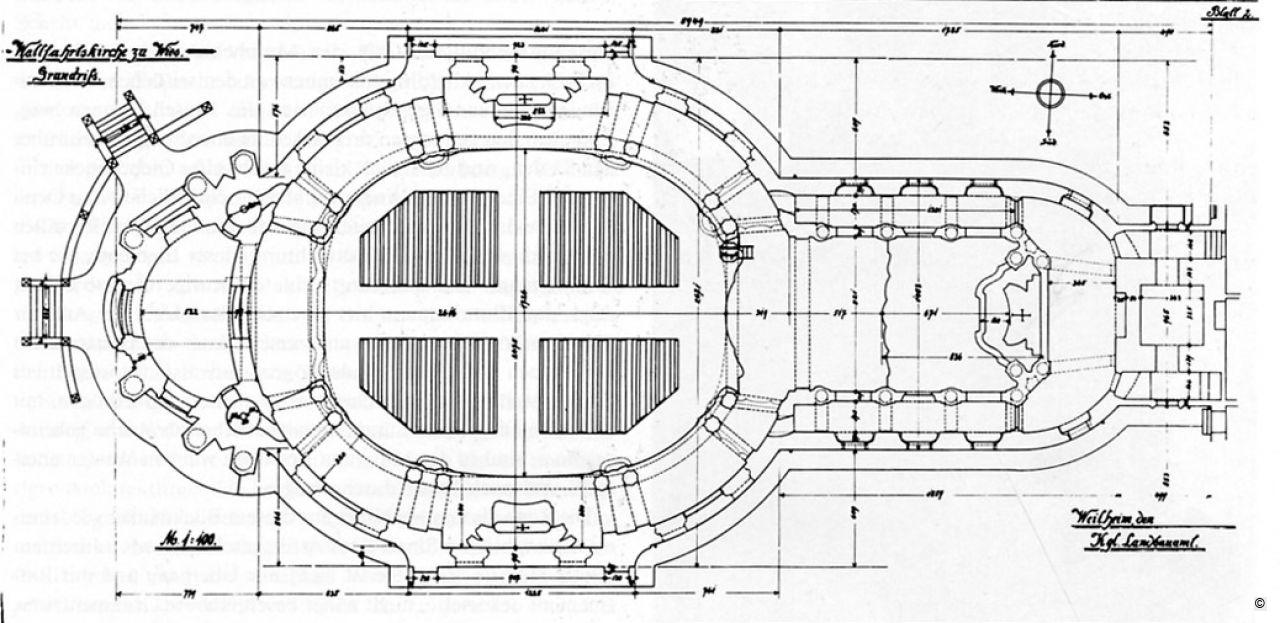
Embedded in the hilly landscape at the foot of a mountain named Trauchberg, the ensemble is comprised of the church building as well as the U-shaped priory building abutting the chancel. The latter served as living quarters for priests, pilgrim hospice and at the same time, as a summer residence of the abbot of Steingaden. The lay church, arranged in an oval central-plan with an interior processional ambulatory, connects to the chancel which is decorated with gilded Rocaille stucco and brightly coloured imitation of marble and is accompanied by galleries for noble persons. The two-storey pilgrimage altar soars in the chancel, integrated into the column architecture of the galleries. The arcaded zone of the predominantly frescoed vaults is decorated with a fully mature Rocaille stucco. This ornamental structure also forms the arches and windows of the architecture in a unique way which is due to the wooden construction of the vaults. This allows the vaults to exhaust all rational rules to the extent that the arches in the chancel appear to sag in a statically absurd manner.
View Short DescriptionWith the so-called Wieskirche, embedded in the hilly landscape of upper Bavarian Alpine upland, the famous church builder and stuccoer Dominikus Zimmermann not only created a major work, but also the Rococo church par excellence, by capriciously making the light-filled architecture subject to the virtuous Rocaille stucco. Additionally, the vaults are decorated with delicately coloured frescoes done by the hand of his brother Johann Baptist.
How Monument was dated:
Chronicle sources
Special features
Pilgrimage Altar (High Altar)
Choir
Circa 1748/49
Altar Architecture: Dominikus Zimmermann (1685–1766) Sculptures: Ägid Verhelst (1696–1749) Altarpiece: Balthasar Augustin Albrecht (1687–1765)
The two-storey pilgrimage altar, here designed due to the concept of a deeply staggered baldachino architecture, is a type commonly used in Bavaria for pilgrimages. In addition to the altar of mercy at ground level, it contains at gallery level a further celebration altar with an altarpiece that shows the Holy Family. The doughy moulded pedestals and entablatures stand in deliberate contrast to the faked marble materials.


The Last Judgement
Vault in the lay church
Circa 1753/54
Johann Baptist Zimmermann (1680–1758)
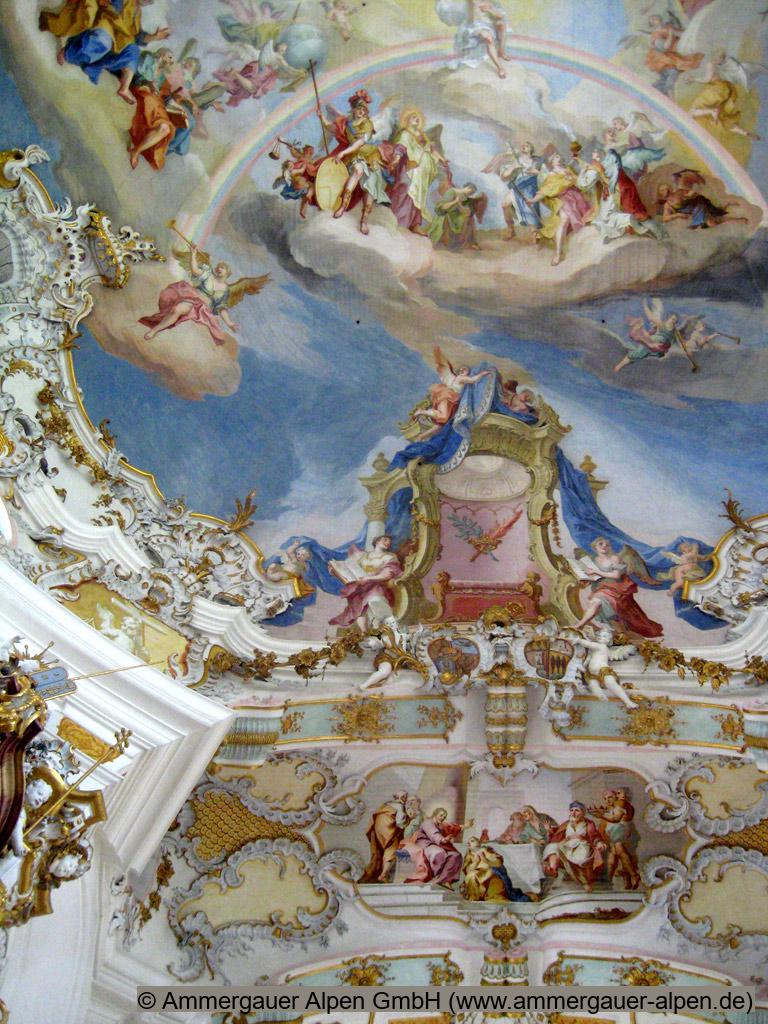
The brightly coloured main fresco promisingly and obviously thematises the Last Judgement as the goal of Christ’s redemption, whose passion began with His suffering leading up to His crucifixion. Opposite the gate to eternity, before which a toppled Chronos symbolises the end of time, is the throne prepared for Christ as the Judge of the World.

Pulpit
Lay church, column pair left of the chancel
Circa 1753/54
Design: Dominikus Zimmermann (1685–1766) Execution: Pontian Steinhauser (1688–1755)
Ornamental structures populated by cherubs as emissaries of the Heavenly Host overrun the foot of the pulpit and pile up on the sounding board. The Old Testament tablets of the Ten Commandments refer to the word of God as well as symbols of the four Latin Church Fathers to its theological interpretation. A boy riding a fish symbolises the baptized soul as the recipient of the homily-conveyed messages of salvation.
Abbot Loge
Lay church, column pair right of the chancel
Circa 1753/54
Design: Dominikus Zimmermann (1685–1766) Execution: Pontian Steinhauser (1688–1755)
The more modest, although no less virtuously modelled and decorated, counterpart to the pulpit forms the loge of the abbot of Steingaden.
The Four Latin Church Fathers
Column pairs in the lay church on the sides of the transept
Circa 1754/56
Franz Anton Sturm (1690–1757)
The statues of the Four Latin Church Fathers, still animated with restrained Baroque pathos, rank as the best works of their creator.
Selected bibliography:
Bauer, H. and Rupprecht, B. (eds), Corpus der barocken Deckenmalerei in Deutschland, Vol. 1: Freistaat Bayern, Regierungsbezirk Oberbayern. Die Landkreise Landsberg am Lech – Starnberg – Weilheim-Schongau, Munich: Süddeutscher Verlag, 1976: 600–623.
Harries, K., The Bavarian Rococo Church: Between Faith and Aestheticism, New Haven/London: Yale University Press, 1983: 94, 139–144.
Hitchcock, Henry-Russell, German Rococo: The Zimmermann Brothers, London: Penguin, 1968: 68–78, 91, 94.
Petzet, M. (ed), Die Wies: Geschichte und Restaurierung (Arbeitshefte des Bayerischen Landesamtes für Denkmalpflege 55), Munich: Lipp, 1992.
Pörnbacher, H., Die Wies: Wallfahrtskirche zum gegeißelten Heiland (Kleine Kunstführer 1), 23rd revised edition, Regensburg: Schnell & Steiner, 2002.
Citation of this web page:
Peter Heinrich Jahn "Pilgrimage Church of the Scourged Saviour "in der Wies" ("in the meadow")" in "Discover Baroque Art", Museum With No Frontiers, 2026.
https://baroqueart.museumwnf.org/database_item.php?id=monument;BAR;de;Mon12;12;en
MWNF Working Number: DE3 12