

 Back
 Add to My Collection
Name of Monument:
Parish Church Birth of the Virgin Mary, St. Peter and Paul, former Convent Church of Augustine Canons
Also known as:
Monastery Church of Rottenbuch
Location:
Rottenbuch, Upper Bavaria, Germany
Date:
1737-1746
Artists:
Architecture and Stucco: Joseph Schmuzer (1683–1752);Stucco: Franz Xaver Schmuzer (1713–75);Frescoes: Matthäus Günther (1705–88);Main Altar: Franz Xaver Schmädl (1705–77)
Denomination / Type of monument:
Ecclesiastical Architecture (Abbey Church)
Patron(s):
Provosts Patrizius Oswald (gov. 1700–40) and Clemens Prasser (gov. 1740–70)
History:
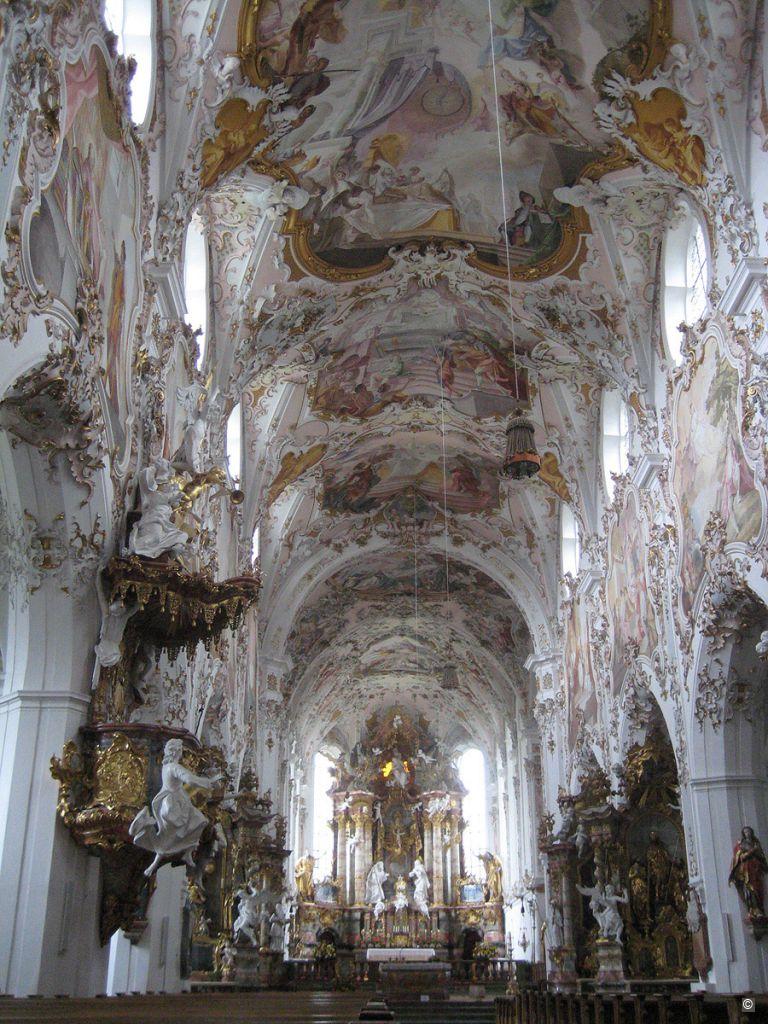
The history of the former Augustinian Convent Church of Rottenbuch can be traced back to the 11th century. After many fires and the collapse of the church tower, a new late gothic Basilica emerged with a transept that remained unchanged in essence after the remodelling of the interior and the refurnishing in Rococo style beginning in 1737 under the direction of Wessobrunn master builder and stucco worker, Joseph Schmuzer. In collaboration with his son, Franz Xaver, Joseph Schmuzer crafted the lavish stucco decorations up to 1744. Immediately following the adorning of the chancel and transept, the famous Augsburg frescoer, Matthäus Günther, began painting throughout the church.
Description:
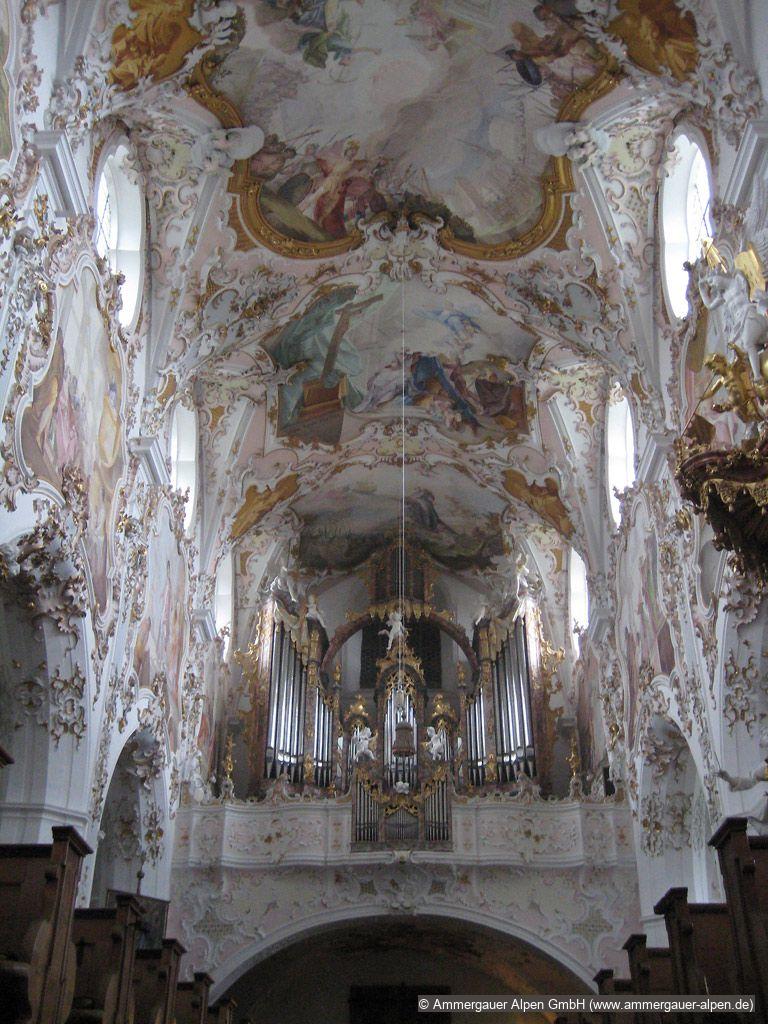
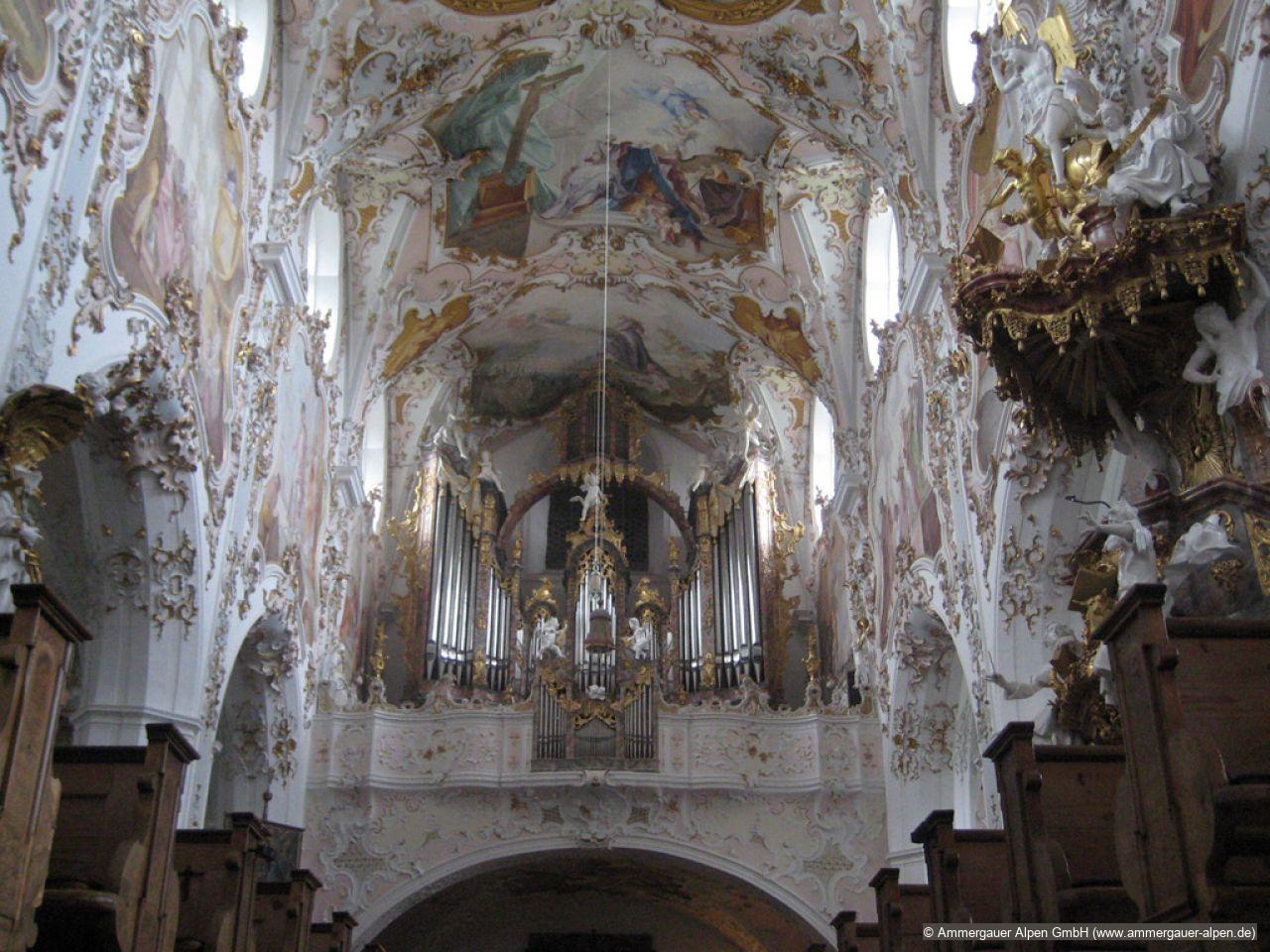
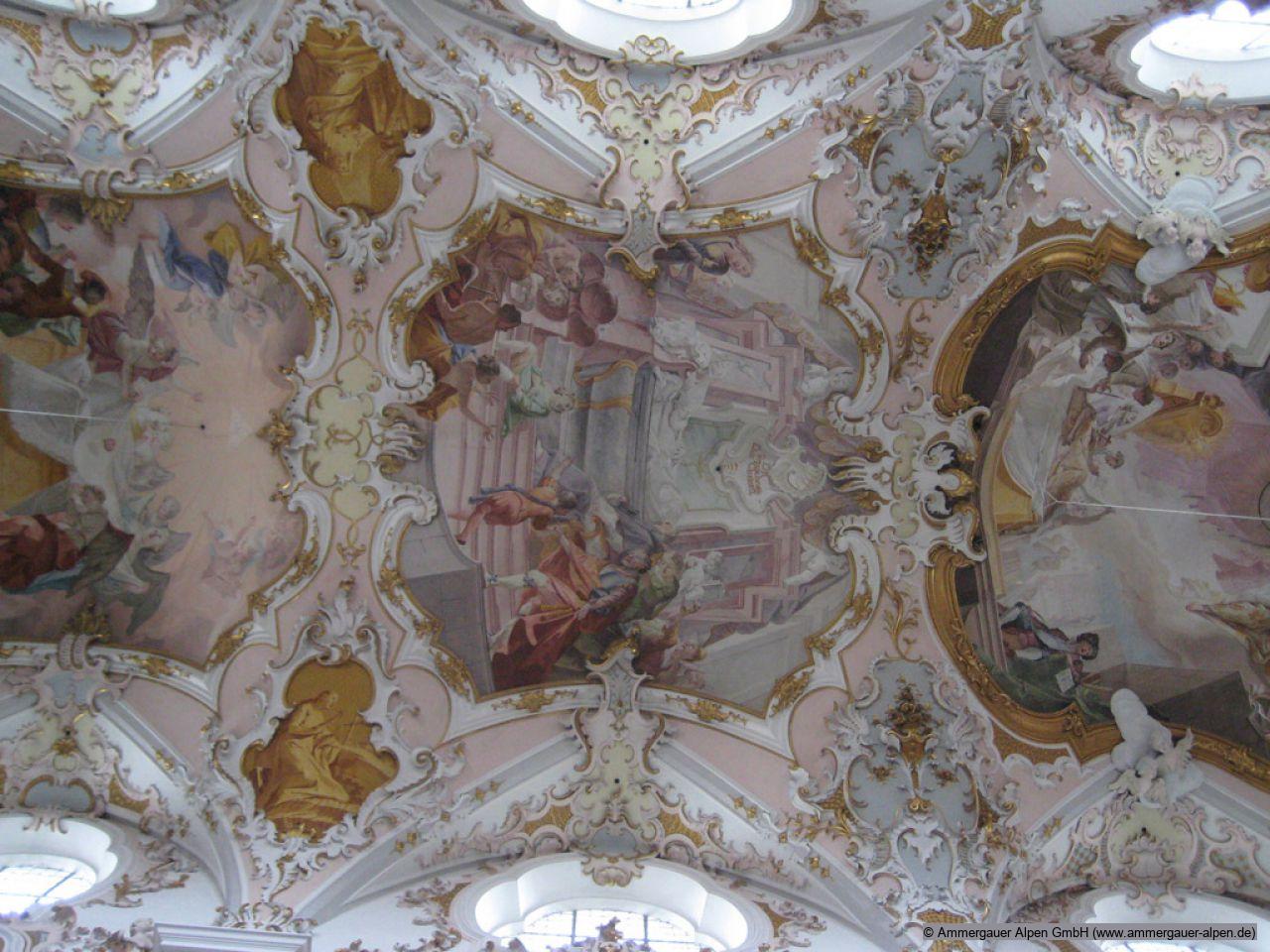
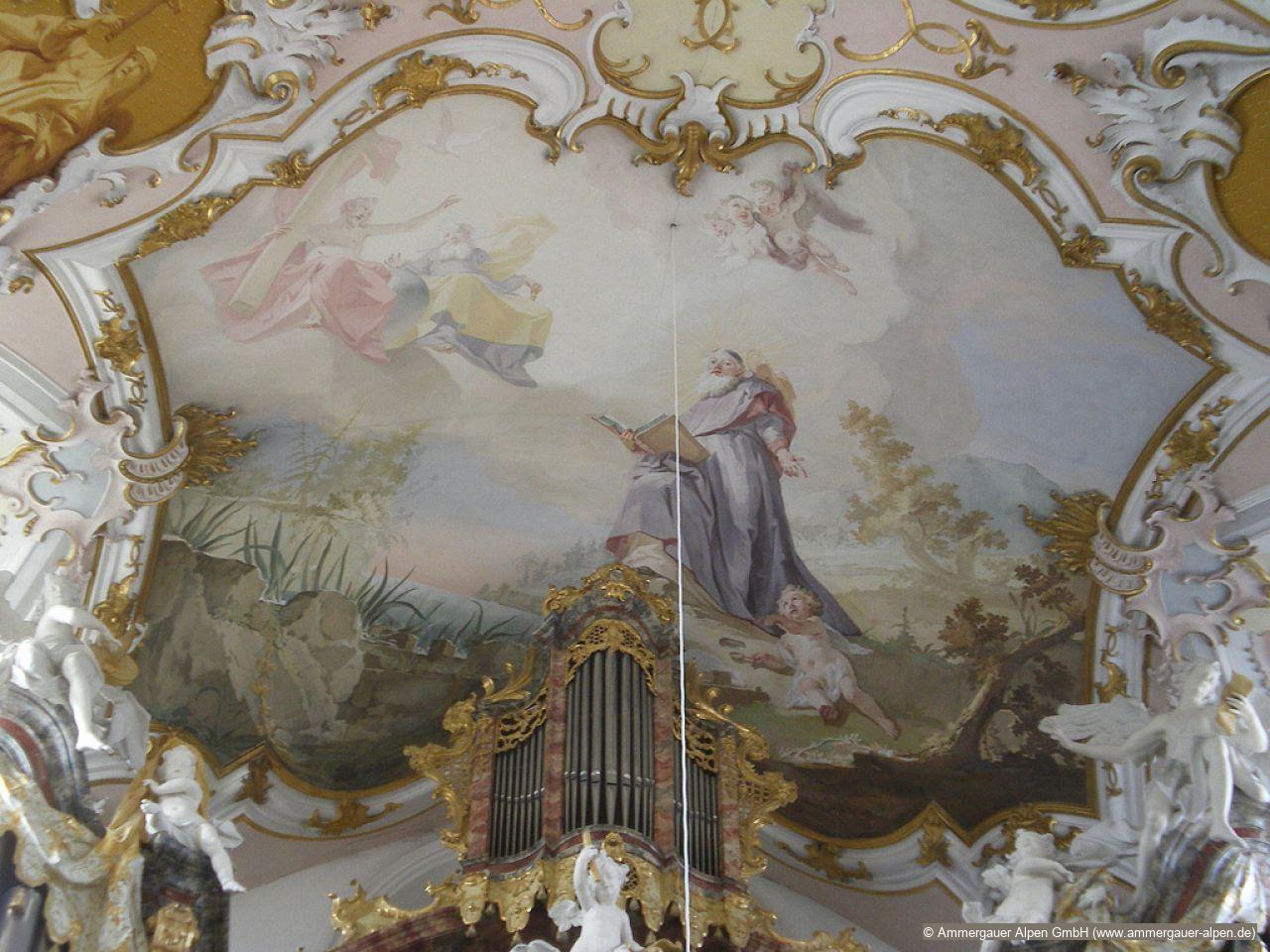
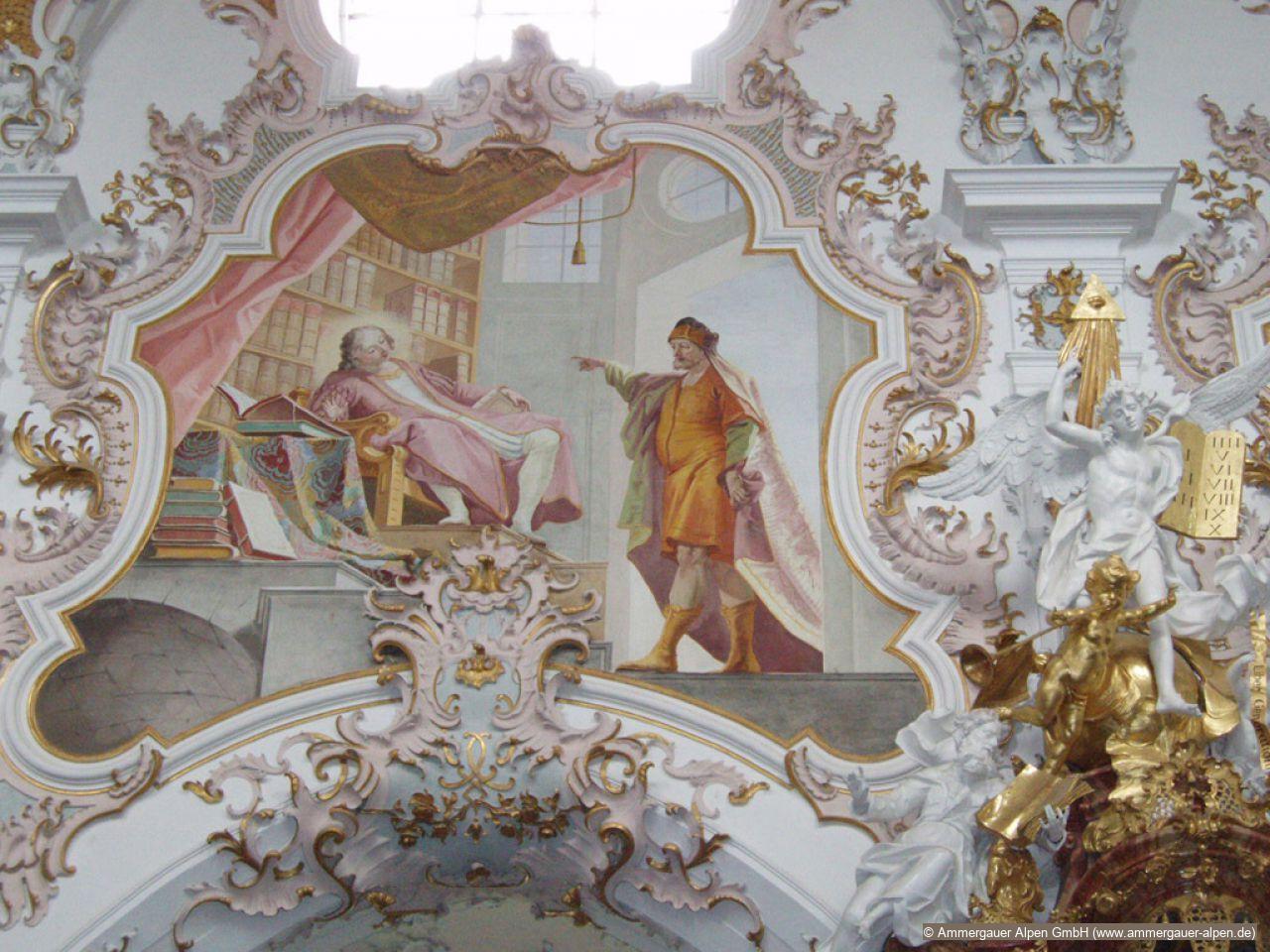
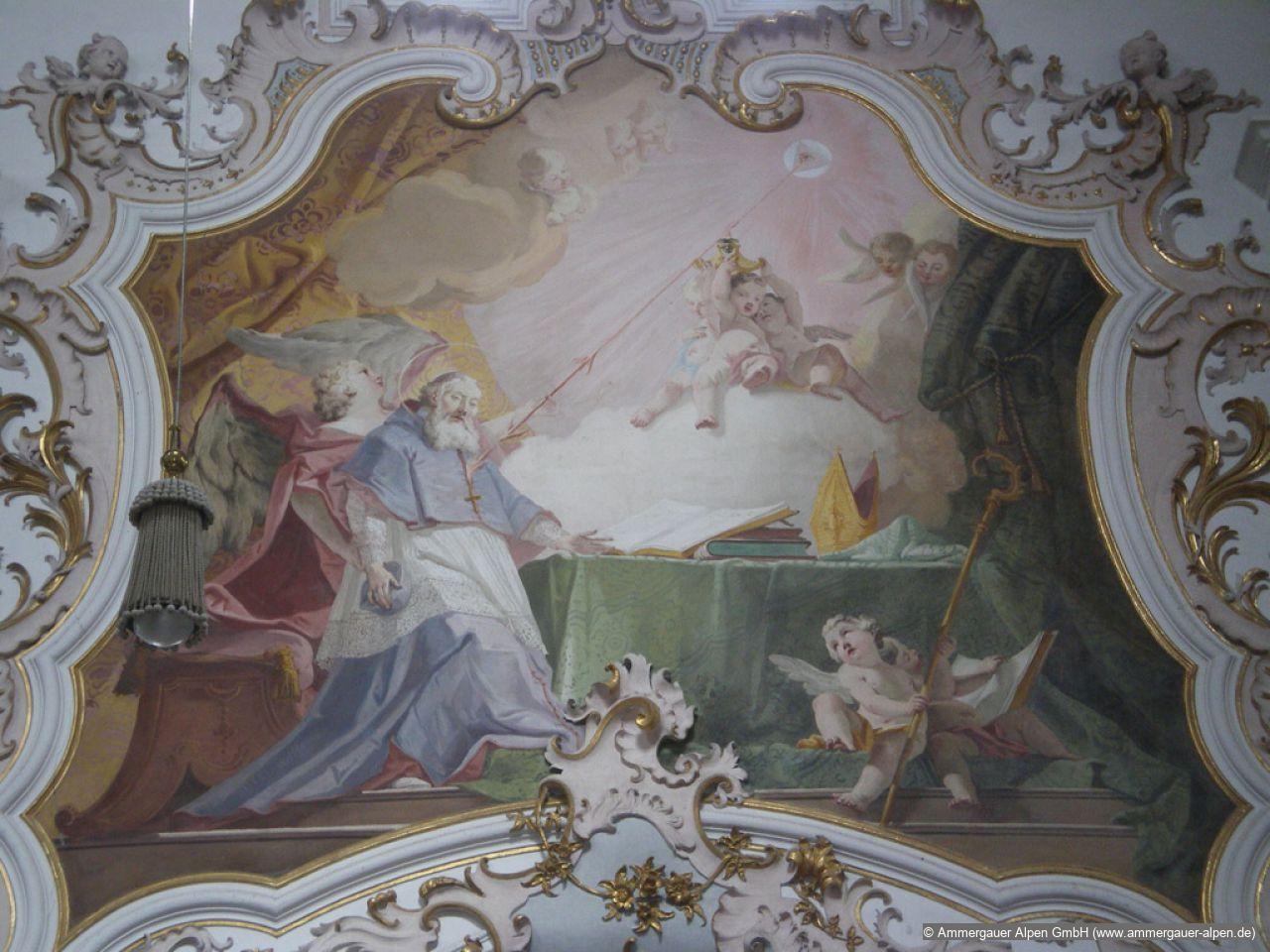
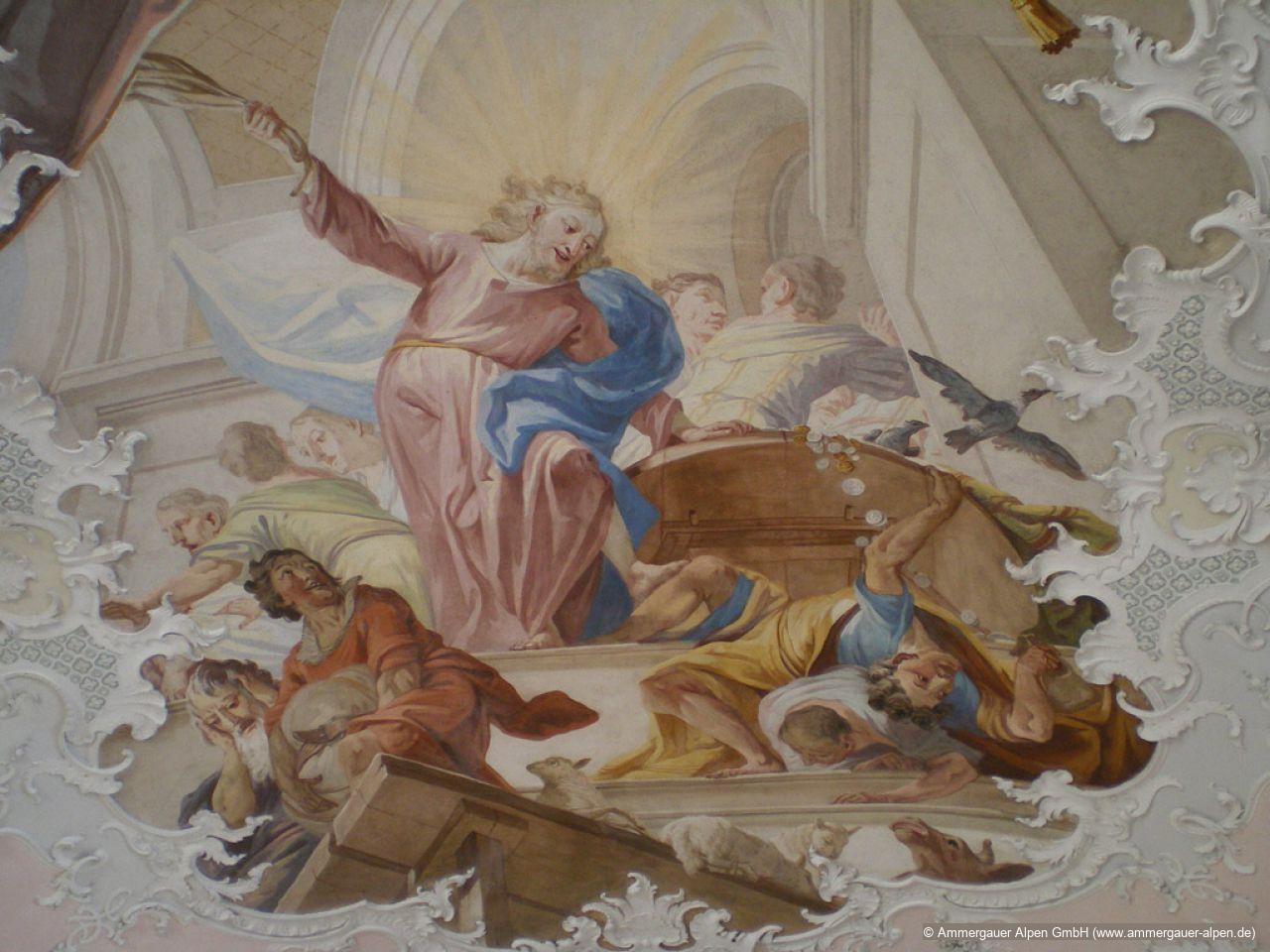
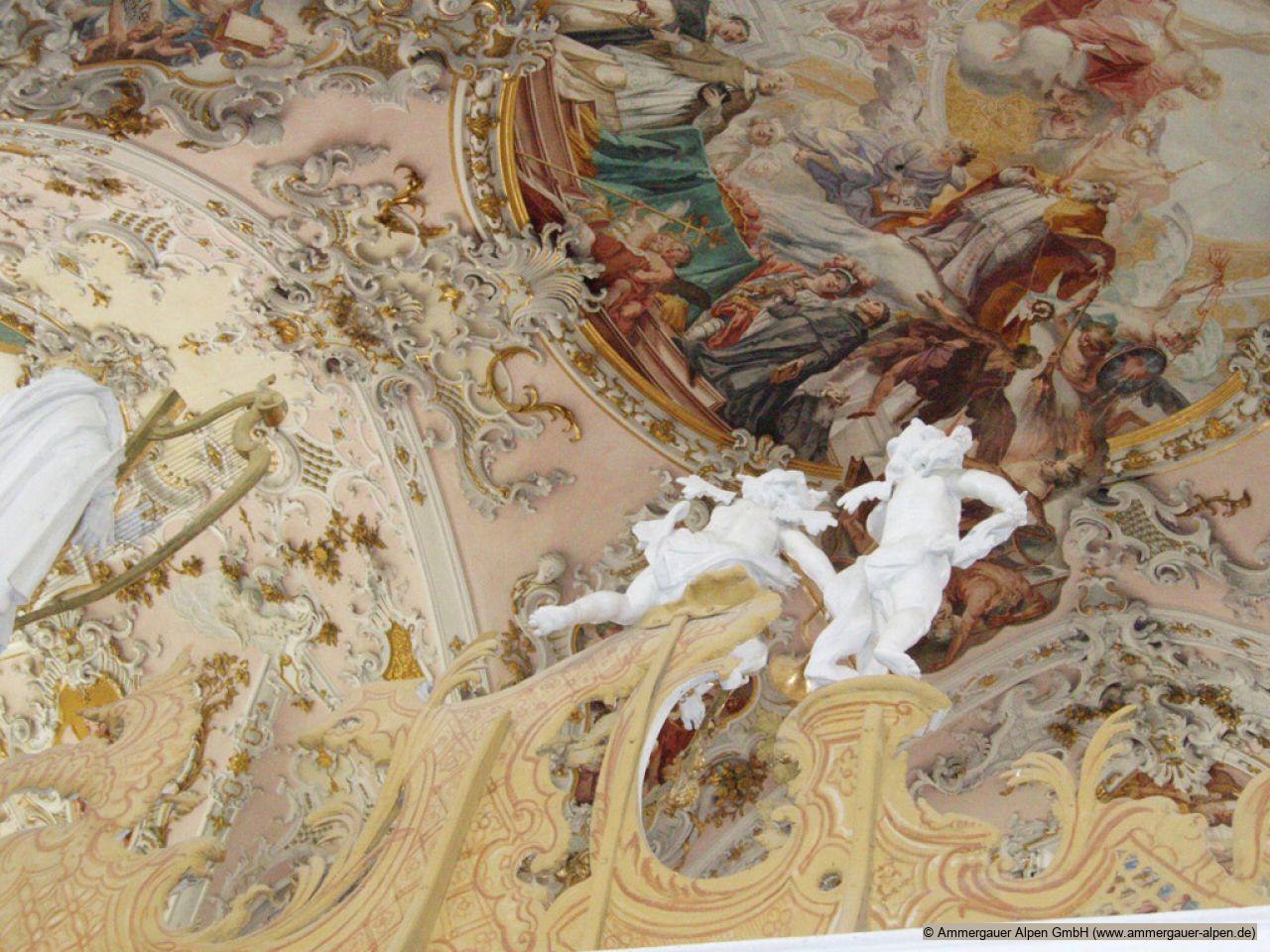
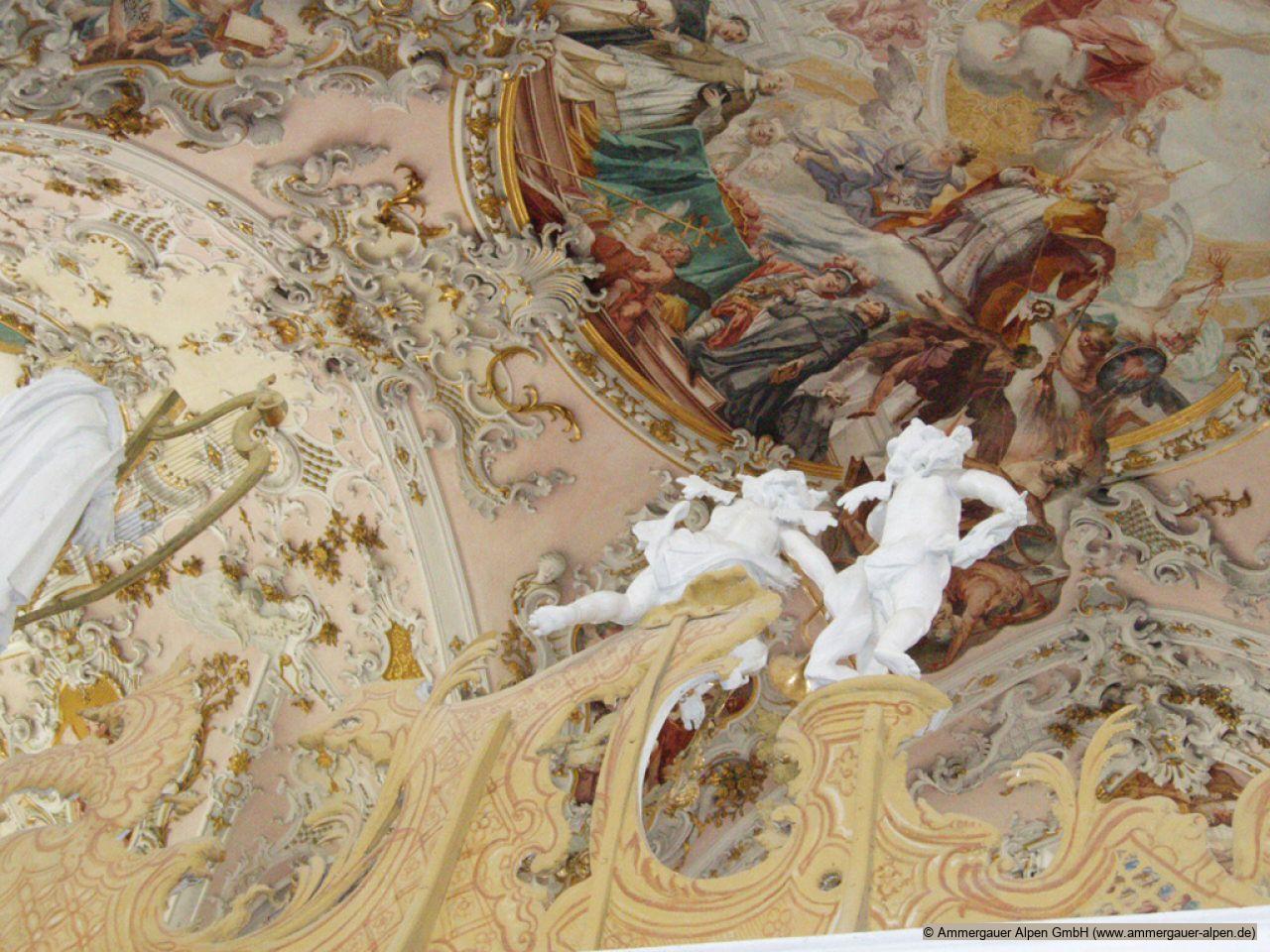
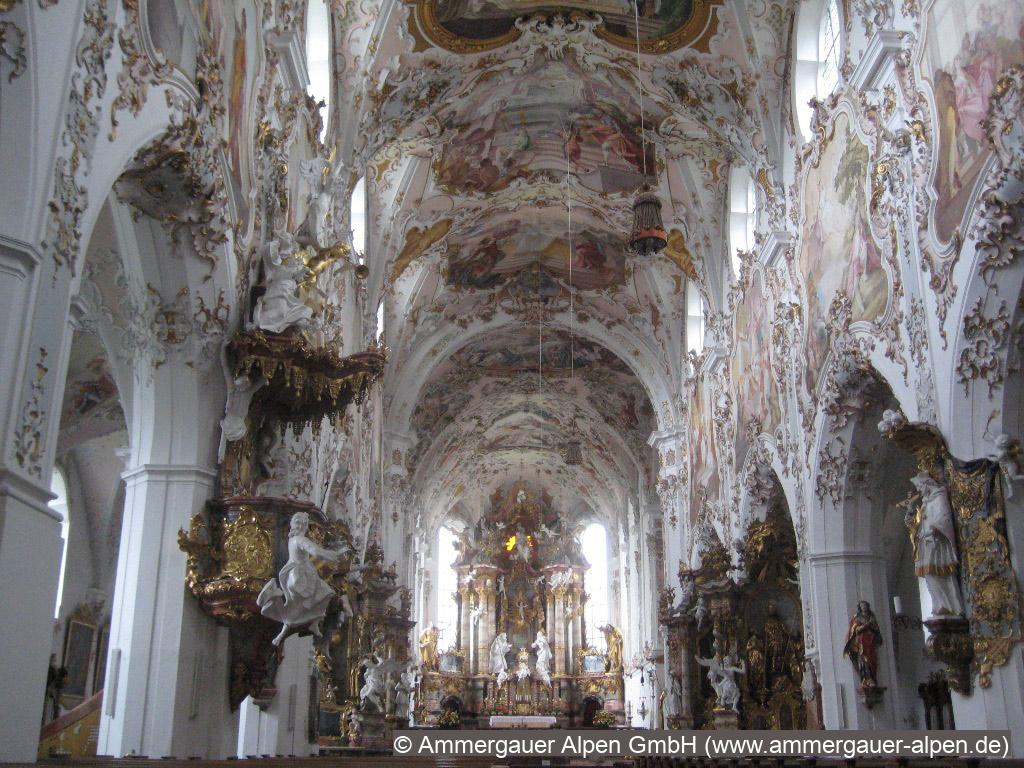
The externally modest triple-naved late gothic Basilica with a free-standing bell tower surprisingly has a lavish Rococo style furnishing on the inside. Cheerfully designed and abundantly dense stucco extends over vaults and the high nave walls. Because the stucco was affixed in stages by the Schmuzer workshop, noticeable distinctions in style can be recognized, starting from the chancel via the nave up to the organ loft: while the foliage and strapwork décor of the chancel are still fashioned in the late Régence style, scalloped Rococo as a new ornamental motif appears in the nave. Matthäus Günther’s extensive fresco cycles with Augustinian scenes expand from west to east on the high nave walls. The circular painting in the crossing of Augustine in heavenly glory replaces a customary Baroque cupola. The parts of the fresco coming out of the framework connect the painting with the stucco works of the vault. With this they resemble frescoes by Cosmas Damian Asam, of whom Günther was a pupil. Franz Xaver Schmädl’s grandiose scenographic main altar and the projecting stage-like side altars in the central nave support the overall theatrical concept of the interior.
View Short DescriptionThe mediaeval Basilica of the Rottenbuch Augustine Canons received a luxurious Rococo furnishing in the 18th century by local artists. Exuberant stucco decorations of the Wessobrunn master craftsmen Joseph and Franz Xaver Schmuzer, a multipartite fresco cycle with scenes from the life of St. Augustine by Matthäus Günther and the scenographic main altar with a rare three dimensional representation of the birth of the Virgin Mary by Franz Xaver Schmädl, give the interior of the convent church an especially solemn effect.
How Monument was dated:
Through archival sources and dated signatures on the frescoes.
Special features
Death of St. Augustine in Hippo
Ceiling fresco of the nave
1742
Matthäus Günther (1705–88)
The main fresco extends across two bays and is highlighted by a golden stucco frame. Matthäus Günther aesthetically contrasts the horrors of the Siege of Hippo by the Vandals to Augustine’s immensely towering deathbed and his ascent into heavenly glory as a theme of redemption. The artist obviously immortalises himself as the chronicler in the painting.

Altar of the Birth of the Virgin Mary (high altar)
Chancel
1748
Franz Xaver Schmädl (1705–77)
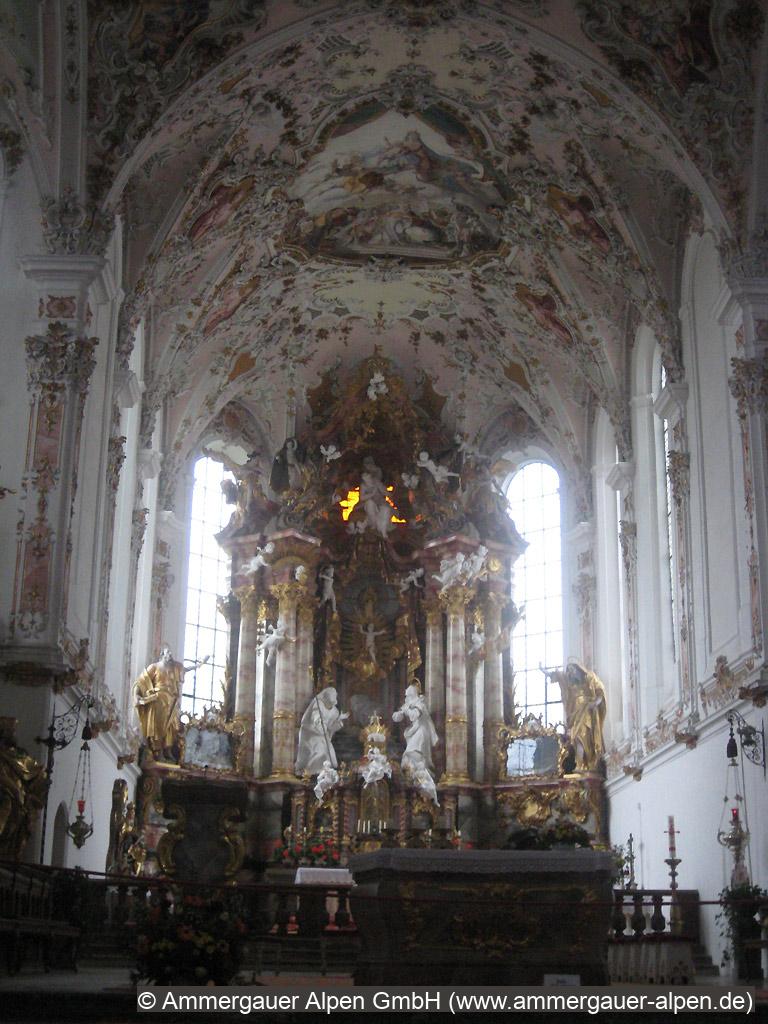
The high altar, Schmädl’s first large scale piece, is impressive due to its extensive architecture of grandiose column clusters and a canopy in the form of a drapery held by angels, with which the stage of a sacred act is architecturally framed in accordance with the Baroque Theatrum Sacrum. Including its uncommon three-dimensional representation of the birth of the Virgin Mary, the Rottenbuch example is designed according to the archetype represented by Egid Quirin Asam’s theatrically sculpted altars.
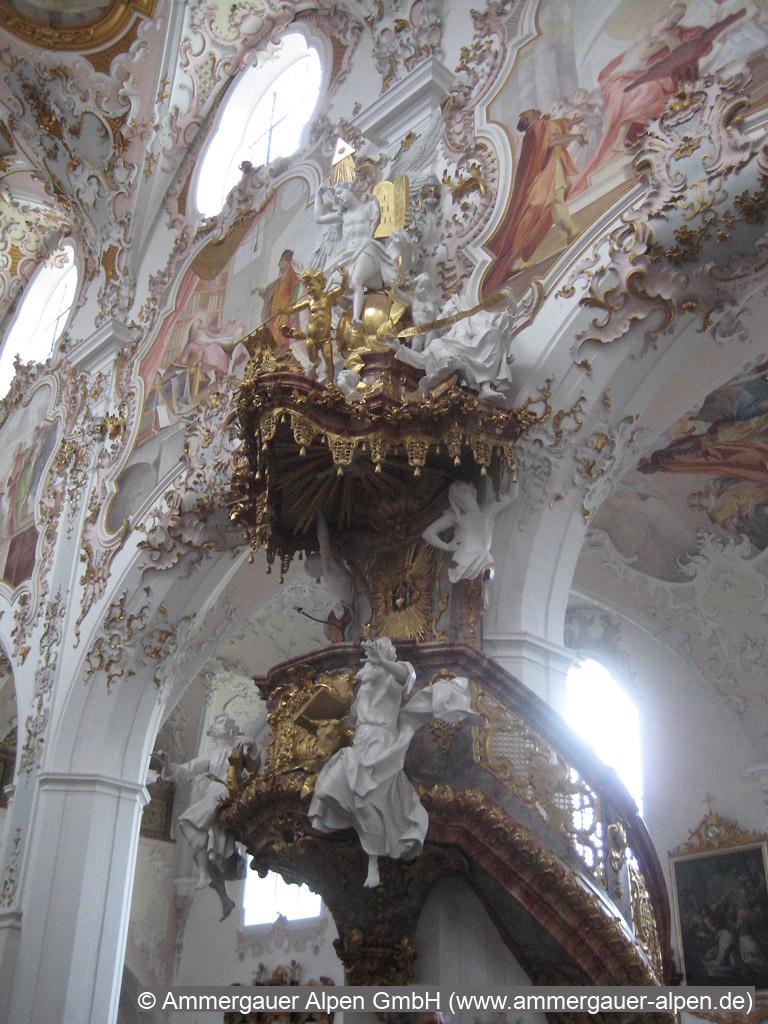
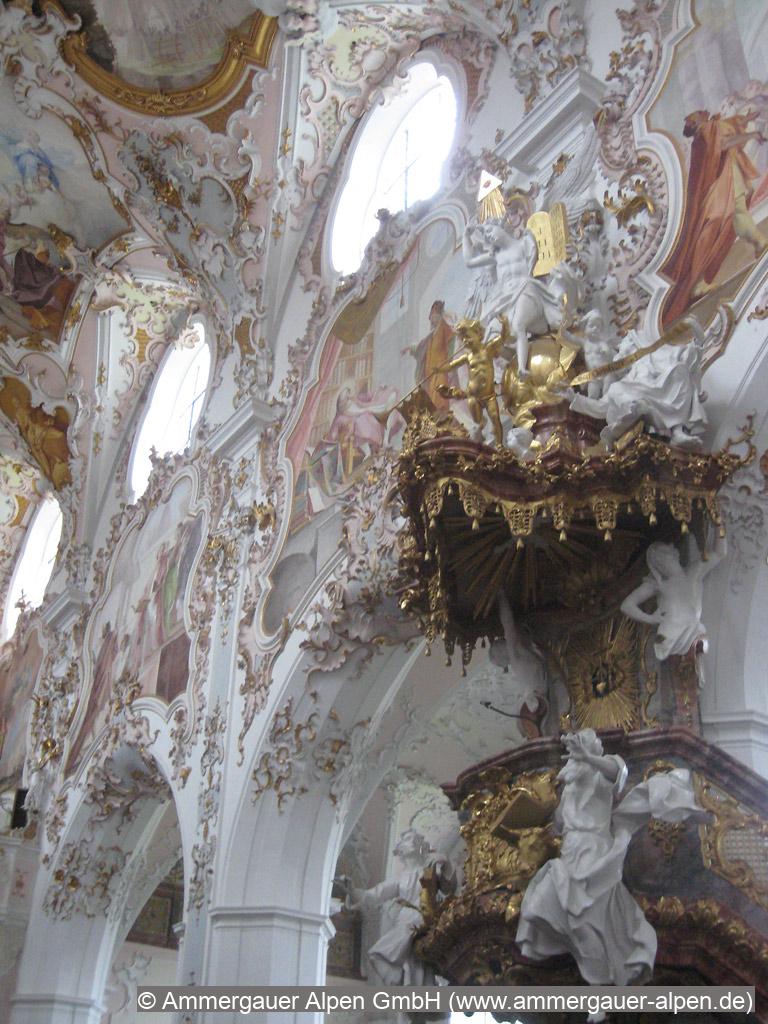
Pulpit
Middle left nave pillar
1743
Franz Xaver Schmädl (1705–77)
The basket and sounding board of the pulpit show a spirited moulding as was typical of the era. Highly gesturally executed sculptures of the four evangelists are mounted in pairs to the basket, while at the very top, an angel with the commandment tablets establishes a typological reference to the Old Testament.
Selected bibliography:
Bauer, H. and Rupprecht, B. (eds), Corpus der barocken Deckenmalerei in Deutschland, Bd. 1: Freistaat Bayern, Regierungsbezirk Oberbayern. Die Landkreise Landsberg am Lech – Starnberg – Weilheim-Schongau, München: Süddeutscher Verlag, 1976: 476–501.
Engelberg, M. von, Renovatio ecclesiae. Die Barockisierung mittelalterlicher Kirchen (Studien zur internationalen Architektur- und Kunstgeschichte 23), Petersberg: M. Imhof, 2005: 352–354, 601–603.
Hitchcock, Henry-Russell, Rococo Architecture in Southern Germany, London/New York: Phaidon, 1968: 138–143.
Pörnbacher, H., Pfarrkirche – ehem. Augustinerchorherrenkirche Rottenbuch (Kleine Kunstführer 8), 36th extended edition, München/Zürich: Schnell & Steiner, 1991.
Vollmer, E. C., Der Wessobrunner Stukkator Franz Xaver Schmuzer. Ein Meister des süddeutschen Rokoko (Bodensee-Bibliothek 24), Sigmaringen: Thorbecke, 1979, 16–21.
Citation of this web page:
Miriam Kuhnke "Parish Church Birth of the Virgin Mary, St. Peter and Paul, former Convent Church of Augustine Canons" in "Discover Baroque Art", Museum With No Frontiers, 2026.
https://baroqueart.museumwnf.org/database_item.php?id=monument;BAR;de;Mon12;13;en
Prepared by: Miriam Kuhnke
Translation by: Gina Gill
Translation copyedited by: Peter Heinrich Jahn, Janice MedinaJanice Medina
Janice Medina is an artist and educator based in Upstate New York. She studied interior design at Syracuse University and obtained her M.S. in Building Conservation in 2008 (Rensselaer Polytechnic Institute) and Master of Fine Arts in 2019 (University at Albany).
Janice is a former participant in the US/ICOMOS International Exchange Program and she has taught courses in the history of design and historic preservation. Her artwork is influenced by her experiences in historic preservation, as well as by building materials and the natural environment.
Janice has participated as a copy-editor with Museum With No Frontiers since 2019. In this role she has had the opportunity to work on a variety of projects including Discover Islamic Art, Discover Baroque Art and Discover Glass Art.
MWNF Working Number: DE3 13