

 Back
Back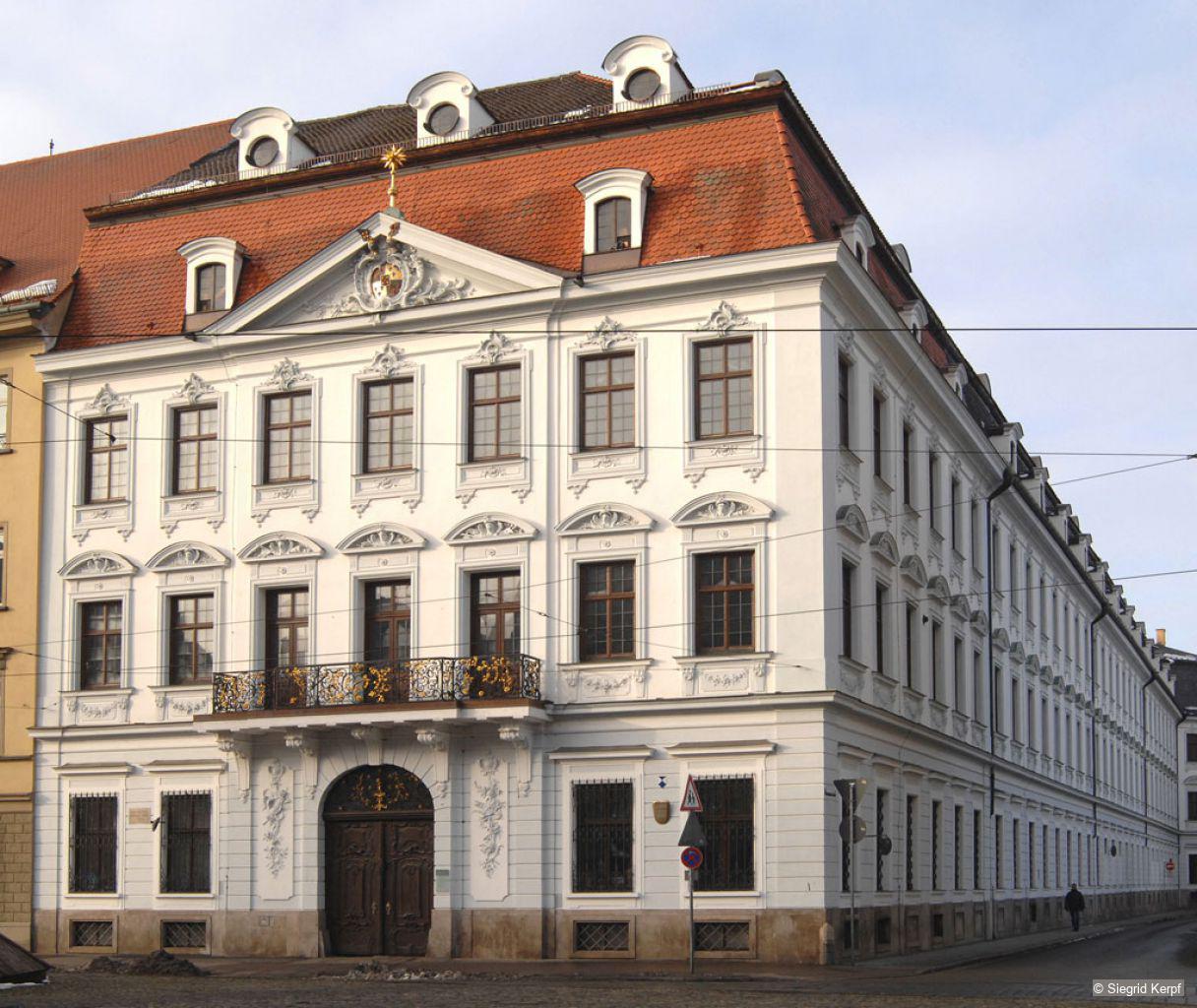
 Add to My Collection
Name of Monument:
Liebert Palace
Also known as:
Schaezlerpalais
Location:
Augsburg, Bavarian Swabia, Germany
Maximilianstraße 46
86150 Augsburg
T : +49 (0)82 13 24 41 02
F : +49 (0)82 32 44 10 5
E : Kunstsammlungen.stadt@augsburg.de
Art Collections and Museums in the city of Augsburg (Responsible Institution)
Date:
1765–1770
Artists:
Palace architecture: Karl Albert von Lespilliez (1723–1796); execution: Johann Gottfried Stumpe (1708–1777); ballroom, design and fresco: Gregorio Guglielmi (1714–1773); stucco: Franz-Xaver Feichtmayr (1735–1803), Simpert Feichtmayr (1732–1806); wood carving: Placidus Verhelst (1727–1778)
Denomination / Type of monument:
Secular architecture (city palace)
Patron(s):
Baron Benedict Adam Liebert von Liebenhofen (1731–1810)
History:
The Augsburgian banker and silver-trader Benedict Adam Liebert von Liebenhofen (1730–1810) whose business connections were wide-reaching in international markets, commissioned the construction of the palace (1765–70 executed by local builder, Johann Gottfried Stumpe) in a prime location on the city’s main street. The occasion for the project was the ennoblement of Liebert to the rank of a Reichsritter (knight), which required an adequate, new and representative residence. For the design of his palace Liebert engaged internationally-renowned artists, as for instance, the courtly master-builder Karl Albert von Lespillez from Munich and the Roman mural painter Gregorio Guglielmi who, as a travelling artist, also worked for the imperial court in Vienna.
Description:
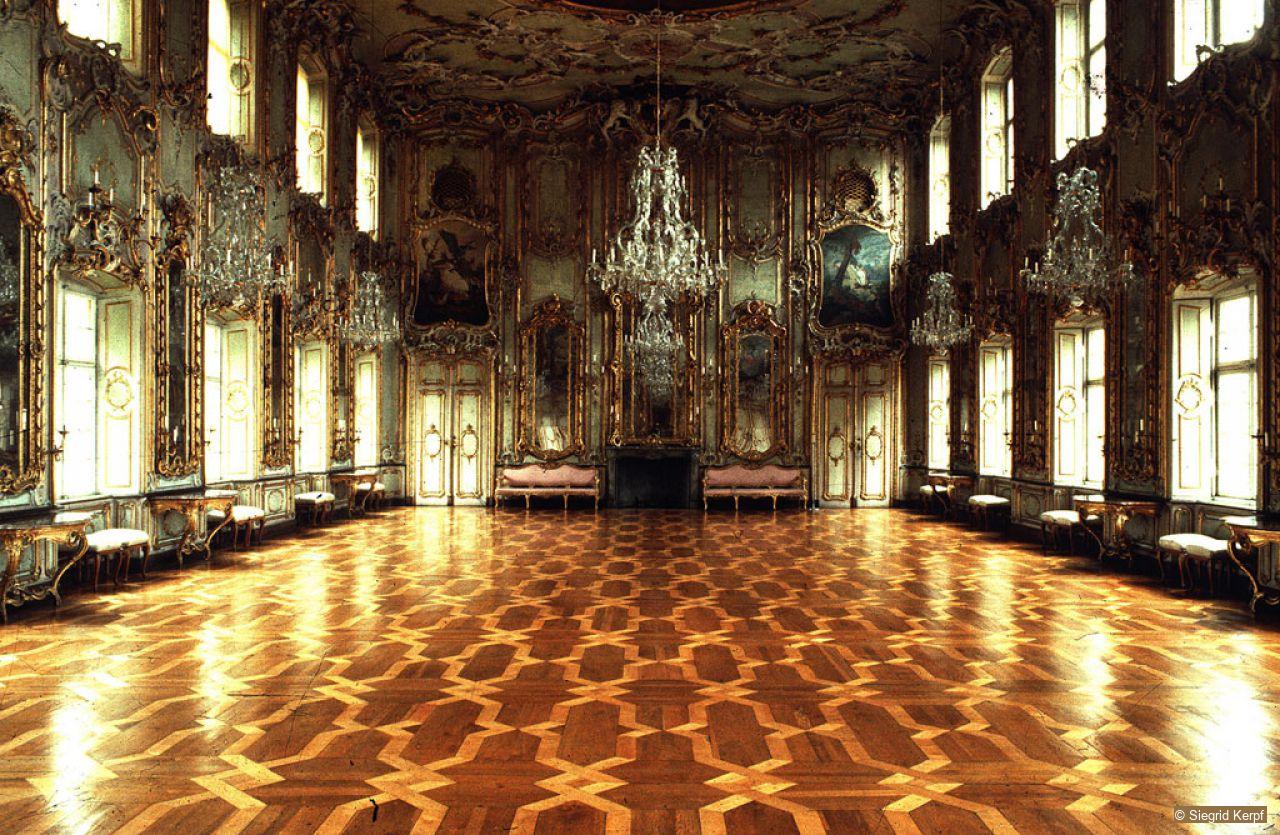
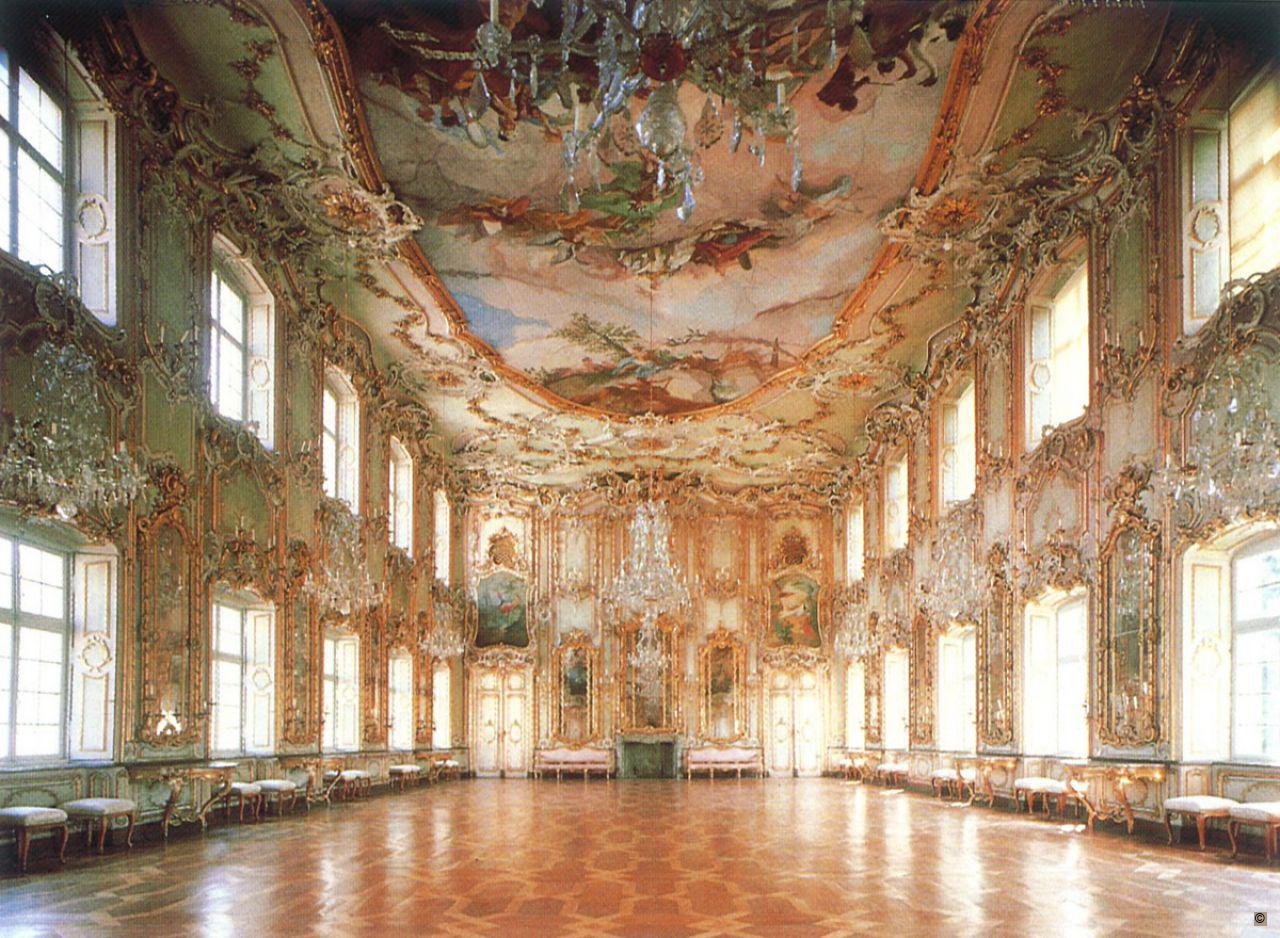
The shorter facade oriented towards the Maximiliansstrasse is, according to the role of the street in the cityscape, the most prominent and most visible side of the palace. There, the three-story building is structured with a small central projection which unites several stately elements, such as a broad archway, a balcony in the piano nobile and a gable with the coat-of-arms of von Liebenhofen. The building evokes a discreet splendour following the example of French Classicism. On the contrary, the long facade facing the Katharinengasse seems quite monotonous. The large ballroom (23 x 11 m) ranging over two storeys is the showpiece of the building. The rich decoration, executed entirely in the local “Augsburgian taste” Rococo style, was probably designed by Gregorio Guglielmi, who also painted the ceiling fresco. The walls are adorned with ornamentally framed panels (wood carving by Placidius Verhelst) partially filled with mirrors or paintings, as are the over-doors, which illustrate local and exotic flora and fauna. The stuccowork by the brothers Franz-Xaver and Simpert Feichtmayr is maybe the most superb element of the decoration. Especially the cornices of the upper windows, which freed from all architectural constraints, are an outstanding masterpiece. Their ornamental richness establishes a floating connection with the frame of the fresco. All in all, a masterly Rococo interior of courtly ambition.
View Short DescriptionThe Schaezlerpalais, built for a rich banker, is the most important secular building in the city of Augsburg. Situated prominently in the centre of the city’s main street, its noble splendour coins the cityscape. The impressively lush interior decoration is an outstanding example of the local Rococo style, the so-called Augsburger Geschmack (Augsburgian taste). The ballroom in particular is especially large and ostentatious, even for a private palace.
How Monument was dated:
Documented in the archive; signature of the ceiling fresco, signed “1767”.
Special features
Ceiling fresco
Ballroom
1767
Gregorio Guglielmi (1714–1773)
Guglielmi’s high-grade ceiling fresco depicts allegories of the Four Continents but doesn’t leave any doubt about the supremacy of Europe. Again, the topic shows a clear connection to the life and work of the patron. In the centre of the painting stands Mercury, the god of trade, with a cornucopia. The theme is trade and its worldwide power spreading European comforts, announced by Fame, all over the world. The accentuated exotic design of the figures corresponds with the painted over-doors in the ballroom.
Ceiling fresco
Staircase
1766/67
Gregorio Guglielmi (1714–1773)
Already on the staircase, the profession, rank and claim to power of von Liebenhofen are demonstrated. The ceiling is decorated with an oval fresco by Guglielmi, framed within gold-plated stucco. Its theme is the benefices of trade for the arts and sciences.
Selected bibliography:
Trepesch, C., Das Schaezlerpalais und die Deutsche Barockgalerie (ein Augsbuch 7), Augsburg 2006, pp. 13–113.
Trauchburg, G. von, Häuser und Gärten Augsburger Patrizier, Munich/Berlin 2001.
Langen, S. von, Die Fresken von Gregorio Guglielmi (tuduv-Studie Reihe Kunstgeschichte), Munich 1994, pp. 227–9.
Hagen, B. Von, Wegener-Hüssen, A., Stadt Augsburg (Denkmäler in Bayern VII.83), Munich 1994, pp. 310–13.
Dietrich, D., Aegid Verhelst 1696–1749. Ein flämischer Bildhauer in Süddeutschland, Weissenhorn 1986, pp. 166, 187.
Citation of this web page:
Hans Christian Hönes "Liebert Palace" in "Discover Baroque Art", Museum With No Frontiers, 2026.
https://baroqueart.museumwnf.org/database_item.php?id=monument;BAR;de;Mon12;26;en
MWNF Working Number: DE3 26
RELATED CONTENT
On display in
Exhibition(s)
Discover Baroque Art
The Ascension of the Bourgeoisie | Trade and Festivities Ephemera, Festivals and Theatrical Representation | Festive sites Travelling and Exoticism | Trade and cultural interactionDownload
As PDF (including images) As Word (text only)