

 Back
Back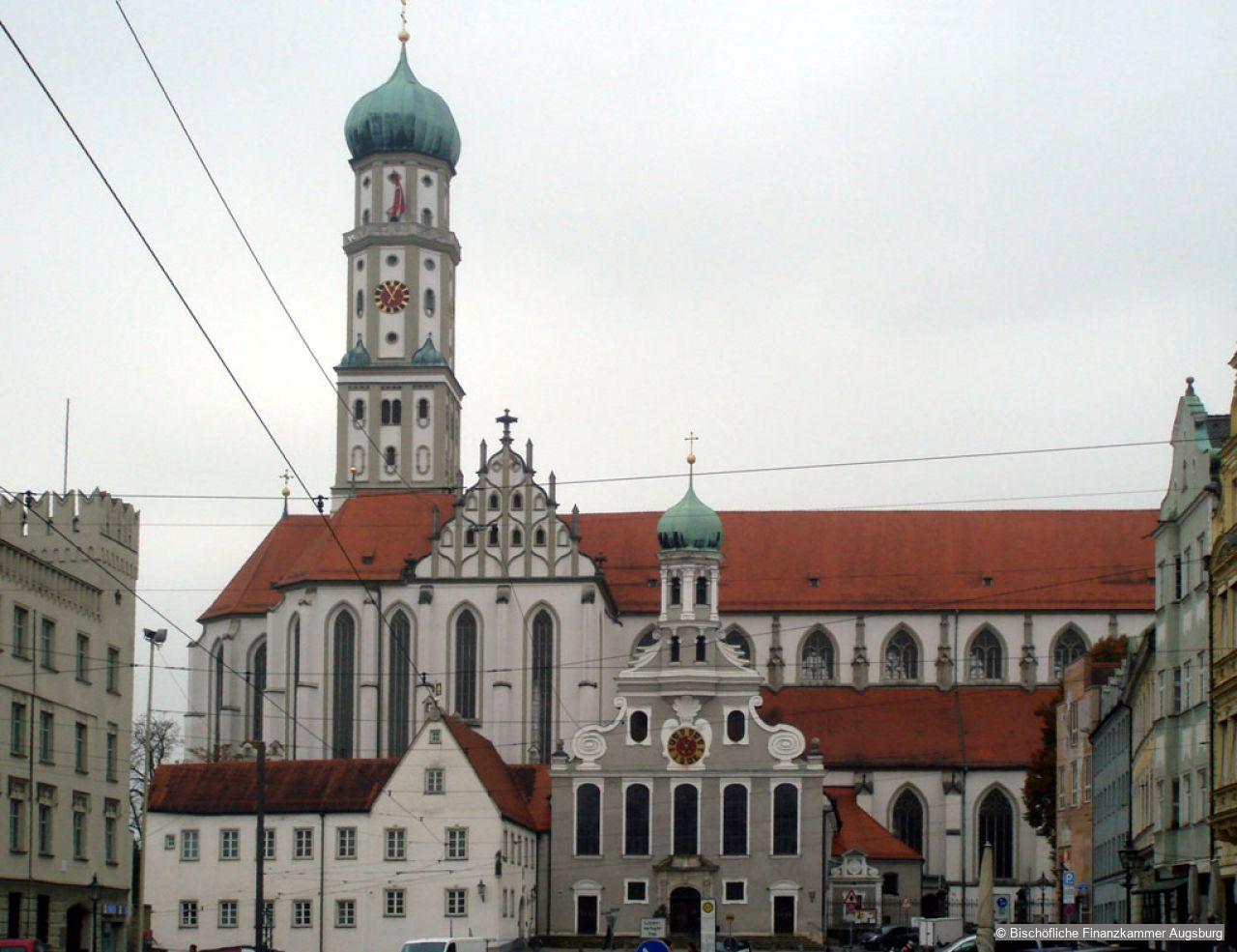
 Add to My Collection
Name of Monument:
Abbey Church of the Benedictine Order St. Ulrich and St. Afra
Also known as:
Ulrichsbasilika
Location:
Augsburg, Bavarian Swabia, Germany
Ulrichsplatz 19
86150 Augsburg
T : +49 (0)82 13 45 56 0
F : +49 (0)82 34 55 64 0
Catholic Parish of St. Ulrich and Afra; parish priest Monsignor Franz Wolf / Diocese of Augsburg (Responsible Institution)
Date:
1603–1608: vaulting and decoration of the altars in the choir; pulpit in the middle nave; 1698–1705: Chapel of All-Saints; 1714: renovation of the Chapel of St. Simpert; 1762–1765: renovation of the Crypt of St. Ulrich
Artists:
Choir altars and pulpit, design: Hans Krumpper (c. 1570–1634); sculptures: Hans Degler (1565–1637); polychrome coating: Elias Greither d. Ä. (1565/70–1646);Bronze sculpture of the crucifixion, model: Hans Reichle (c. 1570–1642); cast: Wolfgang Neidhardt (1575–1632);Chapel of All Saints, stucco: Matthias Lotter [n.d.]; ceiling fresco: Johann Georg Knappich (1637–1704); altar: Johann Georg Schmierer [n.d.];Crypt of St. Ulrich: Placidus Verhelst (1727–1778)
Denomination / Type of monument:
Ecclesiastical architecture (abbey church)
Patron(s):
Abbots Johannes Merk (gov. 1600–32); Willibald Popp (gov. 1694–1735); Joseph Maria von Langenmantl (gov. 1735–90)
History:
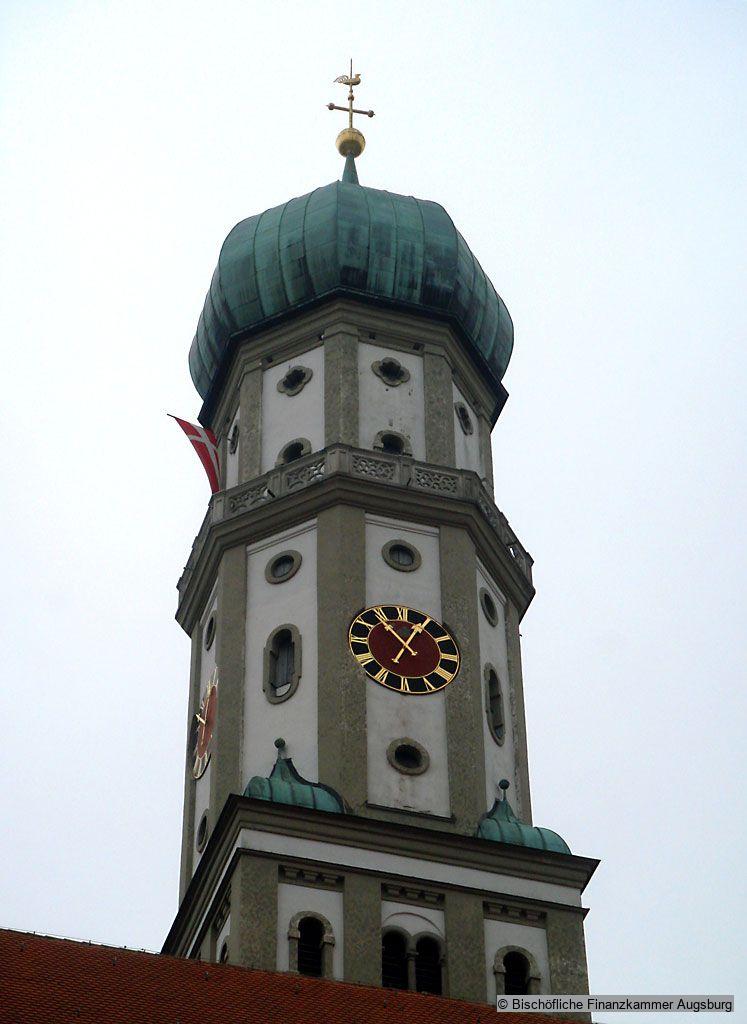
The church has been a place of worship since 1012, being associated with the late antique martyr Afra and then with its second patron, Bishop Ulrich, who was canonized in 993 and one of the heroes of the battle at Lechfeld in 955, at which time it was under the administration of the Benedictine Order. The monastery took a supra-regional role since the late medieval period. Since 1449 it was immediate to the Emperor. It was during that high point in its history, precisely 1467, that today’s Late Gothic building was begun, but never finished. In 1594 the spire was completed; on the occasion of the 1300th anniversary of the martyrdom of St. Afra, in 1604, the church was vaulted. Decoration of the choir followed in 1607. Several other interventions were undertaken with regard to the relics of local saints during the Baroque period: in 1698 a new Chapel of All Saints was built annexed to the sacristy; renovations include the Chapel of St. Simpert of 1714, and in 1762, the crypt, together with the tomb of St. Ulrich.
Description:
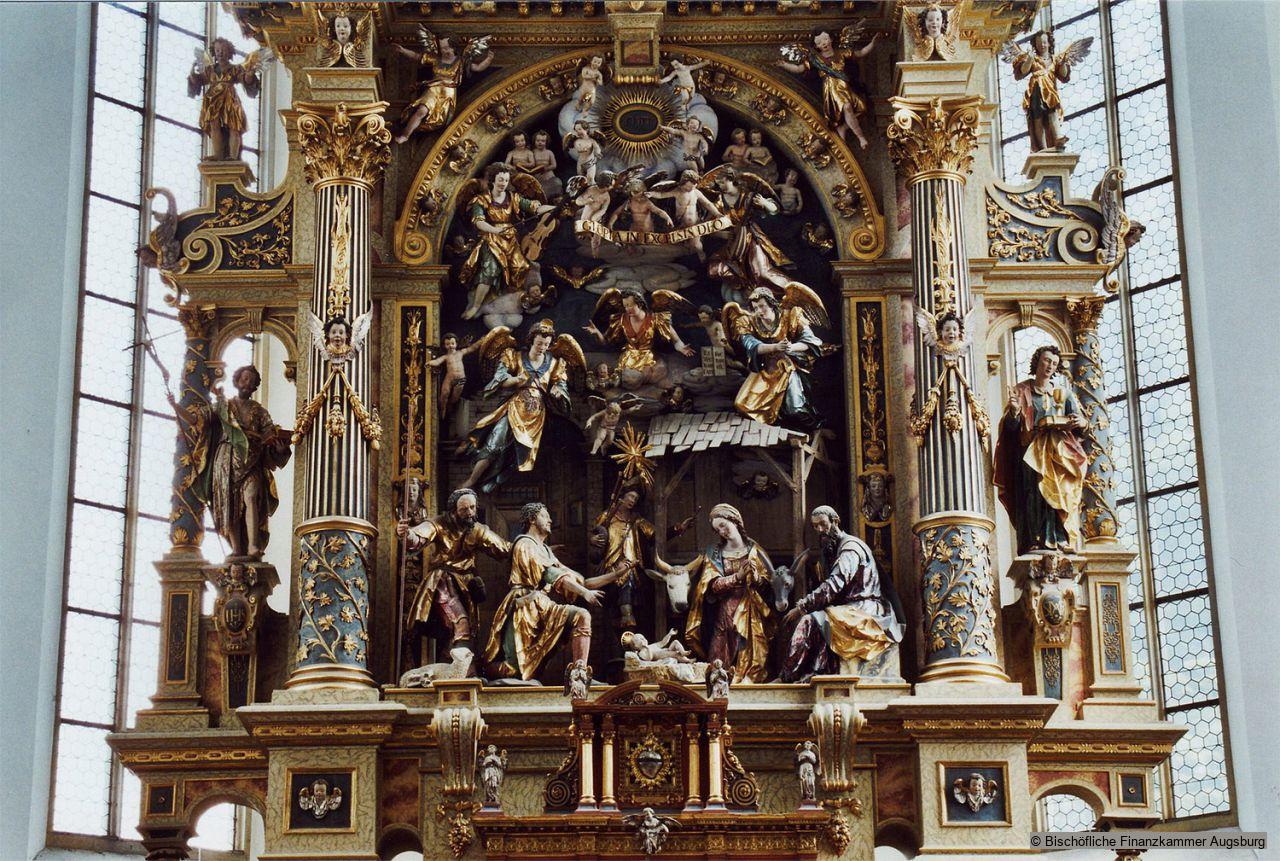
The monumentality of the church soars above the cityscape of Augsburg, especially when seen from the Ulrichsplatz in the north. In particular, the onion dome, destined to be a model for countless later Bavarian churches, dominates the silhouette of Augsburg across a wide area. Unlike the multi-faceted exterior, the Late Gothic interior is a sober architectural piece, its highlight being the tripartite group of altars in the choir: This group comprises the high altar of 1604 (executed by Hans Degler, a representative of the Weilheim school, probably after designs by Hans Krumpper), the altar of St. Ulrich in the south, and the altar of St. Afra in the north. Seen from the middle nave, the three altars amalgamate into a coherent and splendid composition. Stylistically, the interior decoration achieves organic unity with the architecture, even though the interior is 150 years younger. The three carved altars are executed in a hybrid style typical of southern Germany in around 1600. This style adopts antique details while, overall, giving the impression of preserving the decorative richness of the Late Gothic. The main scenes of the altars are not, as would be expected, dedicated to their patrons, but instead show important scenes from the Life of Christ (Birth, Resurrection and Pentecost), therewith marking the most important religious holidays of the year. Scenes from the Life of St. Ulrich and, respectively, of St. Afra are shown in the predella and in a smaller frame at the top of each of the particular altars.
View Short DescriptionThe Late Gothic basilica of St. Ulrich and St. Afra was updated in several phases with a splendid Baroque décor, resulting in spectacular plurality and combination of styles. The three altars in the choir, seen together from the middle nave, create an impressive effect. Their Baroque composition, divided into many small sections, corresponds surprisingly well with the cathedral-like medieval architecture. Altars and architecture respectively share the steeple-like silhouette that bridges the almost 150 years that separate them. The monumental bronze sculpture of the crucifixion by Hans Reichle is one of the most important German works in this genre, dating to around 1600.
How Monument was dated:
Archival documents and an inscription on the high altar: “MCIIII”
Special features
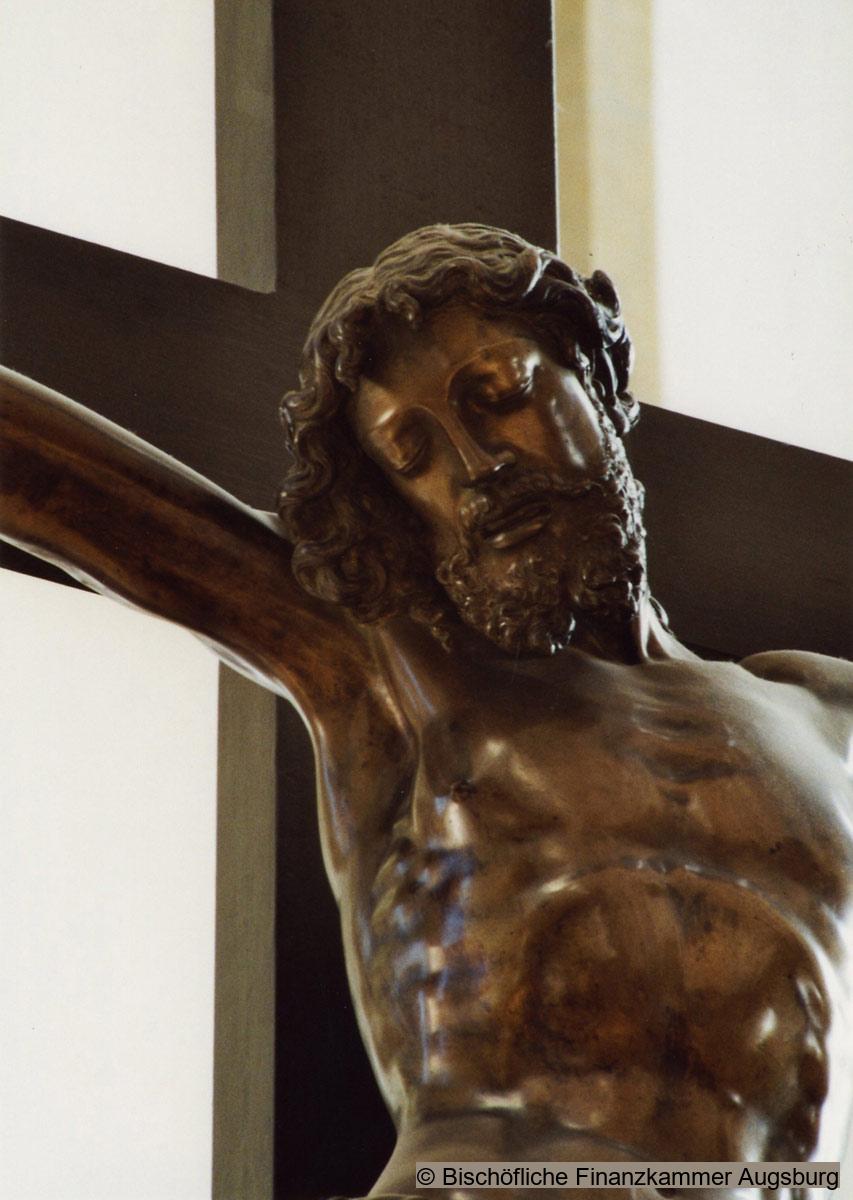
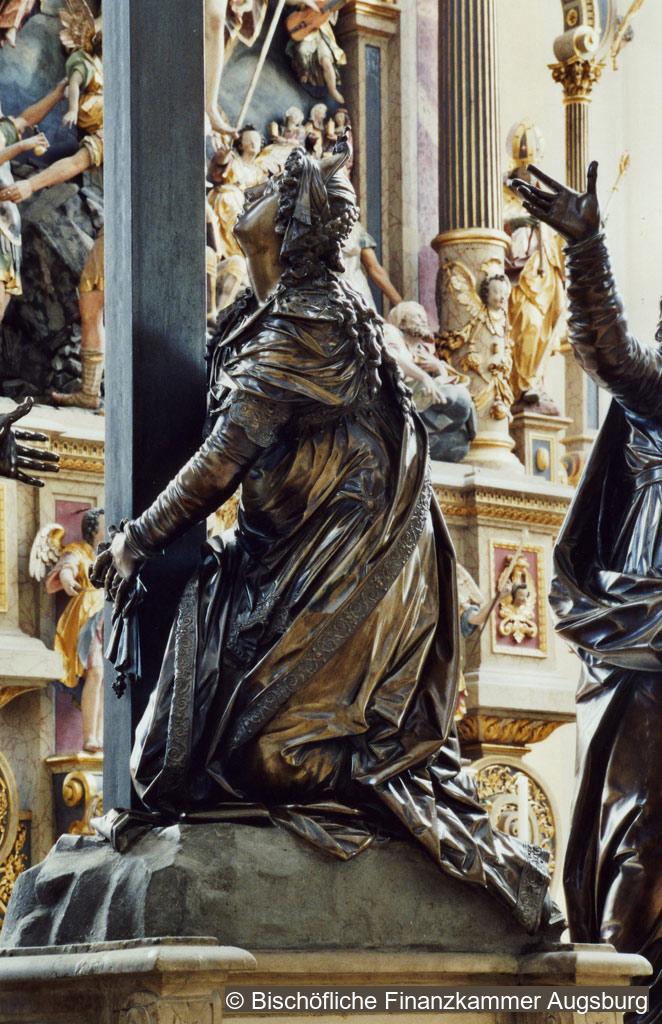
Sculpture of the Crucifixion
In front of the choir / behind the modern altar
1605–1607
Hans Reichle (c. 1570–1642); Wolfgang Neidhardt (1575–1632)
The monumental bronze sculpture of the Crucifixion once belonged to the former Altar of the Holy Cross, where the mass for the people was read. Thematically, it completes the life-story of Christ narrated in the other altars. The Virgin Mary and John the Evangelist standing beside the cross, as well as Mary Magdalena kneeling at its foot, are shown in lamentation expressed through gestures of grief.
Chapel of All Saints
Sacristy
1698–1705
Matthias Lotter [n.d.]; Johann Georg Knappich (1637–1704); Johann Georg Schmierer [n.d.]
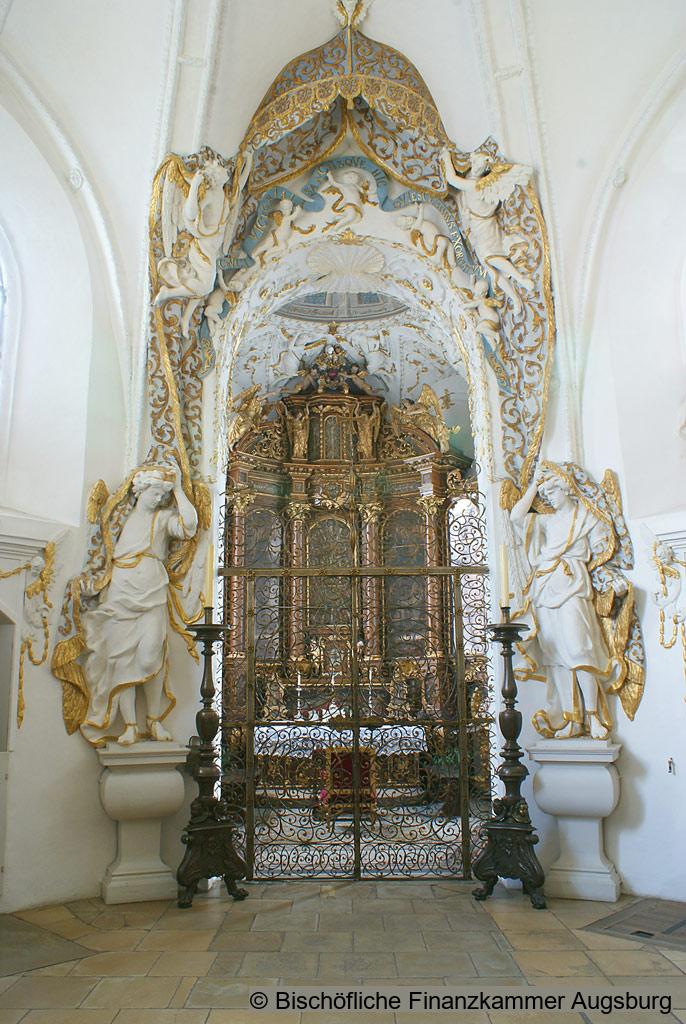
Under a stuccoed baldachin, lifted by angels, the altar of relics is presented to the believers. To its sides, the skeletons of the Four Holy Abbots: Wigpertus, Nidgarius, Adalbero and Thosse are presented in showcases. The connection of their dead bodies with an image of the Crucifixion suggests their successful emulation of Christ.
Burial Chapel of St. Ulrich
Crypt
1762–1765
Placidus Verhelst (1727–1778)
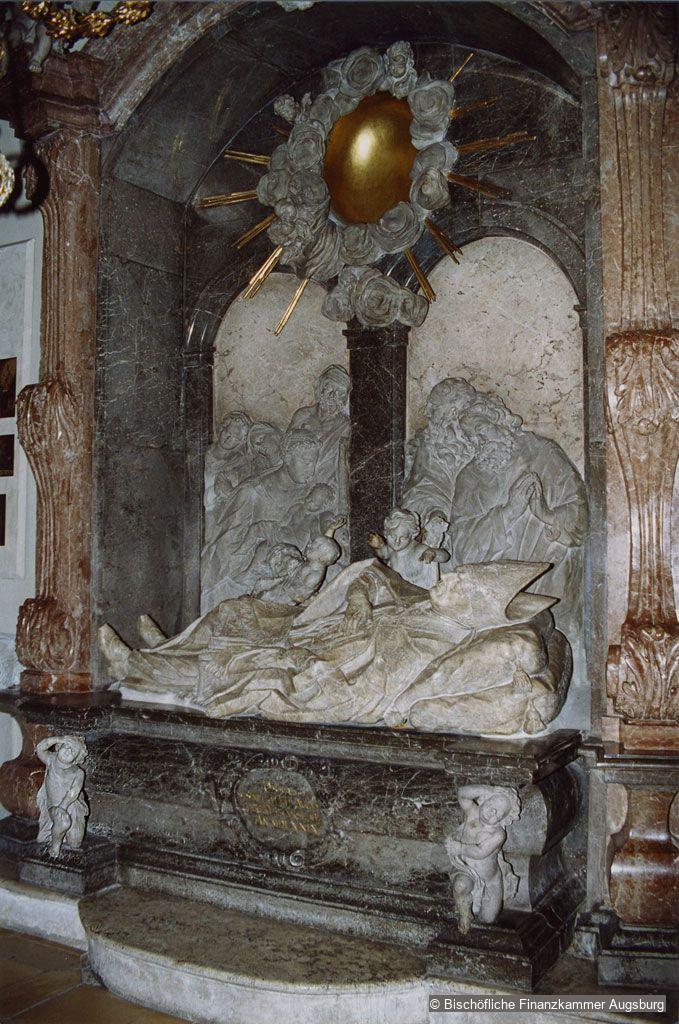
The decoration of the crypt, dedicated to the patron saint of the diocese St. Ulrich, is a prime example for the local variant of the Rococo style in Augsburg, characterised through its playfulness and ornamental abundance. By contrast, the sarcophagus with the figure of the saint stands fully within the tradition of Baroque sepulchre culture.
Selected bibliography:
Engelberg, M. von, Renovatio ecclesiae. Die Barockisierung mittelalterlicher Kirchen (Studien zur internationalen Architektur- und Kunstgeschichte 23), Petersberg 2005, pp. 504–14.
Soffner, M., Wolf, F., St. Ulrich und Afra in Augsburg (Peda-Kunstführer), Passau 2004.
Lieb, N., Augsburg, St. Ulrich und Afra. Stadtpfarrkirche und (seit 1937) Päpstliche Basilika (Kleine Kunstführer 183, 24th edition), Munich 2003.
Sauermost, H.-J., Die Weilheimer. Große Künstler aus dem Zentrum des Pfaffenwinkels, München 1988, pp. 79–89.
Dietrich, D., Aegid Verhelst 1696–1749. Ein flämischer Bildhauer in Süddeutschland, Weißenhorn 1986, pp. 166–9, 186.
Citation of this web page:
Hans Christian Hönes, Peter Heinrich Jahn "Abbey Church of the Benedictine Order St. Ulrich and St. Afra" in "Discover Baroque Art", Museum With No Frontiers, 2026.
https://baroqueart.museumwnf.org/database_item.php?id=monument;BAR;de;Mon12;28;en
MWNF Working Number: DE3 28