

 Back
Back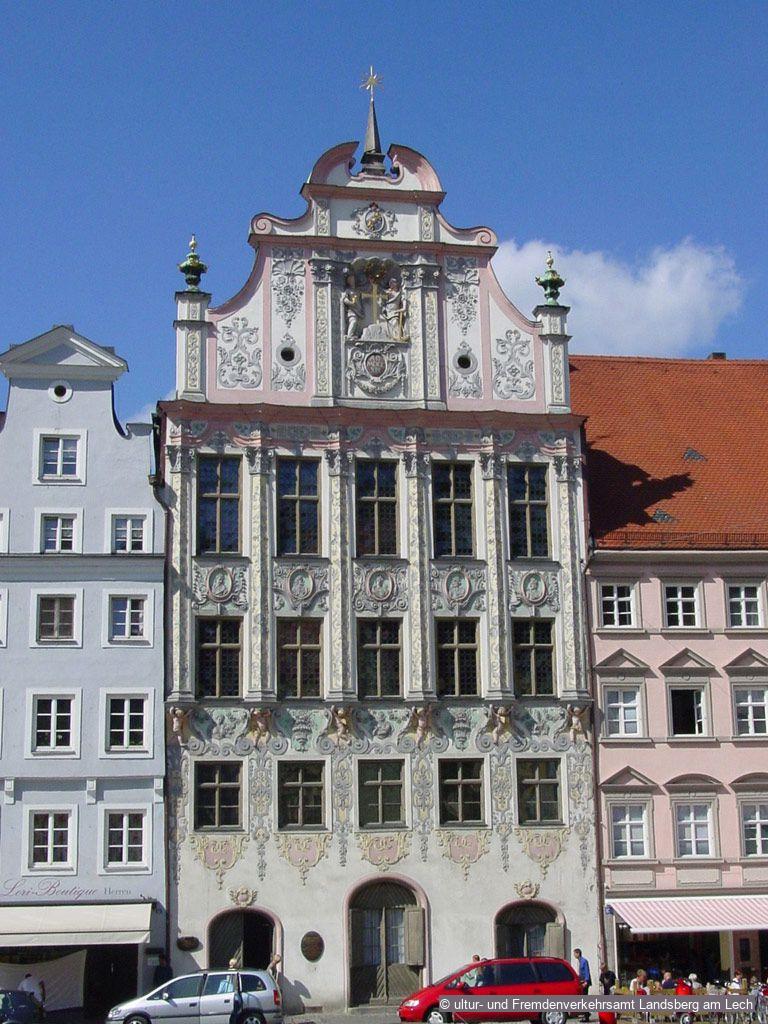
 Add to My Collection
Name of Monument:
City Hall Landsberg
Also known as:
Historical City Hall
Location:
Landsberg am Lech, Upper Bavaria, Germany
Katharinenstrasse 1
86899 Landsberg am Lech
T : +49 (0)81 91/128 265
F : +49 (0)81 91/128 172
E : p_mayr_endhart@landsberg.de
Stadtverwaltung (Municipal Administration) Landsberg am Lech (Responsible Institution)
Date:
1699–1720
Artists:
Design of the façade, stuccowork on the 2nd floor: Dominikus Zimmermann 1685–1766; stuccowork on the 1st floor: Georg III Zöpf [n.d.], Stephan II Finsterwalder [n.d.]
Denomination / Type of monument:
Secular architecture (public building)
History:
In the former Bavarian frontier town, one year after the old city hall was torn down in 1698 because of its ruinous state, a residential building located at the western area of the main square was renovated to become today’s City Hall, being located in the range of vision of the most important gate and therefore catching every visitor’s eye. In 1718, the building was heightened by a storey to incorporate a festivity hall and the scrolled gable of the facade. In the same year, Zimmermann and his workshop stuccoed the second storey vestibule and the assembly hall of the Outer Council; and in 1719, finally, the facade. Since then, a few restorations have taken place, some of which have led to alterations: in about 1800 the scrolled gable was simplified and also the portal by removal of its columns, and much later, between 1870 and1905, the upper halls were redecorated in the antique taste.
Description:
The City Hall, which is only 12 metres wide, housed on the ground floor the so-called “Brothaus” (a hall for selling bread), and in the basement, the jailhouse plus the communal wine cellar. Located on the upper floors are the two assembly halls of both chambers of the City Council, with the smaller room on the first floor used by the Inner Council, and the larger room on second floor used by the Outer Council. The third floor served the purpose of the ballroom.
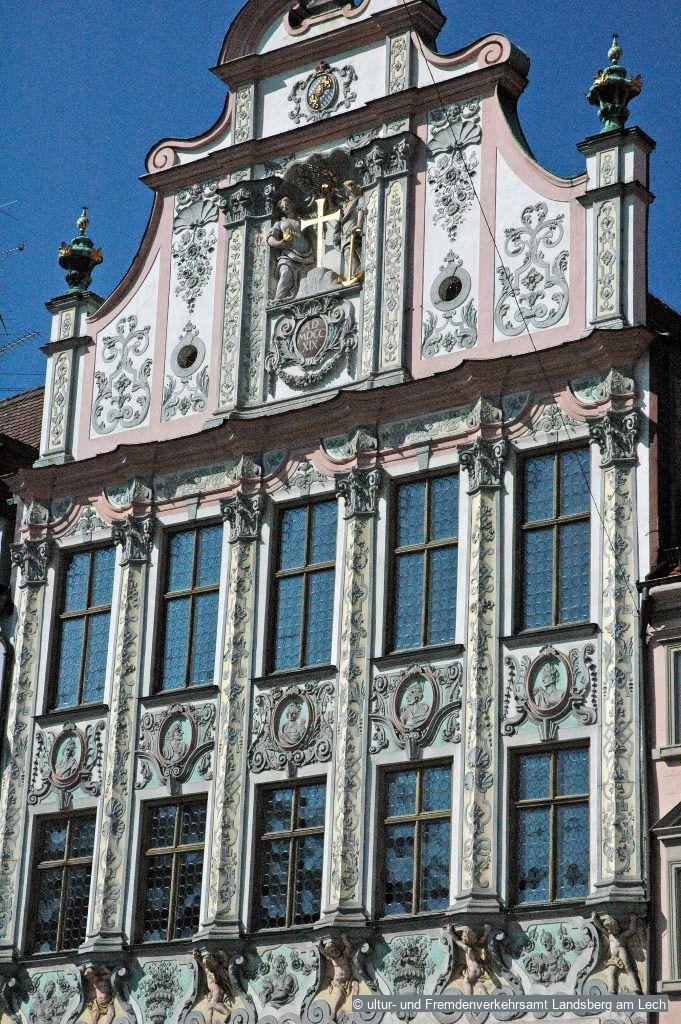
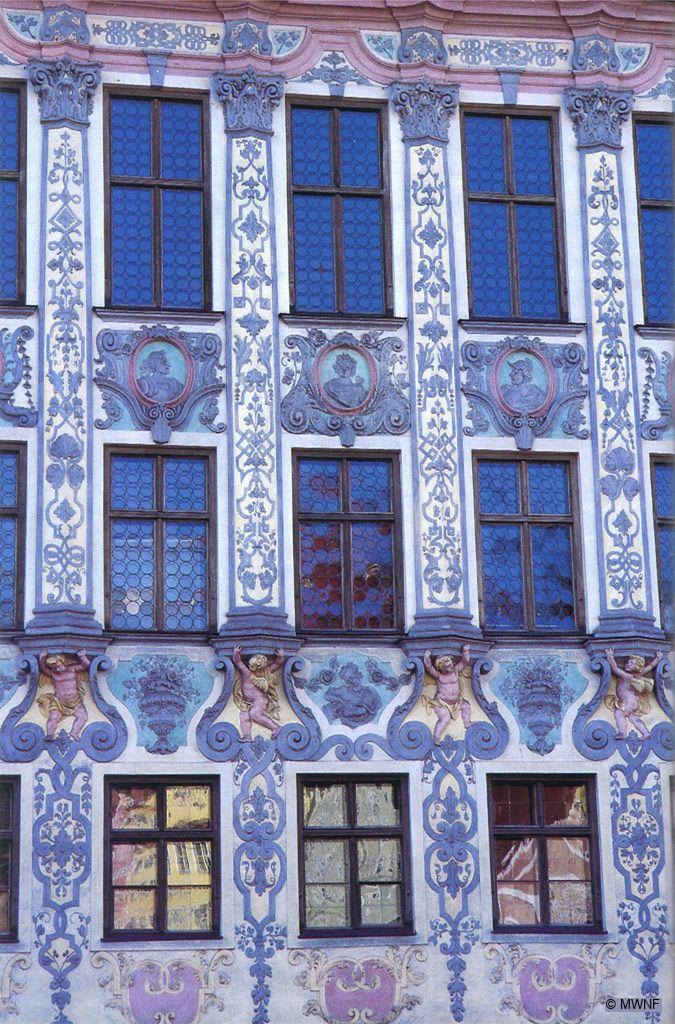
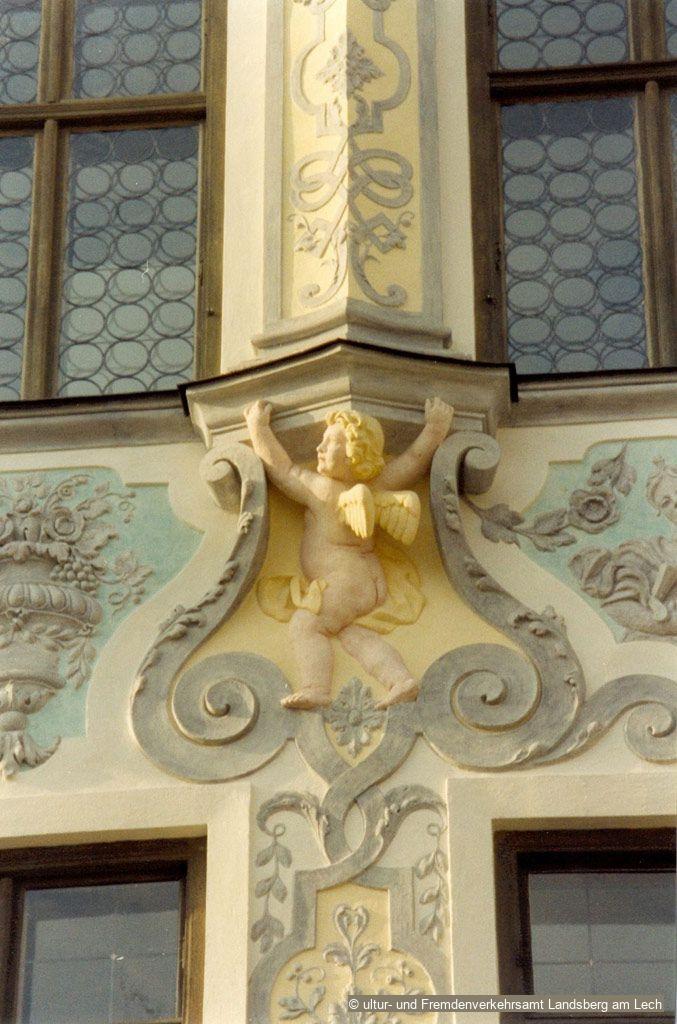
The façade of the City Hall is steeply proportioned and divided regularly into five vertical axes whose windows seem to grow from floor to floor, corresponding to the importance of the rooms behind them. A portal, flanked by columns, at one time accentuated the unadorned ground floor. Like a closely meshed web, a rich stucco decoration of Regency interlacing covers the flat surface of the facade, the integrated iconographic programme of which proclaims the respect the city's government will pay to the virtues, resulting in the success of the whole community. The higher floors are linked by narrow rearward-folded pilasters carried by putti, and united by a partially scrolled entablature over the third floor. “S”-shaped volutes are employed as consoles for the pilasters, but also as framework in which putti, as substitute carriers of the pilasters, alternate with vases and the three allegories of the virtues. The latter, in the form of heroic Old-Testament busts: Susanna and the Elders, Judith with the head of Holofernes, and presumably the Queen of Sheba, symbolise the constancy, bravery and wisdom of the city and its government. The theme is heightened on the second storey, with the display of five vertical oval-bust reliefs, showing antique heroes and generals as symbols of military power and prudence. Furthermore, the fully plastic figurative decoration in the gable area adds to this profane canon of virtues a religious level of meaning: at its centre there is a niche framed by pilasters in which personifications of Charity (Caritas) and Hope (Spes) hold the laurel wreath of victory above the city's coat-of-arms. By being depicted three-dimensionally, the cross of the latter also signifies ambiguously Faith (Fides), so that all three theological virtues are shown. Like a crown, a statue of Justice (Justitia) originally stood amidst the strutted gable, instead of the today's obelisk with the eye of the Lord at the top, as an absolutely necessary virtue of a promising government.
The City Hall of the Bavarian commercial town Landsberg am Lech flaunts a richly decorated façade, which is said to be a magnum opus of the famous plasterer Dominikus Zimmermann in this genre of profane architecture. He developed for this a system of order and decoration which combines elements of Italian architectural design with examples of French ornamental graphics that were popular at the time, and which covers the facade like a fine web. The allegory weaved-in implores a righteous municipal government leading to prosperity.
How Monument was dated:
Archival documents
Selected bibliography:
Dietrich, D., Weißhaar-Kiem, H., Landsberg am Lech, Band 1: Die Bauten in öffentlicher Hand (Die Kunstdenkmäler von Bayern, Neue Folge 3, 1), Munich/Berlin 1997, pp. 304–57.
Stadt Landsberg a. Lech (ed.), Das Landsberger Rathaus. Zur Wiedereröffnung des historischen Rathauses nach der Renovierung im Mai 1991 (Heimatgeschichtliches aus Landsberg am Lech 3), Landsberg am Lech 1991.
Lampl, S., Dominikus Zimmermann, Munich 1987, pp. 274–79.
Bauer, H. and A., Johann Baptist und Dominikus Zimmermann. Entstehung und Vollendung des bayerischen Rokoko, Regensburg 1985, pp. 18, 128–9, 299.
Citation of this web page:
Eva Winter "City Hall Landsberg" in "Discover Baroque Art", Museum With No Frontiers, 2026.
https://baroqueart.museumwnf.org/database_item.php?id=monument;BAR;de;Mon12;30;en
MWNF Working Number: DE3 30