

 Back
Back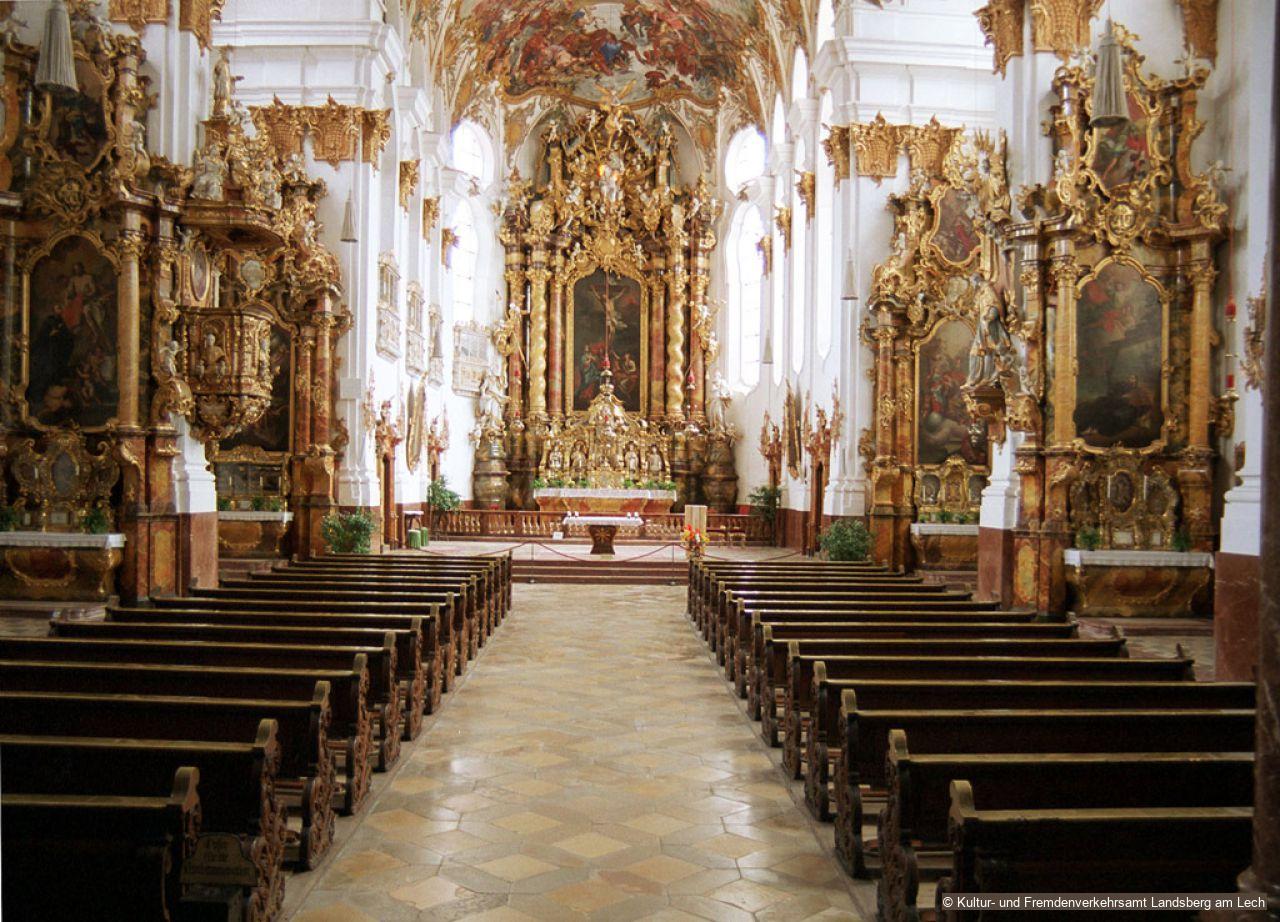
 Add to My Collection
Name of Monument:
Catholic Subsidiary Church of the Holy Cross, former Jesuit Church
Location:
Landsberg am Lech, Upper Bavaria, Germany
Date:
1752-56
Artists:
Architecture: Brother Joseph Ignaz Merani SJ (1693–1762);Main entrance and window design: Dominikus Zimmermann (1685–1766);Stucco: Nikolaus Schütz (1693–1785);Ceiling Frescoes: Christoph Thomas Scheffler (1700–56);Altars: Dominikus Bergmüller of Türkheim (1707–73);High altar and Confessional Sculptures: Franz Xaver Schmädl (1705–77);Paintings: Johann Baptist Baader (1717–80)
Denomination / Type of monument:
Ecclesiastical Architecture (Monastery Church)
Patron(s):
Father Ignatius Rhomberg SJ, Rector of the Landsberg Jesuit College
History:
In 1575, the second Jesuit College after Munich was founded in the Electorate of Bavaria and also included a noviciate. When the latter was in need of extension and renovation around 1750, this was taken as an occasion to also replace the collegiate church. As of 1752, under the direction of the Jesuit architect Joseph Ignaz Merani of Dillingen, a large-scale new building was erected for this purpose. Merani was obviously given a hand with the doorways and windows by the famous Rococo architect based in Landsberg, Dominikus Zimmermann. By 1756, the church building completed two years before was already largely furnished. The ceiling frescoes were the last work of Augsburg’s painter Christoph Thomas Scheffler, trained by Cosmas Damian Asam, and are considered as his most significant creations.
Description:
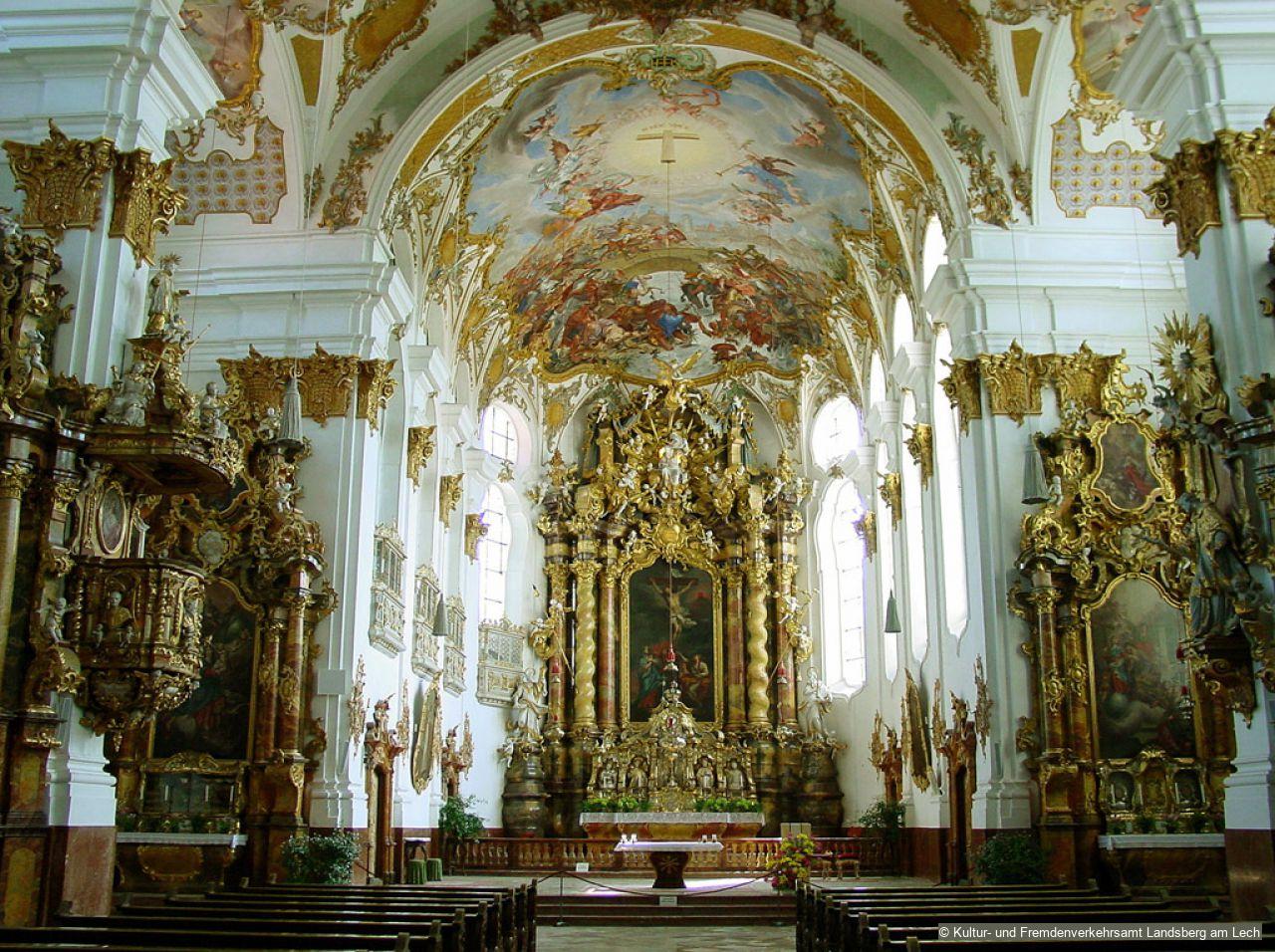
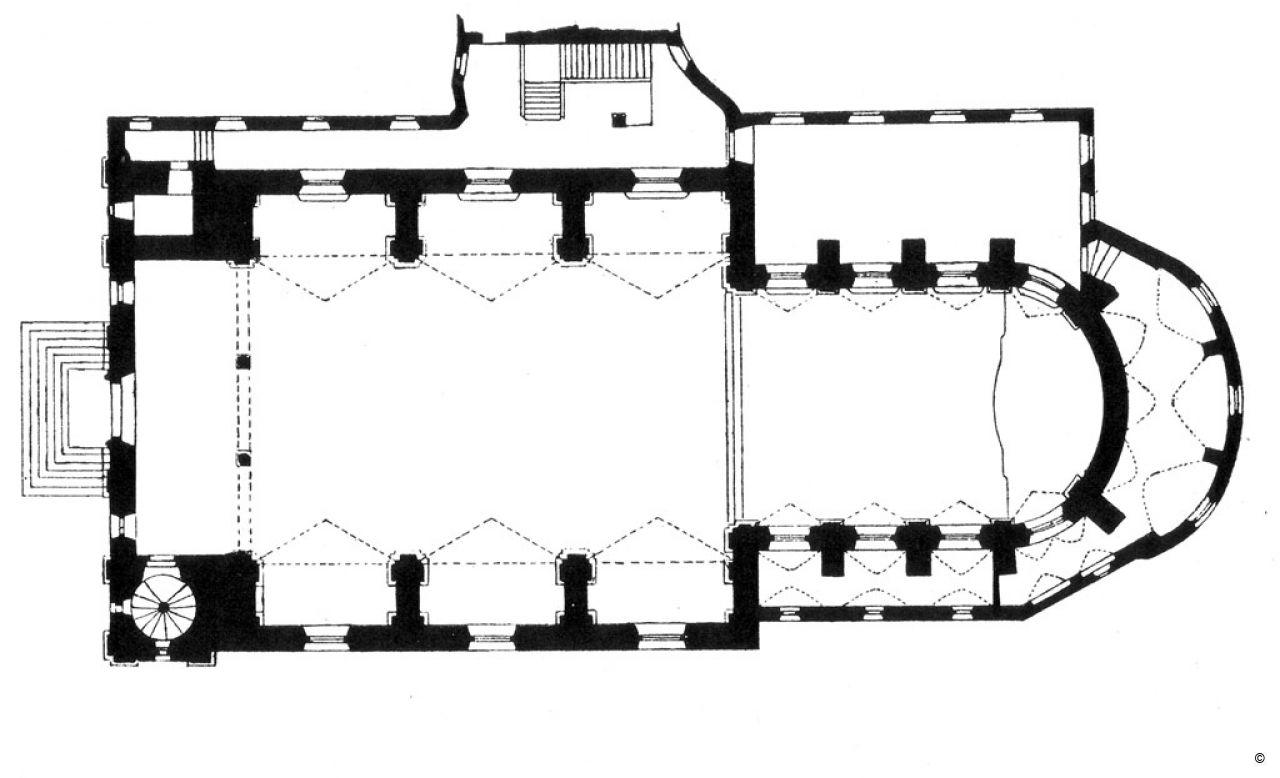
According to the origin of its architect, the Church of the Holy Cross was built after a specific model: the church of the Jesuit University (so-called Study Church), existing since 1617 in the Swabian town of Dillingen on the Danube. Comparable to that archetype, a hall of wall pillars leads to a recessed, deep and apsidal chancel. Only some unique details such as the ornamentalised windows and doorways as well as the Rococo-stucco betray the period of origin which is about 150 years later. Equally characteristic of this period and deviating from the archetype, extensive ceiling frescoes which illustrate the patrocinium cover the nave and chancel vaults. The appearance of the interior space is characterised by the altars which are stylistically uniform and arranged according to scenographic perspectives.
View Short DescriptionSituated high above the old town, the Jesuit Church with its two-towered façade constructed in un-plastered tuff masonry characterises the historical visage of the former old Bavarian border town. Constructed according to the building tradition of southern German Jesuits as a wall pillar church, it is an especially late representation of its building type and therefore exhibits features in the magnificent Rococo style. Multi-figured ceiling frescoes, painted by Christoph Thomas Scheffler, student of Cosmas Damian Asam, dominate the interior space and tell the legend of the cross in dramatic compositions.
How Monument was dated:
Through archival sources; inscription on the ceiling fresco.
Special features
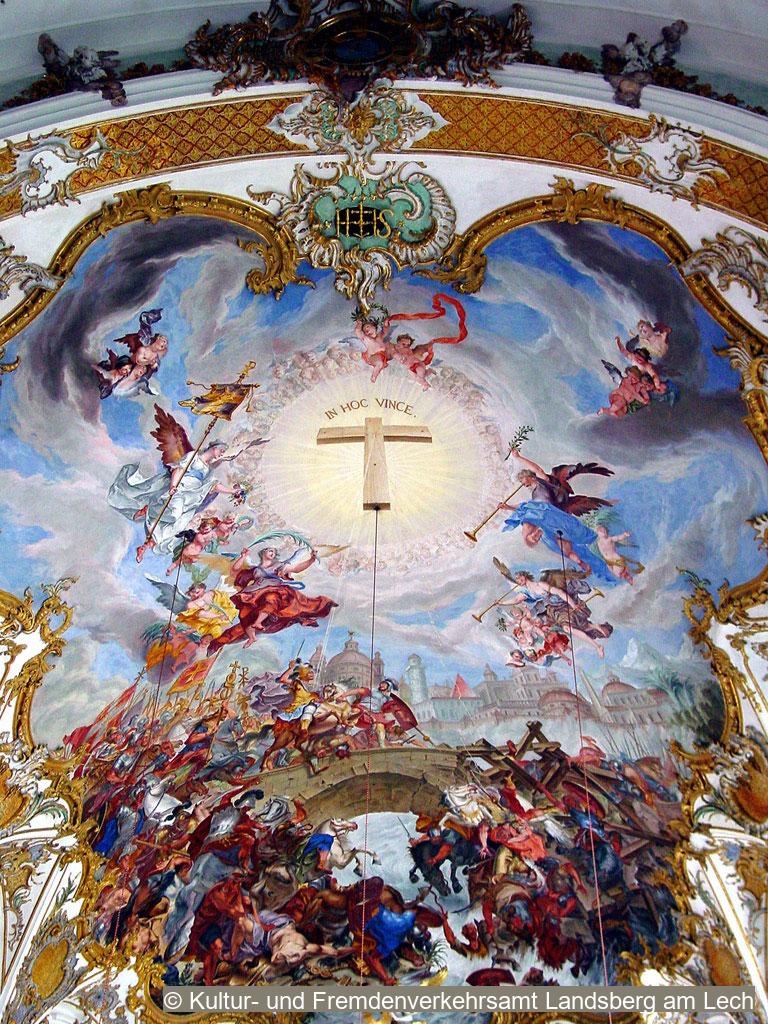
Battle of the Milvian Bridge
Vault in the Chancel
1753
Christoph Thomas Scheffler (1700–56)
The ceiling painting, which covers the entire surface of the chancel vault, shows the battle of Emperor Constantine the Great, led by a vision of the Christian Cross, against Maxentius, his rival to the throne, at the Tiber Bridge north of Rome. The dramatic figural composition, surging around a bridge arch, is based on a famous model by paraphrasing the Battle of the Amazons by Pieter Paul Rubens.
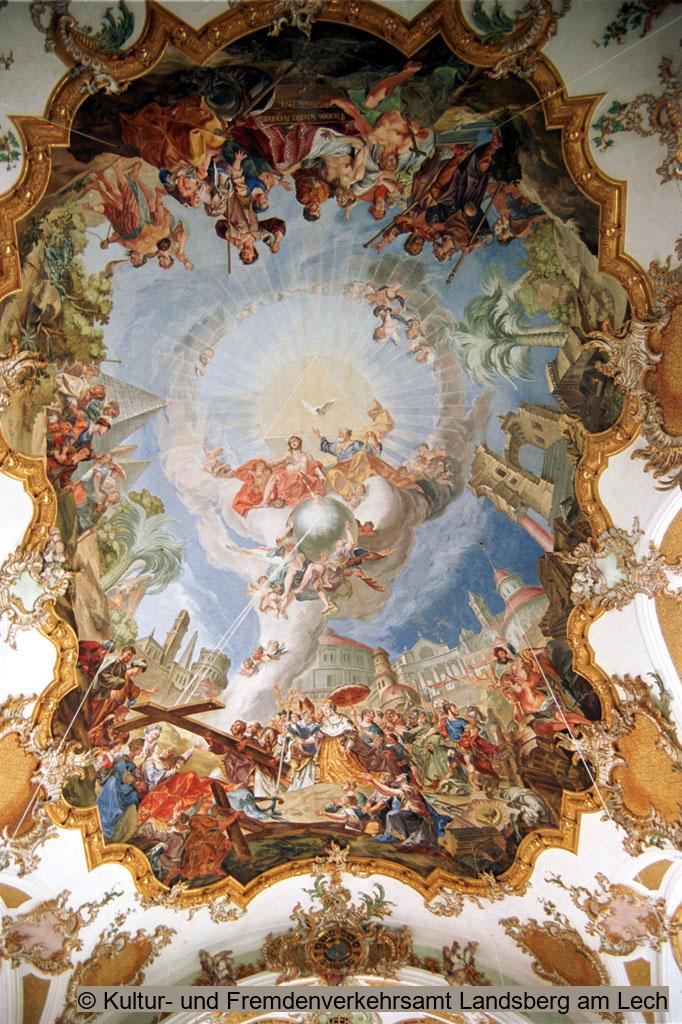
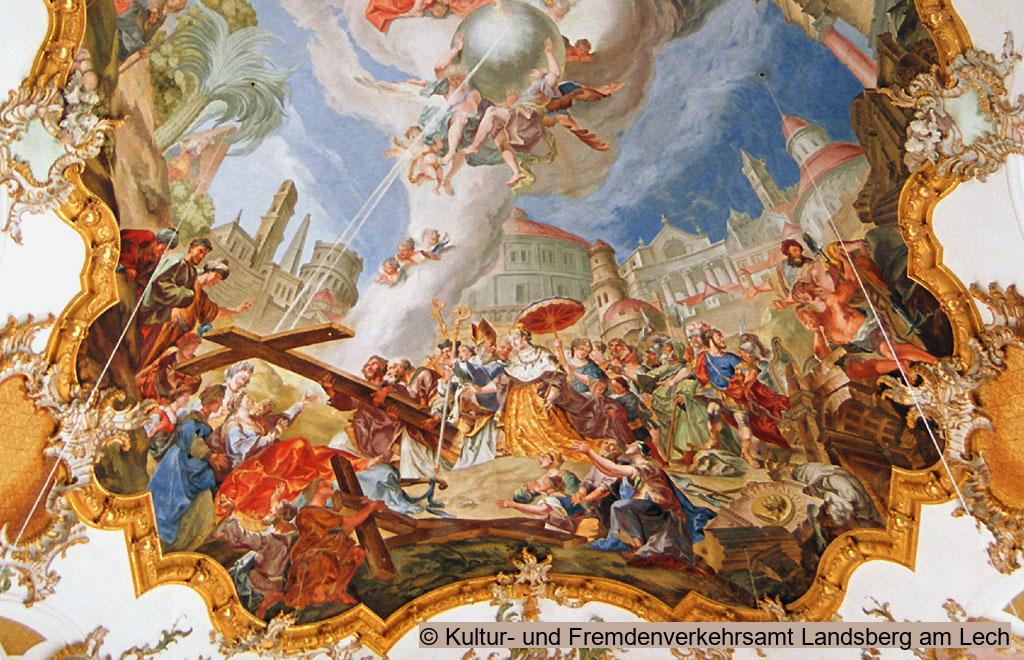
Finding of the Cross by Empress Helena and Trial of the Cross
Vault in the Nave
1754
Christoph Thomas Scheffler (1700–56)
In front of the city scenery of Jerusalem, Empress Helena tries to separate the rediscovered Cross of Christ, relying on its miraculous work, from the two thieves’ crosses. Biographically significant, the already severely sick painter immortalised himself, signature included, as an ailing person amongst a group of people, adjacent to the miracle of the cross, hoping to be healed by the cross relics.
Crucifixion Altar (High Altar)
Chancel
1754–56 Altar and Sculptures1758 Altarpiece
Altar Architecture: Dominikus Bergmüller (1707–73); Sculptures: Franz Xaver Schmädl (1705–77); Altarpiece: Johann Baptist Baader (1717–80)
The mighty high altar with three columns on either side is constructed as a stage altar in which the themes of the religious observance can be theatrically illustrated following the Diessen model. According to the patrocinium, the altar piece shows Christ on the cross whereas the two winding columns, connected above by volute brackets to form a canopy, refer to those in the Roman St. Peter’s Church, thus, together with the statues of the apostle leaders Peter and Paul, claim the leadership of the papacy.
St. John of Nepomuk
Wall pillar opposite the pulpit
1754/56
Franz Xaver Schmädl (1705–77)
Among the Jesuits, the popular confessor and bridge saint enjoyed special reverence as protector of the successful order against hostility based on envy.
Selected bibliography:
Bauer, H. und Rupprecht, B. (eds), Corpus der barocken Deckenmalerei in Deutschland, Bd. 1: Freistaat Bayern, Regierungsbezirk Oberbayern. Die Landkreise Landsberg am Lech – Starnberg – Weilheim-Schongau, Munich: Süddeutscher Verlag, 1976: 132–143.
Dietrich, D., Ehem. Jesuitenkirche Hl. Kreuz und Jesuitennoviziat Landsberg (Kleine Kunstführer 93), 7., completely reworked edition, Regensburg: Schnell & Steiner, 1997.
Dietrich, D. (ed), Heilig-Kreuz-Kirche Landsberg a. Lech (Große Kunstführer 144), Munich/Zurich: Schnell & Steiner, 1984.
Dietrich, D. and Weißhaar-Kiem, H., Landsberg am Lech, Band 2: Sakralbauten der Altstadt (Die Kunstdenkmäler von Bayern, Neue Folge 3,2), Munich/Berlin: Deutscher Kunstverlag, 1997: 338–454.
Lampl, S., Dominikus Zimmermann, Munich/Zurich: Schnell & Steiner, 1987: 417–419.
Citation of this web page:
Katharina Wein, Peter Heinrich Jahn "Catholic Subsidiary Church of the Holy Cross, former Jesuit Church" in "Discover Baroque Art", Museum With No Frontiers, 2026.
https://baroqueart.museumwnf.org/database_item.php?id=monument;BAR;de;Mon12;31;en
Prepared by: Katharina Wein, Peter Heinrich Jahn
Translation by: Gina Gill
Translation copyedited by: Janice MedinaJanice Medina
Janice Medina is an artist and educator based in Upstate New York. She studied interior design at Syracuse University and obtained her M.S. in Building Conservation in 2008 (Rensselaer Polytechnic Institute) and Master of Fine Arts in 2019 (University at Albany).
Janice is a former participant in the US/ICOMOS International Exchange Program and she has taught courses in the history of design and historic preservation. Her artwork is influenced by her experiences in historic preservation, as well as by building materials and the natural environment.
Janice has participated as a copy-editor with Museum With No Frontiers since 2019. In this role she has had the opportunity to work on a variety of projects including Discover Islamic Art, Discover Baroque Art and Discover Glass Art.
MWNF Working Number: DE3 31