

 Back
Back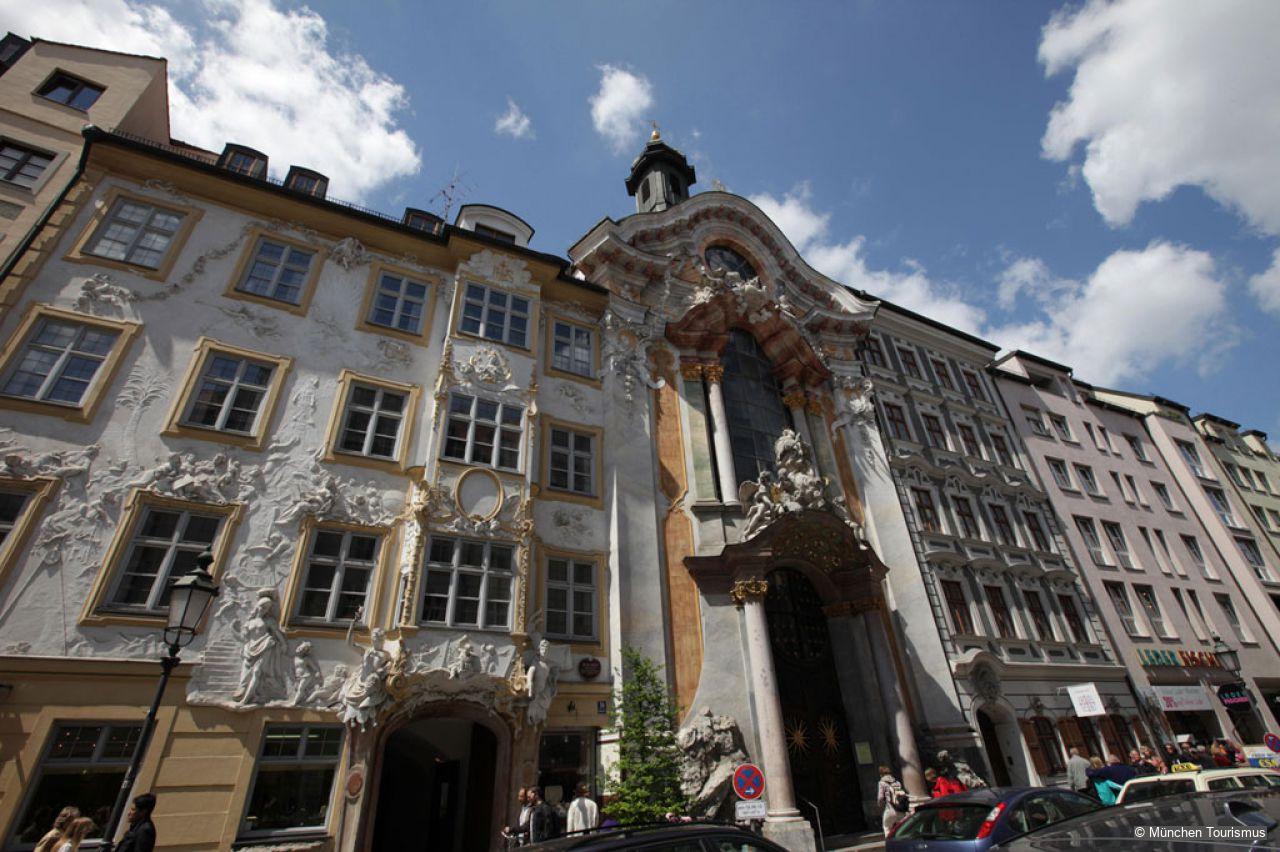
 Add to My Collection
Name of Monument:
Subsidiary Church of St. John Nepomuk and House of the Sculptor Egid Quirin Asam
Location:
Munich, Upper Bavaria, Germany
Date:
1729–35: house; 1733–1746: church
Artists:
Architecture, stucco and sculptures: Egid Quirin Asam (1692–1750); architecture and ceiling frescoes: Cosmas Damian Asam (1686–1739)
Patron(s):
Egid Quirin Asam (1692–1750)
History:
In 1729, Egid Quirin Asam acquired several neighbouring properties in the heart of Munich’s historic district upon which to build his private residence. This included a studio, a rectory and a private church between them. The church contains a family crypt and a private oratory.
At the same time in 1729, the canonisation of St. John of Nepomuk and his subsequent elevation as the patron saint of Bavaria inspired Egid Quirin Asam to accept this saint for the patronage of his church. It is for this reason that the foundation stone was laid on 16 May 1733, St. John’s feast day.
Cosmas Damian Asam, a painter educated in Rome, assisted his brother in the designing and painting of the church, which was consecrated on 1 May 1746. However, the furnishing of the church remained incomplete at the time of Egid Quirin Asam’s death in 1750.
Description:
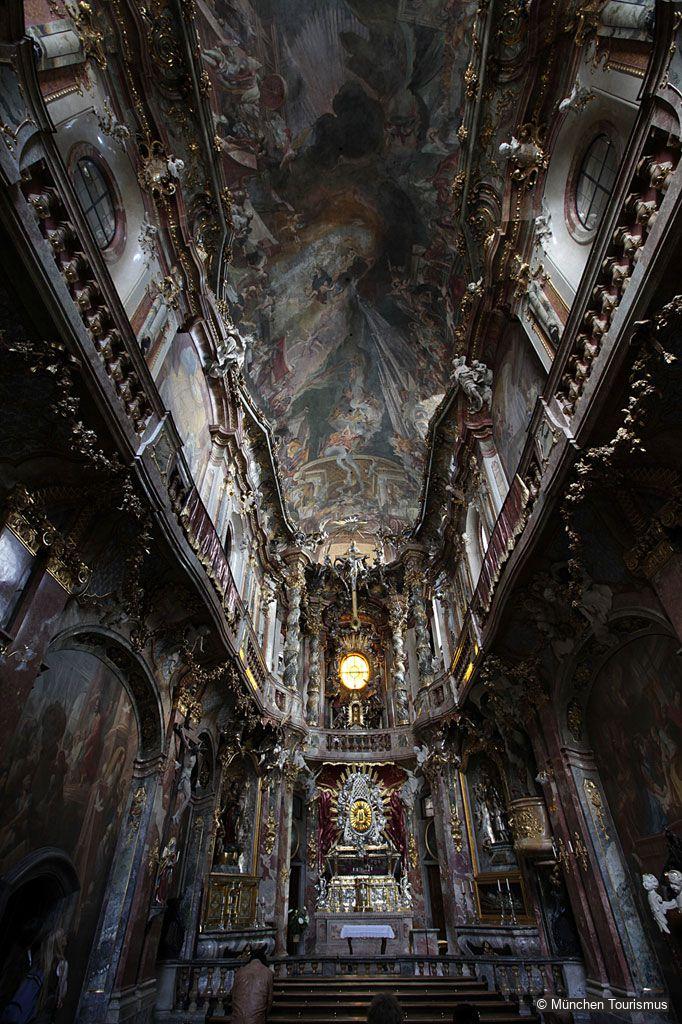
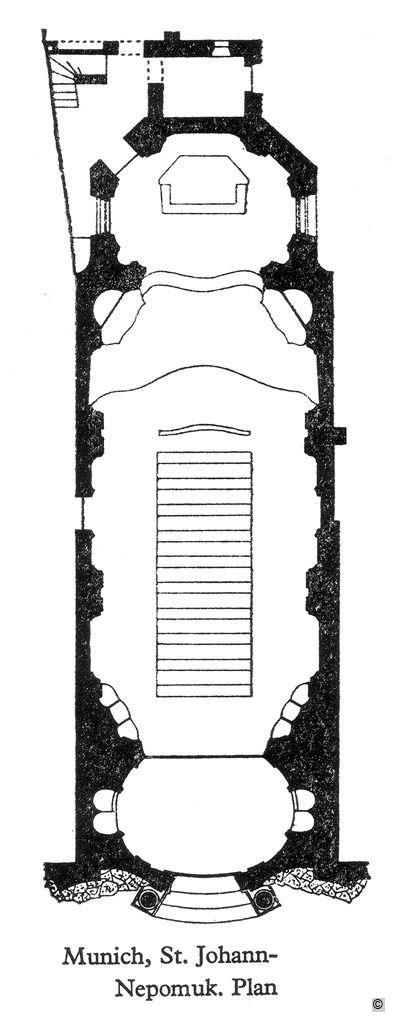
The relatively narrow interior of the church, divided into the vestibule, the nave and the sanctuary, is enclosed by the walls of the houses on each side. For that reason, it only receives light through the façade, at the chancel beside the courtyard and at the base of the vaulted ceiling. The Asam brothers understood how to skilfully use the light to stage their sculptural and pictorial compositions. The nave is arranged like that of a two-storey court church with an overhanging, elegantly curved balcony and balustrade encircling it. It serves as a viewing platform for the “sacred theatre” playing out in the chancel and on the vaulted ceiling.
View Short DescriptionNamed after its builders, the Asam Brothers, this little church in the heart of Munich’s historic district is rightly considered a marvel of Bavarian Baroque architecture. Its splendid grandeur, comparable to that of a court church, provides the right atmosphere for theatrically displaying its Roman-inspired sculptural and pictorial compositions through the effect of light. Furthermore, the equally Roman-inspired exterior of the church which features a sculptural arrangement, pales in comparison to the marvellous stucco façade of Egid Quirin Asam’s own house.
How Monument was dated:
By archival sources; Inscription on the ceiling fresco.
Special features
The Glory of St. John of Nepomuk
Church façade
Circa 1734
Architecture: Cosmas Damian (1686–1739) and Egid Quirin Asam (1692–1750) Stucco and Sculpture: Egid Quirin Asam
This aedicula façade, inspired by Roman Baroque architecture, appears like a triumphant, altar-like monument in honour of Saint John of Nepomuk. His admission into Heaven, symbolized by the canopy over the entrance adorned with gilded stars, is depicted in the medium of a three-dimensional stone sculpture supported compositionally and iconographically by the building’s architectural motifs.
The Four Last Things
The partition wall between the vestibule and the nave, both sides above the confessionals.
Between 1738 and 1750
Egid Quirin Asam (1692–1750)
Due to John of Nepomuk’s role as the patron saint of the sacrament of confession, the significance of penance is emphasized most notably by a grouping of four confessionals in the vestibule. Their dramatic array of sculptural depictions, being rich in gesture, pertain to the “Four Last Things”: death, judgement, Heaven and Hell. These are represented by the saints Bruno, Hieronymus and Peter, as well as by a beatified believer.
The Mercy Seat
Above the sanctuary
Circa 1738
Egid Quirin Asam (1692–1750)
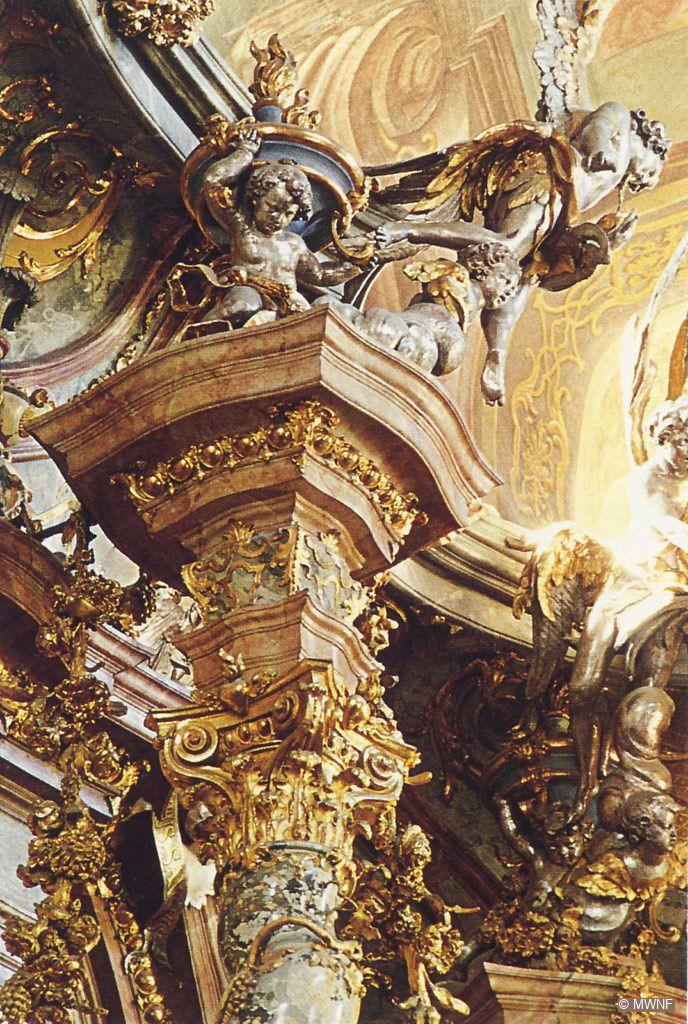
Four winding columns, deliberately imitating the ciborium of St. Peter’s Basilica in Rome, form a pictorial space in front of the upper high altar. There, instead of the modern glory window, a relief of the church’s patron once hung. It is into this space that the Holy Trinity seems to descend in the company of angels. This array of sculptures follows the iconography of the Mercy Seat: God the Father is shown presenting His crucified Son. Moreover, the papal crown that He is wearing, together with the winding columns, symbolizes the Catholic Church’s claim to religious leadership.
The Life and Veneration of St. John of Nepomuk
Vaulted ceiling
Circa 1735
Cosmas Damian Asam (1686–1739)
The ceiling fresco spans the entire length of the church and is located behind an indirectly lit ledge which appears to be an opening in the ceiling vault. This creates the illusion that one is peering into the eternal heavenly realms. Around the periphery of the vault is a fresco depicting scenes from the life of St. John of Nepomuk and his subsequent veneration.
Façade of the Asamhaus
To the left of the church
Circa 1735
Egid Quirin Asam (1692–1750)
Egid Quirin Asam’s house-turned-atelier is distinguished by its rich, figurative stucco façade. In a sense, it constitutes the secular counterpart to the sacred theme of the church façade. Its content centres on the journey of an artist’s soul in the home of the Muses on Mount Parnassus, with Athena Pallas as its guide.
Selected bibliography:
Bauer, R. and Dischinger, G., München, “Asamkirche” St. Johann Nepomuk (Kleine Kunstführer 1277), 7. völlig neubearb. Aufl., Regensburg: 1999.
Sauermost, H.J., Die Asams als Architekten, München/Zürich: Schnell & Steiner, 1986: 65–77.
Lieb, N., St. Johann Nepomuk. Die Asamkirche in München (Große Kunstführer 100), München/Zürich: Schnell & Steiner, 1983.
Rupprecht, B., Die Brüder Asam: Sinn und Sinnlichkeit im bayerischen Barock, Regensburg: Friedrich Pustet, 1980: 23–24, 200–210.
Hitchcock, Henry-Russell, Rococo Architecture in Southern Germany, London/New York: Phaidon, 1968: 81–86.
Citation of this web page:
Katharina Wein, Peter Heinrich Jahn "Subsidiary Church of St. John Nepomuk and House of the Sculptor Egid Quirin Asam" in "Discover Baroque Art", Museum With No Frontiers, 2026.
https://baroqueart.museumwnf.org/database_item.php?id=monument;BAR;de;Mon12;5;en
Prepared by: Katharina Wein, Peter Heinrich Jahn
Translation by: Thomas Milnes
Translation copyedited by: Janice MedinaJanice Medina
Janice Medina is an artist and educator based in Upstate New York. She studied interior design at Syracuse University and obtained her M.S. in Building Conservation in 2008 (Rensselaer Polytechnic Institute) and Master of Fine Arts in 2019 (University at Albany).
Janice is a former participant in the US/ICOMOS International Exchange Program and she has taught courses in the history of design and historic preservation. Her artwork is influenced by her experiences in historic preservation, as well as by building materials and the natural environment.
Janice has participated as a copy-editor with Museum With No Frontiers since 2019. In this role she has had the opportunity to work on a variety of projects including Discover Islamic Art, Discover Baroque Art and Discover Glass Art.
MWNF Working Number: DE3 05