

 Back
Back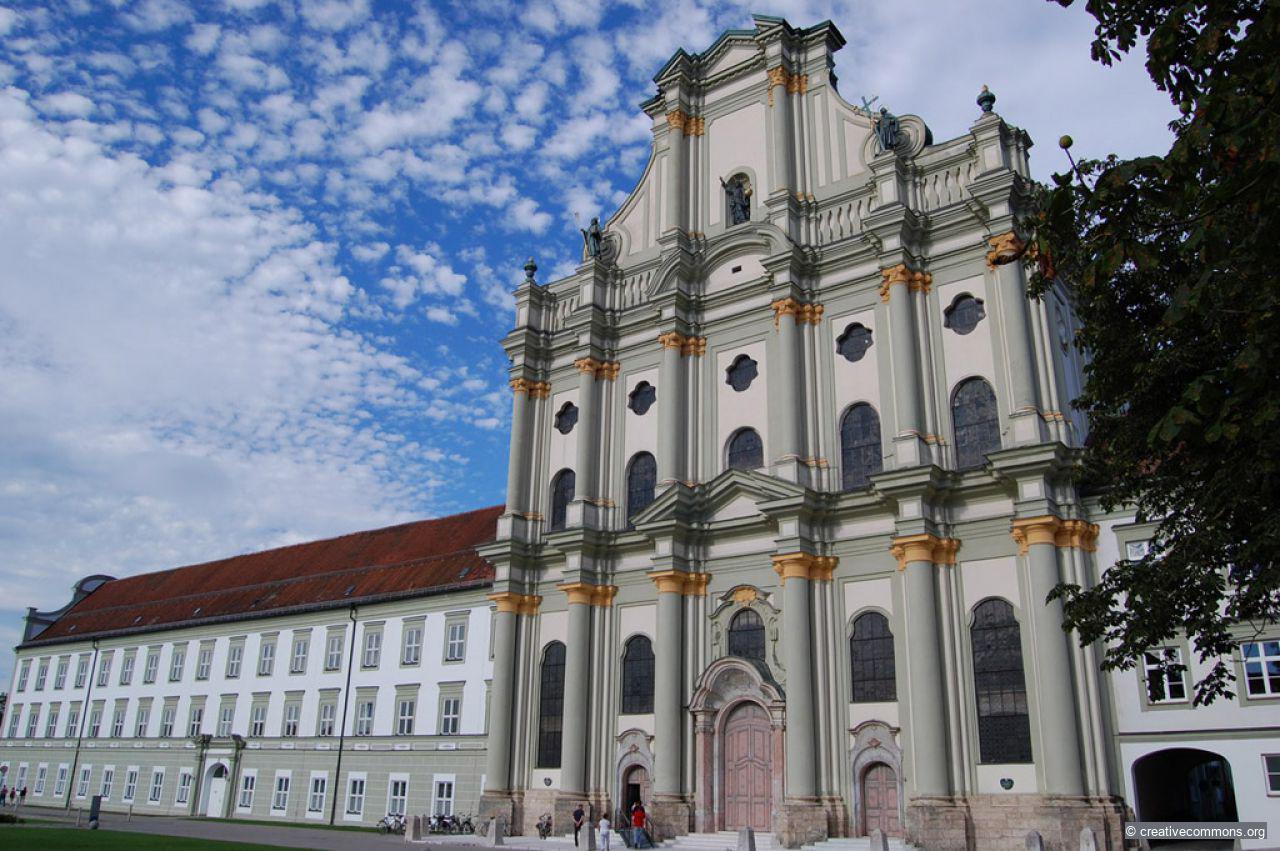
 Add to My Collection
Name of Monument:
Cistercian Abbey of the Assumption of the Virgin Mary
Also known as:
Monastery of Fürstenfeld
Location:
Fürstenfeldbruck, Upper Bavaria, Germany
Klosterstraße
82256 Fürstenfeldbruck
T : +49 (0)81 41 50 16 0; +49 (0)81 41 40 80
F : +49 (0)81 41 50 16 50; +49 (0)81 41 40 82 50
E : st-magdalena.fuerstenfeldbruck@erzbistum-muenchen.de
Church: Catholic Parish Council of St. Magdalene (Archbishopric Munich-Freising); Monastery: Bavarian School of Public Administration and Justice – Department of Police (Responsible Institution)
Date:
1691–1700: monastery and residence building; 1714–1741: church; 1752: church tower; 1760–1762: high altar
Artists:
Architecture: Giovanni Antonio Viscardi (1645–1713); Johann Georg Ettenhofer (1648–1741)Monastery and residence, stucco: Giovanni Nicolò Perti; frescos: Hans Georg Asam (1649–1711)Abbey church, stucco in the choir: Francesco Appiani (1704–92); stucco in the nave: Jacopo Appiani; ceiling frescos: Cosmas Damian Asam (1686–1739); design of the high altar and middle side-altar pair, execution of the latter: Egid Quirin Asam (1692–1750); front and back side-altar pairs, sculptures of all altars, confessionals and apostolic circle: Thomas Schaidhauf (1735–1810); Altar of the Holy Cross, side-altar pair at rear: Thassilo Zöpf (1723–1807); statues of the founders: Roman Anton Boos (1733–1810)
Denomination / Type of monument:
Ecclesiastical architecture (monastery, residence and church)
Patron(s):
Maximilian II Emanuel, elector of Bavaria (1680–1726); Abbots Balduin Helm (1690–1705), Liebhard Kellerer (1714–1736), Konstantin Haut (1734–1744), Alexander Pellhammer (1745–1761), Martin Hazi (1761–1779)
History:
The former Cistercian Abbey Fürstenfeld was founded in 1263 as an atonement monastery by Duke Ludwig (Louis) II in remembrance of his first wife Marie of Brabant whom he had executed on suspicion of adultery. Marie’s son Emperor Ludwig (Louis) the Bavarian further cultivated the abbey. In 1691 Abbot Balduin Helm laid the foundations for the monastery, the design for which was greatly influenced by the Bavarian Elector Maximilian II Emanuel’s wish to extend the monastery connected with his family as a residence. For this project the court architect Antonio Viscardi was contracted, who also began to erect the abbey church as well in 1700. In 1701, however, construction of the church ceased for financial reasons. Due to the occupation of Bavaria by Austria, which followed as a result of the War of the Spanish Succession, and Viscardi’s death, the foreman Johann Georg Ettenhofer was not able to complete the church until 1714 and it was not sanctified until 1741. The monastery itself financed all construction costs itself and did not receive any financial assistance from the reigning Wittelsbach family.
Description:
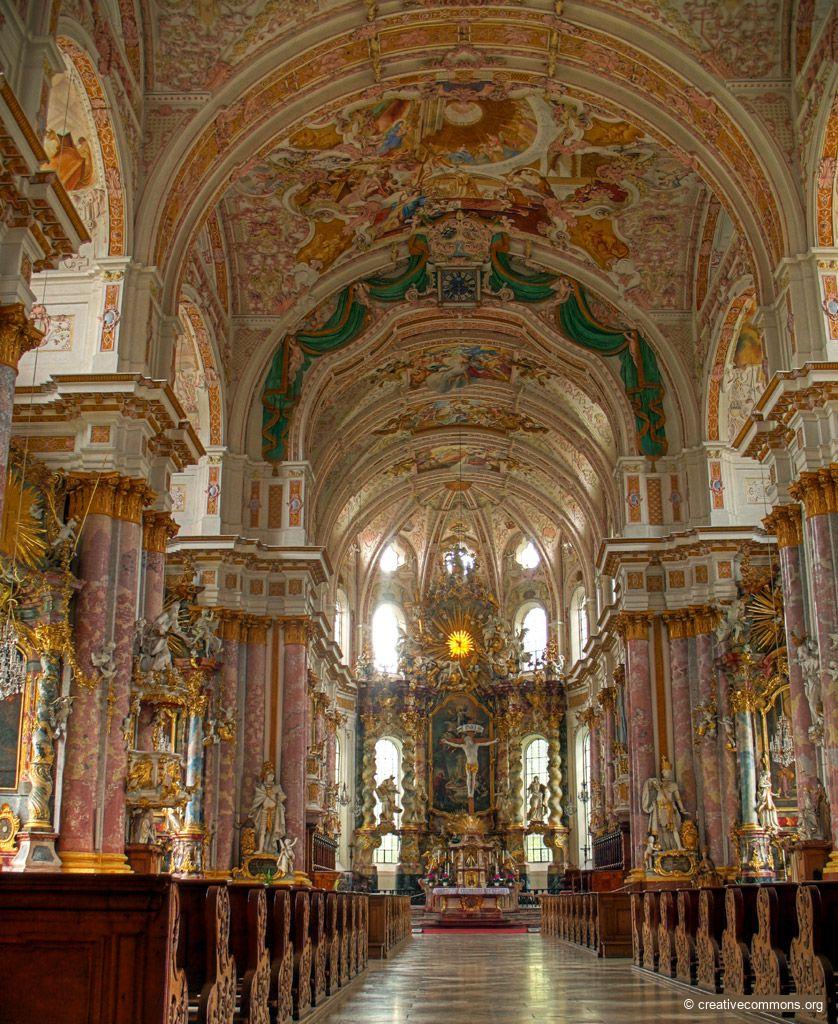
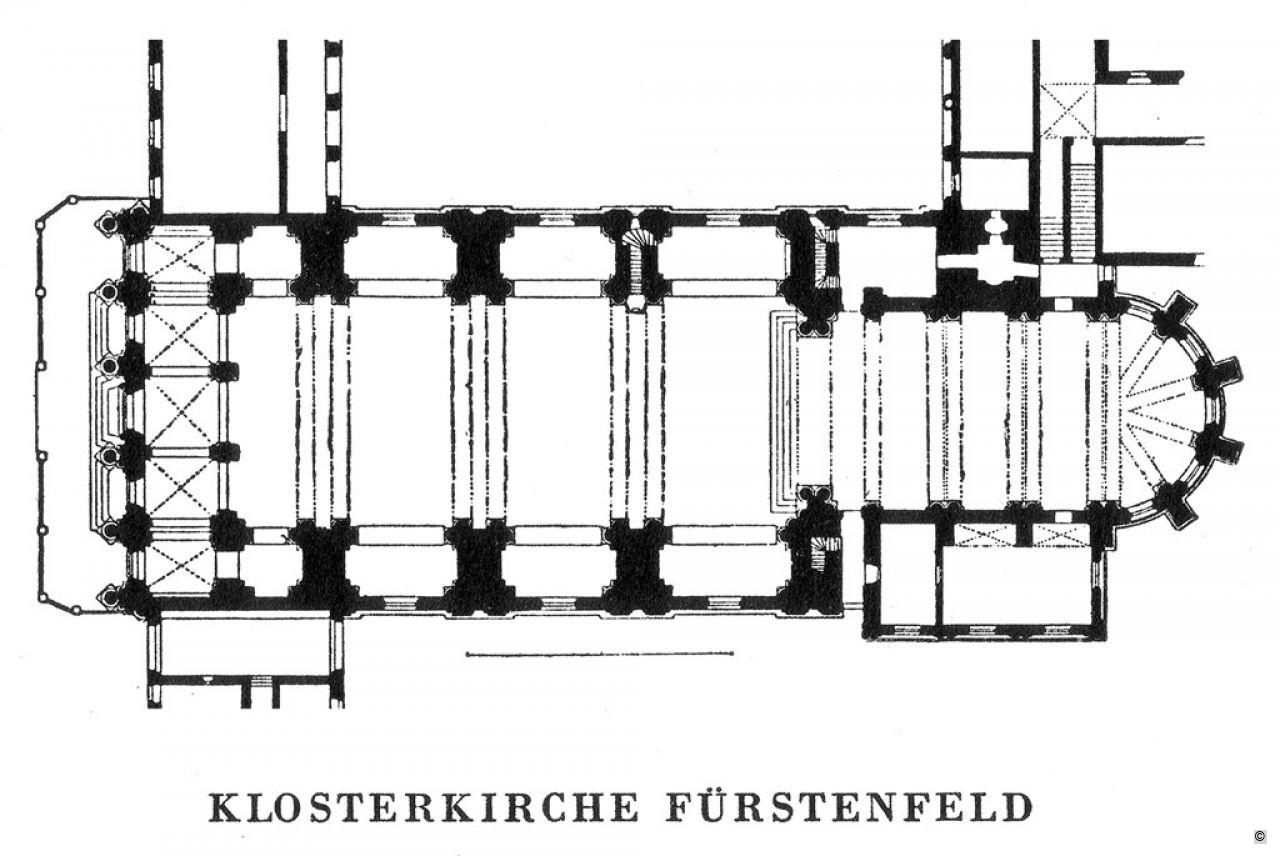
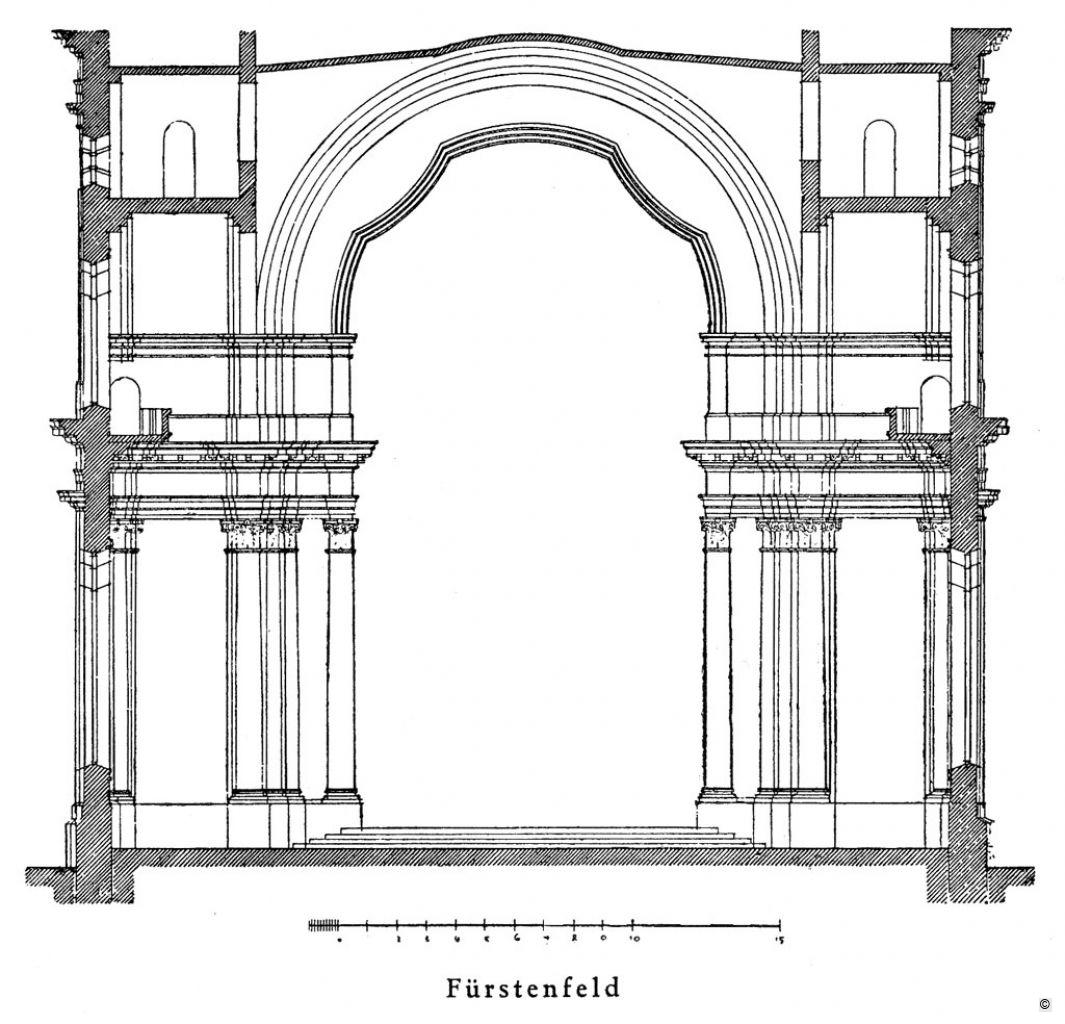
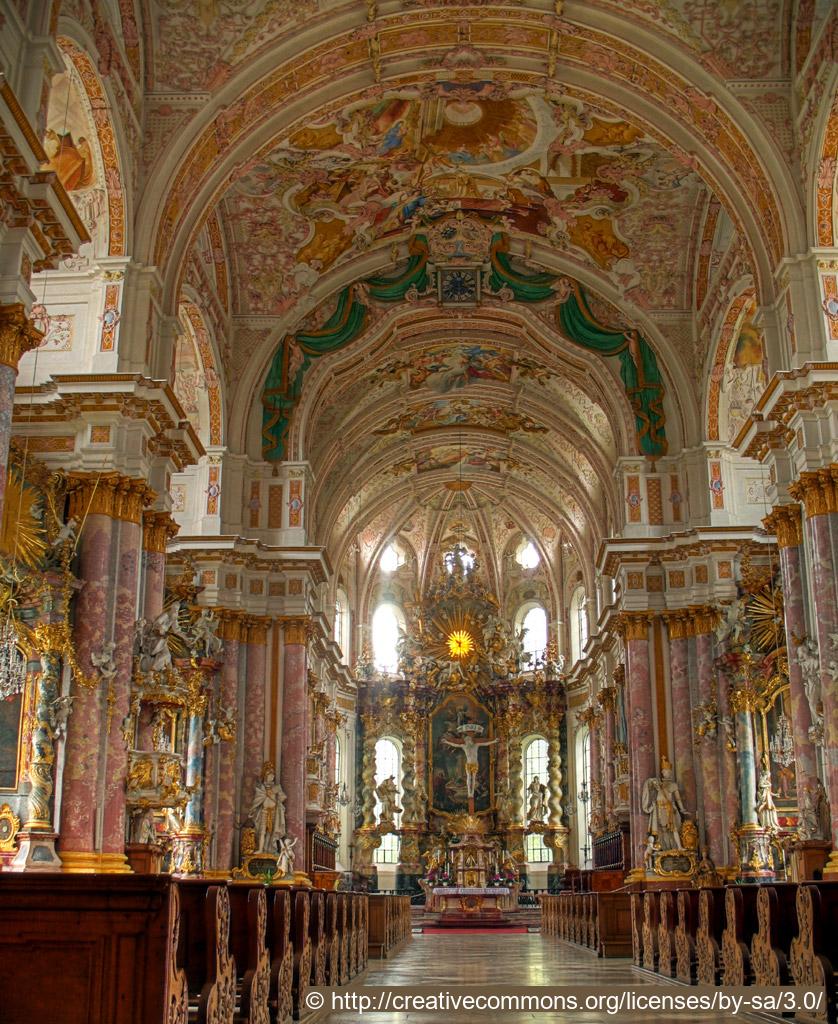
The marvelous obverse of the monastery impressively reveals its double function as a twin-façade: the eastern part of the building to the left serves as a monastery building and the western part, to the right, as a residence. The enormous pomp of the front pillars of the church proclaims visually the duality between spiritual and worldly power. Statues play the roles of Christ as Savior of the World and Saint Benedict and Bernhard of Clairvaux as the patrons of the Cistercian Order. The richly ornamented pillars of the church interior mirror those of the Theatine Church in Munich, while the monumental proportions of the barrel-vaulted wall-pillared hall mimic the Jesuit Church in the same city, expressing that the elector Maximilian II Emanuel is following the tradition of Counter-Reformist foundations of his forefathers. The church nave, flanked by high chapels, opens onto a long choir where numerous choir-stalls are a reminder that the convent once was rich in members. A great number of confessionals stress the idea of the atonement of the monastery’s founder.
View Short DescriptionThe Cistercian Abbey Fürstenfeld is also known as the “Bavarian Escorial” due to its function as a Baroque monastery residence. It contains possibly the most magnificent monastery church of Upper Bavaria, whose grandiose interior is laden with columns and contains, among other fine works, frescos and altars from the famous family of artists, Asam. The interior is abundantly furnished with white carved and stucco figures and a multitude of confessionals, all of which remind one that, at one time, this was the Wittelsbachian Monastery of Atonement.
How Monument was dated:
Documentary and chronological evidence; date 1731 found on the choir-arch clock and there is a corresponding chronogram within the frescos of the nave.
Special features
Main fresco
Nave of church
1731
Cosmas Damian Asam (1686–1739)
The nave frescos of the monastery church are typologically woven into one another, depicting the life of the founder of the Cistercian Order, Bernhard of Clairvaux, and likewise, the Life of Christ. Using the solemnity of the church year from west to east the position of the Cistercians within God’s divine plan for salvation is accented: the Birth of Christ and Saint Bernhard’s vision of it; the Resurrection with its sermon for the Duke of Aquitaine; the Ascent to Heaven with the entrance of the saint into the Citeaux Monastery as well as the despatch of the Holy Ghost with Bernhard’s visions of Christ Crucified and the Virgin Mary.
High altar
Choir
c. 1737: planning; 1760–1762: execution
Egid Quirin Asam (1692–1750); Thomas Schaidhauf (1735–1810); Johann Nepomuk Schöpf (c. 1735–after 1785)
The high apse windows allow light to shine upon the imposing high altar; marble columns wind their way up into the heights, clearly alluding to the choir of the Theatine Church in Munich. Between the columns are the statues of Zacharias and Joachim as well as Anna and Elizabeth, relatives of the Virgin Mary whose Ascension to Heaven is depicted on the altarpiece. The scene develops into a sculptural medium depicting Christ recieving his mother with open arms beneath a glory of rays.
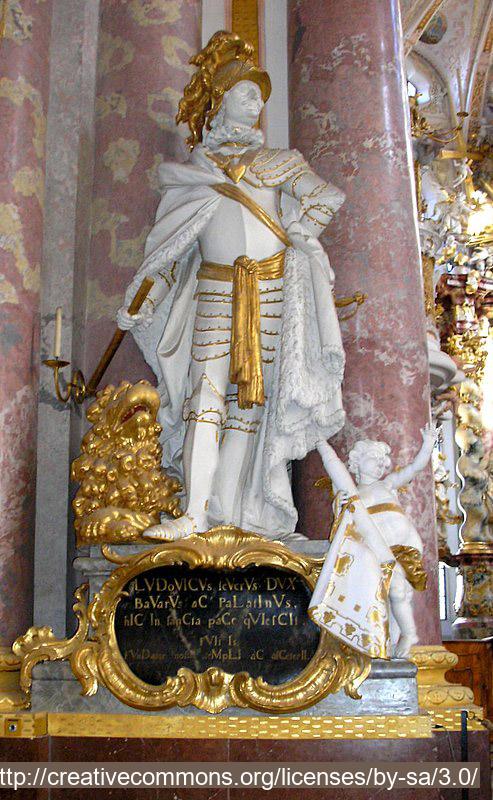
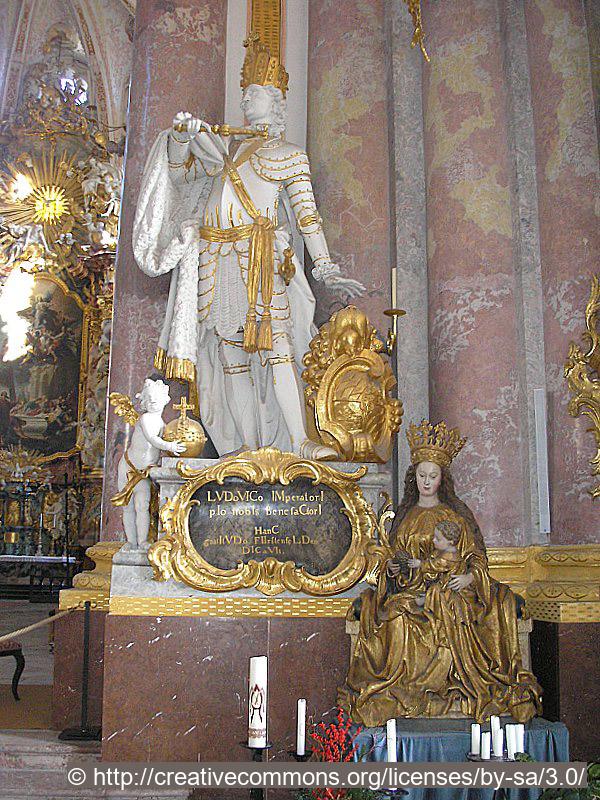
Statues of the Founders
Beneath the choir arch
1765/66
Roman Anton Boos (1733–1810)
The two monumental statues of the founders, the Bavarian Duke Ludwig (Louis) II and his son who shared his name and was promoted to Emperor of the Holy Roman Empire, testify to the relevance of the medieval founding of the monastery up until the end of the Baroque period.
Selected bibliography:
Pfister, P., Fürstenfeld. Ehemalige Zisterzienserabteikirche (Kleine Kunstführer 6, 15th revised edition), Regensburg 2007.
Schiedermair, W. (ed.), Kloster Fürstenfeld, Lindenberg im Allgäu, 2006.
Pfister, P. (ed.), Das Zisterzienserkloster Fürstenfeld, (Große Kunstführer 39, 2nd revised edition), Regensburg 1998.
Bauer, H./Rupprecht, B. (eds.), Corpus der barocken Deckenmalerei in Deutschland, Bd. 4: Freistaat Bayern, Regierungsbezirk Oberbayern. Landkreis Fürstenfeldbruck, Munich 1995, pp. 58–133.
Lampl, S. (ed.), Die Klosterkirche Fürstenfeld – ein Juwel des bayerischen Barock, Munich 1985.
Citation of this web page:
Maximilian Aracena, Peter Heinrich Jahn "Cistercian Abbey of the Assumption of the Virgin Mary" in "Discover Baroque Art", Museum With No Frontiers, 2026.
https://baroqueart.museumwnf.org/database_item.php?id=monument;BAR;de;Mon12;6;en
MWNF Working Number: DE3 06