

 Back




 Add to My Collection
Name of Monument:
Parish Church of the Assumption of the Blessed Virgin Mary, former Convent Church of the Augustinian Canons
Also known as:
The Dießen Monastery
Location:
Dießen am Ammersee, Upper Bavaria, Germany
Date:
1720–28 Inner structure;
1732–39 Completion and decoration of the building
Artists:
Architecture: Johann Michael Fischer (1691–1766); Stucco: Johann Michael (1709–72), Franz Xaver Feichtmayr, the Elder (1698–1763/64) and Johann Georg Üblher (1703–63); Frescos: Johann Georg Bergmüller (1688–1762); Design of the high altar: Egid Quirin Asam (1692–1750) and François de Cuvilliés the Elder (1695–1786); Sculpture work on the high altar: Joachim Dietrich (1690–1735); Side altars: Ehrgott Bernhard Bendl (around 1660–1735), Ägid Verhelst (1696–1749) and Johann Baptist Straub (1704–84); Altarpieces (selection): Balthasar Augustin Albrecht (1687–1765), Giovanni Battista Pittoni (1687–1767), Giovanni Battista Tiepolo (1696–1770) and Johann Evangelist Holzer (1709–40)
Denomination / Type of monument:
Ecclesiastical building (monastery church)
Patron(s):
Provosts Ivo Bader (in office 1719–28) and Herculan Karg (in office 1728–55)
History:
Originally founded by Rathard the Hermit in 815, the Baroque renovation of this legendary monastery began 1681¬–88 with the establishment of a convent building which is largely vanished today. It was not until 1720 that new construction on the monastery church could be carried out. However, the cultured and highly educated Herculan Karg, having been elected provost in 1728, was displeased with the conservative design of the building’s first architect coming from the so-called Vorarlberg School of Masterbuilders. It is for this reason that he compelled the Munich-born architect Johann Michael Fischer to complete the framework which had already been erected up to the cornice. In 1732, the galleries were removed and the chancel and ceiling were redesigned, as were the façade and steeple. The monastery church, having been fully furnished, was consecrated in 1739.
Description:
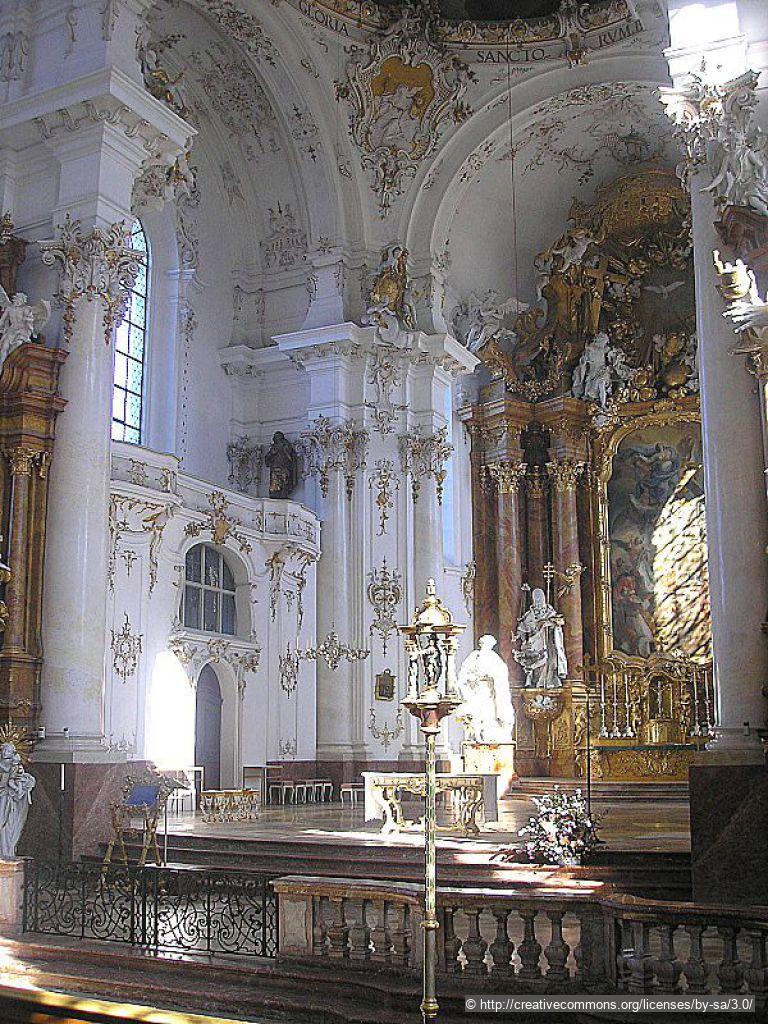
Simple architectural excellence bestows this traditional wall-pillar church its larger-than-life character. Due to its slender proportions and soft curves, the external façade is arguably the most elegant in Bavaria.
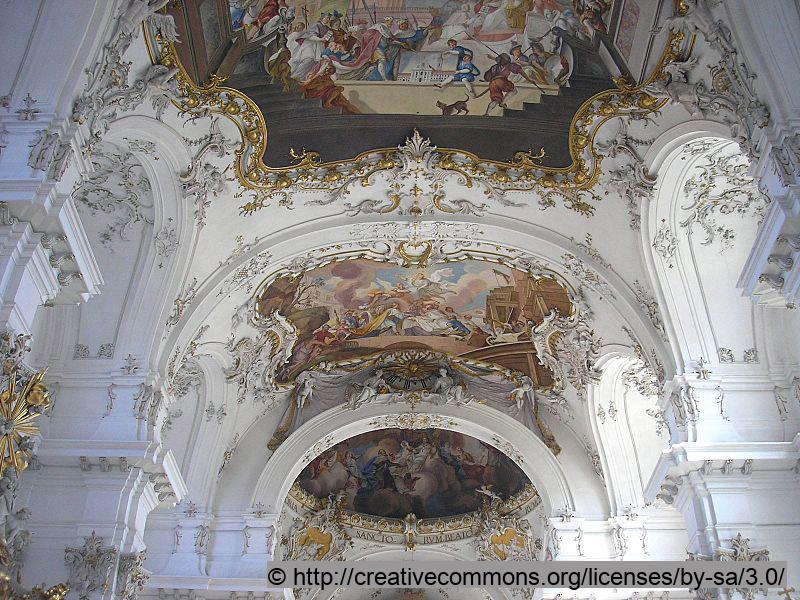
On the inside, a vaulted ceiling reclines lightly on convex curved transverse arches while a symbolically meaningful enclosure of four columnar arches culminates in a pendentive dome over the chancel. Superb Régence stucco work accentuates the walls and ceiling, the latter featuring extensive frescos.
Having been created by multiple artists, the altar layout achieves conceptual unity by cleverly balancing its side altars. As one moves toward the high altar, the side altars increase in size and architectural complexity.
How Monument was dated:
Through archival documents and chronical narratives; inscription on the ceiling fresco.
Special features
The Re-establishment of the Dießen monastery by the Counts of Andechs
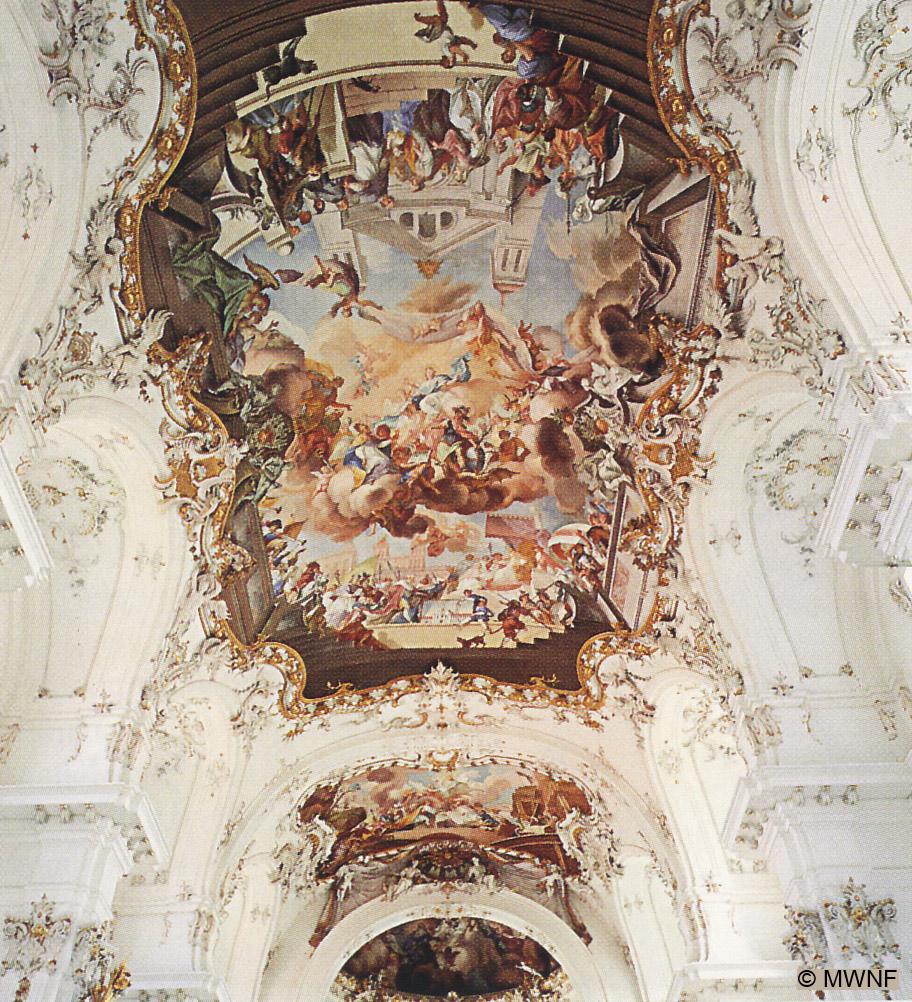
Vault over the Nave
1736
Johann Georg Bergmüller (1688–1762)
Contrary to custom, it is not St. Augustine, the founder of the order of the Augustinian Canons, who dominates the series of frescos, but rather the history of the Dießen monastery itself. This was done to remind the House of Wittelbach as contemporary rulers of Bavaria of its responsibility to care for the monastery as the legal successors of the founding family which had died out in the Middle Ages.
The main fresco recalls the re-establishment of the former double monastery by Count Berthold II of Andechs in this way: Under celestial auspices, papal confirmation is given to the men’s convent of St. Mary in 1132 against the backdrop of the Lateran Palace in Rome. On the other side, the admission of Mechtildis, the Count’s juvenile daughter, into the short-lived women’s convent of St. Stephen in 1139 is depicted against an imagined backdrop of the medieval local monastery church, typologically referring to Mary’s entrance into the Temple.
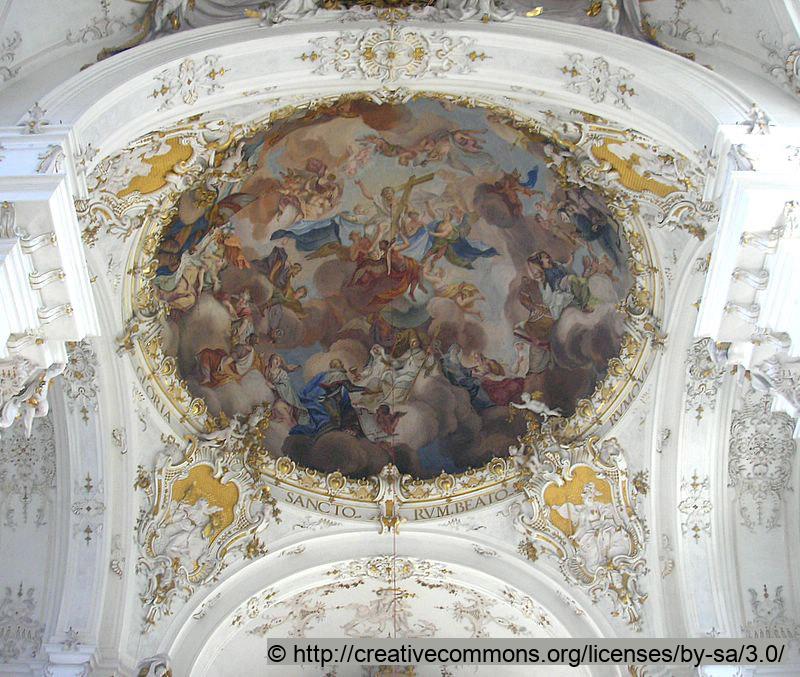
The Saints in Heaven (so-called Heaven of Dießen)
Chancel Dome
1736
Johann Georg Bergmüller (1688–1762)
In this dome fresco, innumerable saints and beatified persons from the various branches of the founding noble family, the Counts of Dießen-Andechs, form a group amassed around Christ. As being such, they exemplify the cardinal virtues which are depicted in the pendentives.
Having been carefully calculated both narrationally and perspectively, the oldest locally revered members of the Dießen-Andechs family (Rasso, Rathard and Mechtildis) are the first to catch the eye of those entering the church.
The Altar of the Assumption of the Virgin Mary (high altar)
Chancel Apse
1738
Preliminary design of the altar architecture and sculpture-work: Egid Quirin Asam;Final draft of the altar architecture: François de Cuvilliés;Sculpture: Johann Joachim Dietrich;Altarpiece: Balthasar Augustin Albrecht
The grandiose high altar, measuring 14 x 20 metres, depicts the Assumption of the Virgin Mary into Heaven through the media of painting and sculpture. The altarpiece can be retracted, revealing interchangeable backdrops which are used to assist with the theatrical displaying of salvation history on different feast days. Four larger-than-life statues of the Church Fathers flank the high altar on both sides – truly they are crowning achievements of Bavarian Baroque sculpture on account of their solemn expressionalism.

Side altars depicting St. Stephen and St. Sebastian
The third pair of altars from the chancel. St. Stephen is on the left and St. Sebastian on the right.
Altars (1736–38); Altarpieces (1738/39)
Architecture and sculpture on the altars: Johann Baptist Straub (1704–84); Altarpieces: Giovanni Battista Pittoni (1687–1767) and Giovanni Battista Tiepolo (1696–1770)
As imports of Venetian painting, the pictures on the two middle altars embody the cosmopolitan taste of the Provost, Herculan Karg. Giovanni Pittoni painted the Protomartyr Stephen. Likewise, Giovanni Tiepolo, Pittoni’s even more renowned colleague, painted St. Sebastian who is the patron saint of plague victims.
By intentionally eschewing the typical retable architecture, the sumptuous altarpieces appear to the viewer as being pictures in a gallery, unveiled by puttos through means of sculpted drapery which seems to be pulled aside. The flanking sculptures belong to a cycle depicting the 12 Apostles who are distributed among the side altars.
Selected bibliography:
Bauer, H. and Rupprecht, B. (eds), Corpus der barocken Deckenmalerei in Deutschland, Bd. 1: Freistaat Bayern, Regierungsbezirk Oberbayern. Die Landkreise Landsberg am Lech – Starnberg – Weilheim-Schongau, München: Süddeutscher Verlag, 1976: 38–47.
Dietrich, D., Aegid Verhelst 1696-1749. Ein flämischer Bildhauer in Süddeutschland, Weißenhorn: A.H. Konrad, 1986: 48–68, 222–232.
Dietrich, D., Ehem. Augustiner-Chorherren-Stift Diessen am Ammersee, Grosser Kunstführer 128, 2. Verbesserte und erweiterte Auflage, München/Zürich: Schnell & Steiner, 1982.
Hitchcock, Henry-Russell, Rococo Architecture in Southern Germany, London/New York: Phaidon, 1968: 180–183, 188–192.
Schnell, W., Ehemalige Augustiner-Chorherrenstiftskirche Mariä Himmelfahrt zu Dießen, seit 1804 Pfarrkirche, Peda-Kunstführer 531, Passau: 2001.
Citation of this web page:
Peter Heinrich Jahn, Hanna Böhm "Parish Church of the Assumption of the Blessed Virgin Mary, former Convent Church of the Augustinian Canons" in "Discover Baroque Art", Museum With No Frontiers, 2026.
https://baroqueart.museumwnf.org/database_item.php?id=monument;BAR;de;Mon12;9;en
Prepared by: Peter Heinrich Jahn, Hanna Böhm
Translation by: Thomas Milnes
Translation copyedited by: Janice MedinaJanice Medina
Janice Medina is an artist and educator based in Upstate New York. She studied interior design at Syracuse University and obtained her M.S. in Building Conservation in 2008 (Rensselaer Polytechnic Institute) and Master of Fine Arts in 2019 (University at Albany).
Janice is a former participant in the US/ICOMOS International Exchange Program and she has taught courses in the history of design and historic preservation. Her artwork is influenced by her experiences in historic preservation, as well as by building materials and the natural environment.
Janice has participated as a copy-editor with Museum With No Frontiers since 2019. In this role she has had the opportunity to work on a variety of projects including Discover Islamic Art, Discover Baroque Art and Discover Glass Art.
MWNF Working Number: DE3 09