

 Back
Back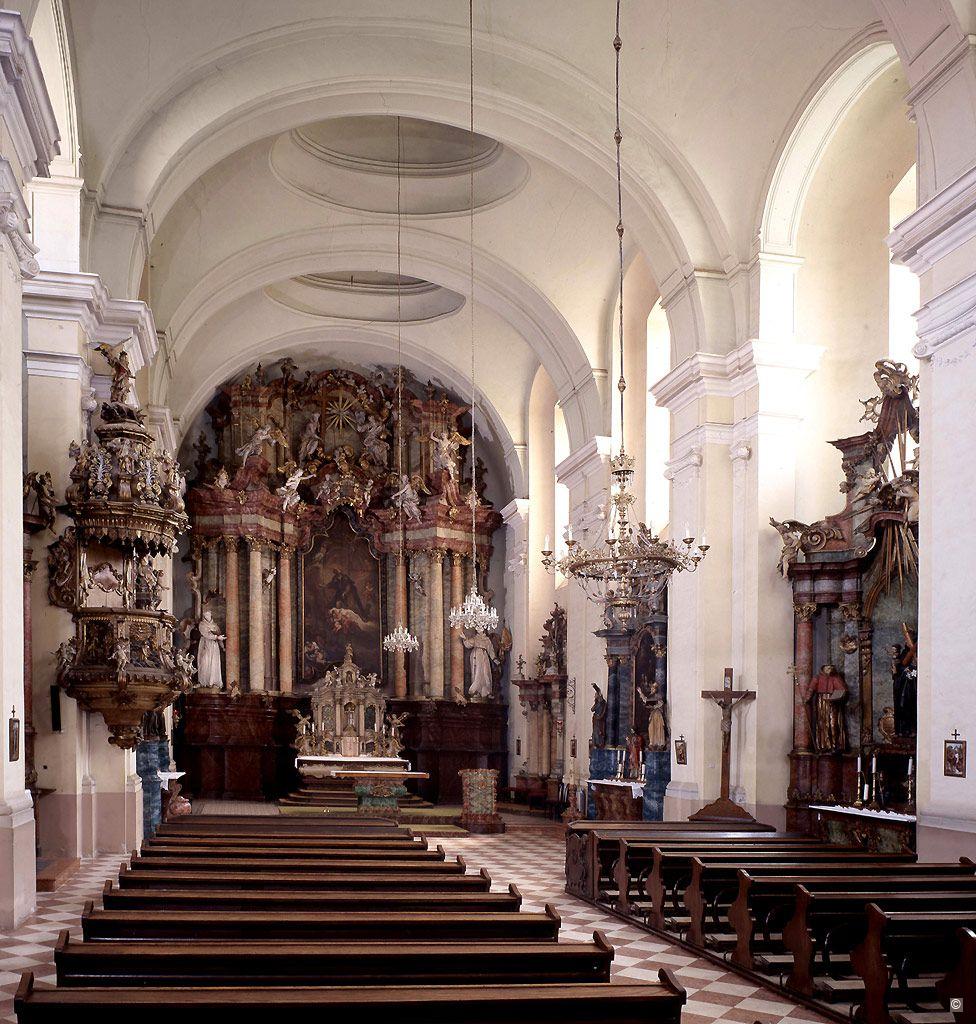
 Add to My Collection
Name of Monument:
Franciscan Church and Monastery of St. Roch, Virovitica
Location:
Virovitica, North-West Croatia, Croatia
Zvonimirov trg 8
33000 Virovitica
T : +385 33 726 731
Parish Office of St. Roch (Responsible Institution)
Date:
Late Baroque (1746–1752)
Artists:
Master builders: Giovanni Bérta (known work c. 1770), Giulio Zérone (known work c. 1770); sculptors: Josip Holzinger (1735–797), Stjepan Severin (c. 1700–1760); painters: Josef Anton Cusetti (1750–1793), Damian Bittner (1733–1768); cabinetmaker: Timotej Schwab (known works c. 1770)
Denomination / Type of monument:
Religious, Baroque four-winged monastery; Late Baroque nave church with ellipsoidal side chapels
Patron(s):
Franciscan Order
History:
Written sources tell of the existence of a Franciscan monastery and church in Virovitica as early as 1280, but after the Ottoman siege of 1552, nothing remained of the medieval complex. It was only after the Franciscans had returned to Virovitica in 1684, and the Turks expelled, that the first wooden monastery and church were constructed. Today’s four-winged masonry-built monastery was erected between 1726 and 1751 (by 1730 the Franciscan theological school was active). The foundation stone of the new church was in place by 1746, and by 1752, the monumental High Baroque building was completed. Following damage by an earthquake in 1757, the church was reconstructed by Italian craftsmen.
Description:
The spatial organisation of the four-winged, two-storey Franciscan complex is based on a classical monastic solution of cross-vaulted corridors in the cloister opened up with arcades, and a sequence of similarly vaulted rooms alongside the external facade. Against this model, the monumental Franciscan Church of St. Roch is characterised by carefully planned Late Baroque features. Although it too is in line with the Franciscan tradition, it is characterised by a nave hall-church with a somewhat narrow straight-ended chancel. The articulation of both walls and ceilings show the presence of a well-informed Central European architect. Alongside the walls, articulated columns rise with elegant Ionic pilasters forming shallow concave side-chapels. The columns and pilasters support the arched architraves and the ceiling strips, in the nave the calottes, and in the sanctuary, the ellipsoidal domes.
Appropriate Late Baroque transformation of Early Baroque wall columns (Wandpfeiler) and side chapels was carried out in the Church of St. Veit am Vogau by the famed Styrian architect, Josef Hueber, from Graz. In 1745, Hueber put forward a prototype solution for a religious space similar to St. Roch for the chapel of Batthyhány Palace in Ludbreg, therefore, it is plausible that he had a very direct impact on the Franciscan church in Virovitica. The argument is more solid when considering St. Roch's grand façade, flanked with a side bell-tower, as this corresponds with the aforementioned Hueber church in Vogau. With markedly similar stylistic and typological characteristics, St. Roch is notable within the body of Franciscan churches of inland Croatia and is echoed during the second half of the 18th century, mainly in the architecture of parish churches.
The Franciscan Church of St. Roch in Virovitica relates to Early Baroque, Central European hall churches with wall columns and side chapels but in its rounded chapels, it also demonstrates the introduction of Late Baroque spatial dynamics. In 1745, the architect Josef Hueber of Graz was engaged in renovations to Batthyhány Palace chapel in Ludbreg, where he appropriately centralised the longitudinal chapel in the Late Baroque manner. In light of this, therefore, it is fair to assume that he influenced the appearance of St. Rochus whose façade articulation is similar to some other Hueber churches in Styria.
Special features
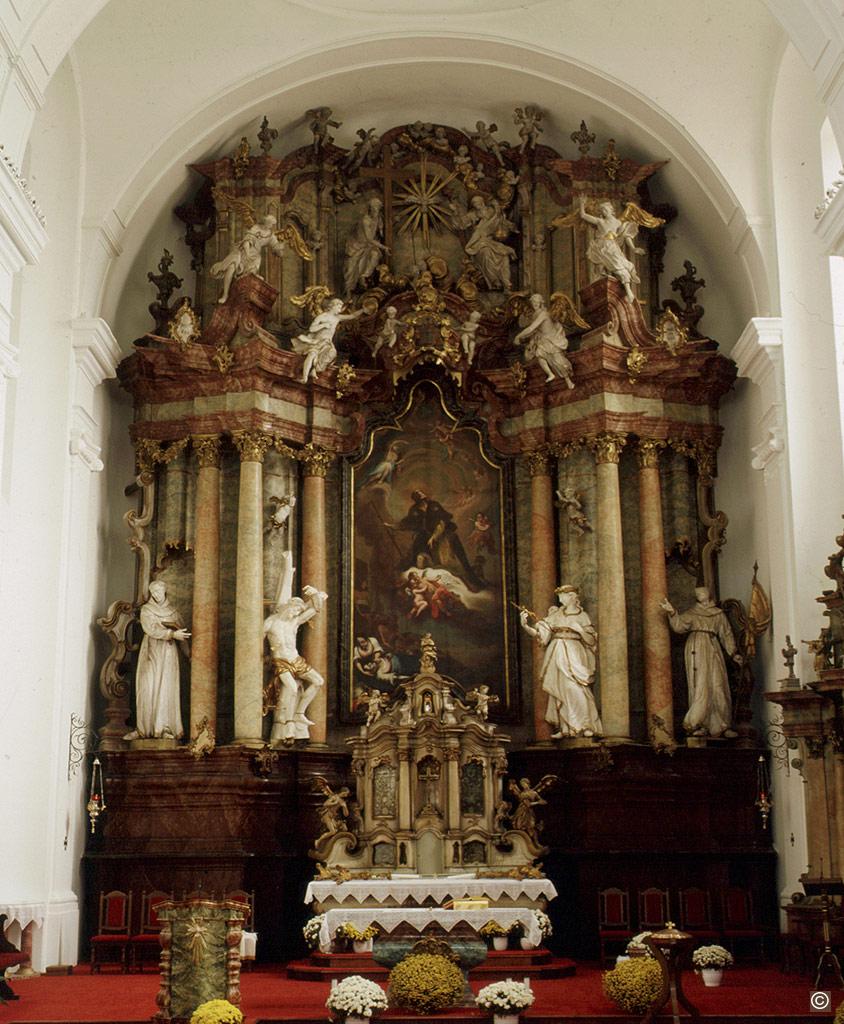
High Altar
Presbytery, Church of St Roch
1767–1769
Josip (Jožef) Holzinger (1735–1797)
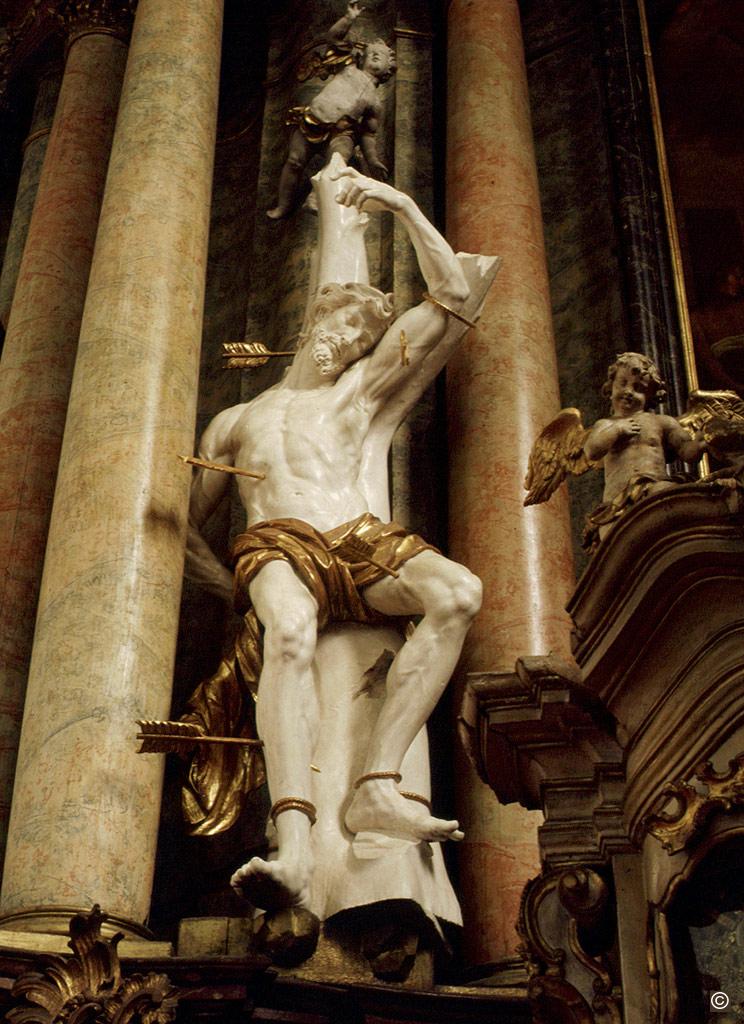
The sculptural figures of St. Rosalie, St. Sebastian and Franciscan saints accompanied by a playful group of angels within the opulent attic of the Church of St. Roch, are the work of Josip Holzinger from Maribor. The chronology of Holzinger's work in north Croatia represents all the stylistic stages of his almost 40 year-long career. They also reflect the dominant stylistic influences to which his individual, highly developed formal language was exposed – that of Josip (Jožef) Straub (1712–1756) and Veit Königer (1729–1792).
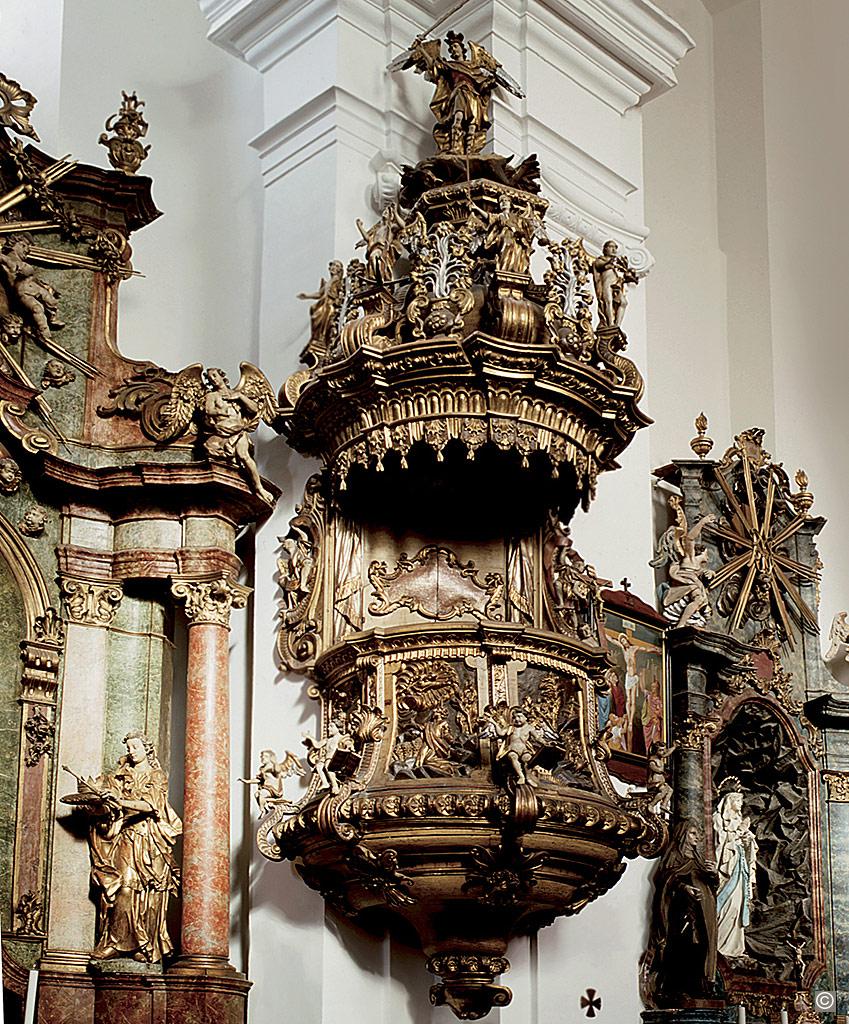
Pulpit
Left-hand side of the nave
1755
Stjepan Severin (c. 1700–1760)
Reliefs on the baldachin present stories from the Old Testament: the Sacrifice of Abraham, Moses and the Burning Bush, The legend of Tobias and Daniel in the Lion's Den, accompanied by statues of the Four Apostles. The decorative motifs are characteristic of Stjepan Severin's work.
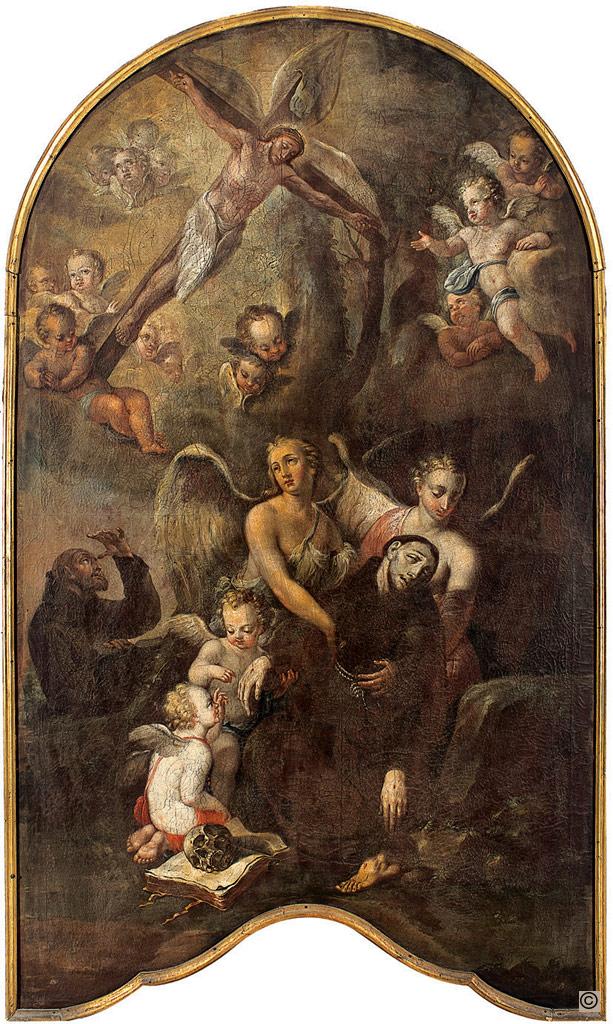
Stigmata of St. Francis
The painting, made originally for the Altar of St. Frances in the church, is in the monastery corridor in the present day.
c. 1770
Josef Anton Cusetti (1750–1793).
Central place in the lower part of the composition belongs to the unconscious saint and angels. Separated by light accents on the dark landscape the brother Leon, in the background, witnesses the stigmatisation. Among the clouds in the upper part of the composition a winged Seraphim carries the Crucified Jesus, followed by a group of angels.
Last Supper
c. 1766
Damian Bittner (1733–1768)
The Franciscan Monastery in Virovitica accommodated several lay-brother painters, one of them being the Styrian lay-brother painter, Damian Bittner, who painted the Last Supper for the refectory together with his associates.

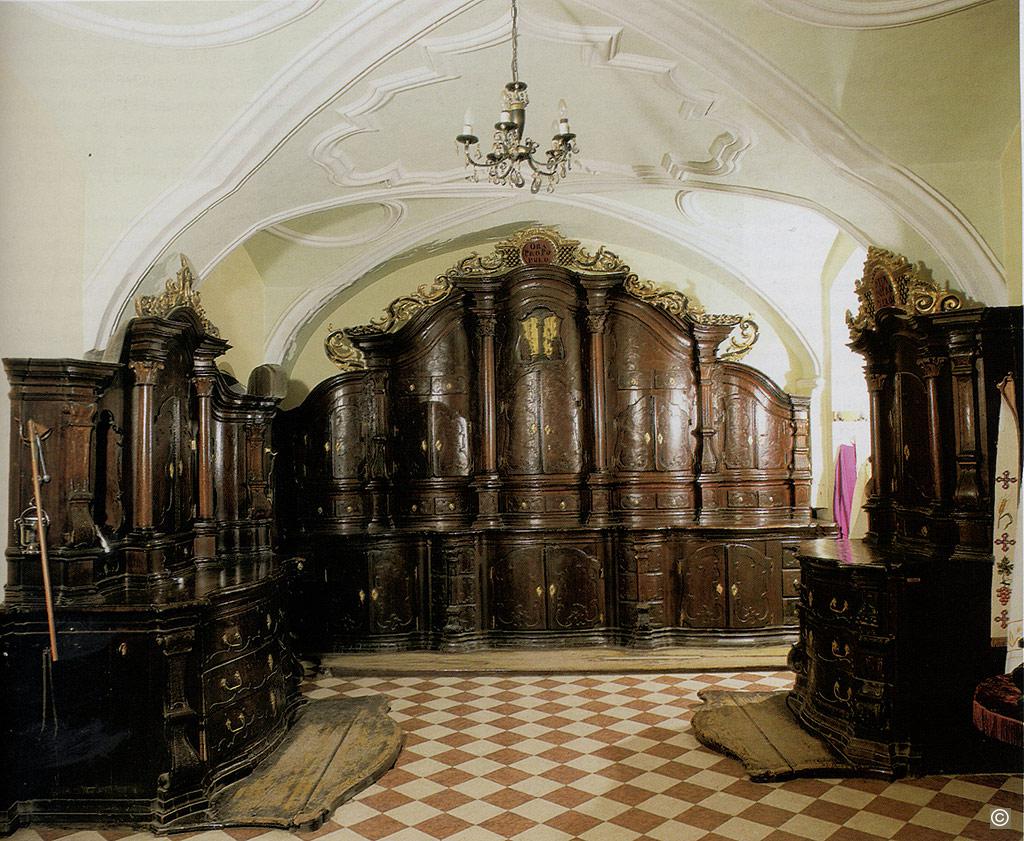
Sacristy cabinet
Sacristy
1771
Timotej Schwab (known works of around 1770)
There are three stylistically uniform cabinets in the sacristy of the Church of St. Roch, Virovitica, the main one is the largest and most richly decorated, seen here.
Citation of this web page:
Katarina Horvat-Levaj, Mirjana Repanić-Braun "Franciscan Church and Monastery of St. Roch, Virovitica" in "Discover Baroque Art", Museum With No Frontiers, 2026.
https://baroqueart.museumwnf.org/database_item.php?id=monument;BAR;hr;Mon11;18;en
Prepared by: Katarina Horvat-LevajKatarina Horvat-Levaj
SURNAME: Horvat-Levaj
NAME: Katerina
AFFILIATION: Institute of Art History, Zagreb
TITLE: PhD, Scientific Consultant
CV:
Katerina Horvat-Levaj graduated with a BA in Art History and Archaeology in 1981 from the University of Zagreb (Faculty of Philosophy, Department of Art History). In 1985 she obtained her MA and in 1988 she was awarded a scholarship at the University of Padua. In 1995 she defended her Doctorate at Zagreb University on Representative Residential Architecture of the Baroque in Dubrovnik. Since 1982, she has been employed at the Institute of Art History in Zagreb, and is presently a Senior Research Associate. Katarina also teaches at the University of Split. At the University of Zagreb she participates at doctoral level in the Faculty of Croatian Studies and the faculties of Architecture and Philosophy., Mirjana Repanić-BraunMirjana Repanić-Braun
SURNAME: Repanić-Braun
NAME: Mirjana
AFFILIATION: Institute of Art History, Zagreb
TITLE: PhD, Scientific Consultant
CV:
From 1981 to 1982 Mirjana Repanić-Braun was a curator of the Academy’s collection of sculpture in the Gliptoteque of the Croatian Academy of Arts and Sciences; from 1983 to 1998 she worked in the Croatian Academy’s Archives for Visual Arts. Mirjana has been employed as a researcher at the Institute of Art History in Zagreb since 1998: from 2001, as head of the scientific project Baroque Painting, Sculpture and Crafts of Continental Croatia, and since 2006, as head of the scientific project Baroque, Classicism and Historicism in the Arts of North Croatia. Mirjana teaches Art History at the universities of Rijeka and Split. At the University of Zagreb, she participates at doctoral level in the Faculty of Croatian Studies and the Faculty of Philosophy.
Translation by: Graham McMaster, Mirjana Repanić-BraunMirjana Repanić-Braun
SURNAME: Repanić-Braun
NAME: Mirjana
AFFILIATION: Institute of Art History, Zagreb
TITLE: PhD, Scientific Consultant
CV:
From 1981 to 1982 Mirjana Repanić-Braun was a curator of the Academy’s collection of sculpture in the Gliptoteque of the Croatian Academy of Arts and Sciences; from 1983 to 1998 she worked in the Croatian Academy’s Archives for Visual Arts. Mirjana has been employed as a researcher at the Institute of Art History in Zagreb since 1998: from 2001, as head of the scientific project Baroque Painting, Sculpture and Crafts of Continental Croatia, and since 2006, as head of the scientific project Baroque, Classicism and Historicism in the Arts of North Croatia. Mirjana teaches Art History at the universities of Rijeka and Split. At the University of Zagreb, she participates at doctoral level in the Faculty of Croatian Studies and the Faculty of Philosophy.
Translation copyedited by: Mandi GomezMandi Gomez
Amanda Gomez is a freelance copy-editor and proofreader working in London. She studied Art History and Literature at Essex University (1986–89) and received her MA (Area Studies Africa: Art, Literature, African Thought) from SOAS in 1990. She worked as an editorial assistant for the independent publisher Bellew Publishing (1991–94) and studied at Bookhouse and the London College of Printing on day release. She was publications officer at the Museum of London until 2000 and then took a role at Art Books International, where she worked on projects for independent publishers and arts institutions that included MWNF’s English-language editions of the books series Islamic Art in the Mediterranean. She was part of the editorial team for further MWNF iterations: Discover Islamic Art in the Mediterranean Virtual Museum and the illustrated volume Discover Islamic Art in the Mediterranean.
True to its ethos of connecting people through the arts, MWNF has provided Amanda with valuable opportunities for discovery and learning, increased her editorial experience, and connected her with publishers and institutions all over the world. More recently, the projects she has worked on include MWNF’s Sharing History Virtual Museum and Exhibition series, Vitra Design Museum’s Victor Papanek and Objects of Desire, and Haus der Kulturen der Welt’s online publication 2 or 3 Tigers and its volume Race, Nation, Class.
MWNF Working Number: HR 22