

 Back
Back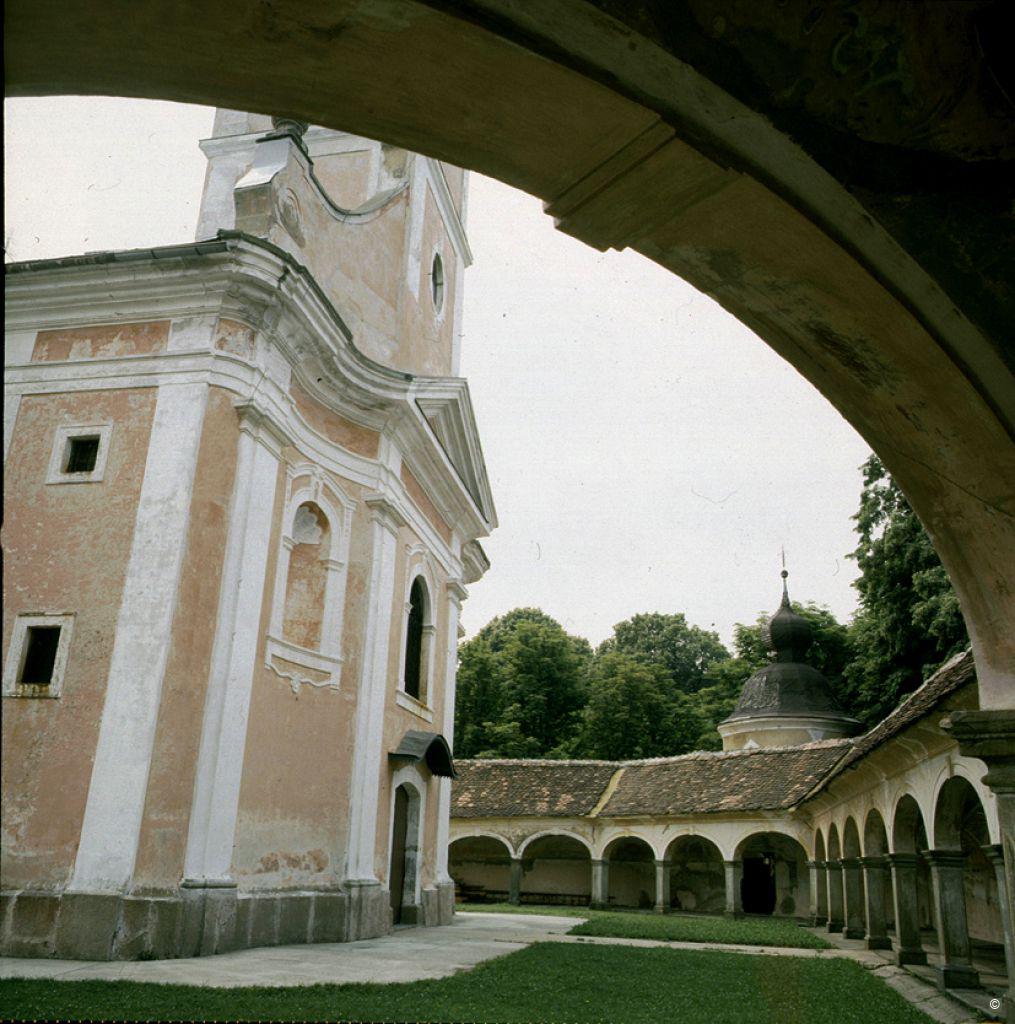
 Add to My Collection
Name of Monument:
Votive church of St. Mary of Jerusalem, Trški Vrh, near Krapina
Also known as:
Crkva Majke Božje Jeruzalemske
Location:
Trški Vrh near Krapina, North-West Croatia, Croatia
Trški Vrh
49000 Krapina
T : +385 49 371 456
The Parish of Krapina (Responsible Institution)
Date:
1750–1761; 1772/1777
Artists:
Architect: Josef Hoffer (1700–1764); builder: Josip Javornik (active c. 1750); Painter: Anton Joseph (Jožef) Lerchinger (Lerhinger) (c. 1720–after 1787); Antun Mersi (active c. 1759); Philipp Jakob Straub (1706–1774)
Denomination / Type of monument:
Religious, church ceiling painting from the Late Baroque
Patron(s):
Members of the Croatian gentry such as Josip Jagušić and Nikola Bedeković Komorski
History:
Designed by the architect, Josef Hoffer, the Votive Church of St Mary of Jerusalem in Trški Vrh was built by Josip Javornik between 1749 and 1752. The ceiling paintings are mentioned for the first time in the so-called Canonic Visitations of 1777. There is a date on a wall inscription of 1873 found when the church was renovated: HAEC ECCLIA AB ANNO DNI 1750 EX PURIS XTI FIDELIUM ELEMOSINIS AEDIFICATA ET ANNO 777 DEPICTA EST SUB PAROCHO N:GORUP ANNO VERO 873 RENOVATA.
Description:
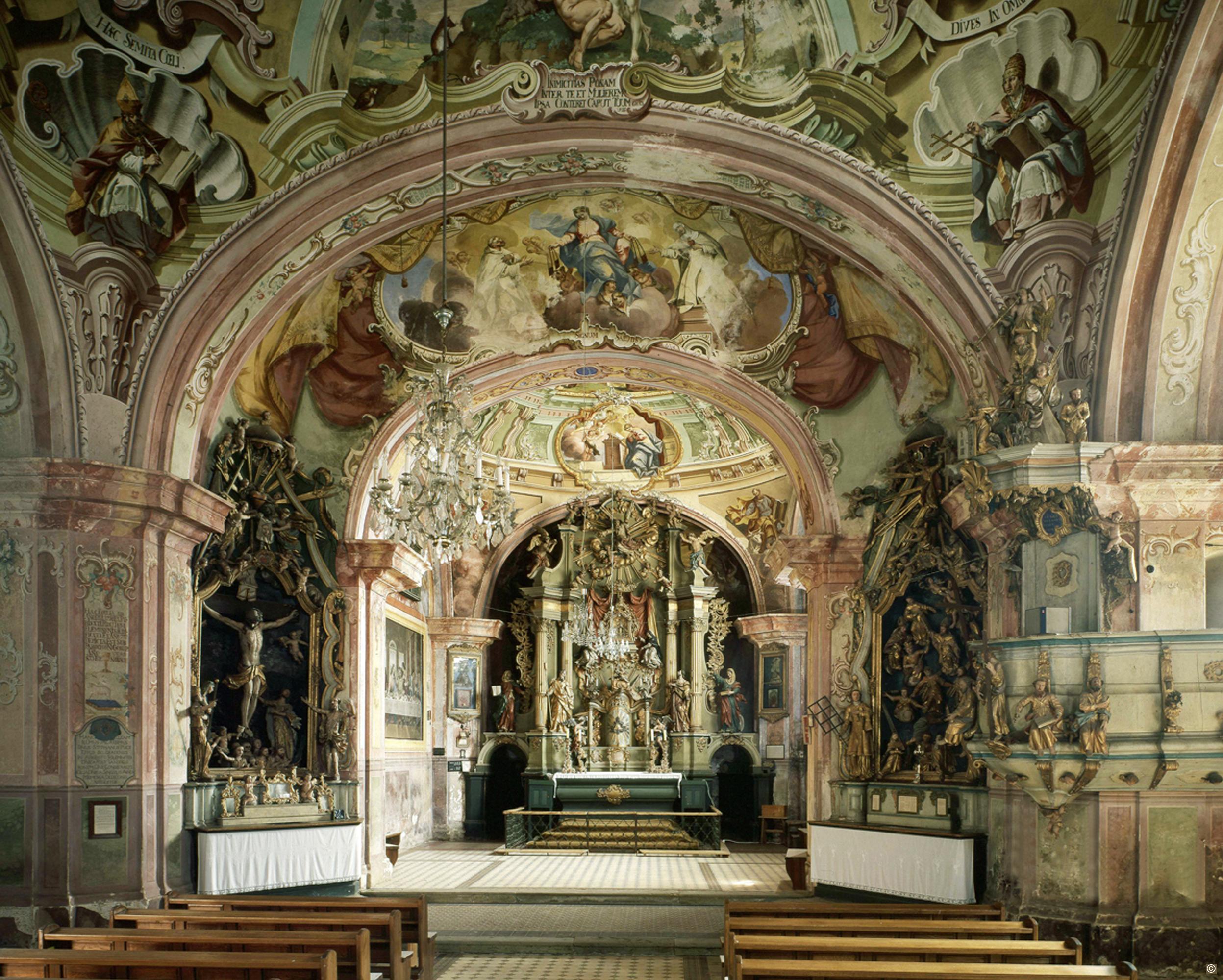
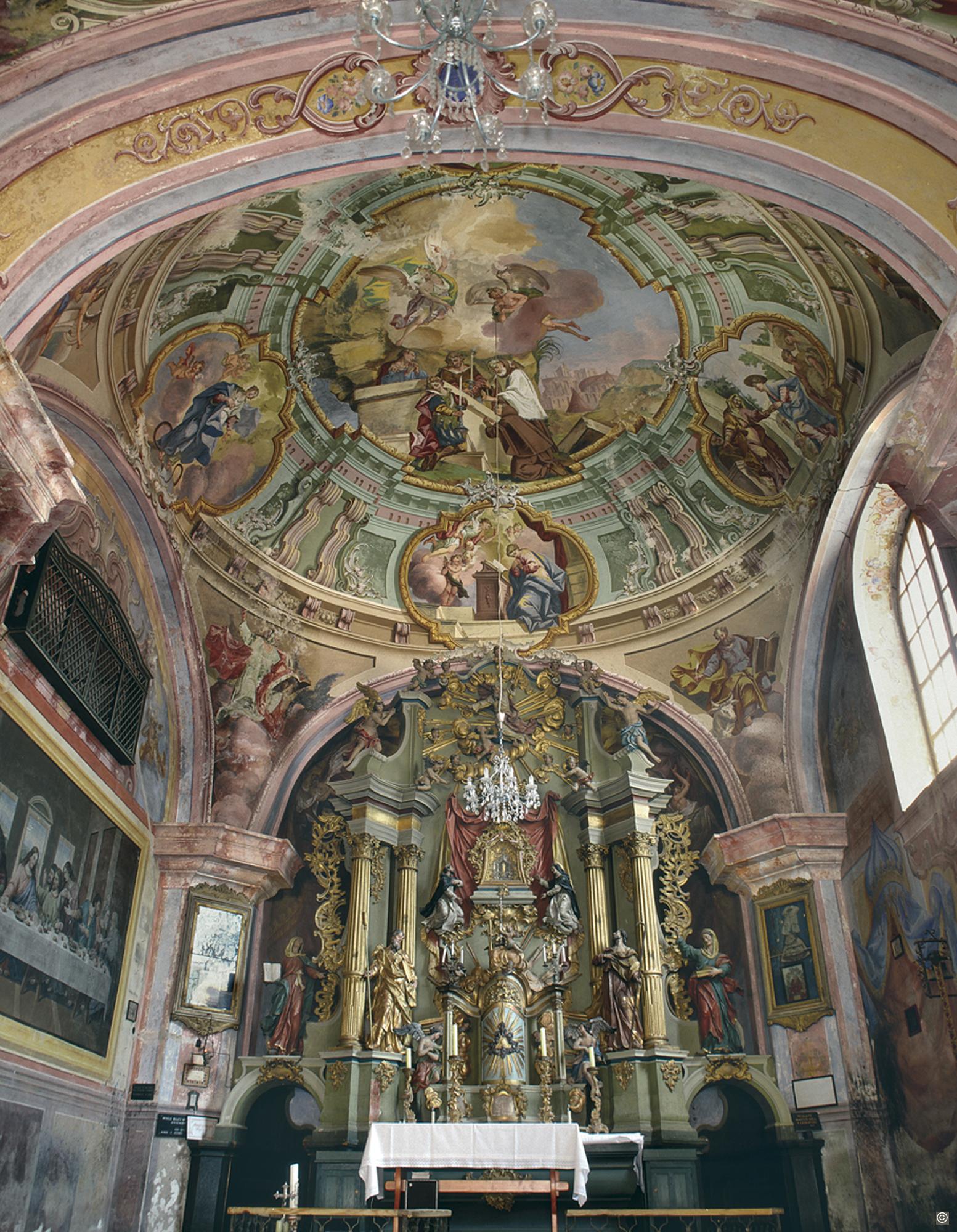
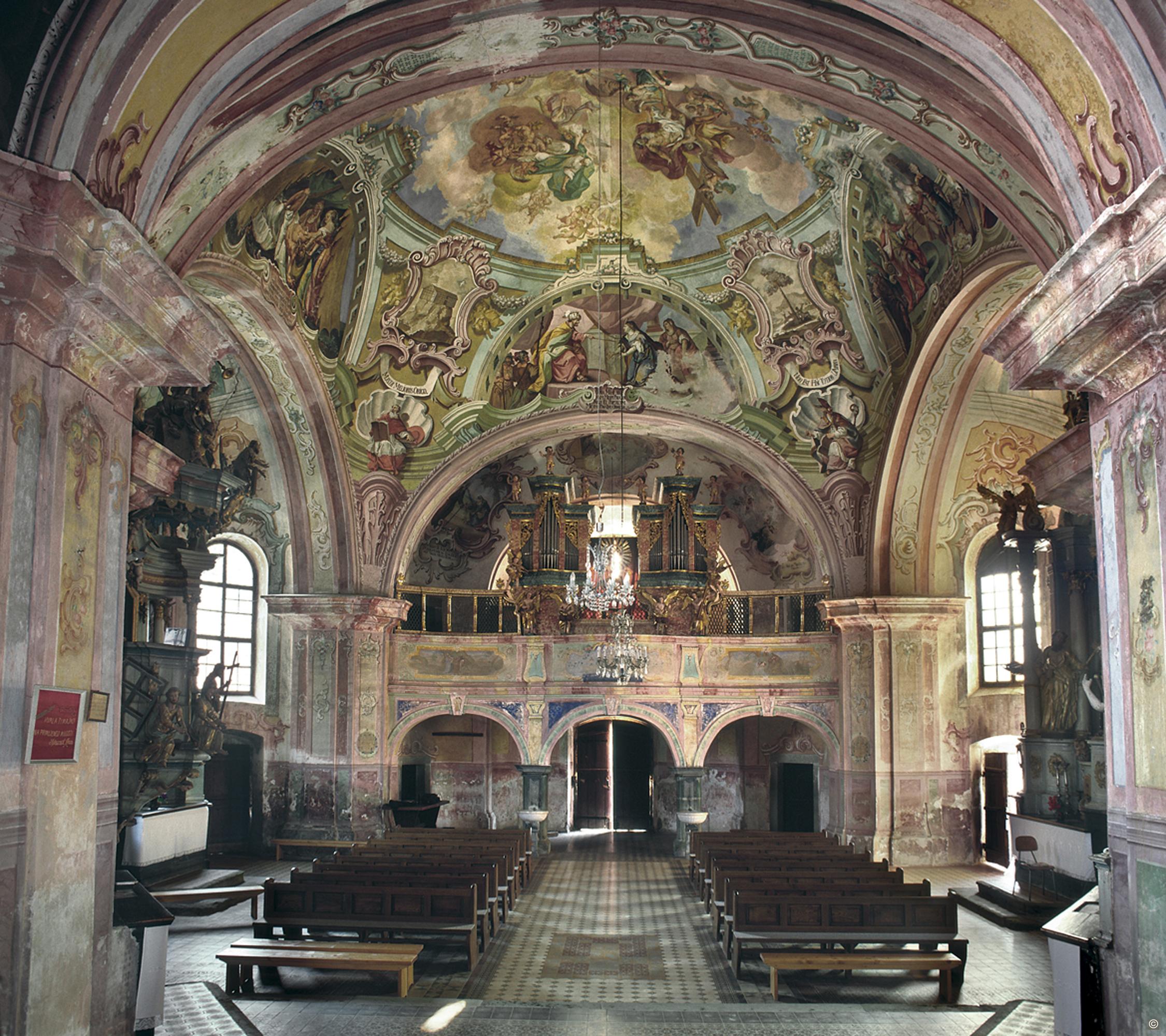
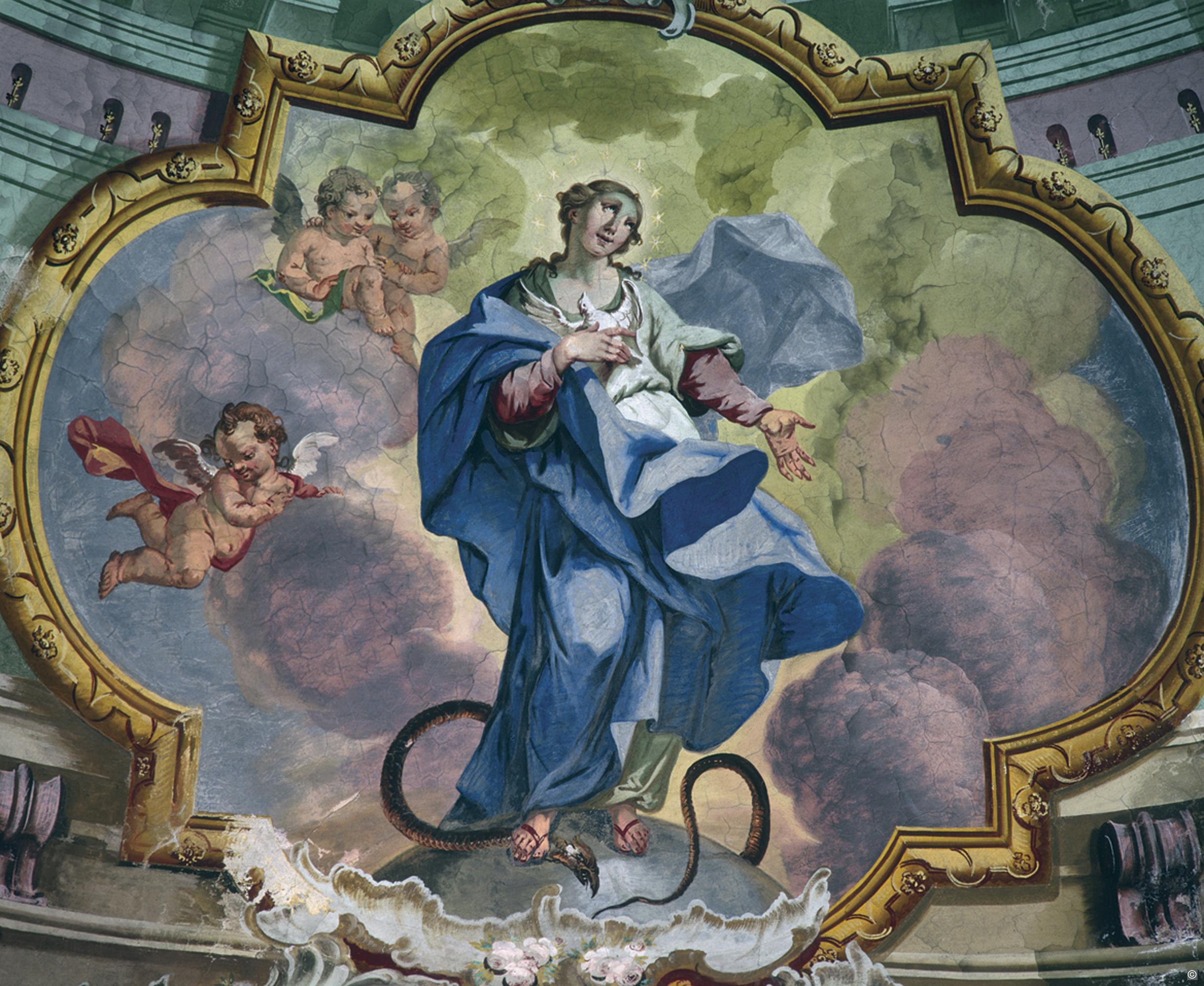
The legend of the Franciscan lay brother, Joachim, who found a small statue of the Virgin Mary under some ruins in Jerusalem, is the central subject of the ceiling painting on the apse vault, surrounded by four medallions depicting scenes from the Life of the Virgin Mary: Birth of the Virgin Mary, the Visitation, the Annunciation, and the Immaculate Conception. On the surfaces of the rather flat dome pendentives, the four evangelists are accompanied by their traditional attributes; further in, the paintings of the central nave become both compositionally and thematically more complex. The dominant position in the centre of the flat dome-like ceiling is dedicated to the Assumption of the Virgin painted in the tradition of illusionist painting but with quadratura that is decorative more than functioning as an extension to the architecture. Surrounded by four scenes from the Old Testament, on the triumphal arch is a depiction of the Original Sin. Eden is presented in deep perspective; a timid landscape shaded by the tree holding the forbidden fruit. Next is Judith Decapitating Holofernes, after a painting by Rubens. Ester and King Ahasver and the Judgment of Solomon follow, painted with similar attention to movement and expression. The Old Testament repertoire is accompanied by depictions of the Four Fathers of the Church; four scenes in grisaille depict more scenes from the Old Testament – Moses Releasing Water from a Rock, Noah's Ark, Jacob's Dream and the symbolic image of the Virgin Mary inspired by the Song of Songs: “Sub umbra illius, quem desideraveram, sedi et fructus eius dulcis gutturi me”. [“I sat down under his shadow, whom I desired: and his fruit was sweet to my palate”].
Lerchinger's characteristic style as seen in Trški Vrh is best described by Anica Cevc: “In adornment, he has developed a distinct personal Rococo language. He is playful and pliable in forming his depicted stucco rocaille imitations, which he uses to densely line vaults. He places flowers between or inside, a permanent decorative element from his earliest to last works. In that instance, his church interiors are visually changed into blossoming summerhouses, or he fills them up in a strip cartoon fashion with a series of images in rich frames hanging from a wall. His frescoes represent a regional variation of Central European Rococo.”
The Votive Church of St Mary of Jerusalem is one of the most beautiful Baroque pilgrim churches of North Croatia. Built on a hill in Trški Vrh near Krapina, and surrounded by a circle of vaulted arcades, the church dominates the scenery. Built according to the architectonic features of the Baroque, it is a central-quatrefoil church with a long, wide sanctuary. Building finished in 1752 and in 1772 the illusionist painter Anton Joseph Lerchinger and his workshop decorated the entire interior with illusionist paintings. The dedication of the church of St. Mary of Jerusalem relates to a legend according to which in 1669 a Franciscan lay brother, Joachim, found a small statue of the Virgin Mary under some ruins in Jerusalem. A depiction of the scene is on the apse vault.
How Monument was dated:
According to the archive, the ceiling painting was first mentioned in 1777. This date is also found on a wall inscription of 1873when the church was renovated: HAEC ECCLIA AB ANNO DNI 1750 EX PURIS XTI FIDELIUM ELEMOSINS AEDIFICATA ET ANNO 777 DEPICTA EST SUB PAROCHO N:GORUP ANNO VERO 873 RENOVAT
Special features
View to the Sanctuary
Votive church of St. Mary of Jerusalem, Trški Vrh, near Krapina
1750–1761; 1772/1777
Architect: Josef Hoffer (1700–1764); builder: Josip Javornik (active c. 1750); painter: Anton Joseph (Jožef) Lerchinger (Lerhinger) (c. 1720–after 1787)
View to the sanctuary
Votive church of St. Mary of Jerusalem, Trški Vrh, near Krapina
1750–1761; 1772/1777
Architect: Josef Hoffer (1700–1764); builder: Josip Javornik (active c. 1750); painter: Anton Joseph (Jožef) Lerchinger (Lerhinger) (c. 1720–after 1787)
View to the Choir
Votive church of St. Mary of Jerusalem, Trški Vrh, near Krapina
1750–1761; 1772/1777
Architect: Josef Hoffer (1700–1764); builder: Josip Javornik (active c. 1750); painter: Anton Joseph (Jožef) Lerchinger (Lerhinger) (c. 1720–after 1787)
Immaculate Conception
Ceiling painting in the sanctuary, Votive church of St. Mary of Jerusalem, Trški Vrh, near Krapina
1772/77
Anton Joseph (Jožef) Lerchinger (Lerhinger) (c. 1720–after 1787)
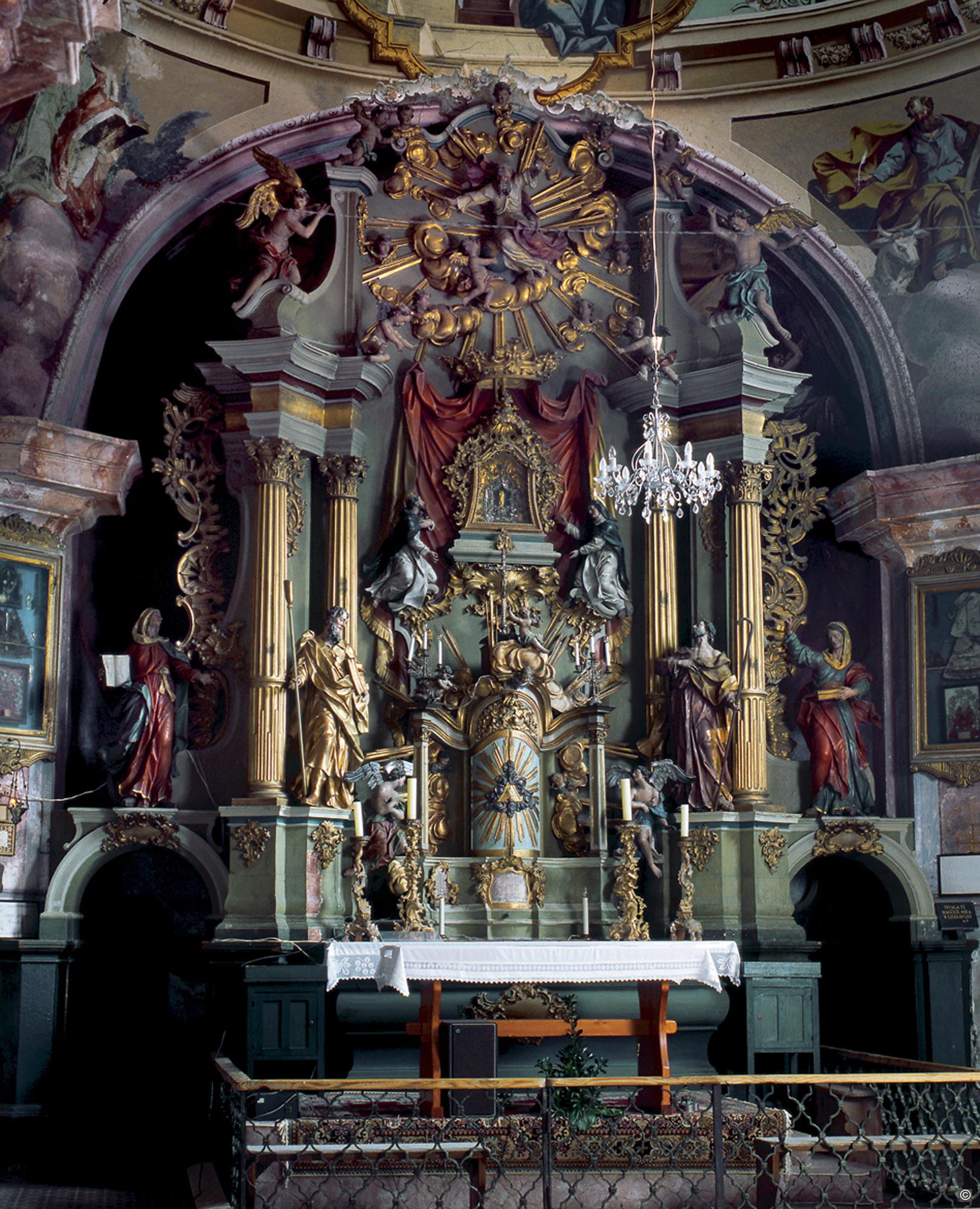
High Altar
Sanctuary, Votive church of St. Mary of Jerusalem, Trški Vrh, near Krapina
1659
Philipp Jakob Straub (1706–1774)
Selected bibliography:
Szabo, Z., “Spomenici kotara Krapina i Zlatar”, Vjesnik hrvatskog Arheološkog društva, in series No. XIII, 1913 and 1914, Zagreb, p. 161.
Zercalo Mariansko Kipa Jerusalimszkoga vu Krapine Pod Bratovschinum Sz. Skapulara Podignyenoga Vu Zagrebu, Stampano pri Andrasu Besse Purgaru Klobucharu, per Anton Jandera Factorem, 1786, Narodno sveučilište Krapina, 1996.
Cevc, A., Anton Jožef Lerchinger, Ljubljana, 2007, pp. 164–174.
Citation of this web page:
Mirjana Repanić-Braun "Votive church of St. Mary of Jerusalem, Trški Vrh, near Krapina" in "Discover Baroque Art", Museum With No Frontiers, 2026.
https://baroqueart.museumwnf.org/database_item.php?id=monument;BAR;hr;Mon11;20;en
Prepared by: Mirjana Repanić-BraunMirjana Repanić-Braun
SURNAME: Repanić-Braun
NAME: Mirjana
AFFILIATION: Institute of Art History, Zagreb
TITLE: PhD, Scientific Consultant
CV:
From 1981 to 1982 Mirjana Repanić-Braun was a curator of the Academy’s collection of sculpture in the Gliptoteque of the Croatian Academy of Arts and Sciences; from 1983 to 1998 she worked in the Croatian Academy’s Archives for Visual Arts. Mirjana has been employed as a researcher at the Institute of Art History in Zagreb since 1998: from 2001, as head of the scientific project Baroque Painting, Sculpture and Crafts of Continental Croatia, and since 2006, as head of the scientific project Baroque, Classicism and Historicism in the Arts of North Croatia. Mirjana teaches Art History at the universities of Rijeka and Split. At the University of Zagreb, she participates at doctoral level in the Faculty of Croatian Studies and the Faculty of Philosophy.
Translation by: Mirjana Repanić-BraunMirjana Repanić-Braun
SURNAME: Repanić-Braun
NAME: Mirjana
AFFILIATION: Institute of Art History, Zagreb
TITLE: PhD, Scientific Consultant
CV:
From 1981 to 1982 Mirjana Repanić-Braun was a curator of the Academy’s collection of sculpture in the Gliptoteque of the Croatian Academy of Arts and Sciences; from 1983 to 1998 she worked in the Croatian Academy’s Archives for Visual Arts. Mirjana has been employed as a researcher at the Institute of Art History in Zagreb since 1998: from 2001, as head of the scientific project Baroque Painting, Sculpture and Crafts of Continental Croatia, and since 2006, as head of the scientific project Baroque, Classicism and Historicism in the Arts of North Croatia. Mirjana teaches Art History at the universities of Rijeka and Split. At the University of Zagreb, she participates at doctoral level in the Faculty of Croatian Studies and the Faculty of Philosophy.
Translation copyedited by: Mandi GomezMandi Gomez
Amanda Gomez is a freelance copy-editor and proofreader working in London. She studied Art History and Literature at Essex University (1986–89) and received her MA (Area Studies Africa: Art, Literature, African Thought) from SOAS in 1990. She worked as an editorial assistant for the independent publisher Bellew Publishing (1991–94) and studied at Bookhouse and the London College of Printing on day release. She was publications officer at the Museum of London until 2000 and then took a role at Art Books International, where she worked on projects for independent publishers and arts institutions that included MWNF’s English-language editions of the books series Islamic Art in the Mediterranean. She was part of the editorial team for further MWNF iterations: Discover Islamic Art in the Mediterranean Virtual Museum and the illustrated volume Discover Islamic Art in the Mediterranean.
True to its ethos of connecting people through the arts, MWNF has provided Amanda with valuable opportunities for discovery and learning, increased her editorial experience, and connected her with publishers and institutions all over the world. More recently, the projects she has worked on include MWNF’s Sharing History Virtual Museum and Exhibition series, Vitra Design Museum’s Victor Papanek and Objects of Desire, and Haus der Kulturen der Welt’s online publication 2 or 3 Tigers and its volume Race, Nation, Class.
MWNF Working Number: HR 25