

 Back
Back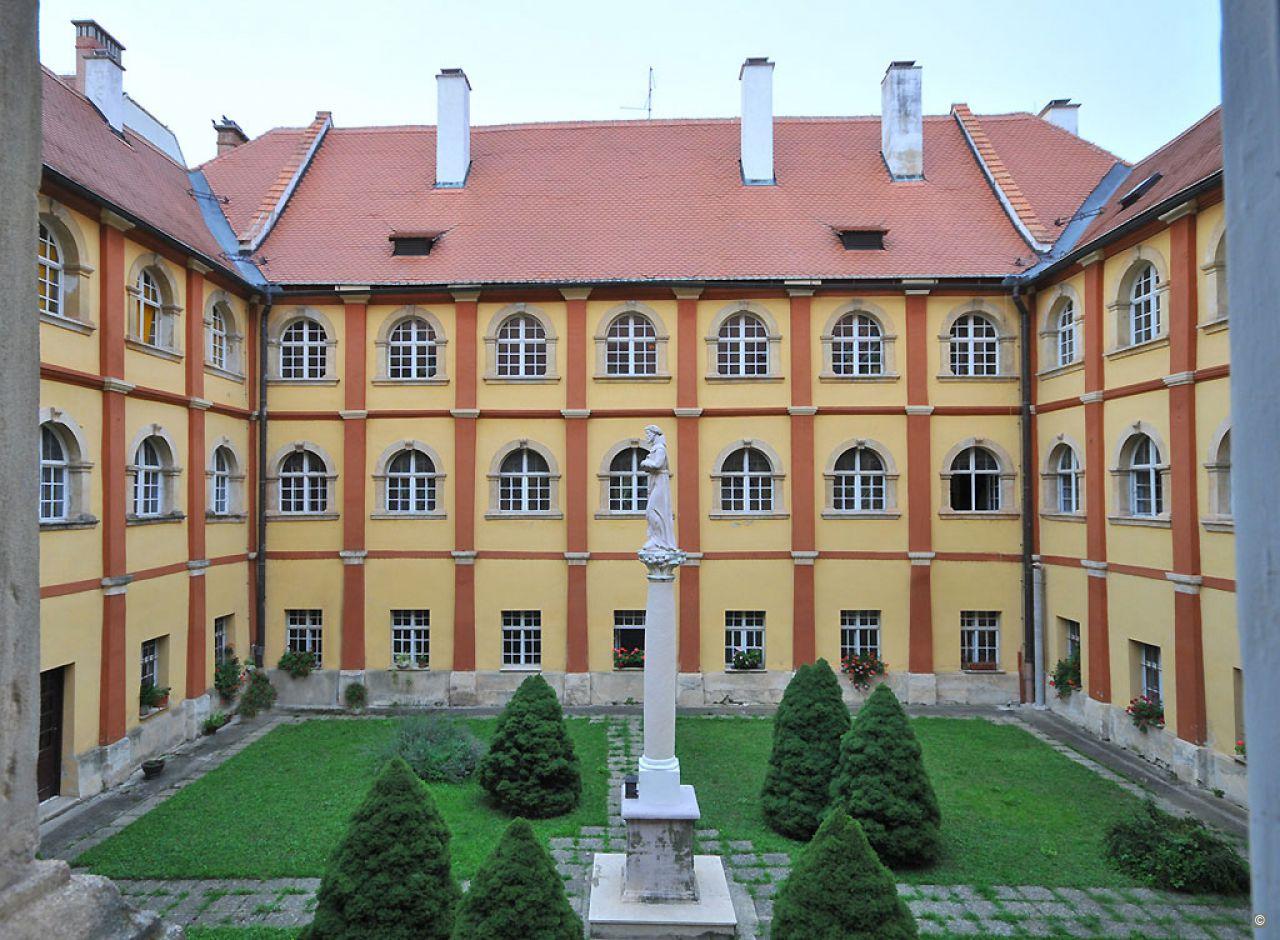
 Add to My Collection
Name of Monument:
Franciscan Church of St. John the Baptist
Location:
Varaždin, North-West Croatia, Croatia
Franjevački trg 8
42000 Varaždin
T : +385 42 213 166
Franciscan Church of St. John the Baptist (Responsible Institution)
Date:
Church (1650–1655); pulpit (1675); high altar (1700–1702); altars of I. A. Rosemberger (1740s); stuccowork of J. A. Quadrio (1716–1717)
Artists:
Builder: Peter Rabba (active second half of 17th–beginning of the 18th century); altar builder: Kristofor Zettl (active c. 1700); sculptors: Franjo Krištof Reiss (d. 1711), Ivan (Johann) Adam Rosemberger (d. 1758); gilder and painter: Joakim Shidt (active 18th century); stuccowork: unknown artist; painter: Ivan Krstitelj (Johann Baptist) Ranger (1700–1753)
Denomination / Type of monument:
Religious, monastery church and interior furnishing
Patron(s):
Franciscan Order
History:
Peter Rabba of Graz built the Early Baroque Church of St. John the Baptist on the foundations of an older church, on the site of the Franciscan Monastery in Varaždin, reconstructed in 1626. The monastery played an important role in Varaždin as the apothecary established there became a public municipal apothecary from 1679 to 1772; the monastery also had an important and active role in education from the early 18th century to the first decades of the 20th.
Description:
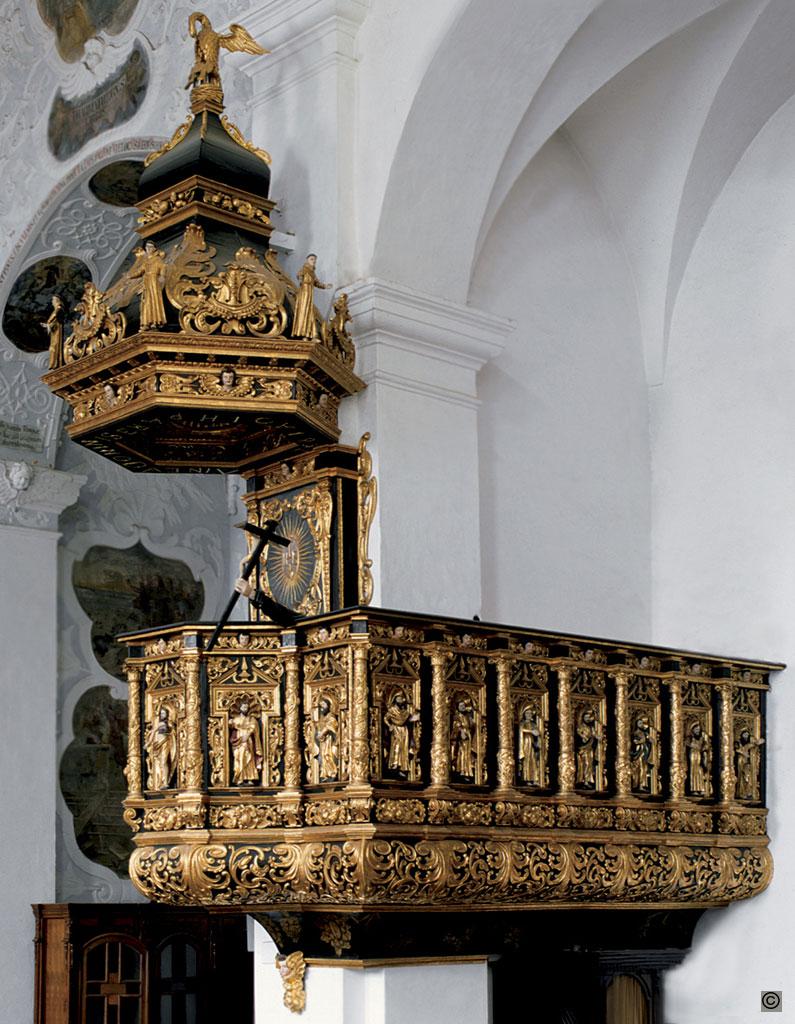
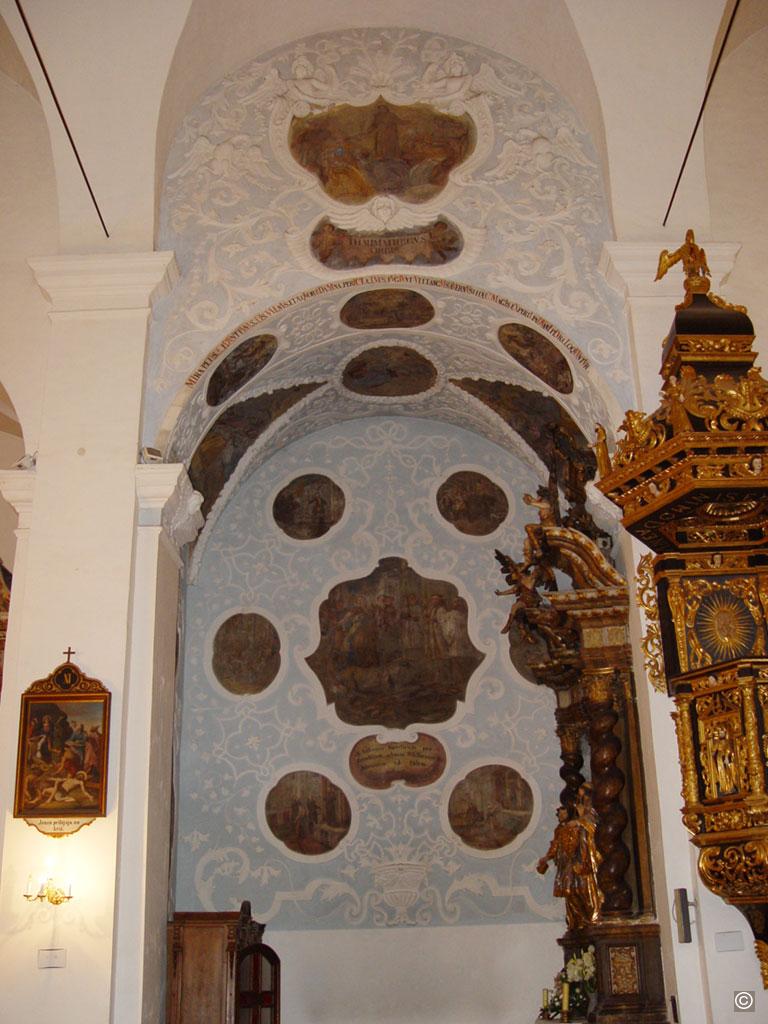
The model for the design of the nave-church of St. John the Baptist with its shallow side-chapels should be sought, judging all in all, in the Zagreb (chapter) Franciscan Church dating to the first decade of the 17th century, or in the Viennese church of the Franciscan Order (1603–1611). In the harmonious Early Baroque space of the Church of St. John the Baptist there are a number of valuable woodcarvings illustrating important phases of the art form in northern Croatia during the Baroque period. The pulpit (1675) – a long and richly articulated item with statues of Christ and the apostles in niches – is a consummate example of Late Mannerist wood carving and one of only a few preserved monumentally founded 17th-century pulpits in Croatia.
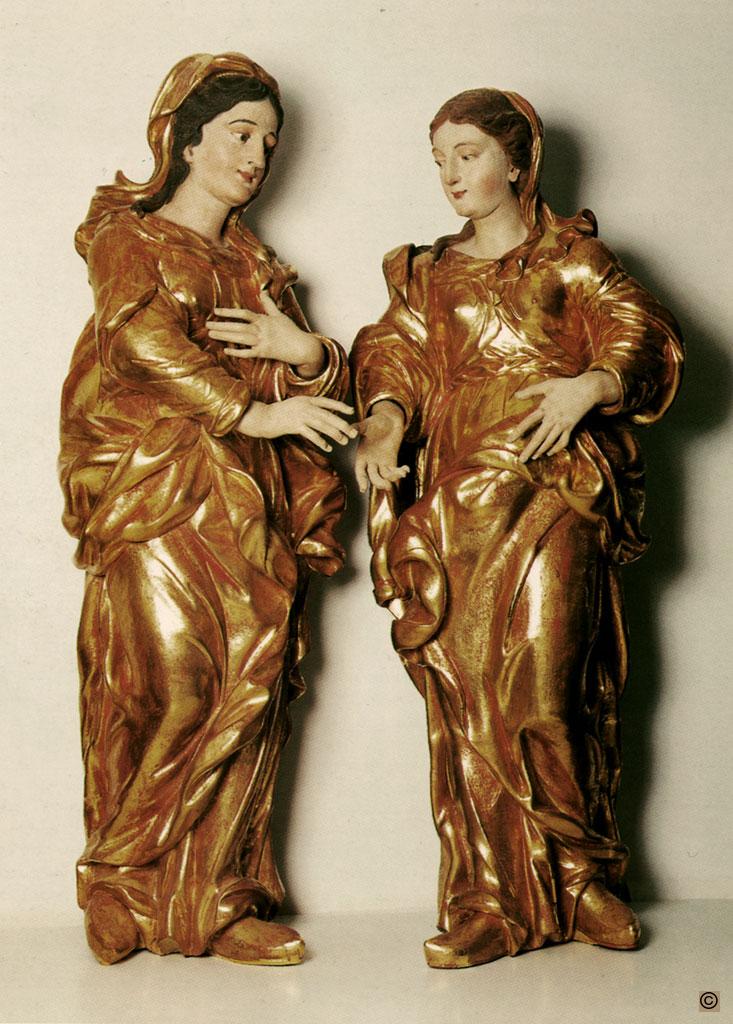
The monumental three-part altar (1700–1702), built according to the designs of the Franciscan, Kristofor Zettl of Munich, fills the chancel completely. The skilled perspective foreshortening of the niches, concluded by coffered vaulting, complement the spaciousness of the altar architecture. The sculptures are by the Maribor sculptor, Franjo Kristof Reiss, and the polychrome and gilding the work of the Zagreb painter and gilder, Joakim Shidt. In the side-chapels there are five altars built during the 1740s, which by stylistic analysis, are attributable to Ivan or Johann Adam Rosemberger, Varaždin's principal sculptors at the time.
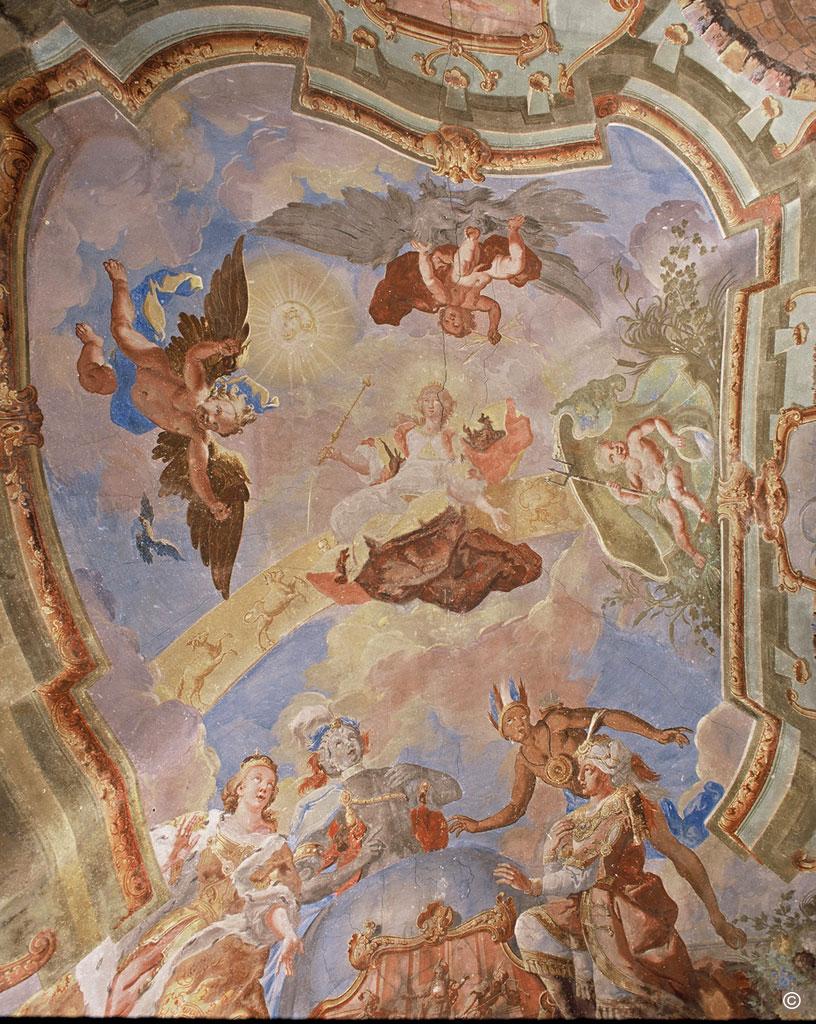
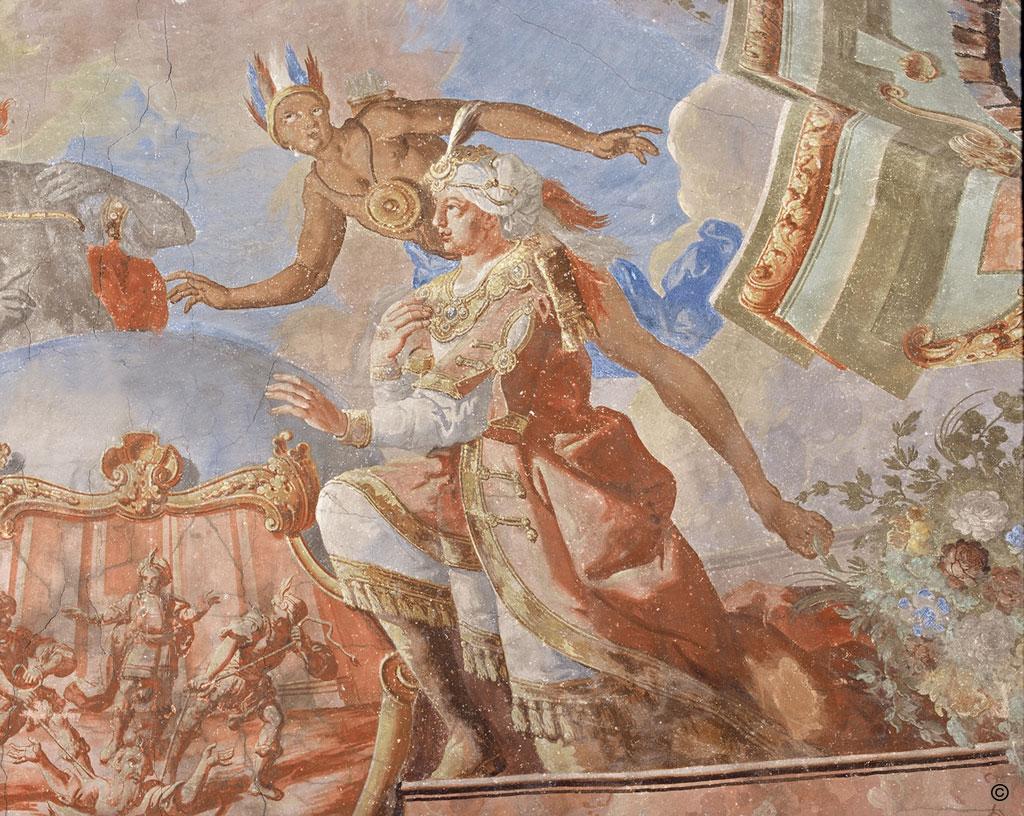
The sculpture of the altars of St. Anthony of Padua (1725) and Our Lady of the Scapular (1735–1745), on the other hand, show a kinship with the work of Ivan Matija Leitner, a sculptor from Bavaria who had a workshop in Graz. The aforementioned altars are found within two chapels decorated by the Styrian stucco master, Joseph Antonio Quadrio. The Paulist painter, Ivan Krstitelj Ranger decorated the monastery apothecary in 1750 – the central scene of this work shows Mary as Queen of the Universe surrounded by allegorical depictions of the Four Continents and Four Elements.
The Early Baroque interior of the church presents a kind of gallery of woodcarving spanning the second half of the 17th and mid-18th centuries. It tells of changes in style and taste, as well as demonstrating the Varaždin Franciscan community's range of commissions. Through the order's connections, the Franciscans were able to commission works by leading foreign artists (the high altar) and from local sculptors (five altars with sculptures by Ivan Adam Rosemberger from Varaždin).
How Monument was dated:
Archival sources and inscriptions.
Special features
Pulpit
Nave, north side
1675
Unknown
The long body of the pulpit is articulated by the sequencing of little columns, in between which there are niches with figures of Christ and the apostles. The copious employment of ornamental motifs on all surfaces of the pulpit and baldachin, along with the rich, gleaming gilding on the dark ground, are characteristic stylistic features of Late Mannerist Central European woodcarving.
High Altar
Chancel
1700–1702
Altar builder: Kristofor Zettl (active c. 1700); sculptor: Franjo Krištof Reiss (d. 1711)
The monumental altar, erected the full width of the chancel, originally had three mensas. The Varaždin Franciscans owed this stylistically up-to-date and, in the context of Baroque altarpiece making in northern Croatia, exceptional, altar plan to the engagement of the altar-maker, K. Zettl, who came from the distant artistic centre of Munich. The stylistic contemporaneity in the context of woodcarving in the sub-alpine area is evident in the characteristics of the sculpture, suffused with a moderate Baroque emotionality and typical of the work of Maribor sculptor F. K. Reiss, whose development in sculpture and his style was helped by his family links with the Schoy family of sculptors in Styria.
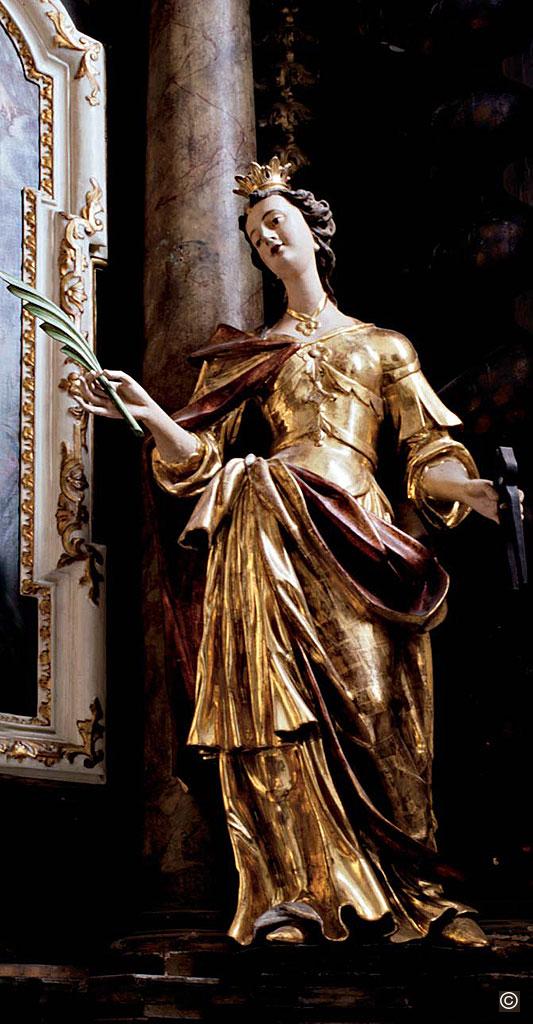
St. Apollonia
Altar and Chapel of St. Barbara
1744
Sculpture: Ivan Adam Rosemberger (d. 1758)
This opulently clad saint holds in her hands the attributes of her the martyrdom, the palm and pincers, which enables us to recognise her as St. Apollonia. Like her companion piece, St. Barbara, she is a characteristic work of Ivan Rosemberger. Rosemberger was prolific, making sculpture of a specific typology and careful in his choice of ornaments. His work set a distinctive stamp on the sculpture of the whole Varaždin region in the first half of the 18th century.
Stucco decoration and paintings in the Chapel of St. Anthony
Chapel of St. Anthony
Stuccowork: 1716–1717; wall painting: 1738?
Stuccowork: unknown artist; painter: Ivan Krstitelj (Johann Baptist) Krstitelj Ranger (1700–1753)
While the stuccowork in Our Lady of the Scapular Chapel facing it is the work of the Styrian practitioner, J. A. Quadrio, the Chapel of St. Anthony has stuccowork made later by an unknown author. Interwoven plants and ribbons frame eight medallions depicting the Life of St. Anthony of Padua, painted by Ivan Krstitelj Ranger, in around 1738.
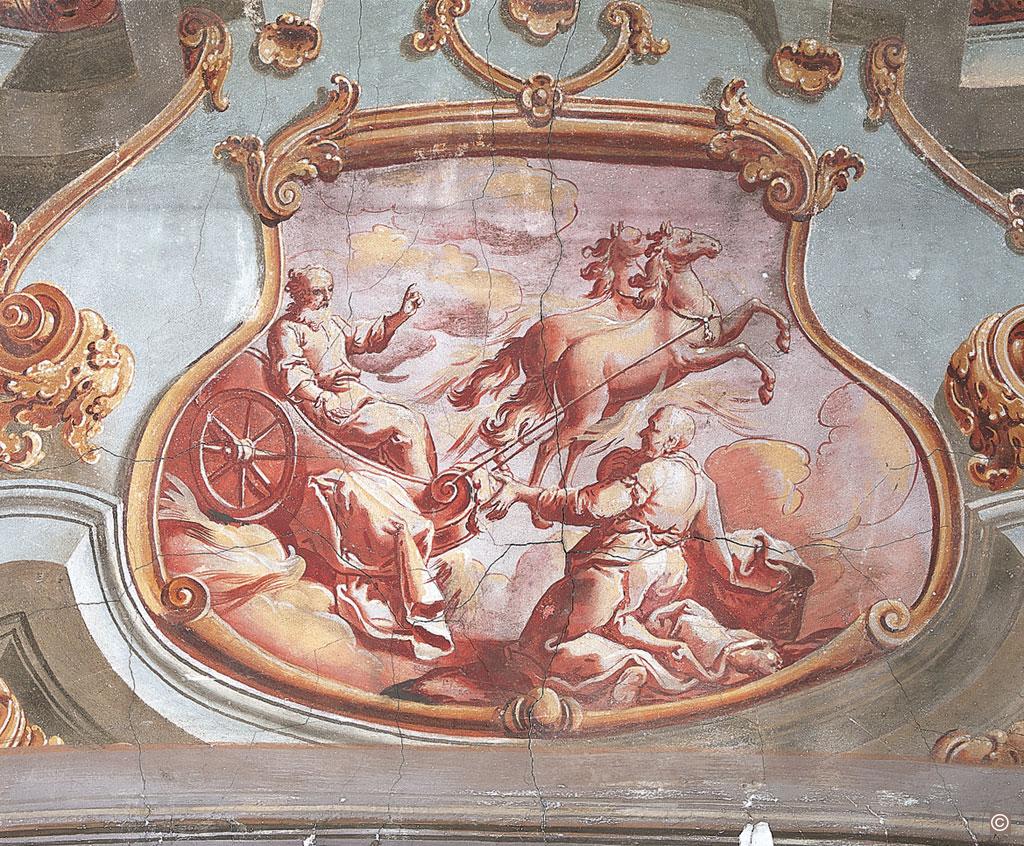
Allegory of Four Continents and Virgin Mary the Queen of the Universe
Ceiling in the former apothecary of the Franciscan Monastery of St John Baptist
1751
Ivan Krstitelj (Johann Baptist) Krstitelj Ranger (1700–1753)
The low ceiling is covered with illusionistic paintings: personifications of the Four Continents and allegories of the Four Elements; the Four Stages in man’s life. The Virgin Mary dominates the composition sitting on a rainbow almost in the centre of the ceiling.
Selected bibliography:
Horvat-Levaj, K., "Barokna franjevačka arhitektura provincija sv. Ladislava i sv. Ivana Kapistranskog" in: Mir i dobro, exhibition catalogue, Zagreb, 2000, pp. 205–219.
Repanić-Braun, M., Barokno slikarstvo u hrvatskoj franjevačkoj provinciji sv. Ćirila i Metoda, Zagreb, 2004.
Baričević, D., Barokno kiparstvo sjeverne Hrvatske, Zagreb, 2008.
Citation of this web page:
Vlasta Zajec, Mirjana Repanić-Braun "Franciscan Church of St. John the Baptist" in "Discover Baroque Art", Museum With No Frontiers, 2026.
https://baroqueart.museumwnf.org/database_item.php?id=monument;BAR;hr;Mon11;28;en
Prepared by: Vlasta ZajecVlasta Zajec
SURNAME: Zajec
NAME: Vlasta
AFFILIATION: Institute of Art History, Zagreb
TITLE: PhD, Scientific Consultant
CV:
Vlasta Zajec was awarded her BA in Art History and Comparative Literature from Zagreb University (Faculty of Philosophy) in 1989. In the same year she began work at the Institute of Art History. She was awarded her MA in 1995 (17th-Century Wooden Altars in Istria), and her PhD in 2001 (17th Century Wooden Sculpture in Istria). She has spent brief periods of study in Italy (Udine, Venice and Trieste) and Germany (Munich). Her areas of research are wooden and marble altars and 17th- and 18th-century sculpture in Istria and North Croatia., Mirjana Repanić-BraunMirjana Repanić-Braun
SURNAME: Repanić-Braun
NAME: Mirjana
AFFILIATION: Institute of Art History, Zagreb
TITLE: PhD, Scientific Consultant
CV:
From 1981 to 1982 Mirjana Repanić-Braun was a curator of the Academy’s collection of sculpture in the Gliptoteque of the Croatian Academy of Arts and Sciences; from 1983 to 1998 she worked in the Croatian Academy’s Archives for Visual Arts. Mirjana has been employed as a researcher at the Institute of Art History in Zagreb since 1998: from 2001, as head of the scientific project Baroque Painting, Sculpture and Crafts of Continental Croatia, and since 2006, as head of the scientific project Baroque, Classicism and Historicism in the Arts of North Croatia. Mirjana teaches Art History at the universities of Rijeka and Split. At the University of Zagreb, she participates at doctoral level in the Faculty of Croatian Studies and the Faculty of Philosophy.
Translation by: Graham McMaster
Translation copyedited by: Mandi GomezMandi Gomez
Amanda Gomez is a freelance copy-editor and proofreader working in London. She studied Art History and Literature at Essex University (1986–89) and received her MA (Area Studies Africa: Art, Literature, African Thought) from SOAS in 1990. She worked as an editorial assistant for the independent publisher Bellew Publishing (1991–94) and studied at Bookhouse and the London College of Printing on day release. She was publications officer at the Museum of London until 2000 and then took a role at Art Books International, where she worked on projects for independent publishers and arts institutions that included MWNF’s English-language editions of the books series Islamic Art in the Mediterranean. She was part of the editorial team for further MWNF iterations: Discover Islamic Art in the Mediterranean Virtual Museum and the illustrated volume Discover Islamic Art in the Mediterranean.
True to its ethos of connecting people through the arts, MWNF has provided Amanda with valuable opportunities for discovery and learning, increased her editorial experience, and connected her with publishers and institutions all over the world. More recently, the projects she has worked on include MWNF’s Sharing History Virtual Museum and Exhibition series, Vitra Design Museum’s Victor Papanek and Objects of Desire, and Haus der Kulturen der Welt’s online publication 2 or 3 Tigers and its volume Race, Nation, Class.
MWNF Working Number: HR 41