

 Back
Back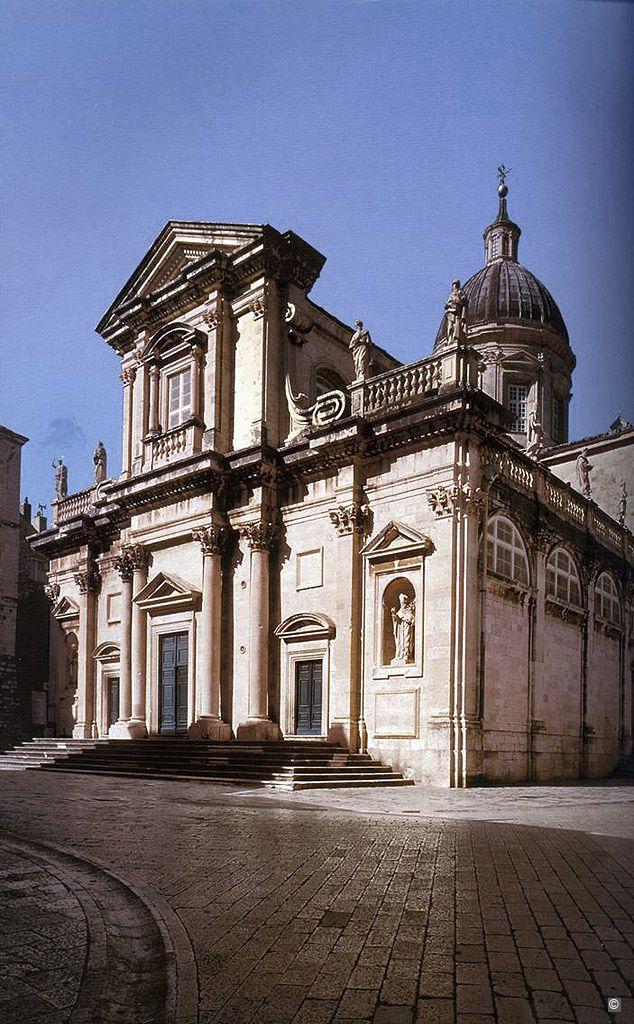
 Add to My Collection
Name of Monument:
Cathedral of the Assumption of Mary, Dubrovnik
Also known as:
Dubrovnik Cathedral
Location:
Dubrovnik, Dalmatia, Croatia
Dubrovnik, Držićeva poljana
20 000 Dubrovnik
T : +385 20 332 566 / 459
Diocese of Dubrovnik (Responsible Institution)
Date:
1671–1713
Artists:
Designer: Andrea Buffalini (active c. 1671–1713); master builders: Paolo Andreotti (active 1671–1674), Pier Antonio Bazzi (active 1677–1678), Tommaso Napoli (active 1689–1705), Ilija Katičić (1647–1728); sculptor and architect: Marino Gropelli (1662–1728); stuccowork: Carlo Degli Frangi [n.d.], Valentino Vissani [n.d.]; painter: Petar Matej[n.d.]
Denomination / Type of monument:
Religious architecture, an Early Baroque nave and two-aisle longitudinal church with side chapels, transept and dome over the crossing
Patron(s):
Dubrovnik Republic (the Senate led by Abbot Stjepan Gradić)
History:
The catastrophic earthquake that consumed Dubrovnik on 6 April 1667 resulted in the demolition of the old Romanesque cathedral (itself built on the foundations of an even earlier Byzantine cathedral). One of the primary tasks in the reconstruction of the town was to erect a new cathedral. Dubrovnik's envoy in the Vatican, Abbot Stjepan Gradić was responsible for the design concept, which he commissioned in Rome from the Urbino architect, Andrea Buffalini. Although building began in 1671, the dedication was not made until 1713. During construction, there were several master builders: Paolo Andreotti (1671–1674) and Pier Antonio Bazzi (1677–1678), both of whom were from Genoa, Tommaso Napoli (1689–1700) from Palermo, and Ilija Katičić from Dubrovnik – all of whom introduced modifications to the original plan.
Description:
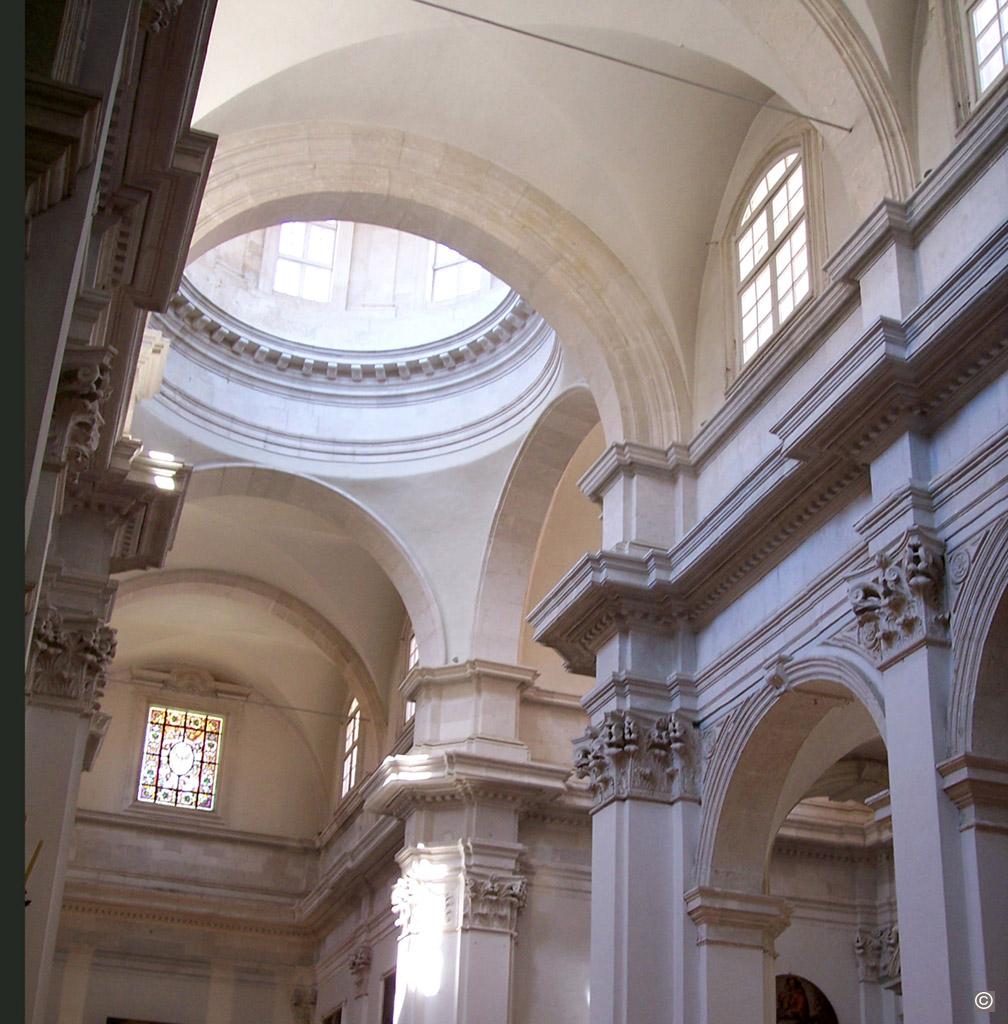
Dubrovnik Cathedral is a basilica consisting of a nave and two aisles with side chapels, a transept and a dome over the crossing, and a chancel with a straight end, flanked by the sacristy and treasury. The nave and aisles, linked by arcades on pillars, are emphasised with Corinthian pilasters that stretch right up to the continuous architrave surmounted by vaulting. An elegant dome on a high tambour with windows concludes the lantern. With these features, the cathedral harks back to the Roman tradition seen in Il Gesù, the Jesuit church in Rome. Further development of the Roman style is seen in the Baroque integration of space, notable in numerous churches of the 17th century, however, unlike the Roman prototype, almost all of them are nave churches. Dubrovnik Cathedral, however, is different in that it is a nave and two-aisle building. This sets a certain seal of originality on it in the conception of the façade, and in the pronounced contrast between the extended lower, and the narrow upper zone, having parallels in models from northern Italy, particularly Genoa, from whence the first two master builders – Paolo Andreotti and Pier Antonio Bazzi – came. More so even than these two architects, it was their successor, Tommaso Napoli, who spent the longest time working on the project. A Sicilian with an international reputation, Tommaso Napoli owned a rich oeuvre that embraced Sicily, Calabria and Vienna. This set his stamp on the design for the Cathedral for which he pushed through new plans to replace the planned barrel-vaulting in the nave, aisles and chancel with cross-vaulting, thus enabling the installation of large basilica windows with frames rich in plastic mouldings (done in contrast to the classicising plastic repertoire of older parts of the cathedral). At the same time, with the execution of side terraces and balustrades, Tommaso Napoli enriched Dubrovnik Cathedral with a new architectural element characteristic of his native Sicily, and while the elaborate handling of volume and space remained relatively isolated in southern Dalmatia, the Napolese-style terraces had a huge effect on the Baroque architecture of Dubrovnik, particularly on conspicuous residential buildings.
View Short DescriptionDubrovnik Cathedral (1671–1713) was the first innovation in town planning and architecture in the reconstruction of Dubrovnik after the disastrous earthquake of 1667. Construction of the new cathedral was on the foundations of the former one, with works overseen by the city senate led by Abbot Stjepan Gradić. Gradić commissioned the plans in Rome and confided management of the construction to a number of excellent Italian architects. With its Early Baroque features, this nave and two-aisle basilica with side chapels, transept and dome over the crossing, united the contemporary architectural influences of Rome, Northern Italy and Sicily.
How Monument was dated:
On the basis of documents and stylistic characteristics.
Special features
Exterior with lateral terraces
South façade
1713
Tommaso Napoli (active 1689–1705)
Apart from the exchange of the tunnel-vault of the original design with a cross vault, and the introduction of Baroque plasticity in the otherwise early Baroque repertoire of the architectural plastic mouldings, Napoli enriched the cathedral by adding side terraces with balustrades.
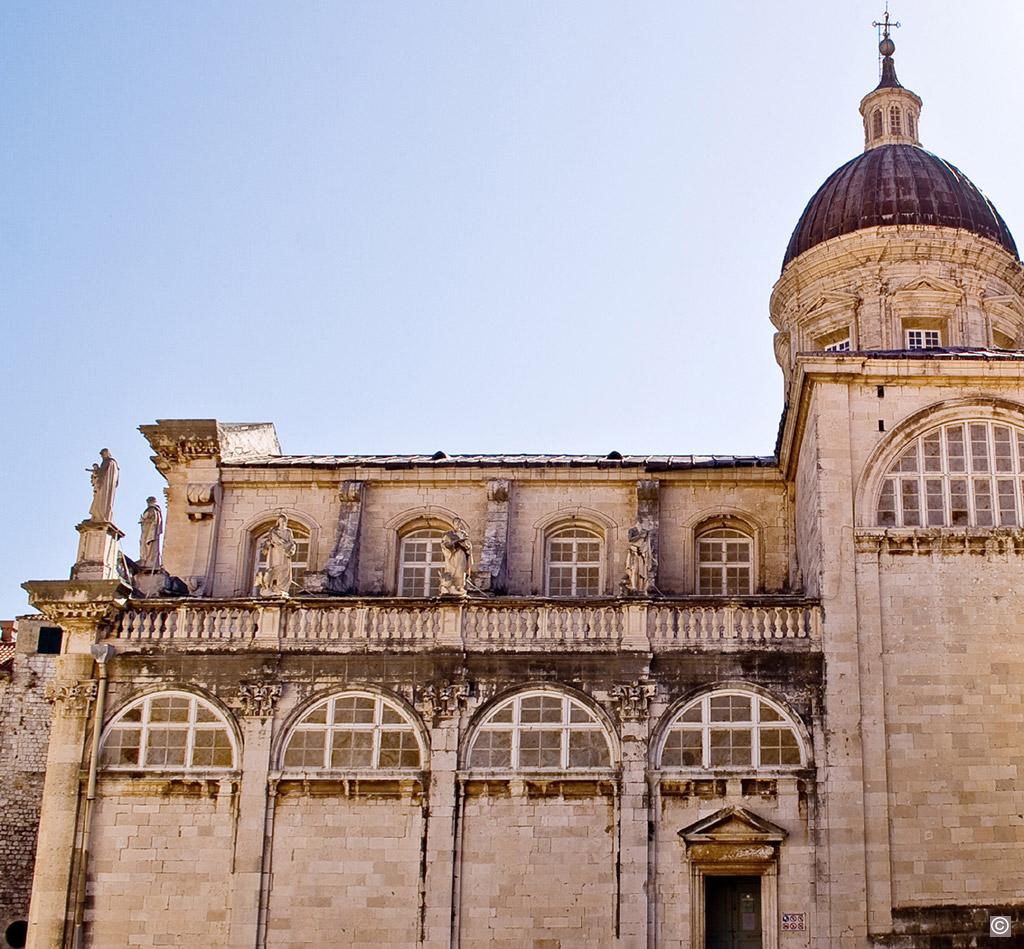
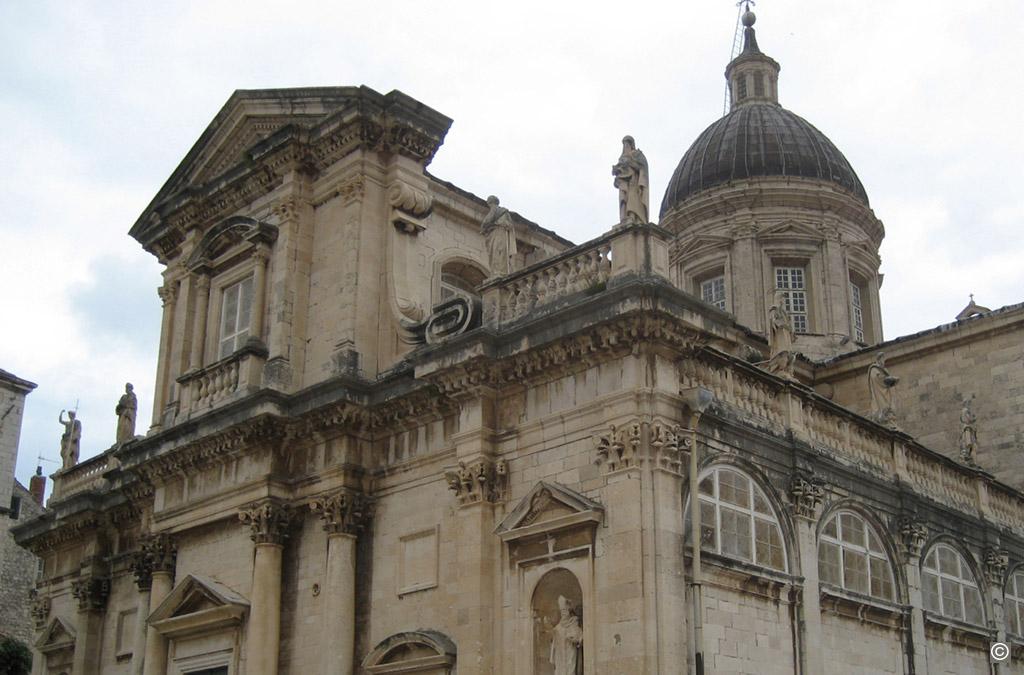
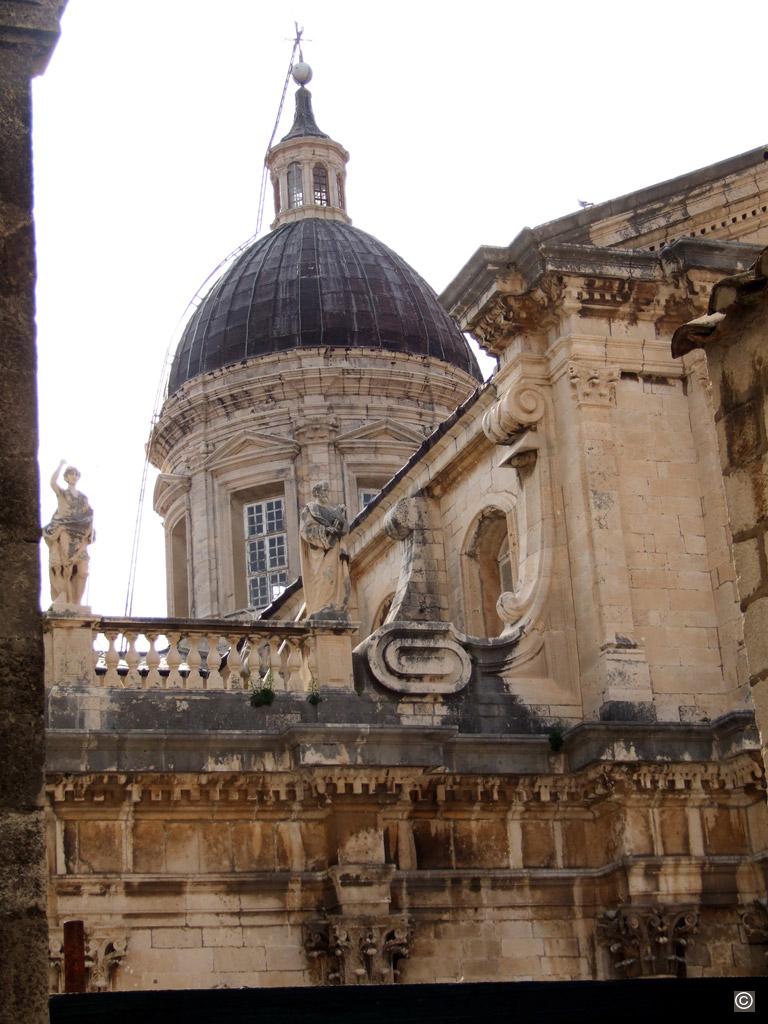
View of the vaulting
Central nave
1713
Tommaso Napoli (active 1689–1705)
Cross vaulting, which enabled the installation of large basilica windows with frames rich in plastic mouldings.
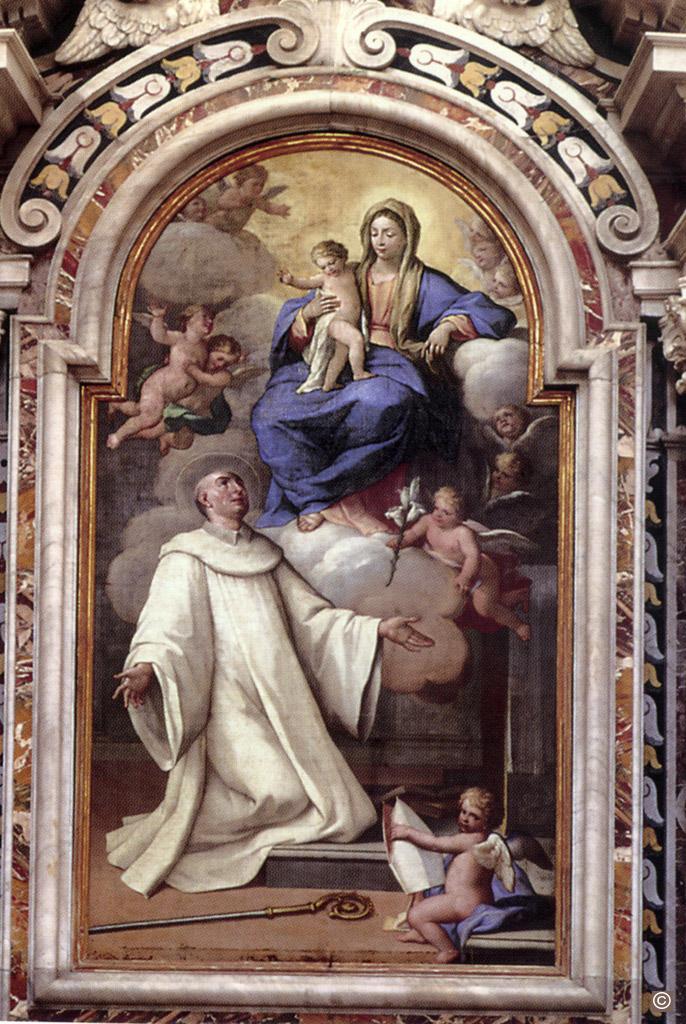
Altar of St. Bernard
Transept of the Cathedral, northern side
1686–1721
Inlay on altarpiece: Carlo Degli Frangi [n.d.]; statues: Marino Gropelli (1662–1728); painter of altarpiece: Petar Matej [n.d.]
Commissioned by the Archdeacon of the Chapter in Dubrovnik, Bernard Dordić, this opulent inlaid altar is the work of Neapolitan sculptor, Carlo degli Frangi. In the shape of a triumphal arch with protruding stripes, it has double Corinthian columns and a segmented, broken gable into which an attic has been inserted. The angels and the dove of the Holy Spirit in the attic were probably the work of the Venetian sculptor, Marino Gropelli, while the Virgin and Child with St Bernard altarpiece was the work of local Dubrovnik painter, Petar Mattej. The notable feature of this altar is in the application of inlay in various coloured marbles. This type of decoration, which is particular to southern Italy, was not common in Venice, and in spite of this Ragusan exception, was not commonly seen in Dalmatia either.
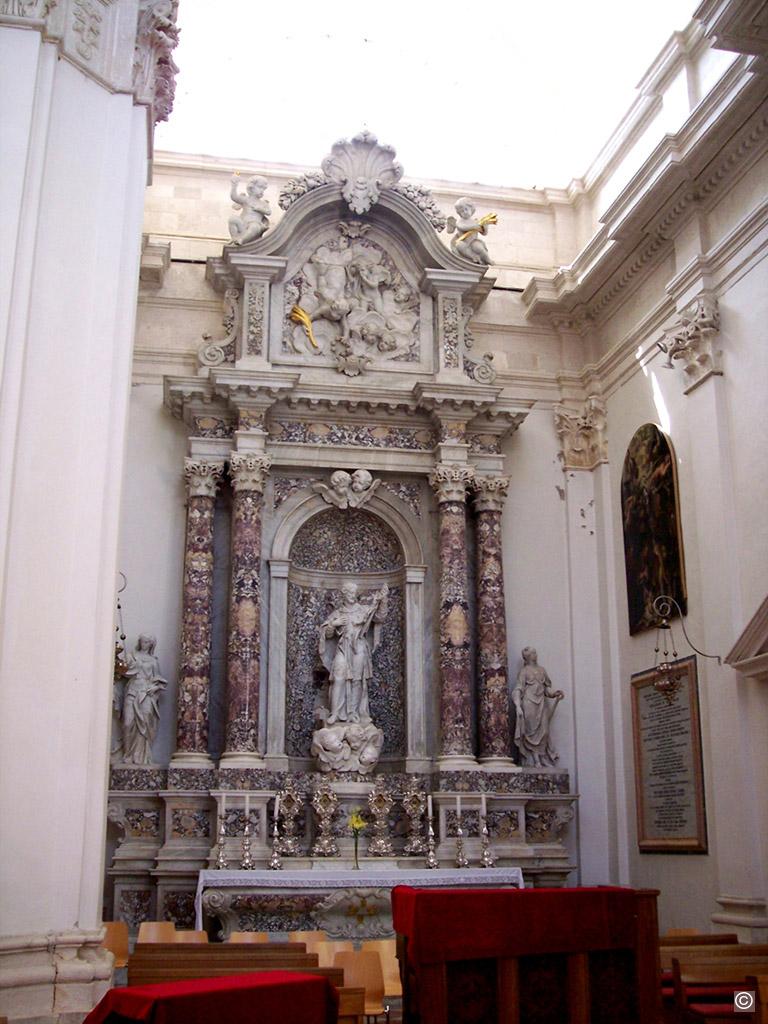
Altar of St. John of Nepomuk
Side altar
1758–1778
Unknown Venetian sculptors
An elegant combination of violet and white marble gives the impression of lightness despite the strict classical architectural elements of this altar. Pairs of columns support the architrave and the attic. The central niche, flanked by a pair of columns, holds the sculpture of St. John of Nepomuk while the side sculptures personify Hope and Faith and are much smaller in scale. It is thought that the altar design was from Vienna and the marble imported from Italy. Master sculptors also came from Venice, but it is still uncertain who they were.
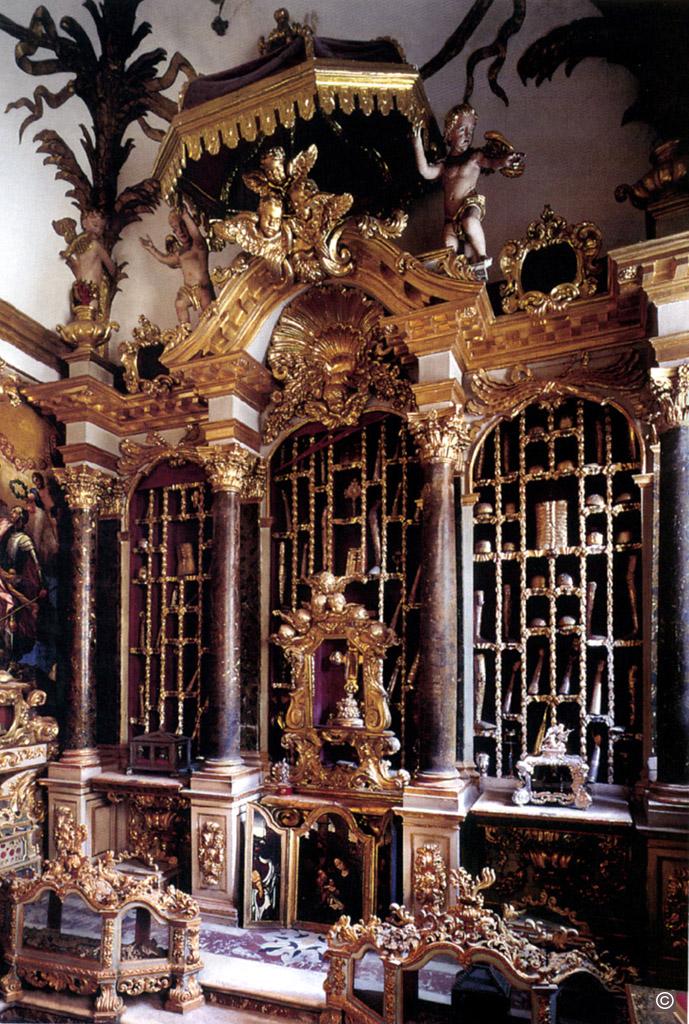
Reliquary of Dubrovnik Cathedral
1712
Marino Gropelli (1662–1728); Carlo Degli Frangi [n.d.]; Valentino Vissani [n.d.]; Petar Matej [n.d.]
Death is one of the central motifs of Baroque art. It is also the motive of this huge reliquary, which belongs in a room decorated by several artists including the Venetian sculptor and architect, Marino Gropelli, the stuccators, Carlo Deli Franghi and Valentino Vissani, and the Dubrovnik painter, Petar Matej.
Selected bibliography:
Prijatelj, K., “Dokumenti za historiju dubrovačke barokne arhitekture” in Tkalčićev zbornik II, Zagreb, 1958, pp. 117–156.
Prijatelj, K., “Barok u Dalmaciji”, in Horvat, A., (ed), Barok u Hrvatskoj, Zagreb, 1982, pp. 649–916.
Tomić R., Barokni oltari i skulptura u Dalmaciji, Zagreb, 1995, pp. 117, 160–163, 193–194.
Horvat-Levaj, K.,“Tommaso Napoli u Dubrovniku” in Umjetnički dodiri dviju jadranskih obala u 17. i 18. stoljeću – zbornik radova, (eds) V. Marković and I. Prijatelj-Pavičić, Split, 2007, pp. 31–52.
Citation of this web page:
Katarina Horvat-Levaj "Cathedral of the Assumption of Mary, Dubrovnik" in "Discover Baroque Art", Museum With No Frontiers, 2026.
https://baroqueart.museumwnf.org/database_item.php?id=monument;BAR;hr;Mon11;6;en
Prepared by: Katarina Horvat-LevajKatarina Horvat-Levaj
SURNAME: Horvat-Levaj
NAME: Katerina
AFFILIATION: Institute of Art History, Zagreb
TITLE: PhD, Scientific Consultant
CV:
Katerina Horvat-Levaj graduated with a BA in Art History and Archaeology in 1981 from the University of Zagreb (Faculty of Philosophy, Department of Art History). In 1985 she obtained her MA and in 1988 she was awarded a scholarship at the University of Padua. In 1995 she defended her Doctorate at Zagreb University on Representative Residential Architecture of the Baroque in Dubrovnik. Since 1982, she has been employed at the Institute of Art History in Zagreb, and is presently a Senior Research Associate. Katarina also teaches at the University of Split. At the University of Zagreb she participates at doctoral level in the Faculty of Croatian Studies and the faculties of Architecture and Philosophy.
Translation by: Graham McMaster
Translation copyedited by: Mandi GomezMandi Gomez
Amanda Gomez is a freelance copy-editor and proofreader working in London. She studied Art History and Literature at Essex University (1986–89) and received her MA (Area Studies Africa: Art, Literature, African Thought) from SOAS in 1990. She worked as an editorial assistant for the independent publisher Bellew Publishing (1991–94) and studied at Bookhouse and the London College of Printing on day release. She was publications officer at the Museum of London until 2000 and then took a role at Art Books International, where she worked on projects for independent publishers and arts institutions that included MWNF’s English-language editions of the books series Islamic Art in the Mediterranean. She was part of the editorial team for further MWNF iterations: Discover Islamic Art in the Mediterranean Virtual Museum and the illustrated volume Discover Islamic Art in the Mediterranean.
True to its ethos of connecting people through the arts, MWNF has provided Amanda with valuable opportunities for discovery and learning, increased her editorial experience, and connected her with publishers and institutions all over the world. More recently, the projects she has worked on include MWNF’s Sharing History Virtual Museum and Exhibition series, Vitra Design Museum’s Victor Papanek and Objects of Desire, and Haus der Kulturen der Welt’s online publication 2 or 3 Tigers and its volume Race, Nation, Class.
MWNF Working Number: HR 07