

 Back
Back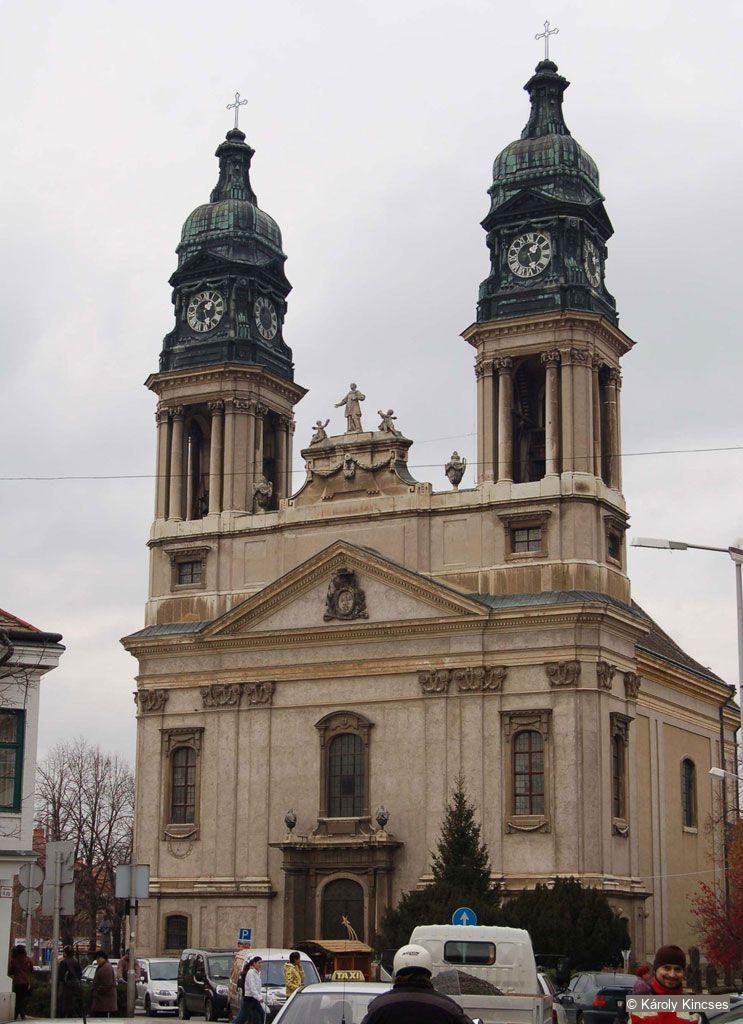
 Add to My Collection
Name of Monument:
Parish Church of St. Stephen the Protomartyr
Also known as:
Roman Catholic Parish Church
Location:
Pápa, Nyugat-Magyarország / West Hungary, Hungary
Fő tér 11
8500 Pápa
T : +36 06 89 324 105
Catholic Church of Hungary (Responsible Institution)
Date:
1774–1786
Artists:
Architects: Jakab Fellner of Fellenthal (1722–1780), József Grossmann (1747–1785); painters: Franz Anton Maulbertsch (1724–1796), Hubert Maurer (1738–1818), János Zirckler, August Rummel, Johann Maidinger; sculptors: Johann Messerschmidt, Johann Georg Mess, Martin Rumpelmayer, Carlo Adami, Giacomo Adami, Philipp Jakob Prokop
Denomination / Type of monument:
Religious architecture, parish church
Patron(s):
Count Károly Esterházy, Bishop of Eger (1725–1799)
History:
In 1771 Bishop of Eger Károly Esterházy, decided to demolish the Medieval Church of Pápa dedicated to St. Stephen the Protomartyr, and build a new church on the same site. He entrusted Jakab Fellner, the family's architect, to design the plans and oversee the construction. Fellner worked on the project between 1774 and 1780 and, after his death, József Grossman continued the work until 1785. The interior decoration of the church was created by the Viennese painter, Franz Anton Maulbertsch and his team of architectural painters, between 1782 and 1783.
The Bishop decided that the grisaille scenes of the pendentives under the three cupola murals, should be similar in terms of theme (and sometimes even in terms of the figures used) to the murals portraying the story of St. Stephen the Protomartyr in the Church of Santo Stefano Rotondo in Rome (the “Hungarian Church”), painted by Niccolò Circignani in 1582, and of which the Bishop had made colourful sketches as a reference from which Maulbertsch and his team worked.
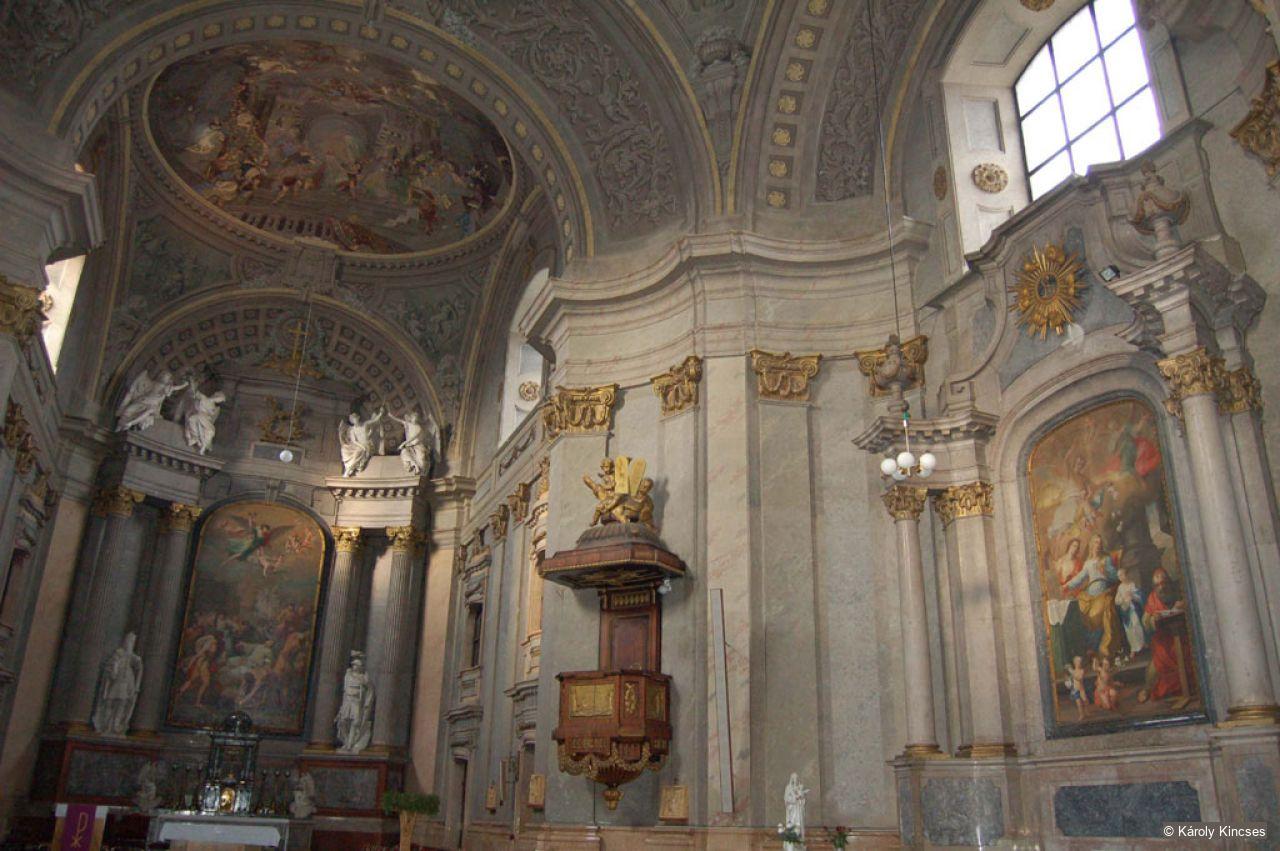
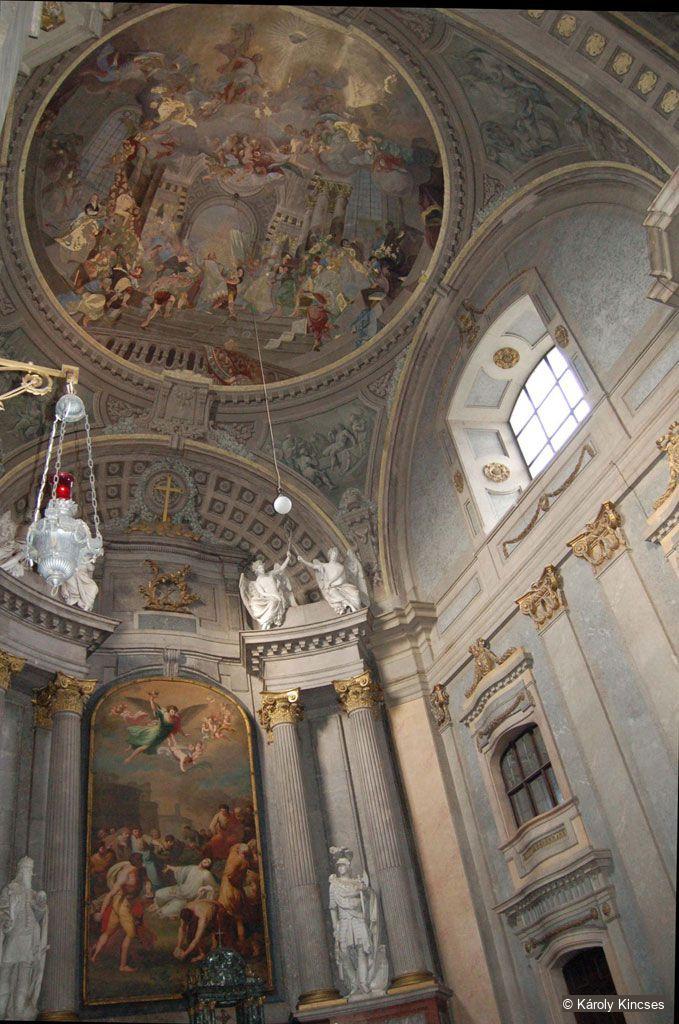
Other elements of the church decoration were the work of several masters: Johann Messerschmidt created the statue group on the façade; other stone decorations were made by Johann Georg Mess and Martin Rumpelmayer. The main and side altars were built by József Grossman, and the marble decorations of the main altar are by Carlo and Giacomo Adami, two masters from Süttő. The figures in Carrara marble are by Philipp Jakob Prokop. On the main altarpiece, the painting, The Stoning of Saint Stephen, is by Hubert Maurer from Vienna in 1785, and those on the side altars by János Zickler from Eger between 1783 and 1786. Károly Esterházy also appears in an altarpiece painting accompanied by St. Charles Borromeo, who was a personal beau ideal for the Bishop. The Church was consecrated in 1795.
Description:
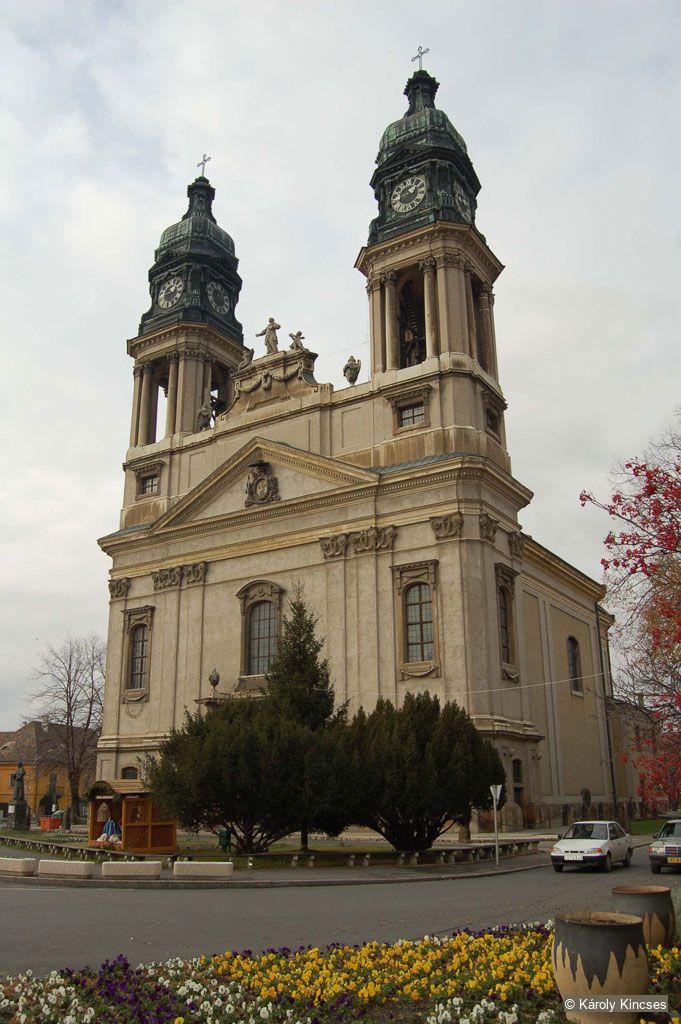
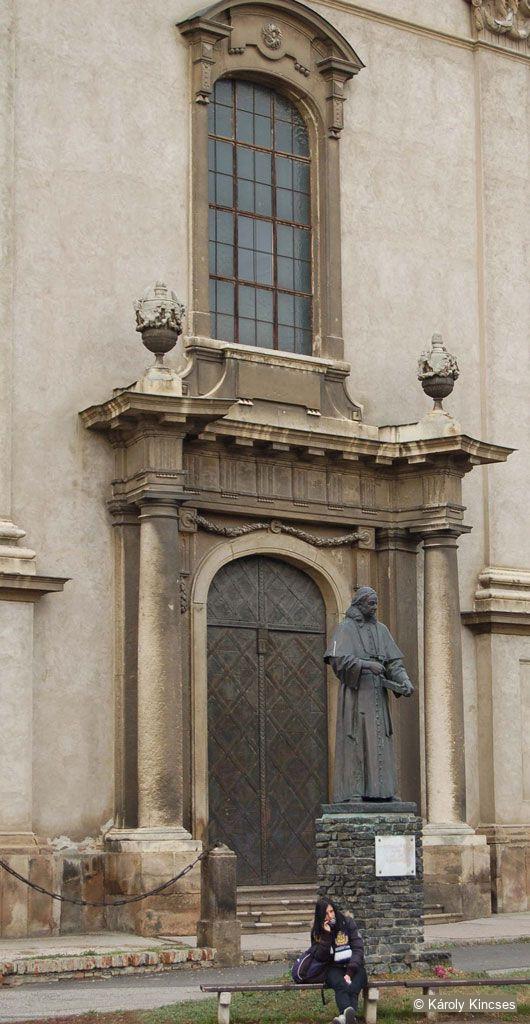
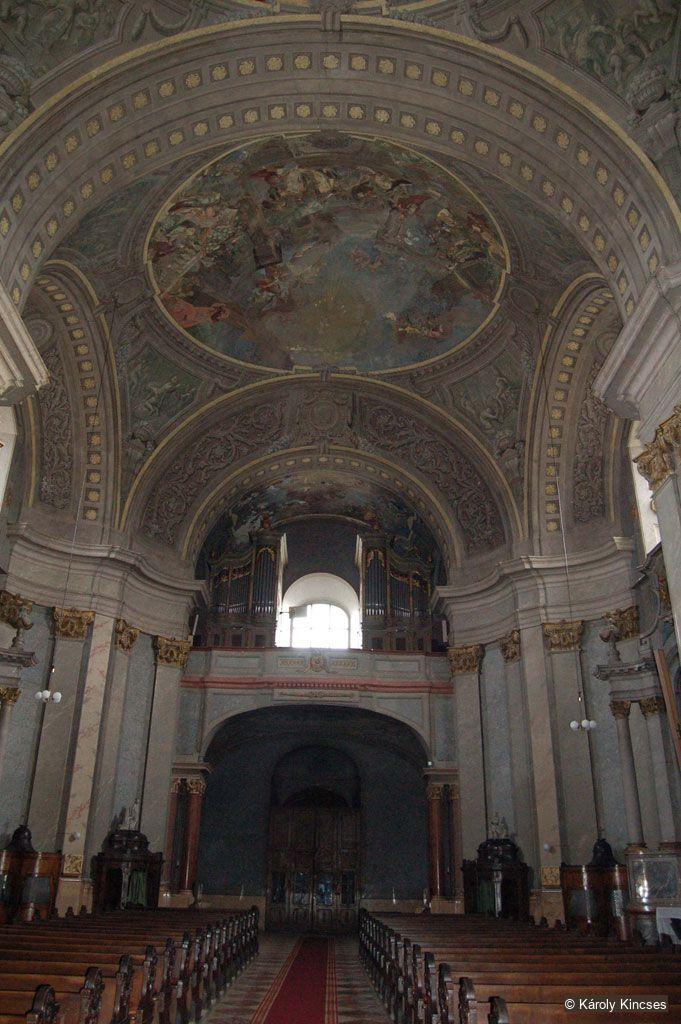
The Parish Church of Pápa, with its façade bearing Classicist features and its two emphatic front towers, is a Late Baroque creation that reflects the refined taste of the Bishop of Eger, Károly Esterházy. The entirely flat façade is articulated by smooth pillars with Ionic capitals. Above the pillars, on the simple main moulding, is a tympanum that frames the Bishop's coat of arms. Two towers are mounted above the attic the highest tops of which are held by columns and pillars, the latter angled by 45 degrees on the façade, which brings to mind the monumentality of Roman Baroque. On the gables in between the towers, and surrounded by decorative vases, is a statue group of St. Stephen the Protomartyr and two angels.
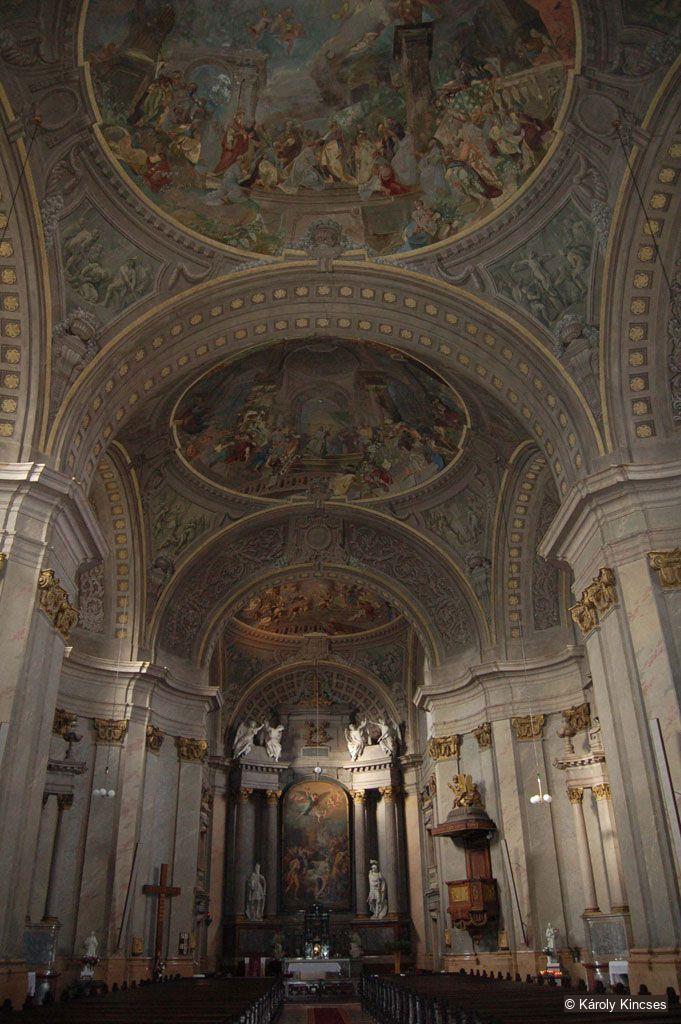
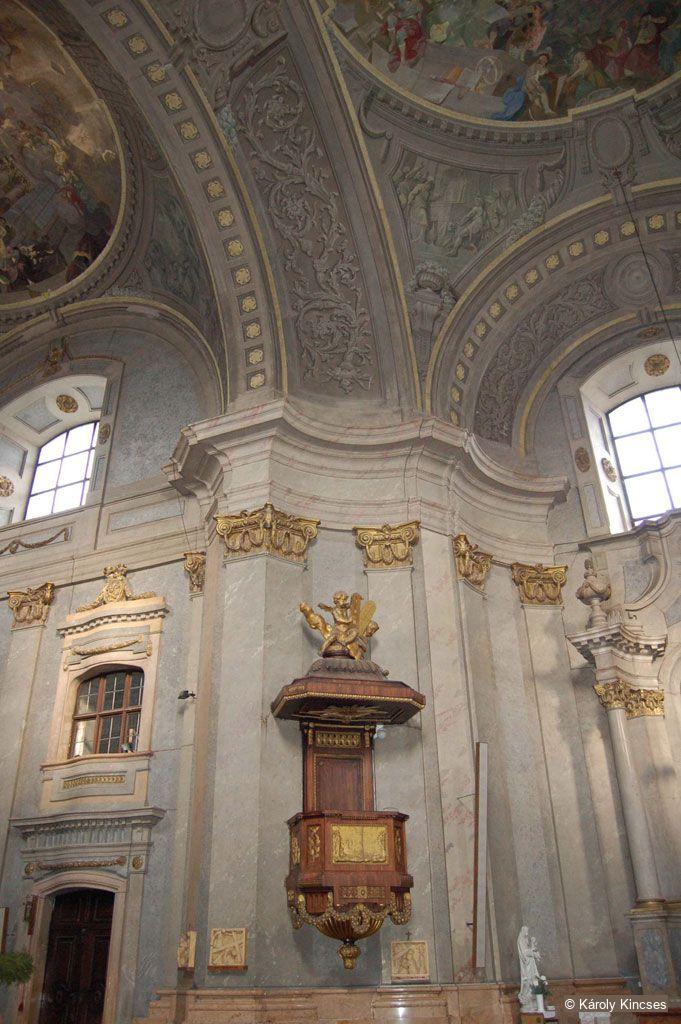
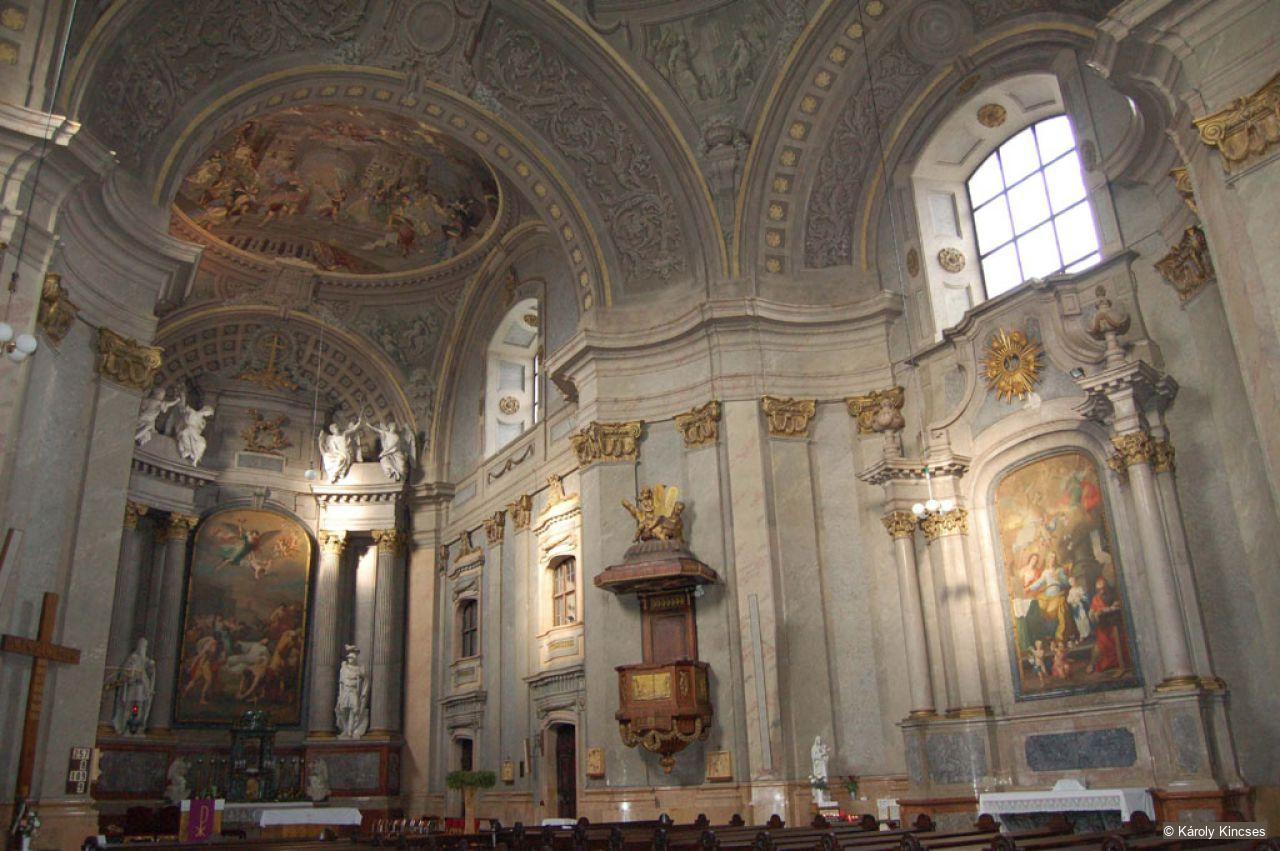
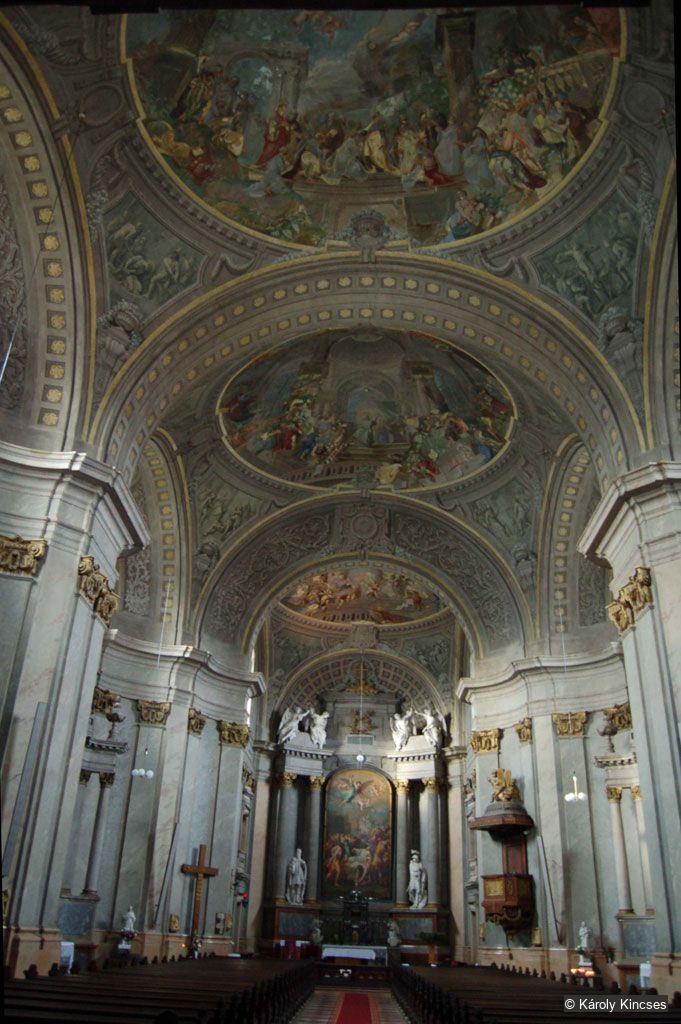
Inside, the nave is composed of an entrance hall, two sections covered by flat “cupolas”, and the sanctuary topped by a cupola. There are no side chapels along the nave as the aim of the designer was to create a space that could easily be taken in at a glance from any standpoint.
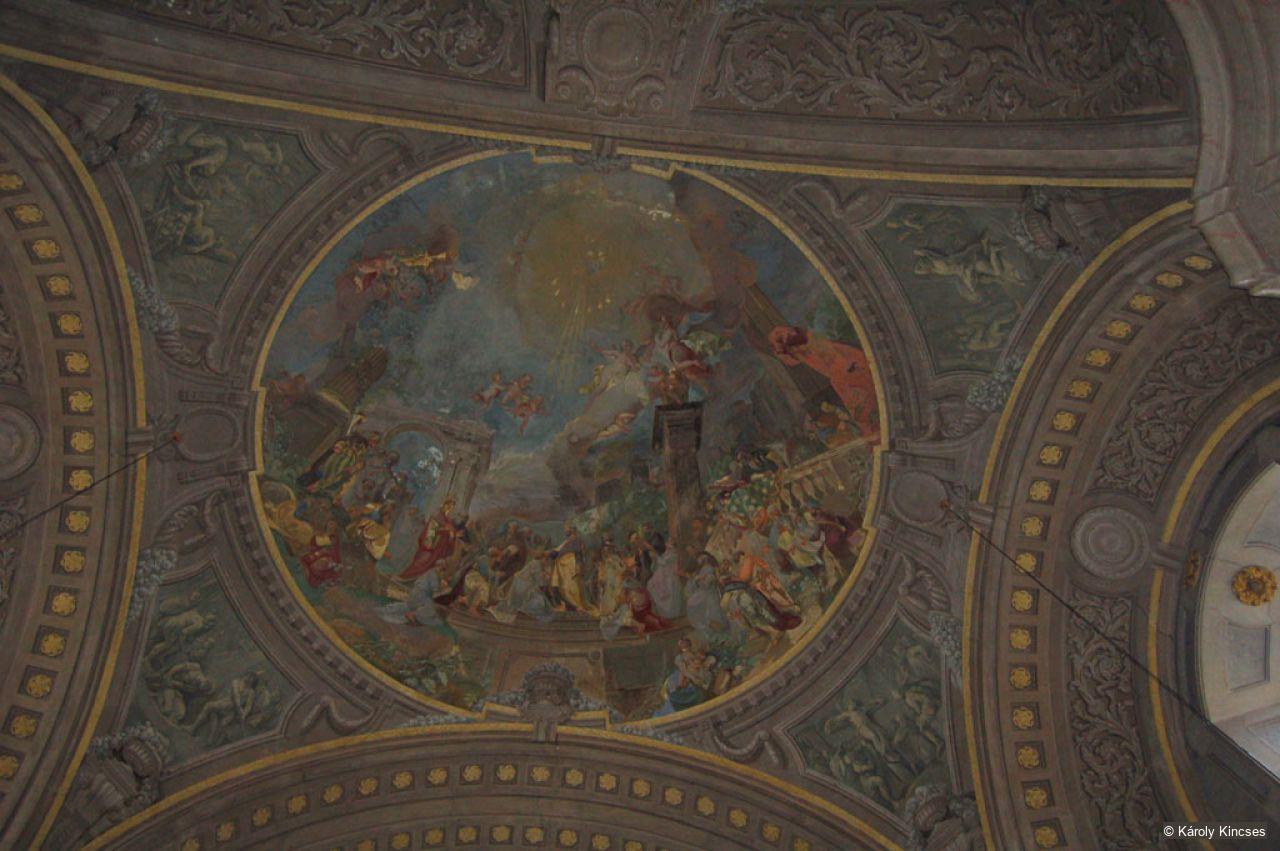
The painted decorations of the church include the colourful scenes in the frame of the quadratura (painted perspectives of architecture) on the cupolas, and the grisaille paintings on the pendentives that Maulbertsch termed “high reliefs” and which follow the frescoes of the Church of Santo Stefano Rotondo in Rome.
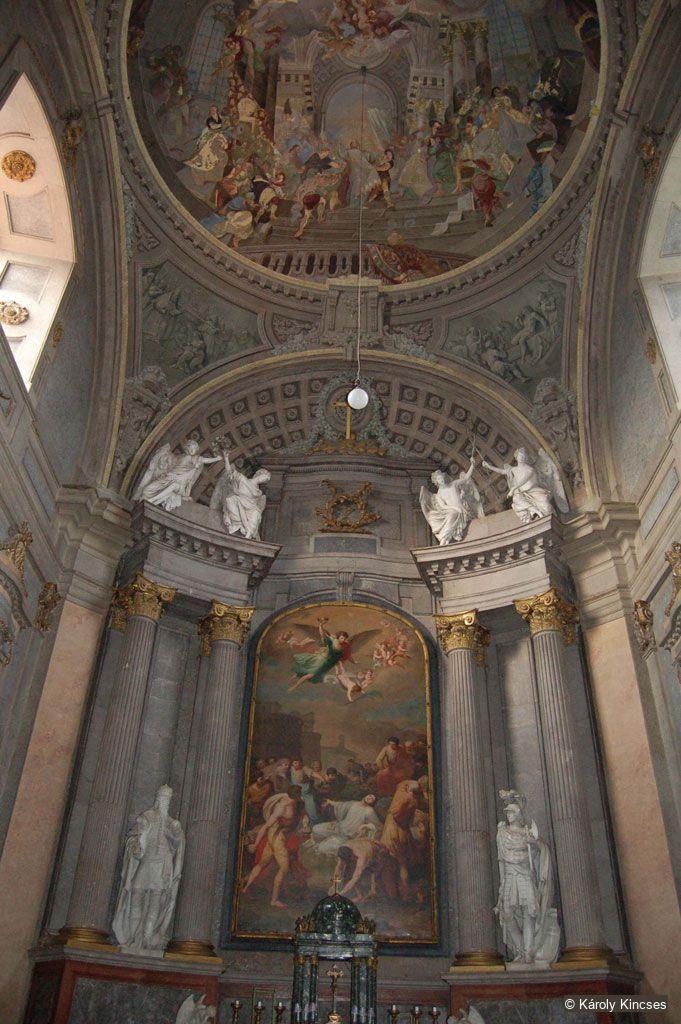
Further paintings include the Twenty-Four elders Praising the Lord from the Book of Revelation above the organ-loft by the entrance; St. Stephen and his Followers Being Ordained as Deacons on the first section of the cupola and the Martyrdom of the Followers of St. Stephen on the pendentives; St. Stephen Preaching in a Church on the second section of the cupola, and the Miraculous Deeds of St. Stephen on the pendentives; St. Stephen Being Dragged to the Synagogue and his Heavenly Revelation on the sanctuary cupola, and depictions of the Miracles after the Death of St. Stephen on the pendentives.
In his program from 1779 the Bishop emphasised one scene in particular from the latter depictions – also seen in the Church of Santo Stefano Rotondo in Rome – in which St. Stephen the Protomartyr appears to Sarolta wife of Géza, Grand Prince of the Magyars, and prophesies the birth of her son, King St. Stephen (Szent István).
There are other works by Maulbertsch in the vestry and chapel. The main altar holds a statue of two angels with the figures of St. Stephen and St. Andrew, made of Carrara marble either side, and a painting, The Stoning of St. Stephen, in the middle. On the instructions of the Bishop, four side-altars were built (consecrated to the Deaths of St. Joseph, St. Anne and St. Mary, St. John of Nepomuk, and St. Charles Borromeo).
Count Károly Esterházy (Bishop of Eger and an outstanding benefactor of his time) ordered construction of the parish church in Pápa. The Bishop, who was a follower of the more modern spiritual trends of the Catholic church, defined the details of the construction and the decoration in several programs. He found the most suitable practitioners for the job: the architect Jakab Fellner, the family's architect, and the painter Franz Anton Maulbertsch. The completed church, along with all its architectural forms and mural formations, reflect the Bishop's rational intellectuality, or in Maulbertsch's words [the building is] “bright, quietly ordered and easily recognisable in terms of [the character's] clothing and clarity of the stories”.
How Monument was dated:
Based on written and visual sources, and stylistic research.
Selected bibliography:
Pigler, A., A pápai plébániatemplom és mennyezetképei (The Parish Church of Pápa and its Murals), Budapest, 1922.
Garas, K., Magyarországi festészet a XVIII. században (Painting in Hungary in the 18th century), Budapest, 1955, pp. 85–89.
Aggházy, M., A barokk szobrászat Magyarországon (Baroque Sculpture in Hungary), Vols. 1–3, Budapest, 1959, Vol. 2, p. 207.
Gerő, L., Sedlmayr, J., Pápa, Budapest, 1959, pp. 160—167.
Citation of this web page:
Péter Sárossy "Parish Church of St. Stephen the Protomartyr" in "Discover Baroque Art", Museum With No Frontiers, 2026.
https://baroqueart.museumwnf.org/database_item.php?id=monument;BAR;hu;Mon11;13;en
Prepared by: Péter Sárossy Péter Sárossy
SURNAME: Sárossy
NAME: Péter
AFFILIATION: National Trust of Monuments for Hungary
TITLE: Art Historian; MWNF DBA author (Hungary)
CV:
Péter Sárossy works as an Art Historian at The National Trust of Monuments for Hungary. Awarded his MA in Art History and Italian Studies at the Eötvös Loránd University in Budapest, he then completed a fellowship in Italy. Currently, Péter is a PhD student at the same university in the Faculty of Humanities, Italian Literature and Civilisation. Formerly, he worked as an Art Historian at the State Centre for the Conservation and Restoration of Historic Monuments, Budapest, and lectured in Baroque Literary Theory at the Eötvös Loránd University. He has published on a wide range of subjects, including ancient and modern Italian art and literature and the history of conservation in Hungary. He is a contributing author for MWNF DBA (Hungary).
Copyedited by: Terézia BardiTerézia Bardi
SURNAME: Bardi
NAME: Terézia Anna
AFFILIATION: National Trust of Monuments for Hungary
TITLE: Art Historian, Vice Director for Research at The National Trust of
Monuments for Hungary; MWNF DBA local co-ordinator (Hungary), author
and copy-editor
CV:
Terézia Bardi, Vice Director for Research at the National Trust of Monuments for Hungary since 2004, was awarded her MA in History and History of Art at the Eötvös Loránd University in Budapest. After a period of fellowships mainly in Italy, Terézia gained her PhD from the Faculty of Art History at the same university for her thesis Presentation and Representation – the European Reception of the Liberation of Buda in 1686: Feast and Public Opinion. Her main fields of research are 17th-and18th-century Baroque and Rococo: the spectacles, festival decorations and associated iconography – including theatre productions of the period – and interior decoration of historic houses. Since 1988, she has edited a number of art historical books that include some on Oriental art and architecture. She is MWNF DBA’s local (Hungarian) co-ordinator, author and copy-editor.
Translation by: Judit Harangozó, Philip Barker
Translation copyedited by: Mandi GomezMandi Gomez
Amanda Gomez is a freelance copy-editor and proofreader working in London. She studied Art History and Literature at Essex University (1986–89) and received her MA (Area Studies Africa: Art, Literature, African Thought) from SOAS in 1990. She worked as an editorial assistant for the independent publisher Bellew Publishing (1991–94) and studied at Bookhouse and the London College of Printing on day release. She was publications officer at the Museum of London until 2000 and then took a role at Art Books International, where she worked on projects for independent publishers and arts institutions that included MWNF’s English-language editions of the books series Islamic Art in the Mediterranean. She was part of the editorial team for further MWNF iterations: Discover Islamic Art in the Mediterranean Virtual Museum and the illustrated volume Discover Islamic Art in the Mediterranean.
True to its ethos of connecting people through the arts, MWNF has provided Amanda with valuable opportunities for discovery and learning, increased her editorial experience, and connected her with publishers and institutions all over the world. More recently, the projects she has worked on include MWNF’s Sharing History Virtual Museum and Exhibition series, Vitra Design Museum’s Victor Papanek and Objects of Desire, and Haus der Kulturen der Welt’s online publication 2 or 3 Tigers and its volume Race, Nation, Class.
MWNF Working Number: HU 13