

 Back
Back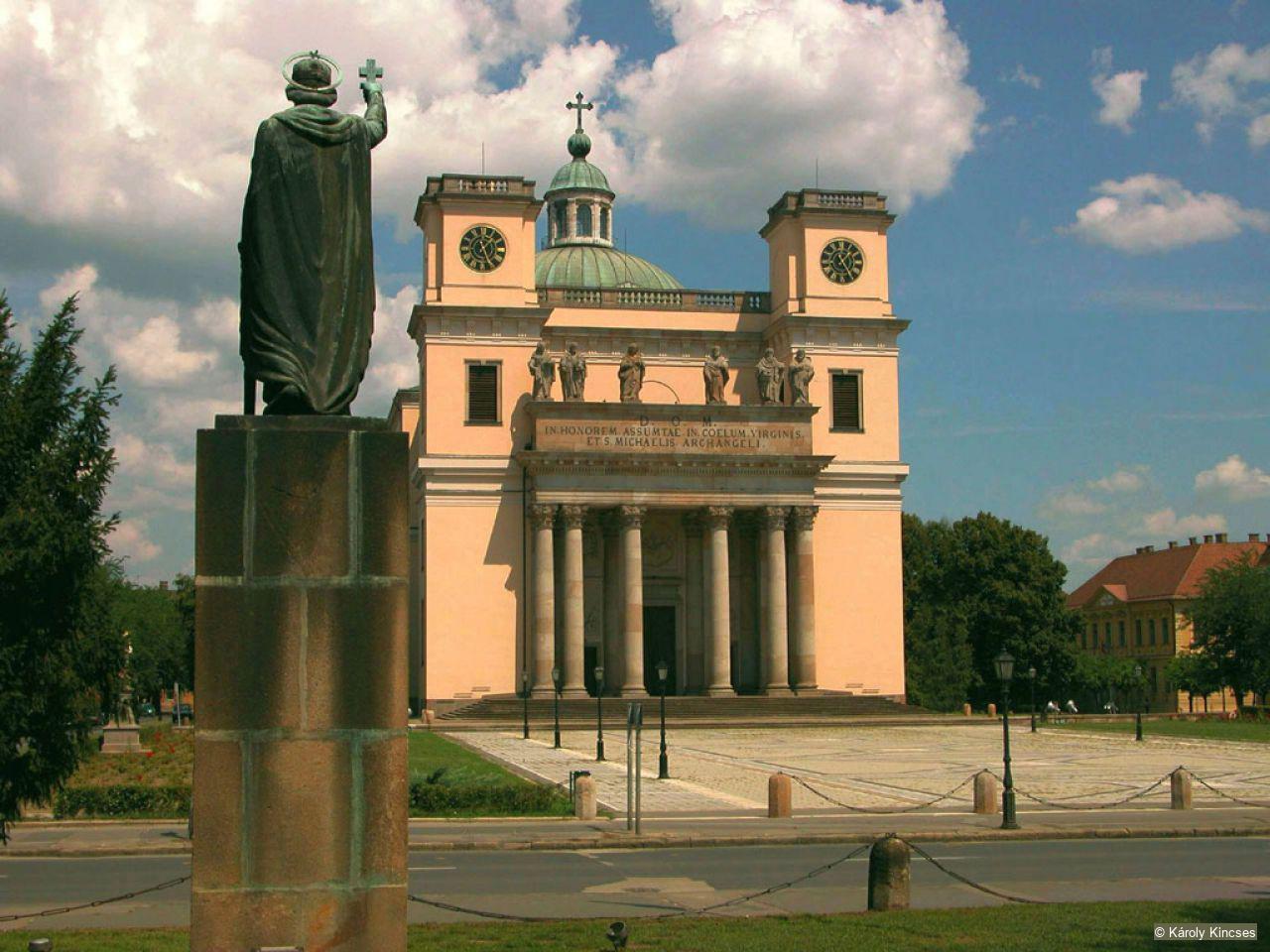
 Add to My Collection
Name of Monument:
Vác Cathedral
Also known as:
Cathedral of Our Lady
Location:
Vác, Közép-Magyarország / Central Hungary, Hungary
Konstantin tér 7
2600 Vác
T : +36 27 317 010
Catholic Church in Hungary, Diocese of Vác (Responsible Institution)
Date:
1761–1777; 1792
Artists:
Architect: Isidore Ganneval (c. 1730–1786); stonemason: Matthias Chmelik; sculptors: Joseph Bechert, Carlo Adami, Joseph Minich; painters: Franz Anton Maulbertsch (1724–1796), J. M. Schmidt (alias Feigel Georg Kremserschmidt), Balthasar Fischer, Valentin Steiner; Marbling: Martin Karl Keller; Joiner: Joseph Regele; master blacksmith: Johann Georg Birbaum; Bell founder: Adam Wieland; Glazier: Jakob Peziak
Denomination / Type of monument:
Religious architecture, cathedral
Patron(s):
Count Károly Esterházy, Bishop of Vác (1757–1761); Bishop Christoph Anton Migazzi (1756–1757; 1761–1785)
History:
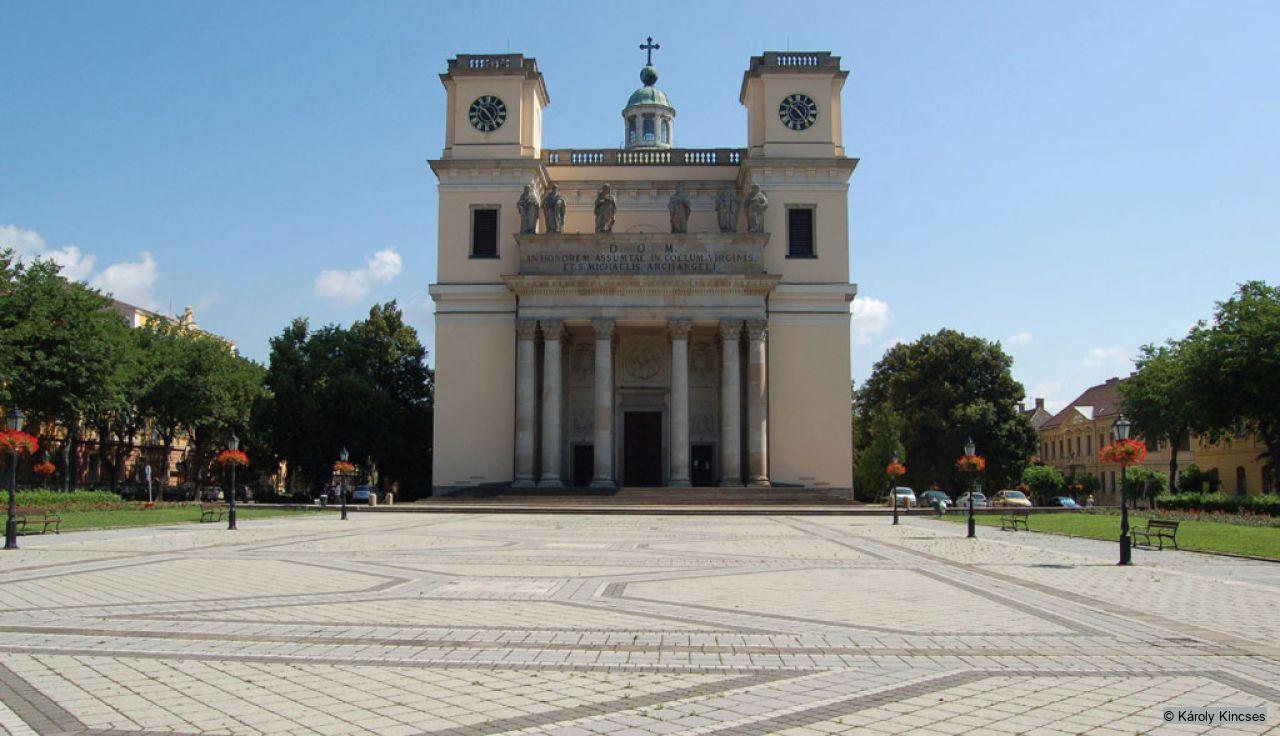
In 1760, the Bishop of Vác, Count Károly Esterházy, asked Franz Anton Pilgram to design the new Vác Cathedral. The finished plans were for an extensive Baroque building complex, but in 1761 Esterházy was summoned to Eger to serve as Bishop there and his successor, Archbishop of Vienna Christoph Anton Migazzi, continued with the construction but requested new plans. The new designer was Isidore Ganneval from France (a student of Niccolò Servandoni) and he introduced Neo-Classicism to Migazzi's court. This style was composed of classical elements and simple geometric shapes, which at the time was a novelty in Central Europe. As construction had already begun according to Pilgram's designs, Ganneval incorporated the walls of the sanctuary into his own design.
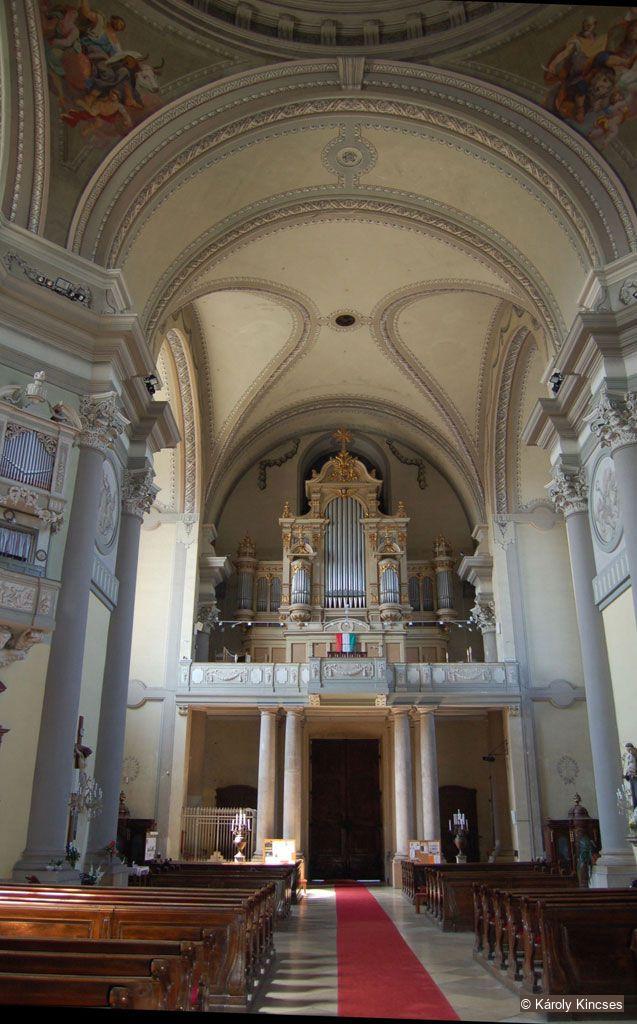
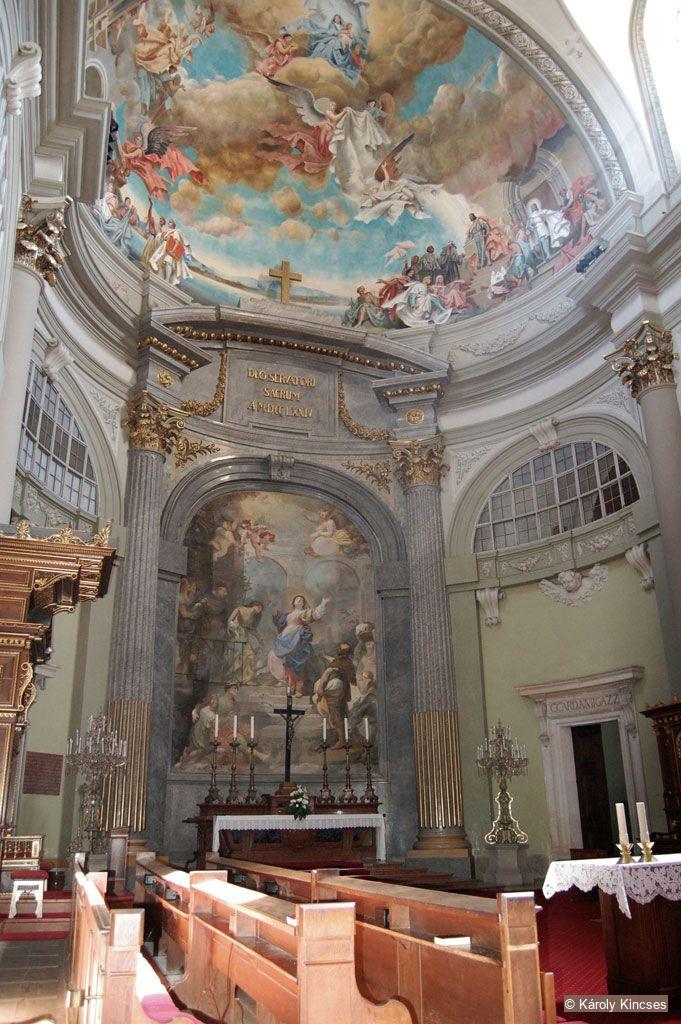
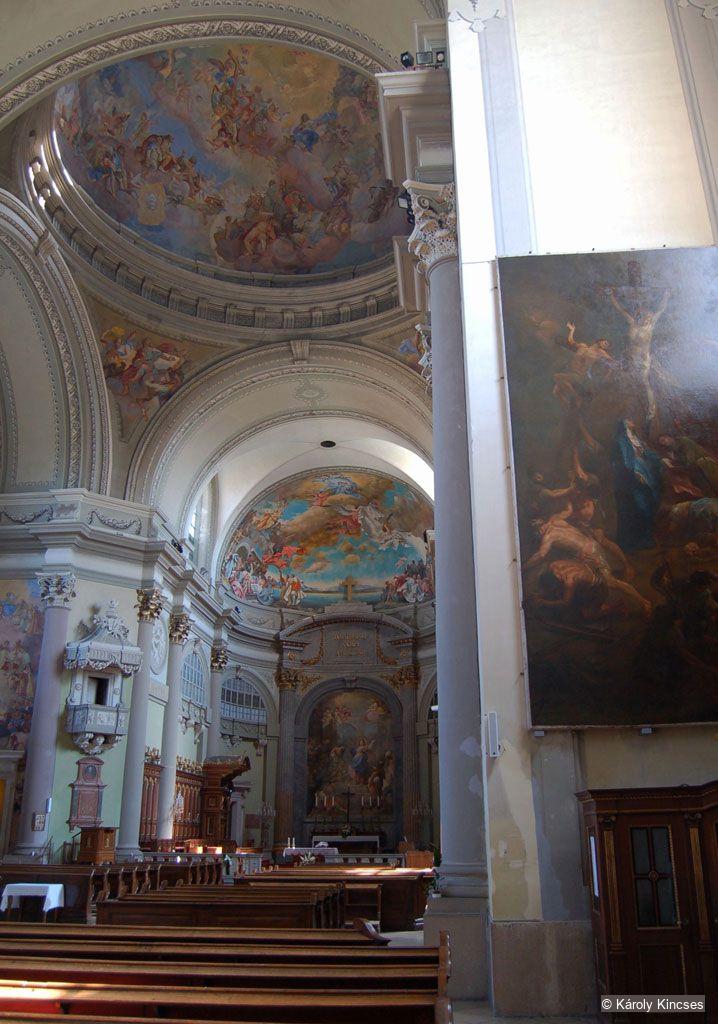
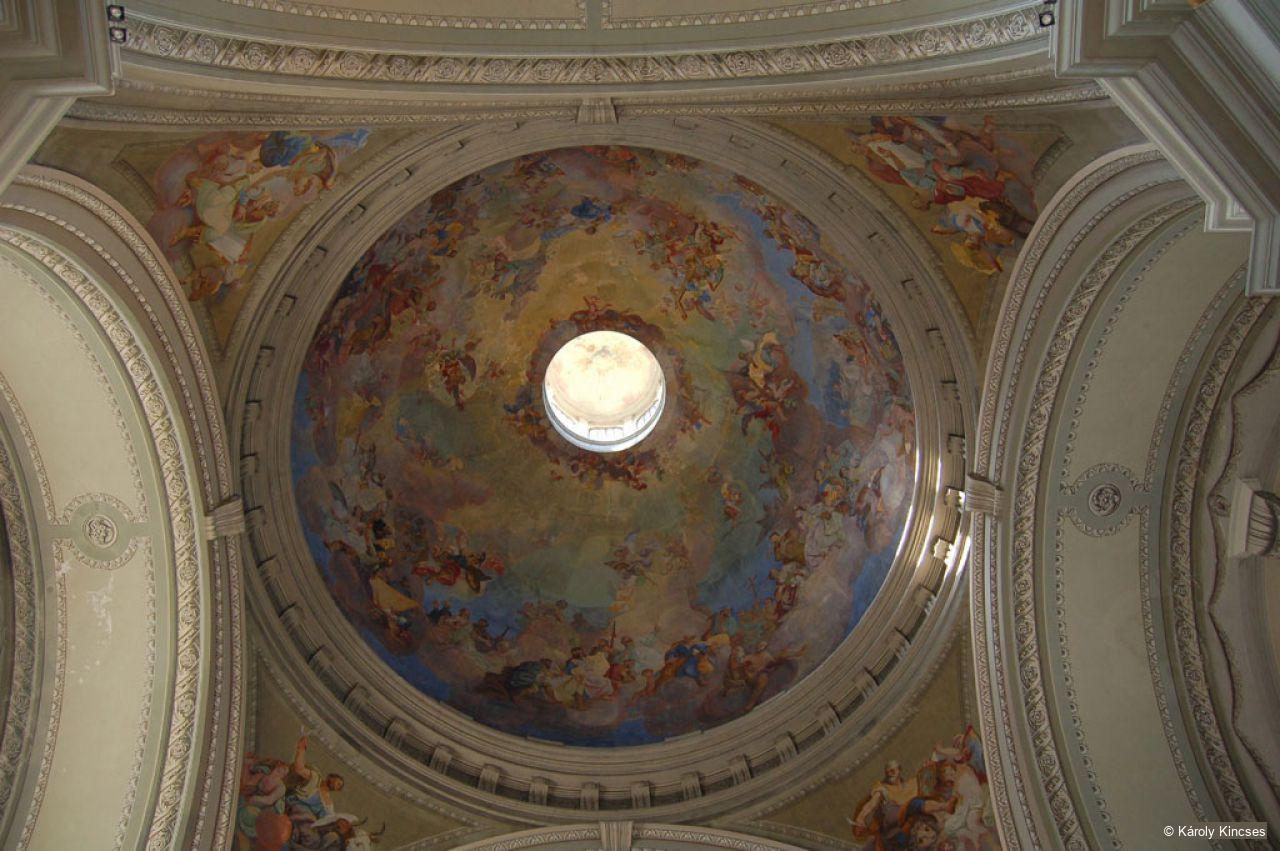
The dome over the central building is decorated with a fresco, the Triumph of the Holy Trinity by Franz Anton Maulbertsch, painted between 1770 and 1771. The main altarpiece painting, the Visitation, was also by Maulbertsch, but at Migazzi's request it was over-painted with a Crucifixion by Kremserschmidt; Maulbertsch's painting was only uncovered during renovation in 1942. By 1777, construction was complete with the clock-tower erected by 1792.
Description:
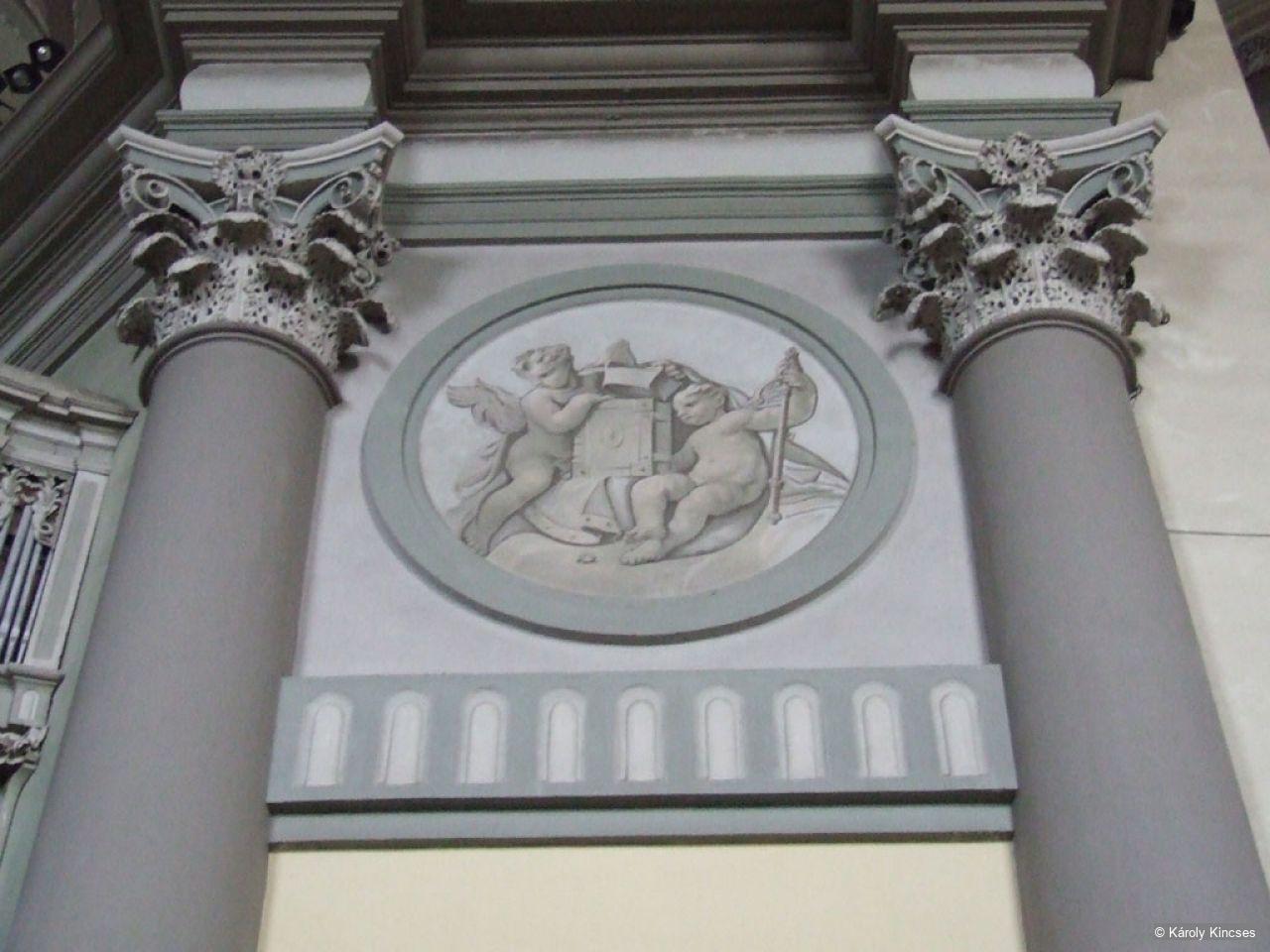
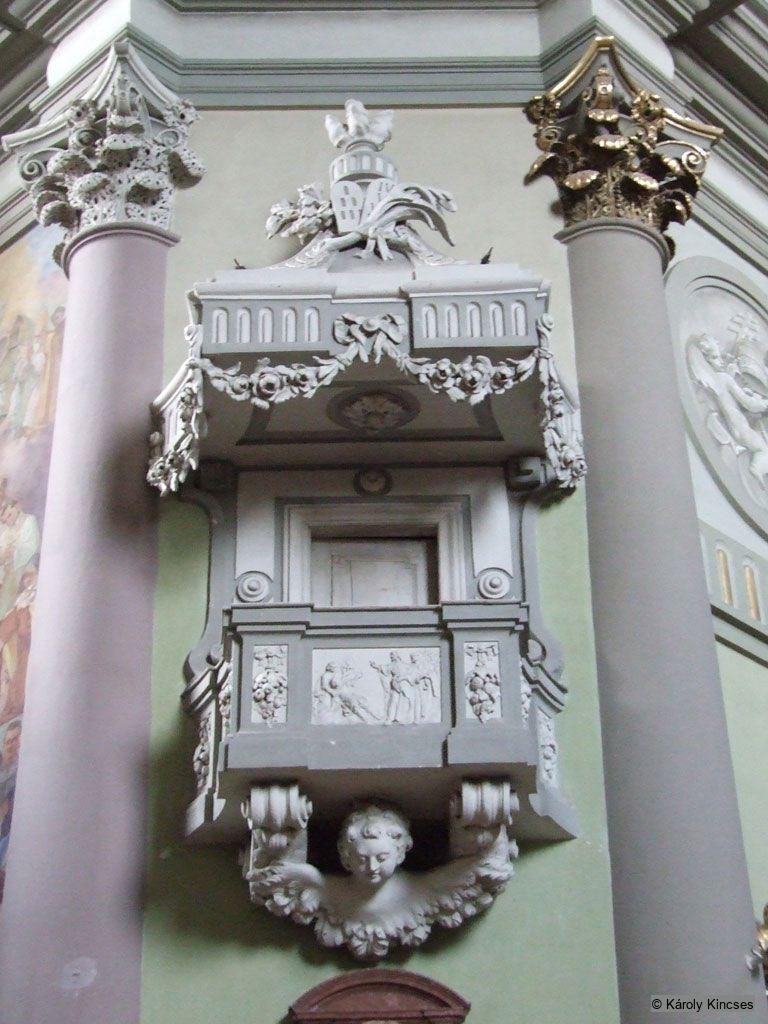
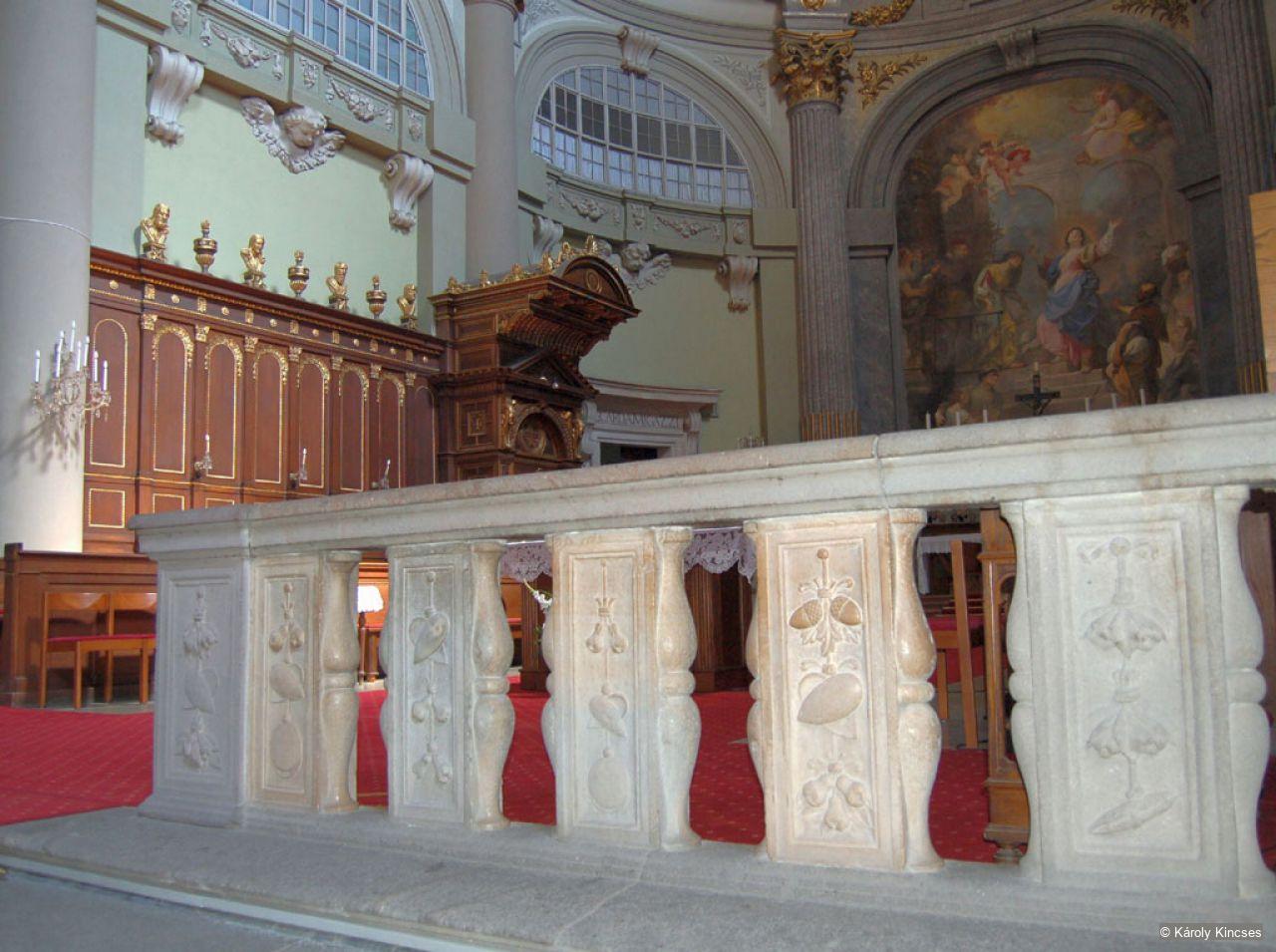
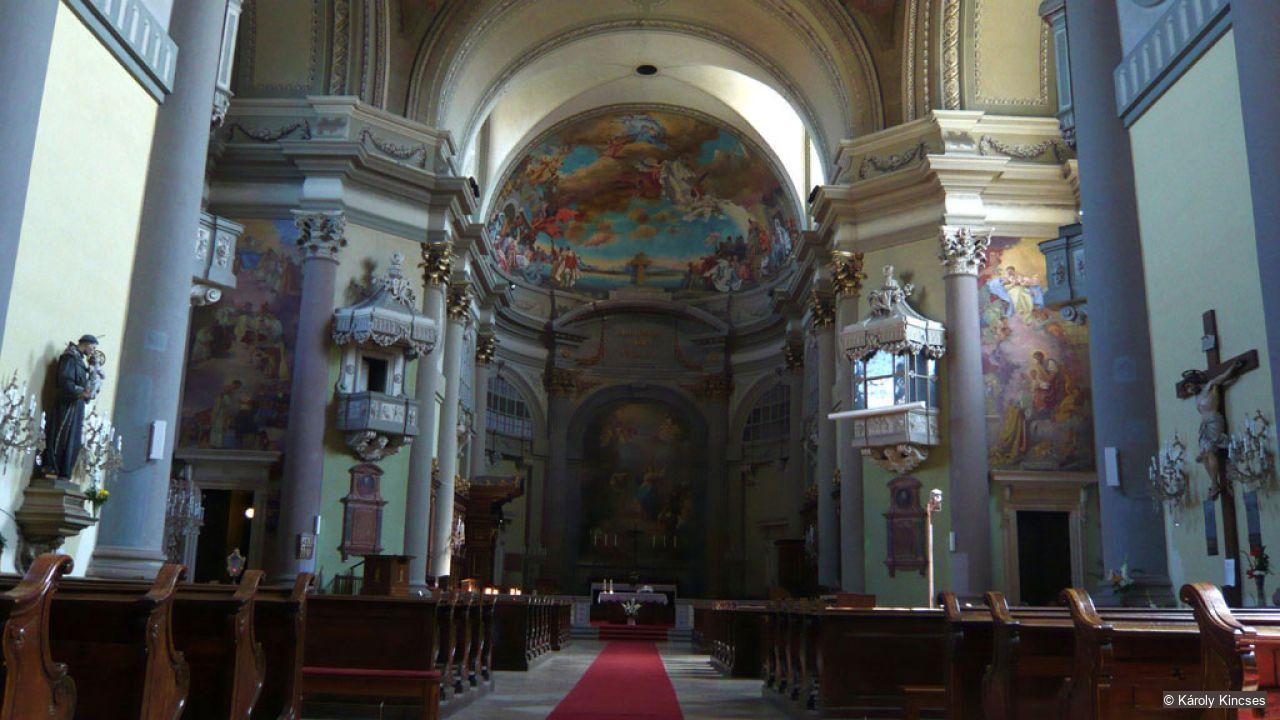
The cathedral is arranged around a central, open, floor plan. Under the organ loft is a section covered by a barrel-vault, either side of which are the Altars of St. Nicholas and St. John of Nepomuk; Kremserschmidt's Crucifixion is located in this section as well. The central area of the Cathedral is topped by a cupola without a drum, according to local architectural tradition, and painted with a rendition of the Triumph of the Holy Trinity. Either side are copies of paintings by Guido Reni: St. Michael the Archangel and the Assumption of the Virgin Mary. The extended sanctuary, on both sides of which are entrances to the vestries, is elevated, and the stone statuettes on the balustrade are 16th-century Renaissance works; the frescoes were painted in 1942. The walls of the church are articulated by Corinthian columns, and with its features simple and classical, the combined effect is monumental. The prebendary stalls were completed in 1829.
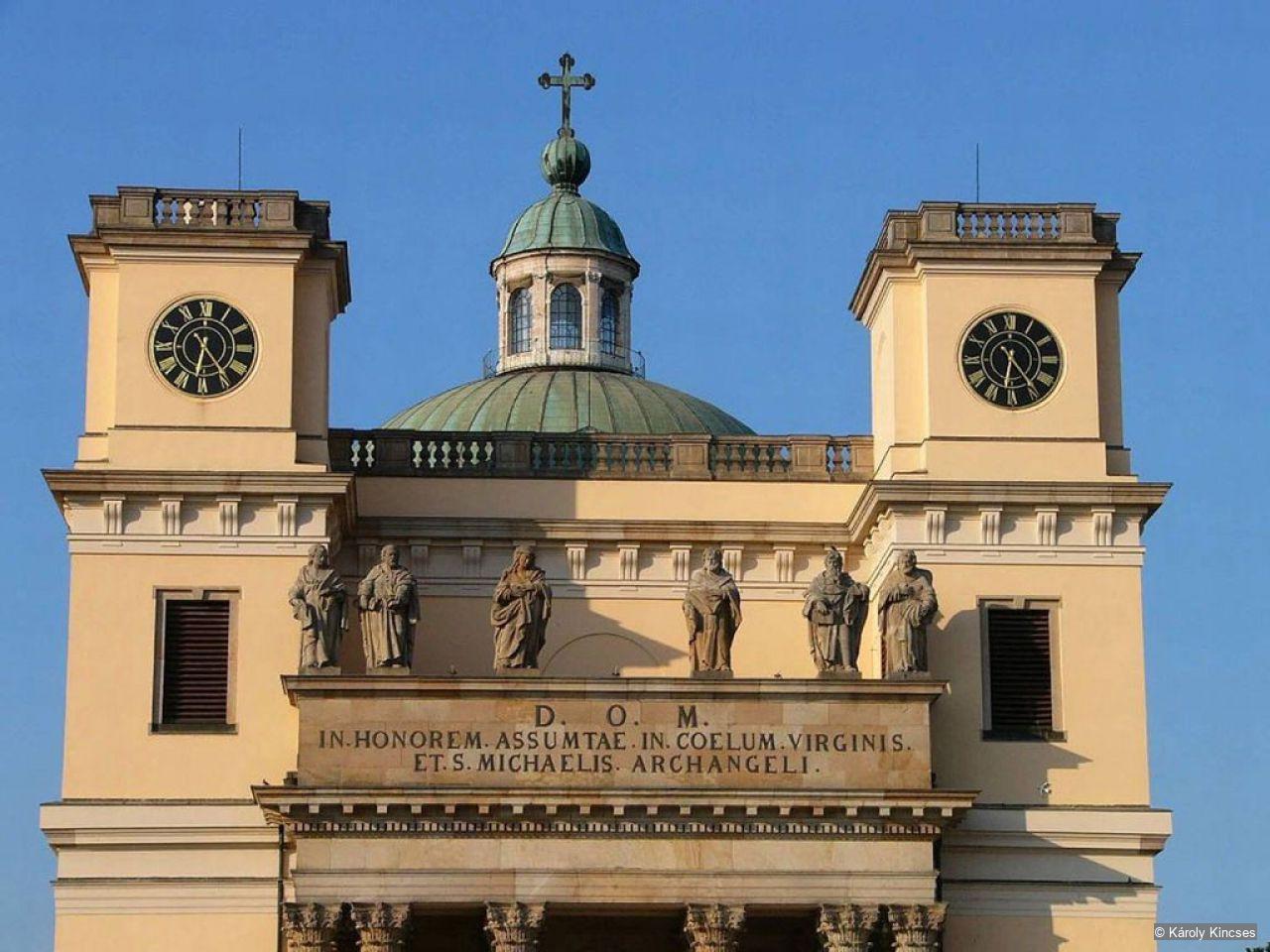
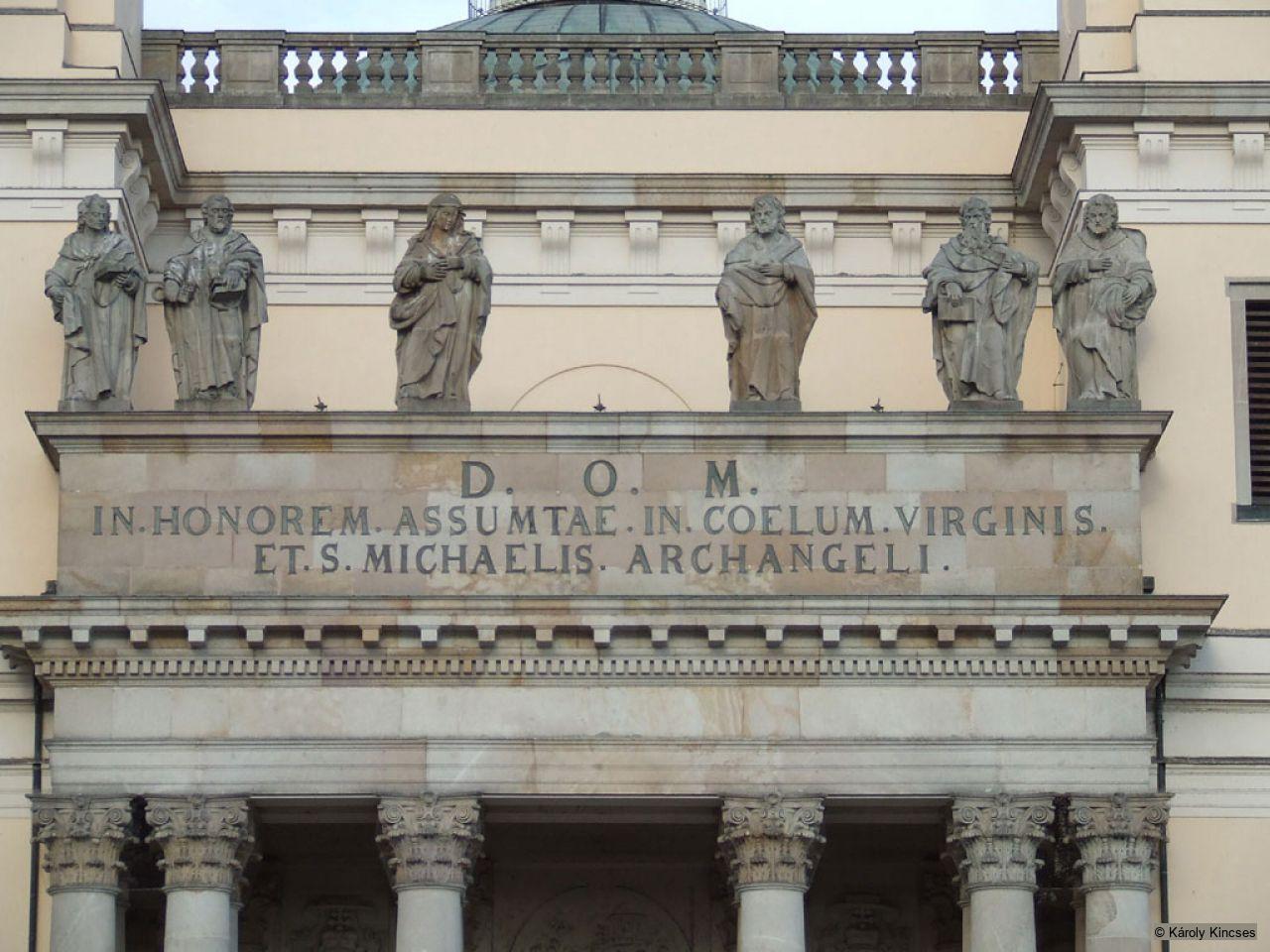
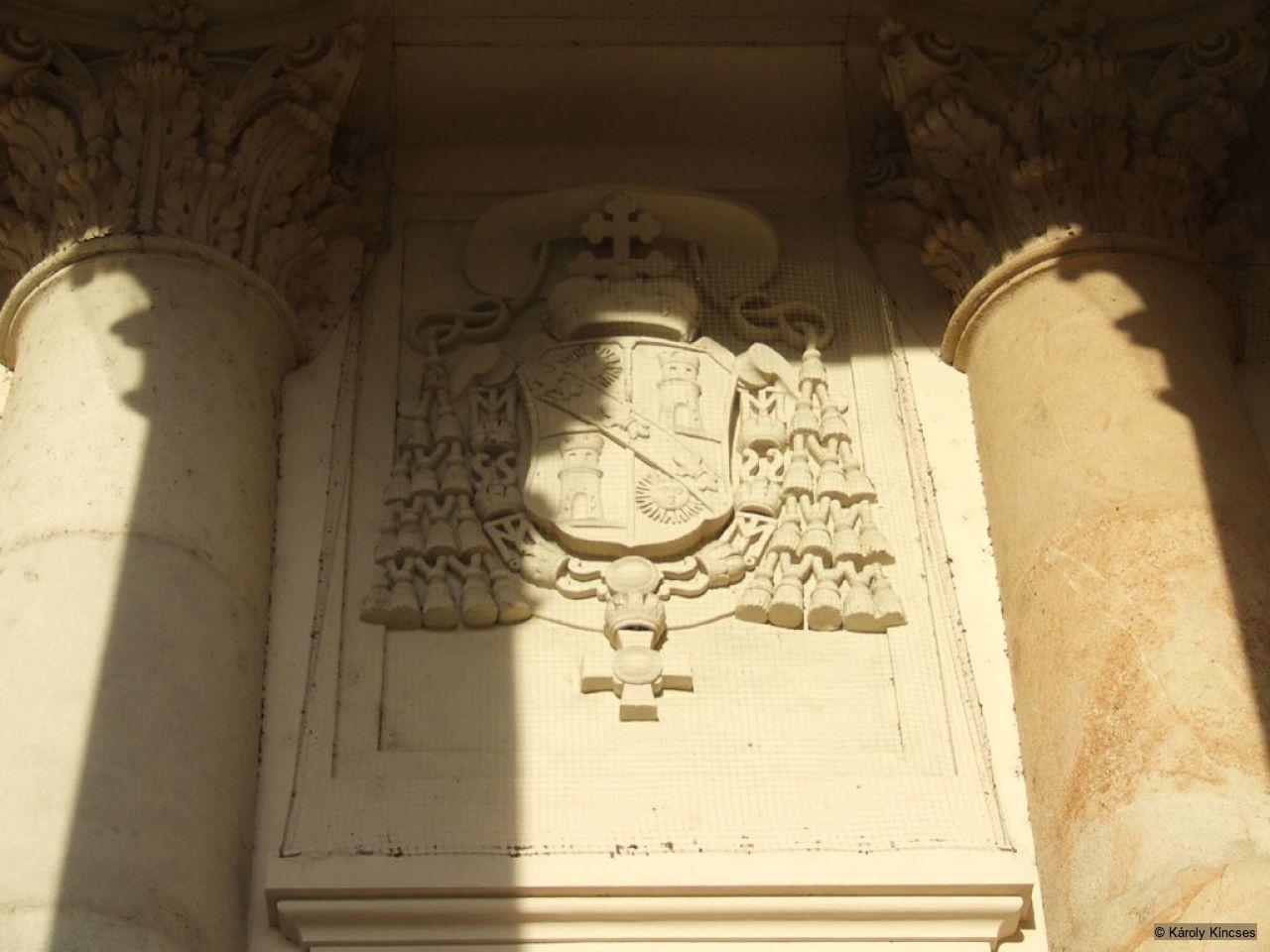
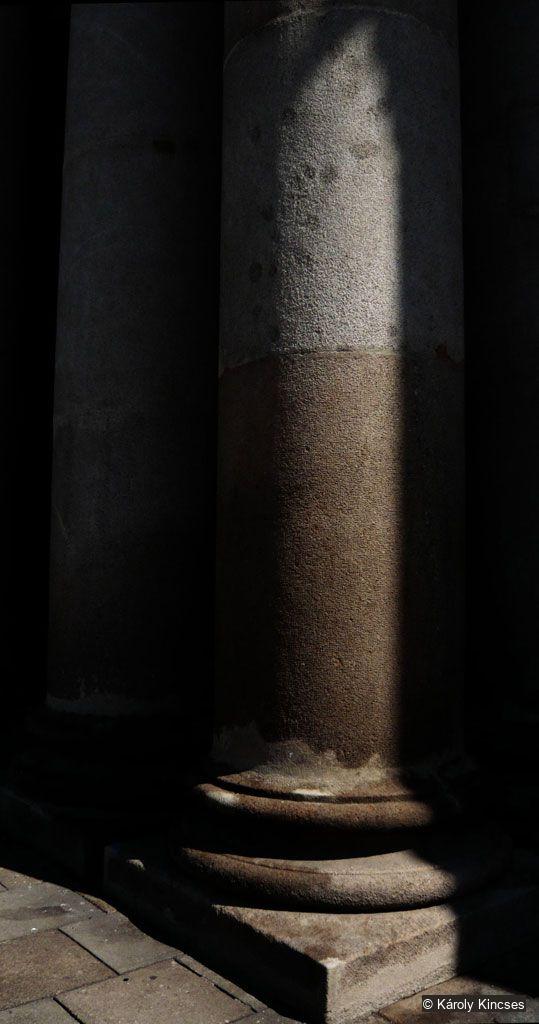
The layout of the façade is simple using basic cubic shapes. The monumental portico, guarded by a tower on both sides, consists of Corinthian columns and a 2-1-1-2 “rhythm”. This layout resembles the Church of Saint-Sulpice in Paris, which was designed by Niccolò Servandoni, Ganneval's tutor. Above the dentil mouldings are statues of the Virgin Mary, St. Joseph, St. Peter, St. Paul, St. John and St. Jacob. The inscription on the attic reads: “D. O. M. / IN. HONOREM. ASSUMTAE. IN. COELUM. VIRGINIS. / ET. S. MICHAELIS. ARCHANGELI”. (“D[eo]. O[ptimo]. M[aximo] – The God, The Blessed, The Greatest / In Honour of the Virgin [Mary's] Assumption to Heaven and to St. Michael Archangel”). Behind the columns, on the wall of the entrance hall, there are biblical scenes in high relief. Above the three entrance gates is Migazzi's coat-of-arms. Two doors open from the side walls of the entrance hall and bear the first (1761) and final year (1777) of construction. The entrance to the crypt is found behind the sanctuary, built in 1900, after the nave hatch was closed up.
Vác Cathedral was an outstanding building when it was built in the 18th-century. In both Hungary and Central Europe, it was a unique example of early French Neo-Classicism at a time when the Baroque, late Baroque and Rococo styles dominated. Combining Neo-Classical elements and simple geometric shapes, the building appeared exceptionally novel to Central Europeans of the time, and it was for this reason that local artists and craftsmen did not follow the style for decades to come.
How Monument was dated:
Based on written and visual sources.
Selected bibliography:
Bibó, I., “Études sur Ganneval”, Acta historiae artium Academiae Scientiarum Hungaricae, 42: 1–4, 2001, pp. 169–186.
Bibó, I., “A váci székesegyház helye és jelentősége a magyar építészet történetében”, Maradandóság és változás. Művészettörténeti konferencia. Ráckeve, 2000, (“The Place and Significance of the Cathedral of Vác in the History of Hungarian Architecture” Permanence and Change, Conference on Art History in Ráckeve, 2000), Budapest, 2004, pp. 205–218.
Dercsényi, D. (ed.), Pest megye műemlékei II (Monuments of Pest County Vol. II), Budapest, 1958, pp. 279–311.
Nefzger, U., “Die Romidee des Frühklassizismus und die Kathedrale in Waitzen”, Alte und Moderne Kunst, 28: 190–191, 1983, pp. 15–22.
Citation of this web page:
Áron Tóth "Vác Cathedral" in "Discover Baroque Art", Museum With No Frontiers, 2026.
https://baroqueart.museumwnf.org/database_item.php?id=monument;BAR;hu;Mon11;15;en
Prepared by: Áron Tóth Áron Tóth
SURNAME: Tóth
NAME: Áron
AFFILIATION: National Trust of Monuments for Hungary
TITLE: Art Historian; MWNF DBA author (Hungary)
CV:
Áron Tóth works as an Art Historian at The National Trust of Monuments for Hungary. He was awarded his MA in Art History at the Eötvös Loránd University in Budapest, and received his PhD at the university’s Institute of Art History in 2009. He was a scholar at the Research Institute for Art History at the Hungarian Academy of Sciences from 2005 until 2009. His research interests embrace 17th- and 18th-century architecture and architectural theory. He is Secretary for the Association Art Centre – New Workshop of Art Historians – in Budapest and a contributing author for MWNF DBA (Hungary).
Copyedited by: Terézia BardiTerézia Bardi
SURNAME: Bardi
NAME: Terézia Anna
AFFILIATION: National Trust of Monuments for Hungary
TITLE: Art Historian, Vice Director for Research at The National Trust of
Monuments for Hungary; MWNF DBA local co-ordinator (Hungary), author
and copy-editor
CV:
Terézia Bardi, Vice Director for Research at the National Trust of Monuments for Hungary since 2004, was awarded her MA in History and History of Art at the Eötvös Loránd University in Budapest. After a period of fellowships mainly in Italy, Terézia gained her PhD from the Faculty of Art History at the same university for her thesis Presentation and Representation – the European Reception of the Liberation of Buda in 1686: Feast and Public Opinion. Her main fields of research are 17th-and18th-century Baroque and Rococo: the spectacles, festival decorations and associated iconography – including theatre productions of the period – and interior decoration of historic houses. Since 1988, she has edited a number of art historical books that include some on Oriental art and architecture. She is MWNF DBA’s local (Hungarian) co-ordinator, author and copy-editor.
Translation by: Judit Harangozó, Philip Barker
Translation copyedited by: Mandi GomezMandi Gomez
Amanda Gomez is a freelance copy-editor and proofreader working in London. She studied Art History and Literature at Essex University (1986–89) and received her MA (Area Studies Africa: Art, Literature, African Thought) from SOAS in 1990. She worked as an editorial assistant for the independent publisher Bellew Publishing (1991–94) and studied at Bookhouse and the London College of Printing on day release. She was publications officer at the Museum of London until 2000 and then took a role at Art Books International, where she worked on projects for independent publishers and arts institutions that included MWNF’s English-language editions of the books series Islamic Art in the Mediterranean. She was part of the editorial team for further MWNF iterations: Discover Islamic Art in the Mediterranean Virtual Museum and the illustrated volume Discover Islamic Art in the Mediterranean.
True to its ethos of connecting people through the arts, MWNF has provided Amanda with valuable opportunities for discovery and learning, increased her editorial experience, and connected her with publishers and institutions all over the world. More recently, the projects she has worked on include MWNF’s Sharing History Virtual Museum and Exhibition series, Vitra Design Museum’s Victor Papanek and Objects of Desire, and Haus der Kulturen der Welt’s online publication 2 or 3 Tigers and its volume Race, Nation, Class.
MWNF Working Number: HU 15