

 Back
Back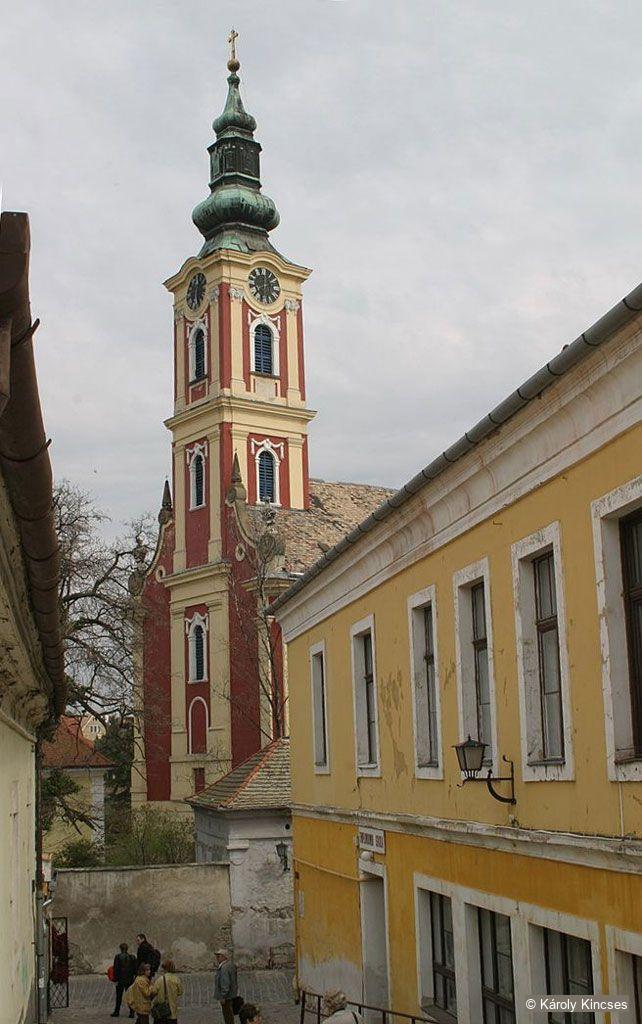
 Add to My Collection
Name of Monument:
Blagovestenska (Annunciation) Church of the Blessed Virgin
Also known as:
Blagovestenska Serbian Orthodox Church
Location:
Szentendre, Közép-Magyarország / Central Hungary, Hungary
Fő tér
2000 Szentendre
Serbian Orthodox Diocese of Buda (Responsible Institution)
Date:
1752–1754; 1790s; early 1800s
Artists:
Architect: András Mayerhoffer? (1690–1771); painter: Mihailo Živković (Mihály Zsivkovics, 1776–1824)
Denomination / Type of monument:
Religious architecture, church
Patron(s):
Dionisije Novaković; Dionisziosz Popović, Bishop of Buda; Serbian Orthodox Church
History:
The expansion of Turkish influence in the Balkans propelled waves of Greek, Dalmatian, Bosnian and Serbian refugees to the Hungarian Kingdom. In 1691, King Leopold I issued a “letters patent” for the sake of the Serbs who fled and settled in Hungary. King Leopold wished them to settle only temporarily in Hungary while their country was under Turkish rule, but the occupation dragged on for an unexpectedly long period. By the end of the 18th century the number of Serbs began to decrease both in terms of the population and the magistracy of Szentendre, while at the same time, the proportion of Hungarians and Germans increased, so a Catholic town magistrate was selected for a year and replaced by an orthodox magistrate the following year.
In the 17th century some 800 fugitive families, including several merchants, sought refuge in Szentendre. They constructed a church in 1690 under the supervision of Arsen Crnojević Patriarch of Ipek. The iconostasis of the simple wooden church paid homage to the Blagovestenska (Annunciation) and was painted by masters from the Balkans in 1721. The iconostasis was later transferred to the Church of Izbég.
The foundation stone of today's church was laid in 1752 and was consecrated in honour of the Annunciation by Dionisije Novaković Bishop of Buda in 1754. The design of the church is attributed to András Mayerhoffer, on account of its similarity to the Serbian Church of Pest and the Cathedral of Kalocsa, both of which were designed by him. The iconostasis was completed between 1802 and 1804.
The 1787 decree of King Joseph II made German the compulsory language in schools, and thus the town council of Szentendre had to provide German language education for both Catholic and Greek Orthodox schools. Construction of the schools was slow, however, and there was a suggestion that Blagovestenska Church be converted into a school, but King Joseph II rescinded his language decree before he died rendering the conversion unnecessary.
Description:
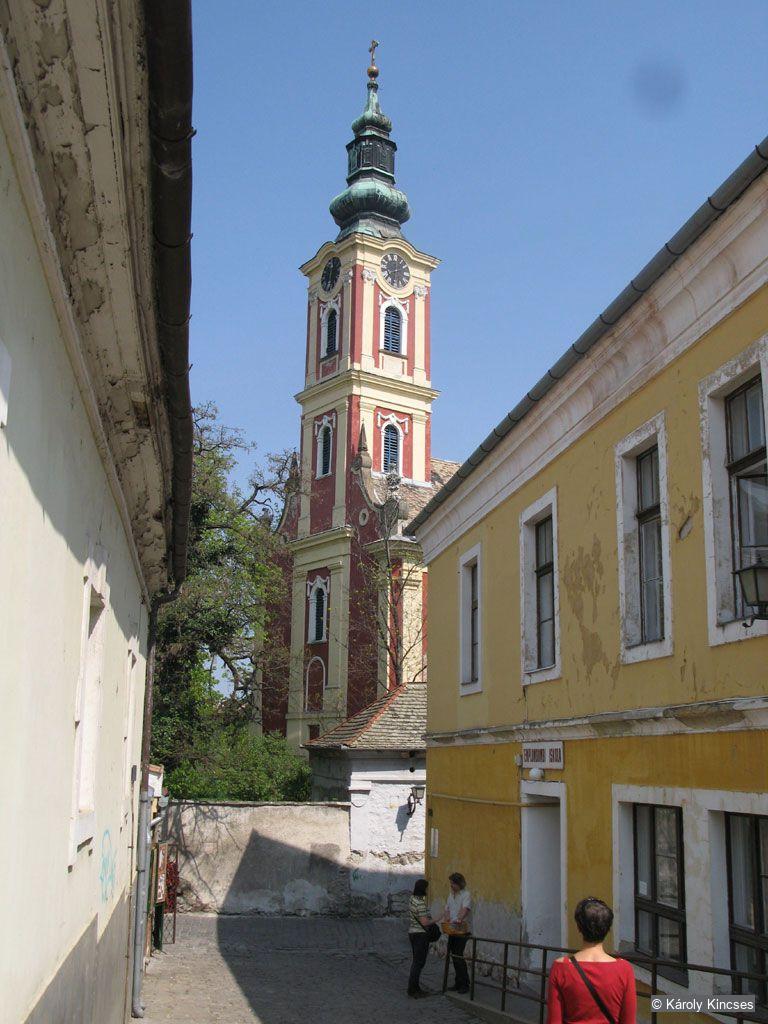
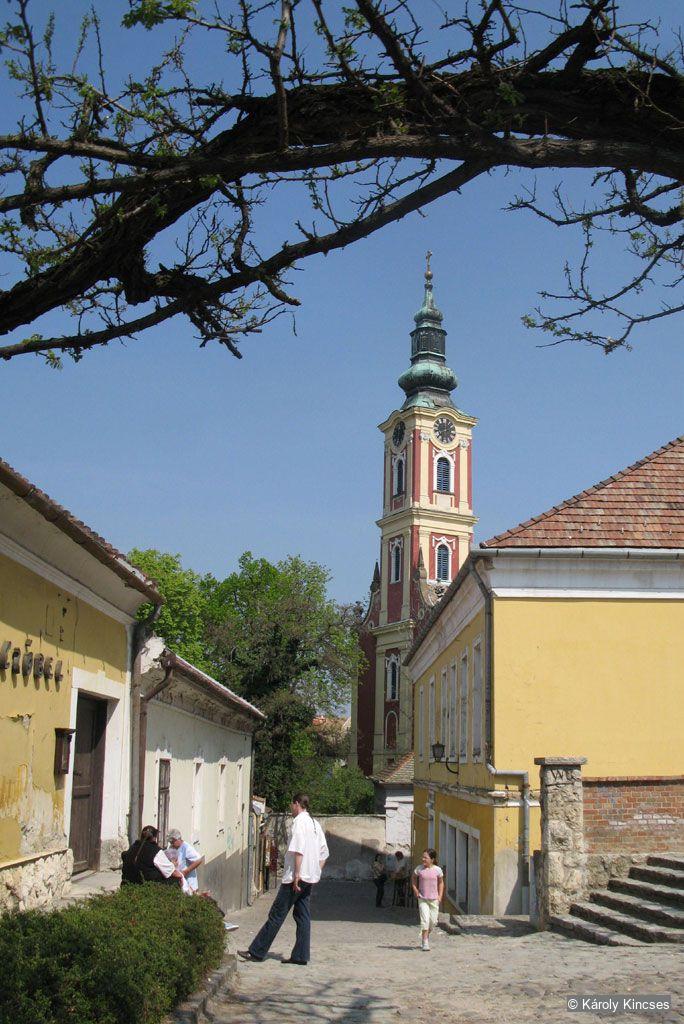
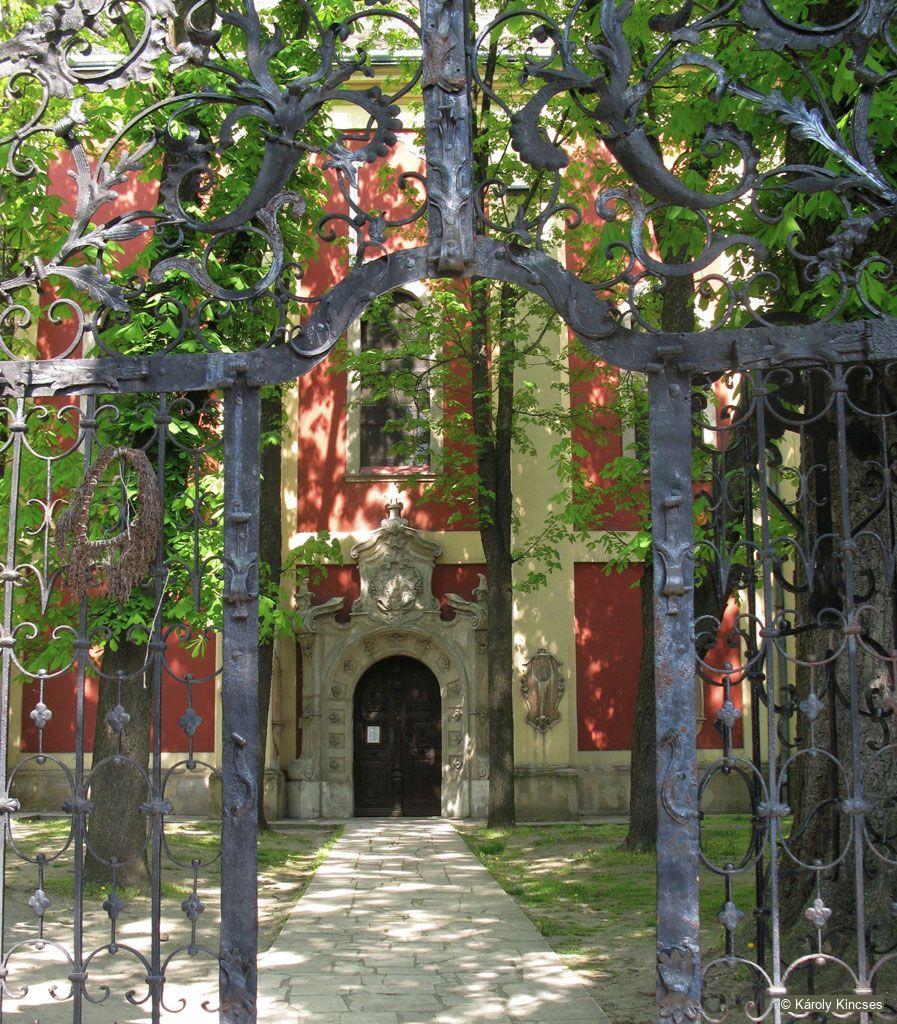
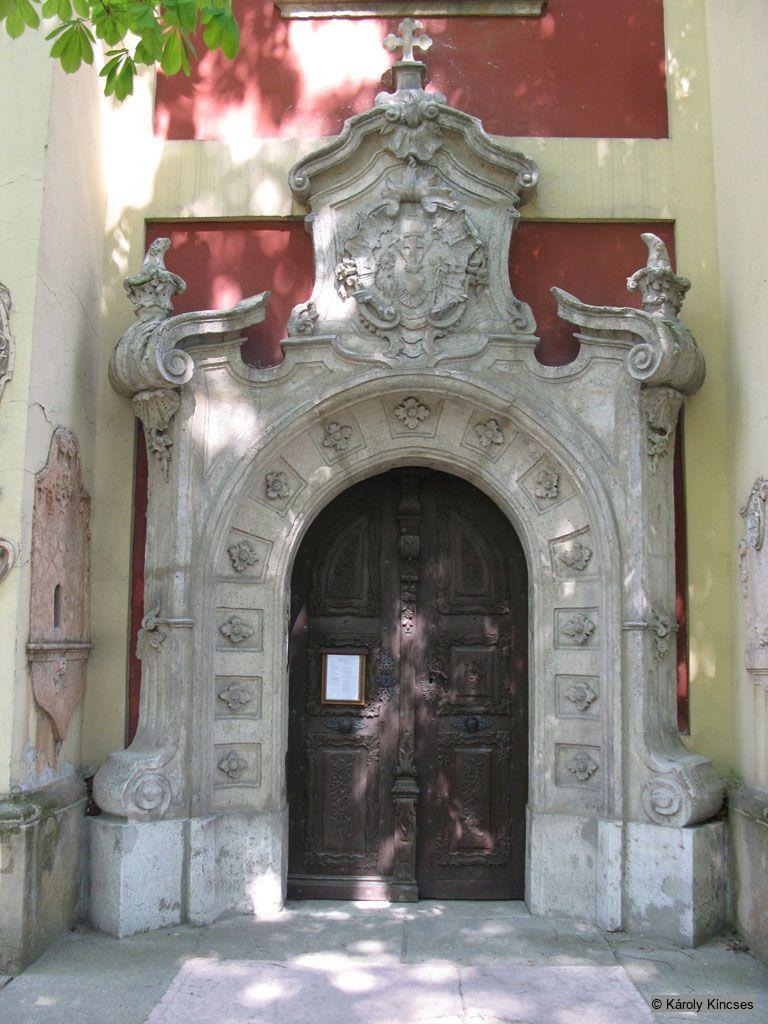
The main facade of the one-nave church – articulated with wall columns and emphatic mouldings – is crowned with a tower. The main gate, framed by garlands and topped with a heavily projected drip moulding, is embraced by columns decorated with leaves and spirals that support a stone balcony. Behind the balcony, the blind, oval choir window with an arched moulding is visible, both sides of which there are two blind windows with staggered mouldings. Above its shoulder, the facade is decorated with volutes, vases and obelisks. In front of the bell windows, arched and ajouré stone balconies can be seen.
The side facades of the church are articulated by pairs of wall columns and oval, arched and square-shape windows.
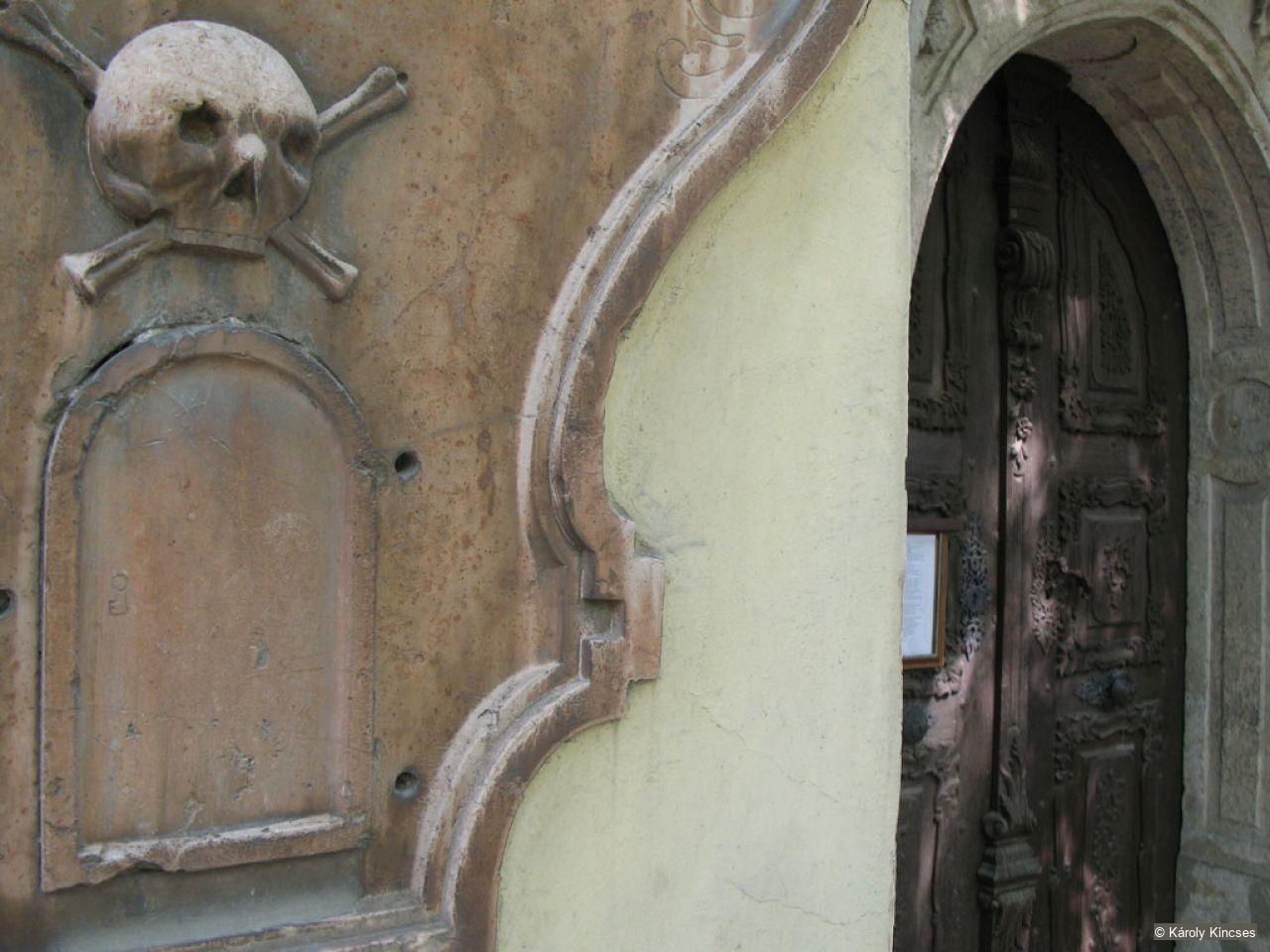
To the left of the main gate is the red marmor tomb (with an inscription in Greek) of Demeter Tolojanne, a Greek merchant from Vác, who came to Szentendre from Macedonia and died in 1759 at the age of 48. Above the entrance are portraits of St. Constantine and St. Helena in an arch-shaped frame.
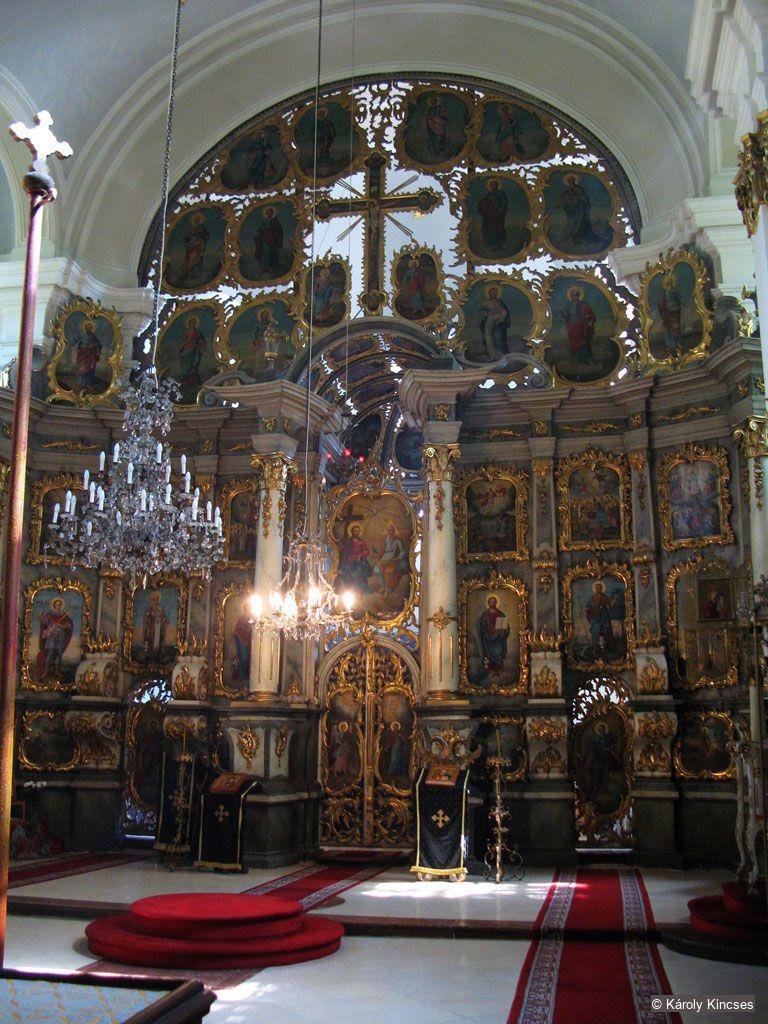
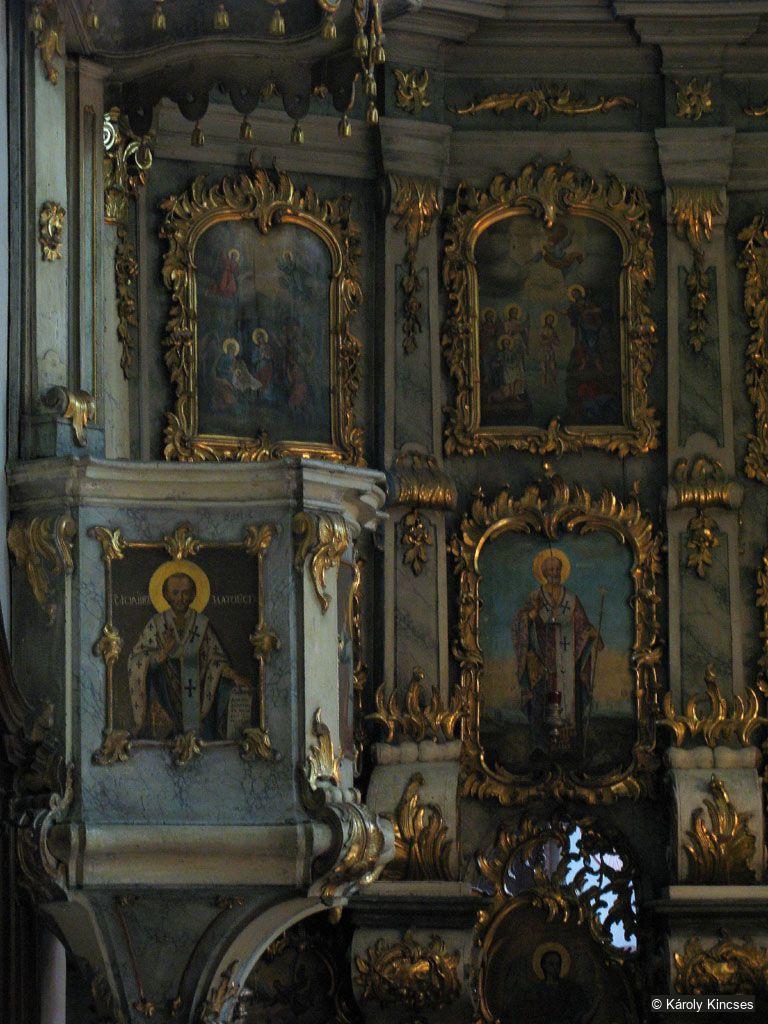
The three vaulted sections of the church are covered by net-vaults, and the stone choir is covered by a sail vault. The arcade under the choir is topped by a barrel vault. The walls of the nave are articulated by semi-columns, and decorated with frescoes of the Life of Jesus. The gilded pulpit of the bishop is decorated with a portrait of St. Nicholas.
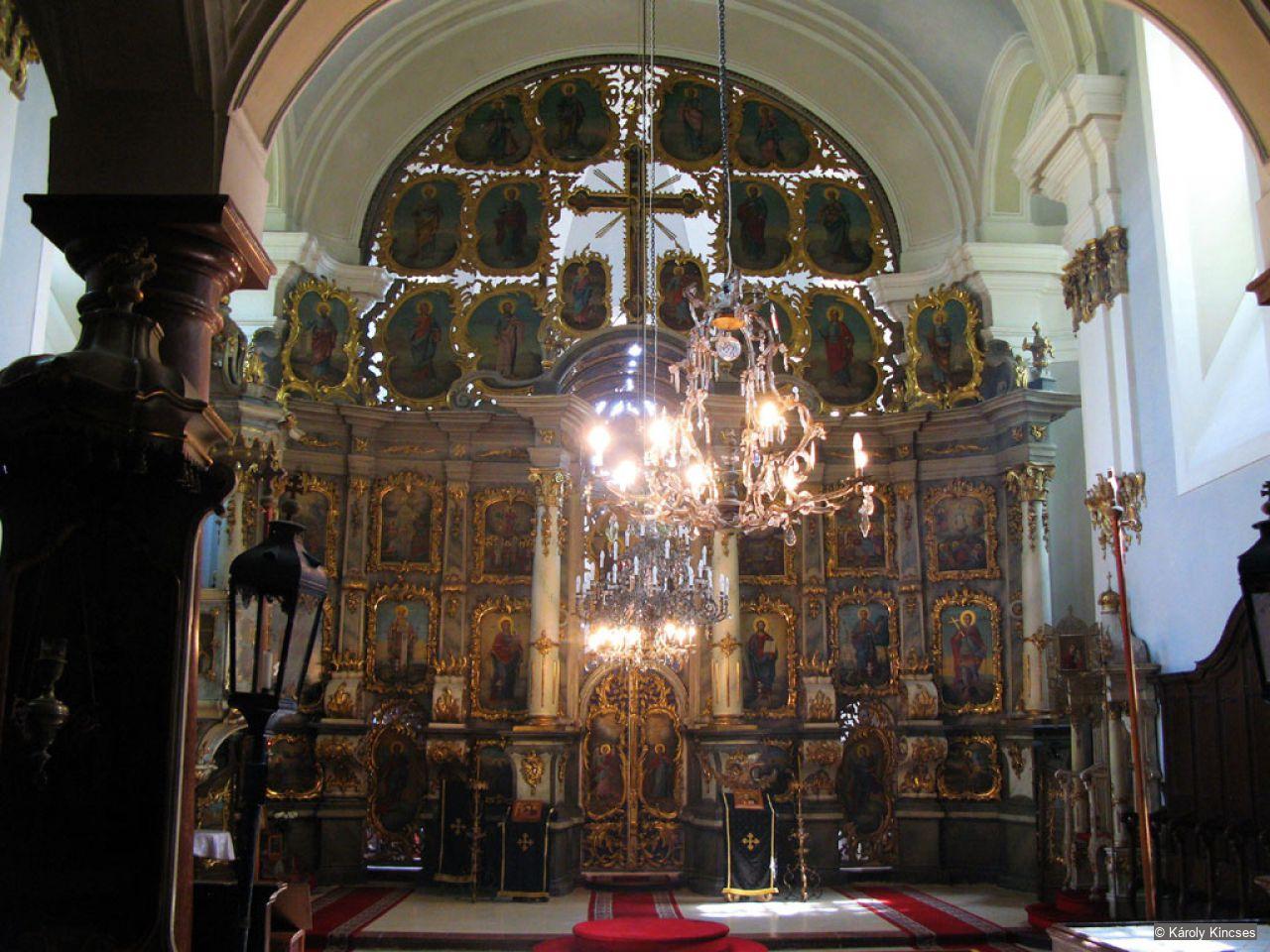
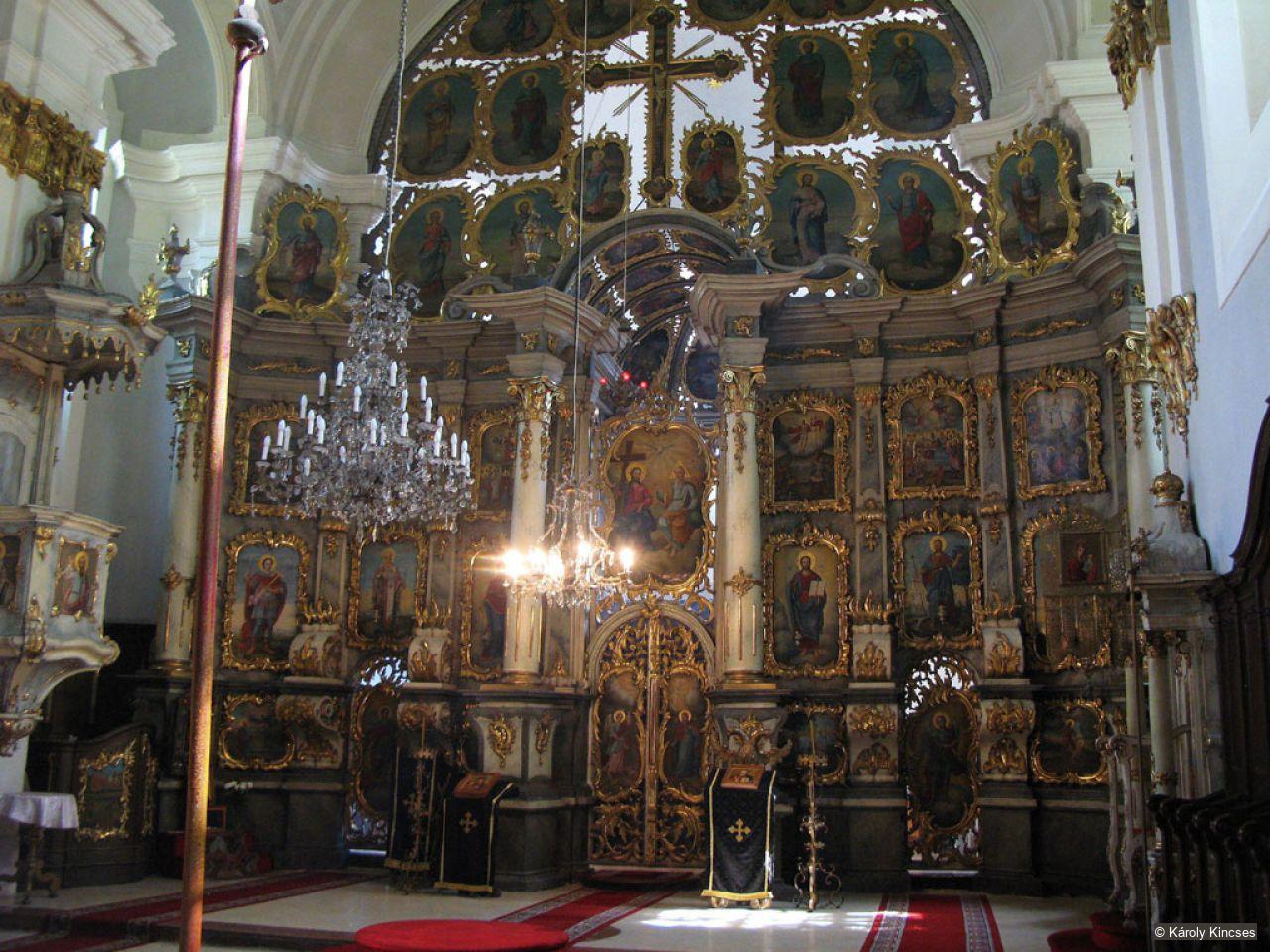
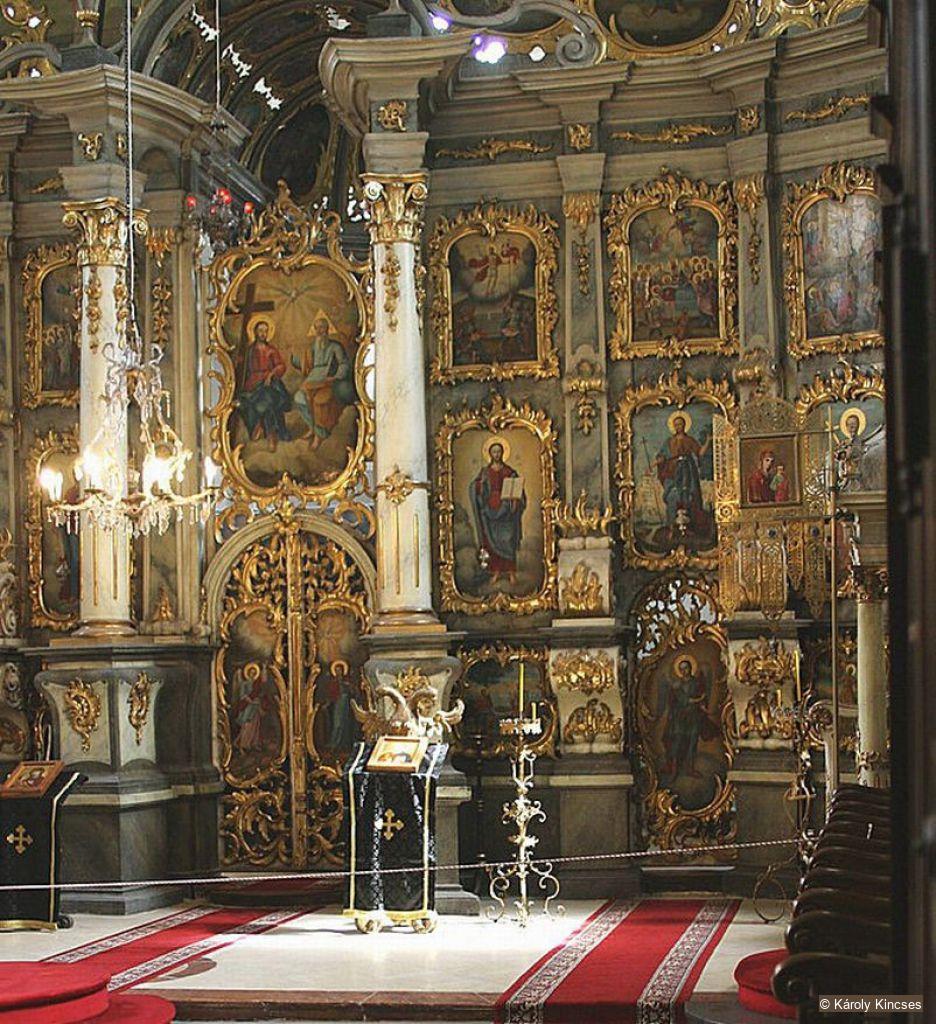
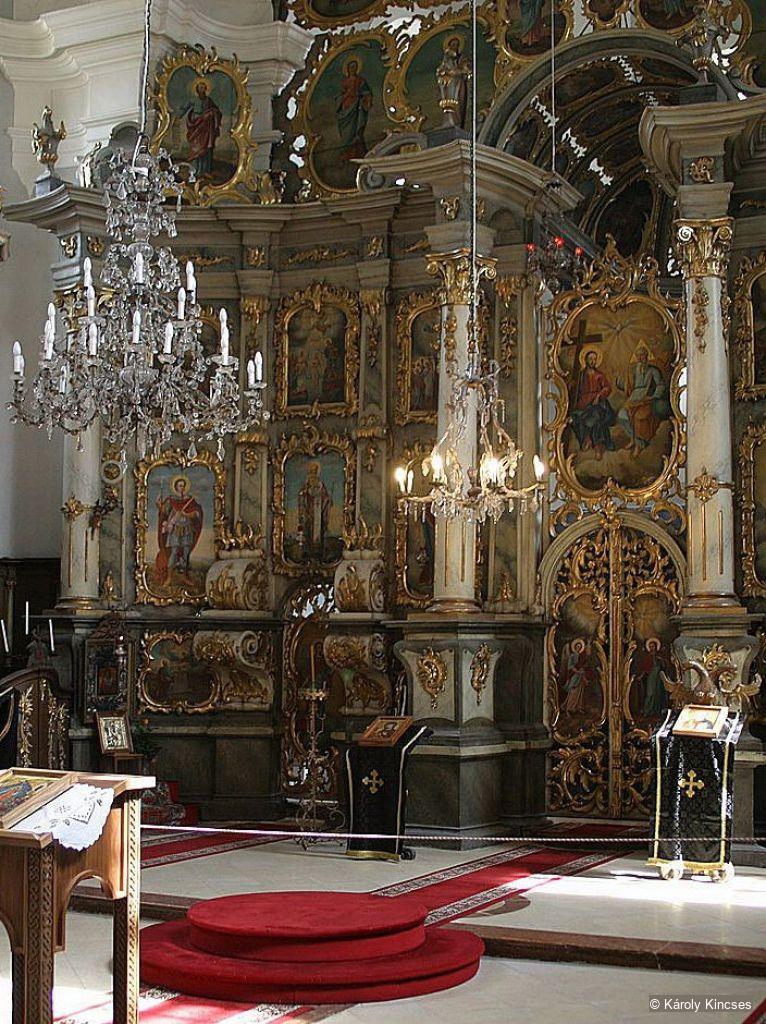
The Rococo iconostasis (icon screen), which separates the nave and the sanctuary and rises as high as the nave, is a painted oak structure. It is the work of Mihailo Živković (Mihály Zsivkovics), a Serbian painter from Buda and protégé of Dionisziosz Popović Bishop of Buda. The iconostasis dates to the 1790s (or c. 1802–1804 according to some scholars), and is separated in the middle by a moulding which creates two main parts. The lower part is further separated by columns into five fields, each holding a painting by Zsivkovics in a richly gilded frame. In the middle, on the Gate of the Tsars, are scenes from the Annunciation, and above the gate is a painting of the Last Supper. On the left-hand side above the Gate of the Tsars is the Virgin Mary with the Infant Jesus. At the bottom are scenes from the Life of Jesus. To the right, above the Gate of the Tsars, is Jesus Giving Blessings and at the bottom are more scenes from the Life of Jesus. On other sections of the iconostasis are St. Stephen the Deacon, the Annunciation, and St. John the Golden Mouth. In the upper section (above the moulding) are paintings of the Holy Trinity and Virgin Mary, framed by volutes. Portraits of the 12 Apostles are contained in gilt and ajouré medallions.
The altar table in the sanctuary, which closes off three sides of a trapezium, is made from red marble; the preparatory table for receiving the sacrament is of coloured stone (1754). The gilt Zopfstil candleholder, the painted cross of the altar table and the church Evangeliary (the work of a goldsmith from Moscow) are outstanding works.
The Neo-Classical (1797) Serbian Orthodox school building adjoins the northern side of the church. The building used to serve as a teacher-training school between 1812 and 1816, but was then converted into a museum.
The Blagovestenska (Annunciation) Church of the Blessed Virgin was built between 1752 and 1754, and represents an outstanding example of Serbian Orthodox architecture in Hungary. Featuring elements of the Baroque and Rococo styles with a one-tower western façade, the church has an interior appropriate for Byzantine liturgy. The paintings of the richly carved and gilded iconostasis (icon screen) are the works of Mihailo Živković (Mihály Zsivkovics), a Serbian painter from Buda.
How Monument was dated:
Based on written and visual sources, and local site research.
Selected bibliography:
Vukoszávlyev, Z., "Magyarországi szerb ortodox templomok – stílusjegyek ötvöződése a magyar és szerb építéshagyományban" (“Serbian Orthodox Churches in Hungary – A Combination of Hungarian and Serbian Architectural Stylistic Features”), Architectura Hungariae, 1, No. 2, 1999.
Davidov, D., A szentendrei szerb ortodox templomok (The Orthodox Churches of Szentendre), Szentendre, 2005.
Görög örökség (Greek Heritage), A görög ortodox diszpóra Magyarországon a XVII—XIX. században (The Greek Orthodox Diaspora in Hungary between the 17th and 19th Centuries), Kat., Szerk., Szabó. K., Budapest, 2009, pp. 46–47.
Citation of this web page:
Terézia Bardi "Blagovestenska (Annunciation) Church of the Blessed Virgin" in "Discover Baroque Art", Museum With No Frontiers, 2026.
https://baroqueart.museumwnf.org/database_item.php?id=monument;BAR;hu;Mon11;17;en
Prepared by: Terézia BardiTerézia Bardi
SURNAME: Bardi
NAME: Terézia Anna
AFFILIATION: National Trust of Monuments for Hungary
TITLE: Art Historian, Vice Director for Research at The National Trust of
Monuments for Hungary; MWNF DBA local co-ordinator (Hungary), author
and copy-editor
CV:
Terézia Bardi, Vice Director for Research at the National Trust of Monuments for Hungary since 2004, was awarded her MA in History and History of Art at the Eötvös Loránd University in Budapest. After a period of fellowships mainly in Italy, Terézia gained her PhD from the Faculty of Art History at the same university for her thesis Presentation and Representation – the European Reception of the Liberation of Buda in 1686: Feast and Public Opinion. Her main fields of research are 17th-and18th-century Baroque and Rococo: the spectacles, festival decorations and associated iconography – including theatre productions of the period – and interior decoration of historic houses. Since 1988, she has edited a number of art historical books that include some on Oriental art and architecture. She is MWNF DBA’s local (Hungarian) co-ordinator, author and copy-editor.
Copyedited by: Terézia BardiTerézia Bardi
SURNAME: Bardi
NAME: Terézia Anna
AFFILIATION: National Trust of Monuments for Hungary
TITLE: Art Historian, Vice Director for Research at The National Trust of
Monuments for Hungary; MWNF DBA local co-ordinator (Hungary), author
and copy-editor
CV:
Terézia Bardi, Vice Director for Research at the National Trust of Monuments for Hungary since 2004, was awarded her MA in History and History of Art at the Eötvös Loránd University in Budapest. After a period of fellowships mainly in Italy, Terézia gained her PhD from the Faculty of Art History at the same university for her thesis Presentation and Representation – the European Reception of the Liberation of Buda in 1686: Feast and Public Opinion. Her main fields of research are 17th-and18th-century Baroque and Rococo: the spectacles, festival decorations and associated iconography – including theatre productions of the period – and interior decoration of historic houses. Since 1988, she has edited a number of art historical books that include some on Oriental art and architecture. She is MWNF DBA’s local (Hungarian) co-ordinator, author and copy-editor.
Translation by: Judit Harangozó, Philip Barker
Translation copyedited by: Mandi GomezMandi Gomez
Amanda Gomez is a freelance copy-editor and proofreader working in London. She studied Art History and Literature at Essex University (1986–89) and received her MA (Area Studies Africa: Art, Literature, African Thought) from SOAS in 1990. She worked as an editorial assistant for the independent publisher Bellew Publishing (1991–94) and studied at Bookhouse and the London College of Printing on day release. She was publications officer at the Museum of London until 2000 and then took a role at Art Books International, where she worked on projects for independent publishers and arts institutions that included MWNF’s English-language editions of the books series Islamic Art in the Mediterranean. She was part of the editorial team for further MWNF iterations: Discover Islamic Art in the Mediterranean Virtual Museum and the illustrated volume Discover Islamic Art in the Mediterranean.
True to its ethos of connecting people through the arts, MWNF has provided Amanda with valuable opportunities for discovery and learning, increased her editorial experience, and connected her with publishers and institutions all over the world. More recently, the projects she has worked on include MWNF’s Sharing History Virtual Museum and Exhibition series, Vitra Design Museum’s Victor Papanek and Objects of Desire, and Haus der Kulturen der Welt’s online publication 2 or 3 Tigers and its volume Race, Nation, Class.
MWNF Working Number: HU 17