

 Back
Back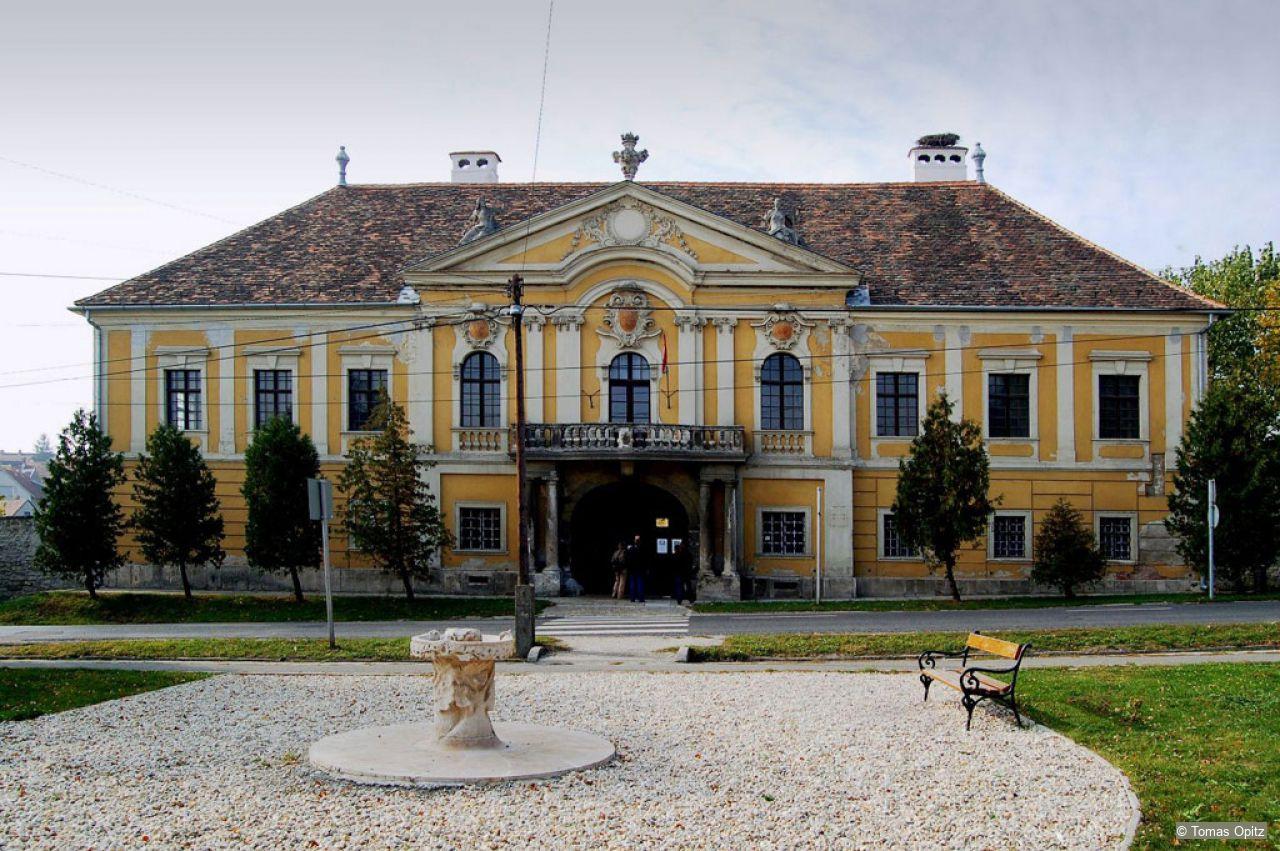
 Add to My Collection
Name of Monument:
Bishop’s Palace
Location:
Fertőrákos, Nyugat-Magyarország / West Hungary, Hungary
Fő u. 153
9421 Fertőrákos
T : +36 99 537 640
F : +36 99 537 640
E : info@eszterhaza.hu
Eszterháza Centre for Culture, Research and Festivals (Responsible Institution)
Date:
1650s–1680s; late 1690s–early 1700s; 1743–1745
Artists:
Stoves: Károly Magner (active: 1760–1790); paintings: Sigismund Fritsch (18th century), Caietano di Rosa (18th century)
Denomination / Type of monument:
Secular building, residential palace, summer palace
Patron(s):
György Draskovich Bishop of Győr (1578–1587); Count György Széchenyi Bishop of Győr (1658–1685), Archbishop of Kalocsa from 1668, Archbishop of Esztergom from 1685); Ágost Wettin Keresztély (Christian August von Sachsen-Zeitz) Saxon Prince Bishop of Győr (1696–1725, Cardinal from 1696, Archbishop of Esztergom from 1717); Count Ferenc Zichy Bishop of Győr (1743–1783)
History:
Rákos lies close to Sopron on land that was probably given to the Bishops of Győr by St. Stephen when the bishopric was founded. A long period of discord between the bishop and the town of Sopron probably relates to possession of the settlement and its benefits. The people of Sopron subsequently demolished the palace, but following reconciliation with the bishop in 1311, they were obliged to pay indemnification. Based on certified documents, it is probable that the rebuilt palace (merely a fortified building) was already standing in 1368. Although Rákos was pledged to Frederick III, it was owned by the Bishop of Győr during the reign of Matthias Corvinus. During the Turkish-Hungarian battles of the 16th century the bishops of Győr often resided in Rákos Palace, but it was during this period that the building was partially destroyed. Bishop György Draskovich, therefore, demolished the remains of the old palace and built another on two levels in its place (1580s). This is the core of the north wing of the present palace and part of its street facade (east wing). The palace was donated by Gábor Bethlen to the town of Sopron in 1619, but returned to the bishopric in 1622.
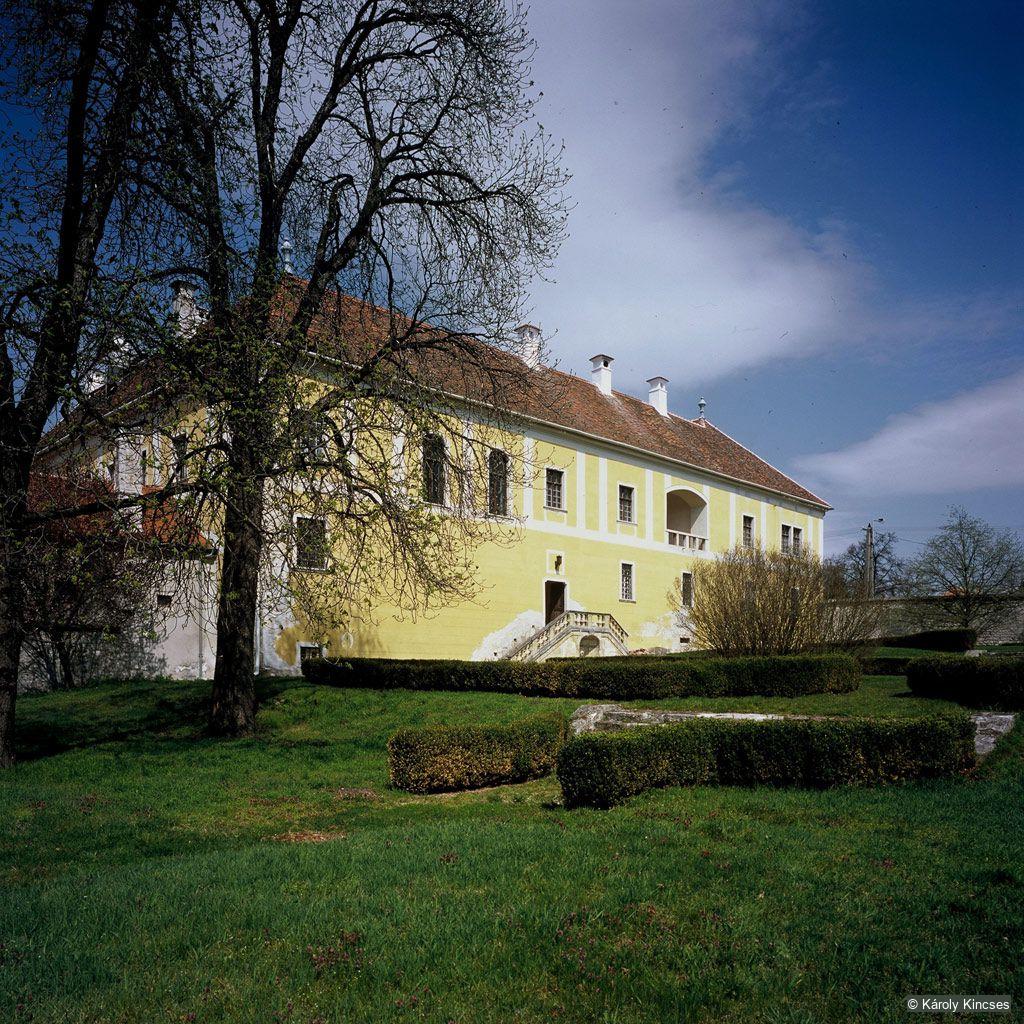
The present shape of the palace was developed under three bishops in the 17th and 18th centuries. The first was by György Széchenyi, who erected a U-shaped building. The east wing, less the middle bay and south wing, are his accomplishments. Leopold I Holy Roman Emperor visited the palace in 1681; in the same period, Turkish troops on their way to Vienna besieged the palace and set fire to it, but the bishop managed to rescue both his private property and the valuables of the bishopric, and despatch it all to Vienna.
The second important bishop in the history of the building was Ágost Keresztély who not only renovated the palace but built the west wing and extended the south wing.
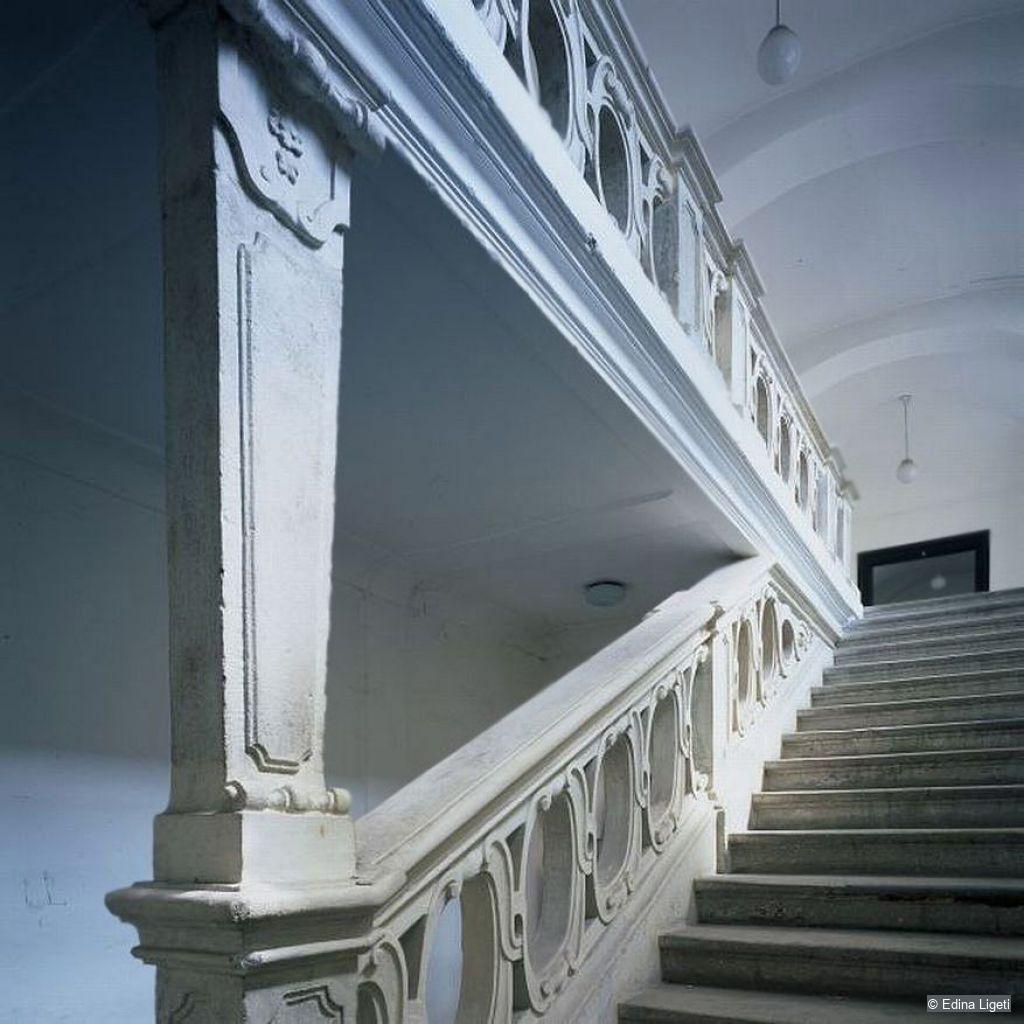
The third period, which ended in 1745, was during the bishopric of Count Ferenc Zichy. He built the middle bay of the main facade and the decorative stairway, painted the exterior of the building, furnished the chapel, installed stoves in the rooms and established a garden on the south side.
Description:
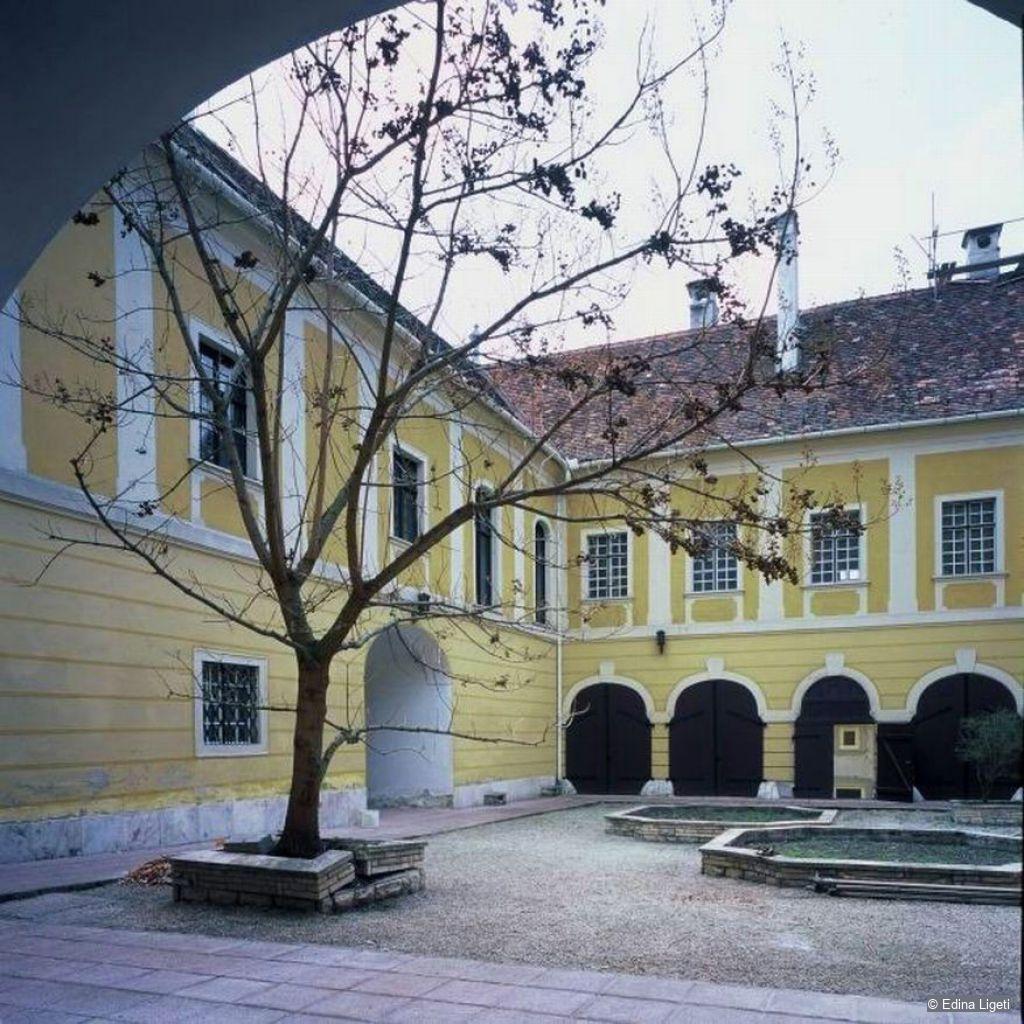
The Bishop's Palace was built in three different periods. A building on two levels, it surrounds a courtyard on four sides. The three-axial middle bay of the nine-axial facade is slightly abutting and has a higher cornice. The ground-floor windows and the windows of the side risalits are in rectangular frames, while over the three round-arched windows on the second floor of the middle bay crowned with a tympanum, there are the coats of arms of the three patron bishops associated with the building (Count Ferenc Zichy on the left, Ágost Keresztély in the middle and György Széchenyi on the right). The main gate, with a stone balcony on Tuscan columns over it, is in the middle. The main facade is divided by astragal moulding, alettes and Ionic pilasters. The top of the tympanum is adorned with vases and allegorical female figures, and there is a cartouche with garlands and shell motifs in the middle. Red and white painted rectangles from the 16th century were revealed during an examination of the walls for research purposes.
A stone balustrade surrounds the stairway with putti holding wrought-iron candelabras.
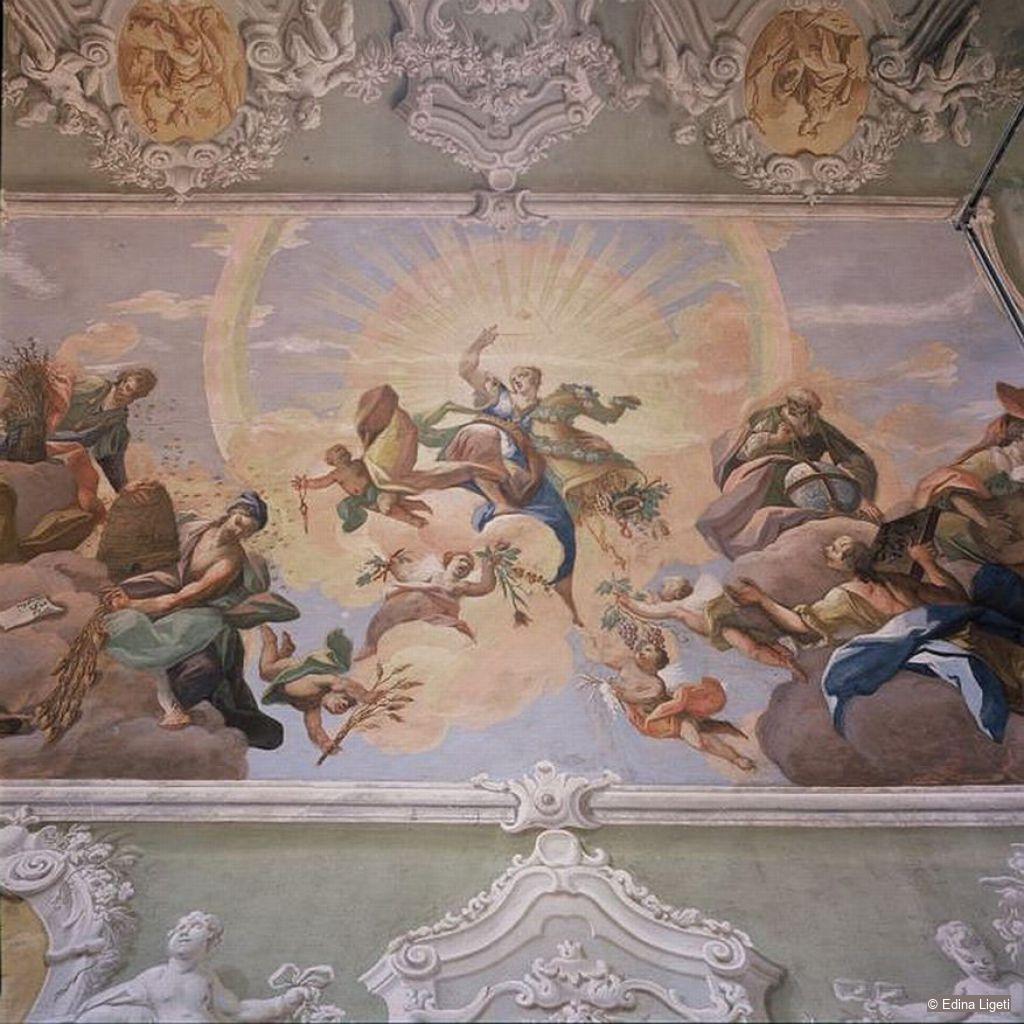
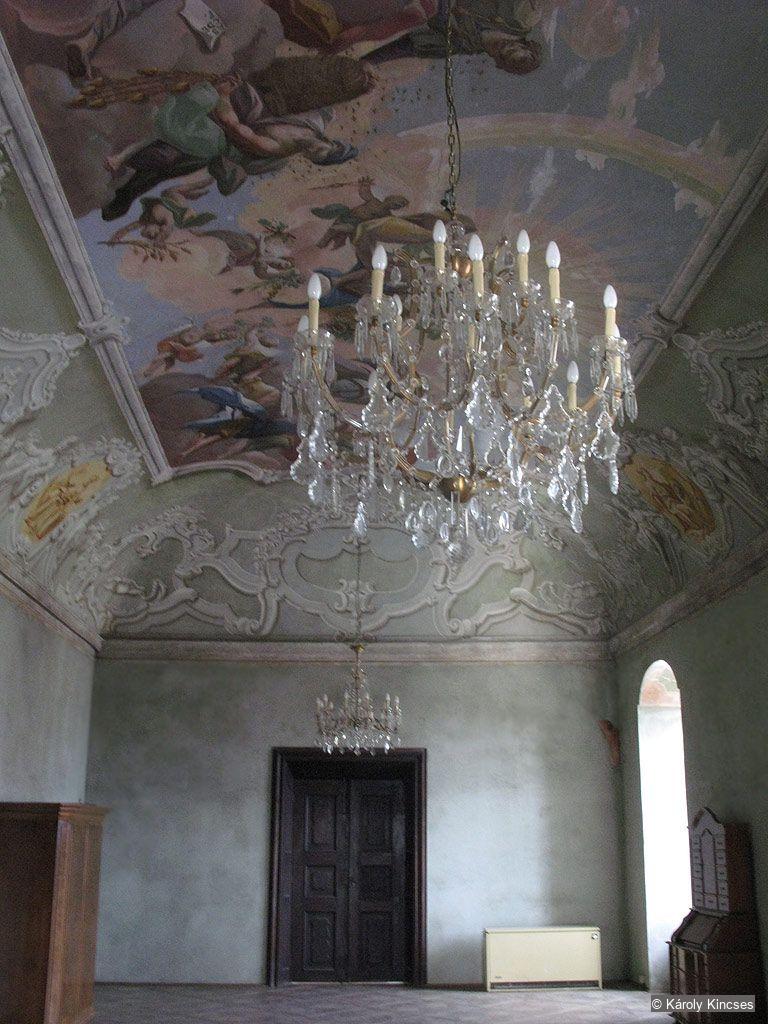
The most representative rooms are those on the second floor of the east wing – built by György Széchenyi – and in the bishop's private apartments in the south wing (its closed balcony was reconstructed in the 1960s). In the banqueting hall (east wing, second floor) there is a magnificent ceiling painting by Caietano di Rosa, an Italian artist working in Austria. Signed and dated (“D. Rosa. F. A. 1745”), the work represents the Veneration of the Seven Liberal Arts in Front of God's Eyes; four grisailles in oval medallions framed with garlands and held by putti: allegorical images of Pallas Athene/Minerva (sciences) Hestia (home, the fireplace), Hephaestus/Vulcan (industry), Hermes/Mercury (trade).
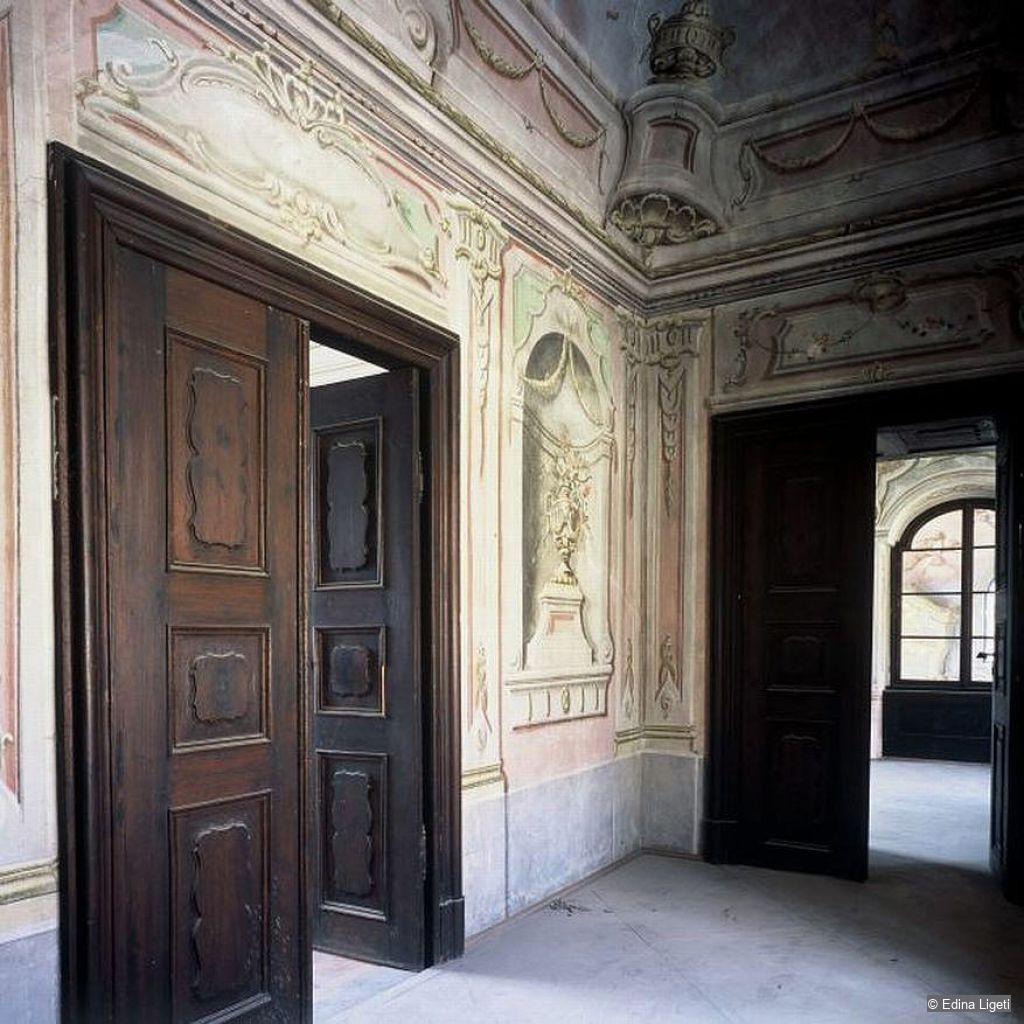
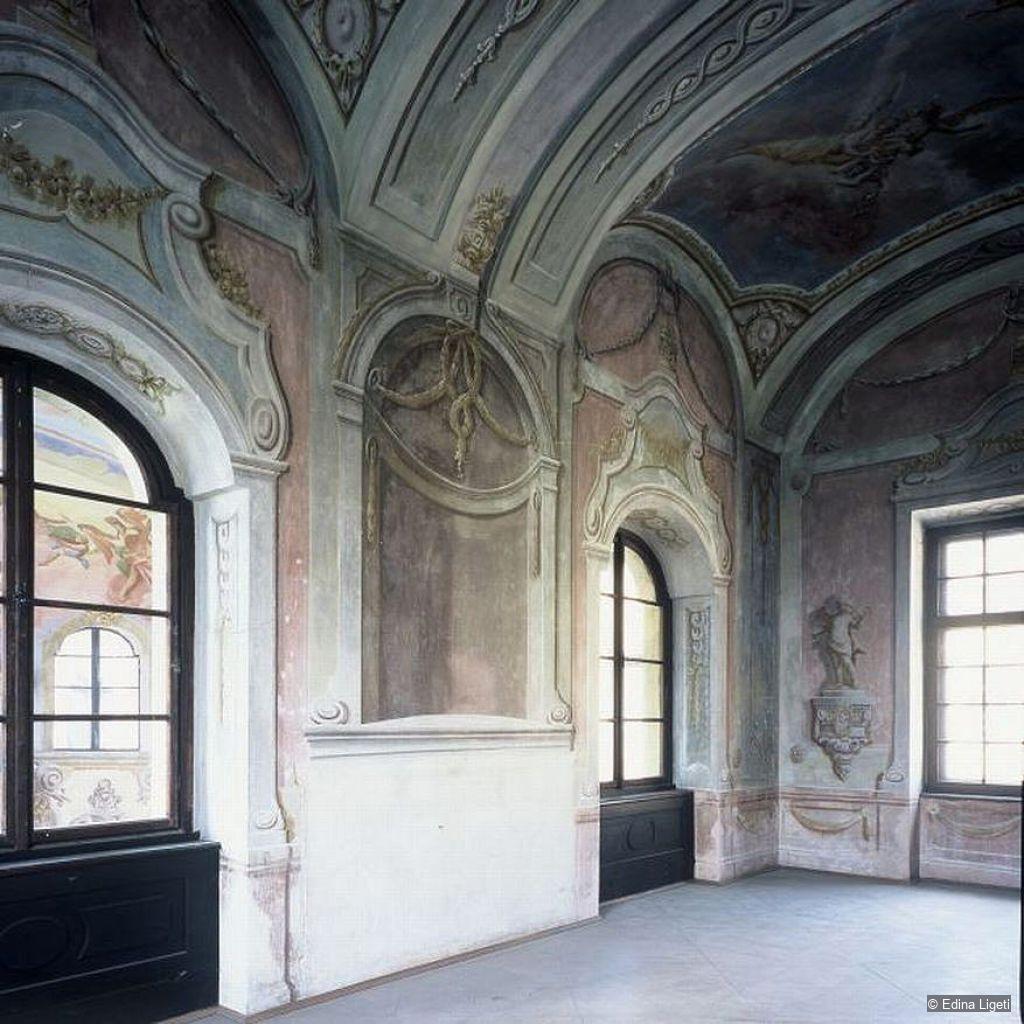
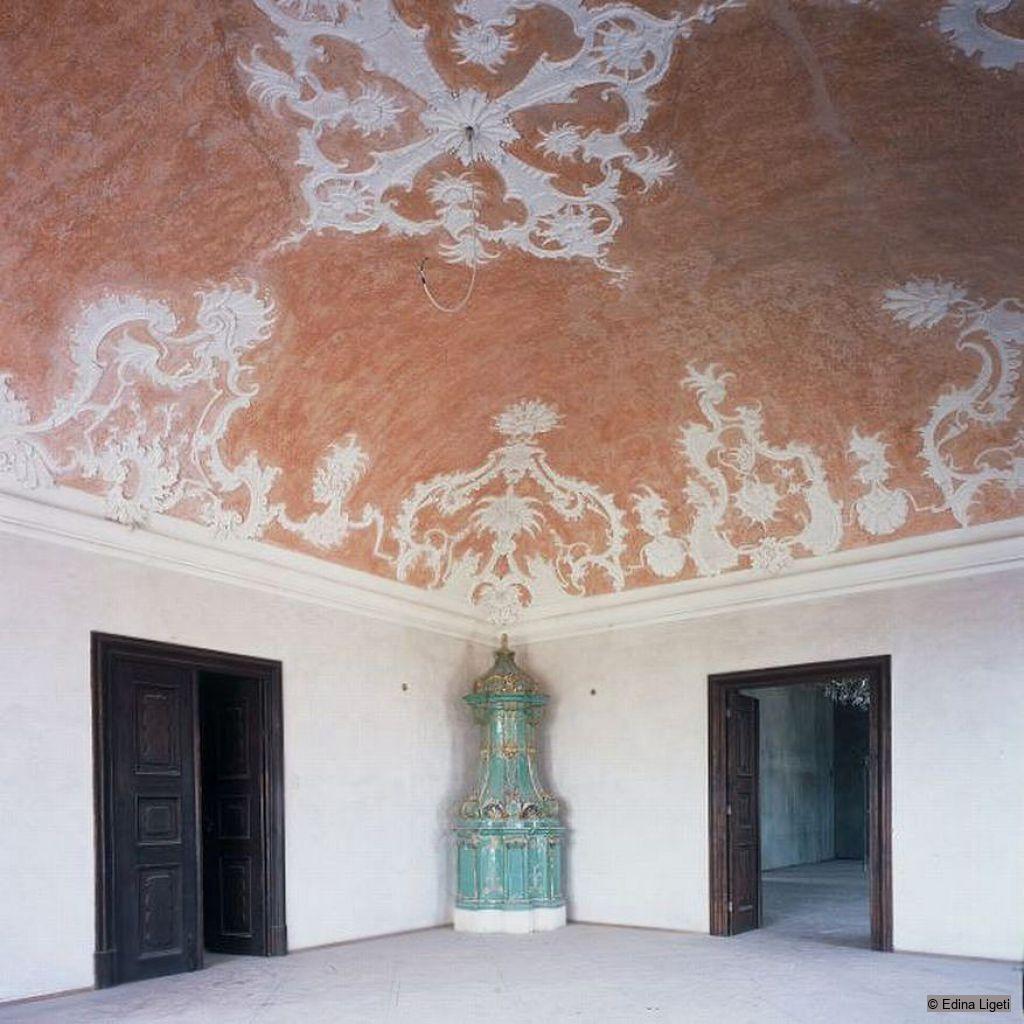
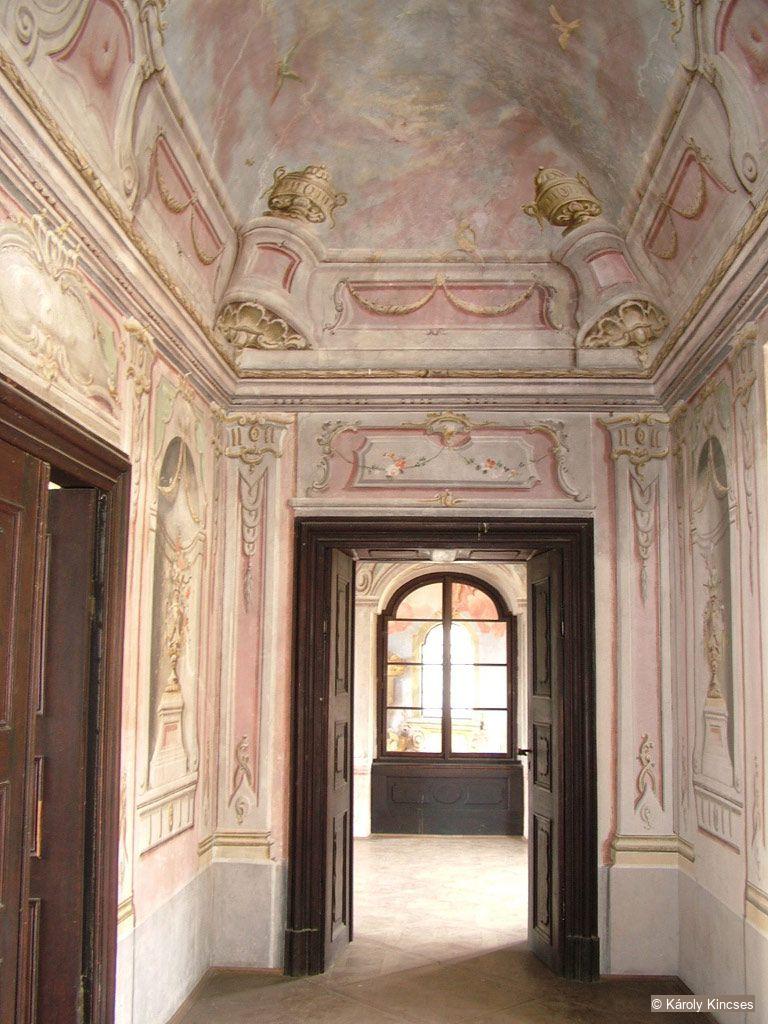
The rooms either side of the banqueting hall have stuccoed Rococo-shell motifs on the ceiling and paintings of vases and garlands on the walls (possibly by Caietano di Rosa and his associates). The walls and ceilings of the corridor, from which rooms lead off, are also painted; on the ceiling of the first part of the corridor is the coat of arms of Bishop Ferenc Zichy upheld by putti, and on the second section, a painted sky is filled with flying birds.
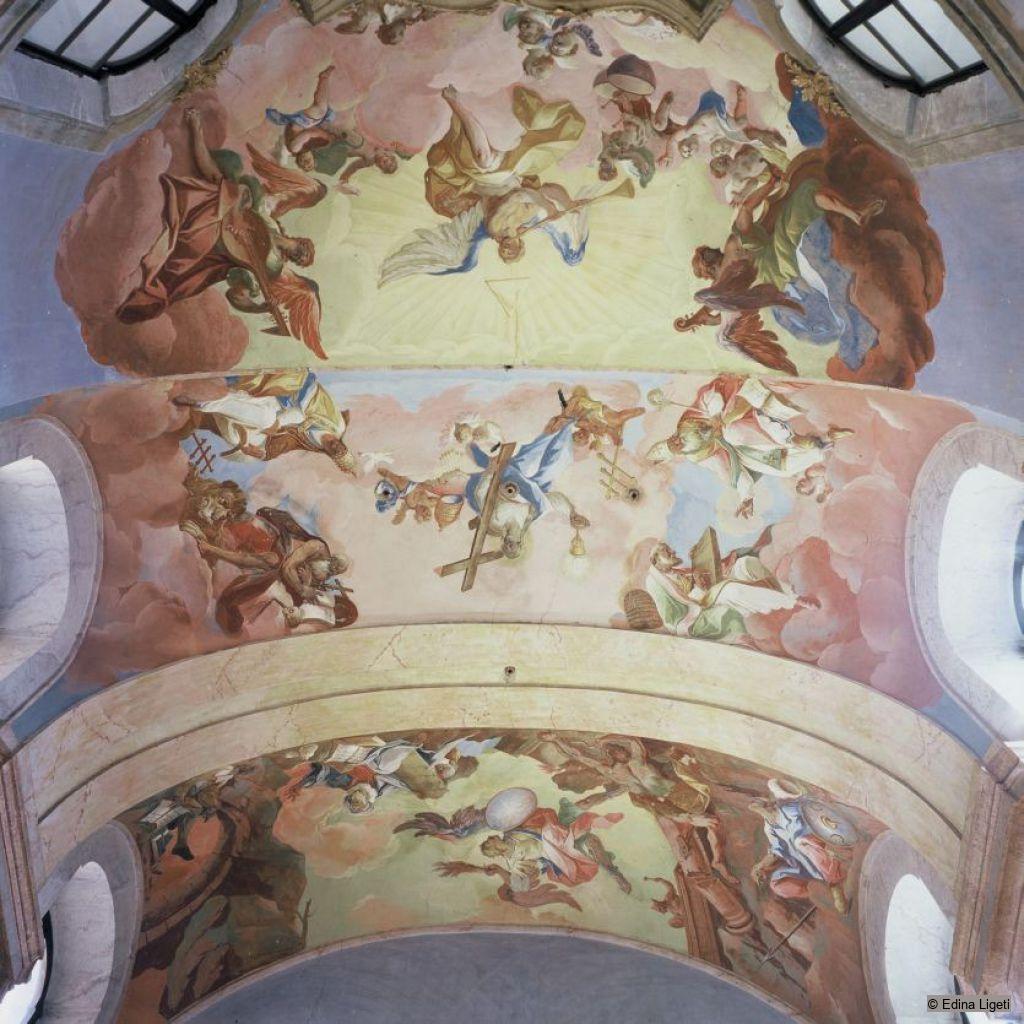
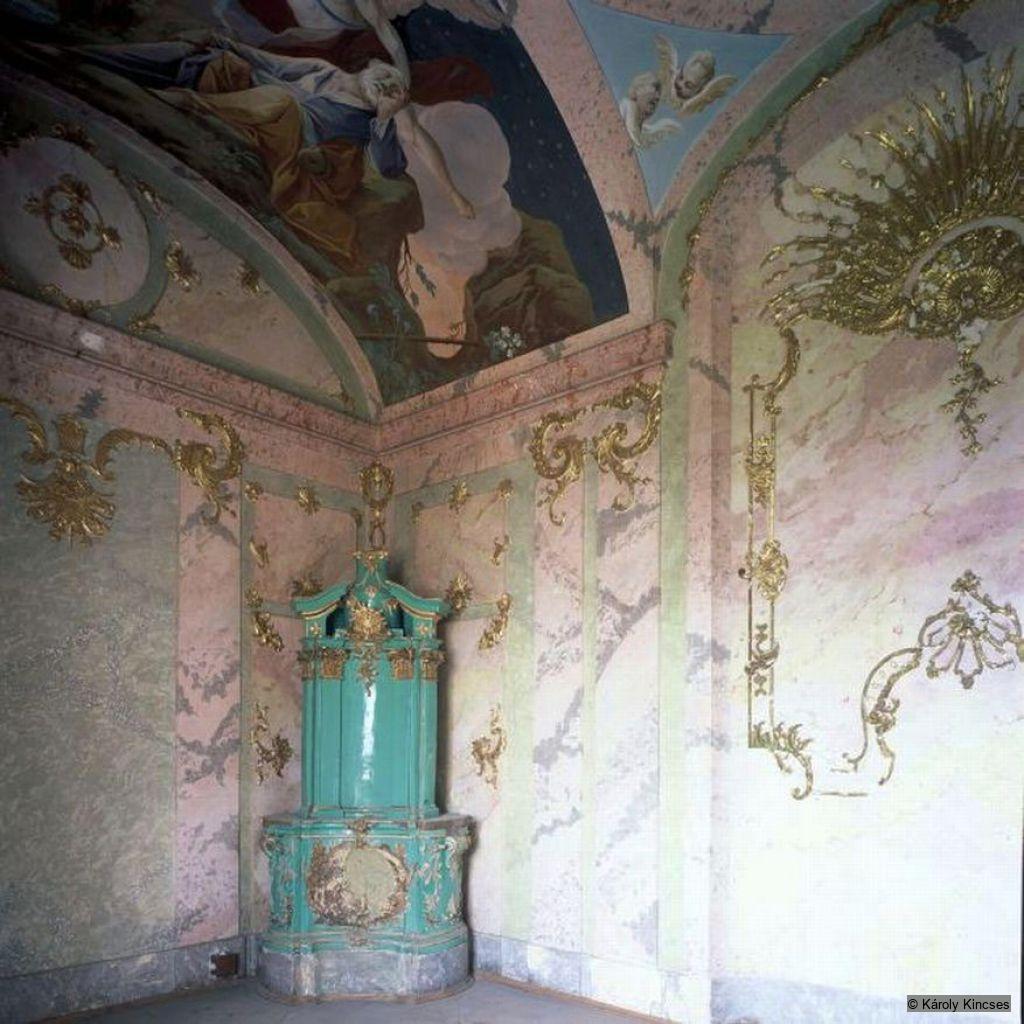
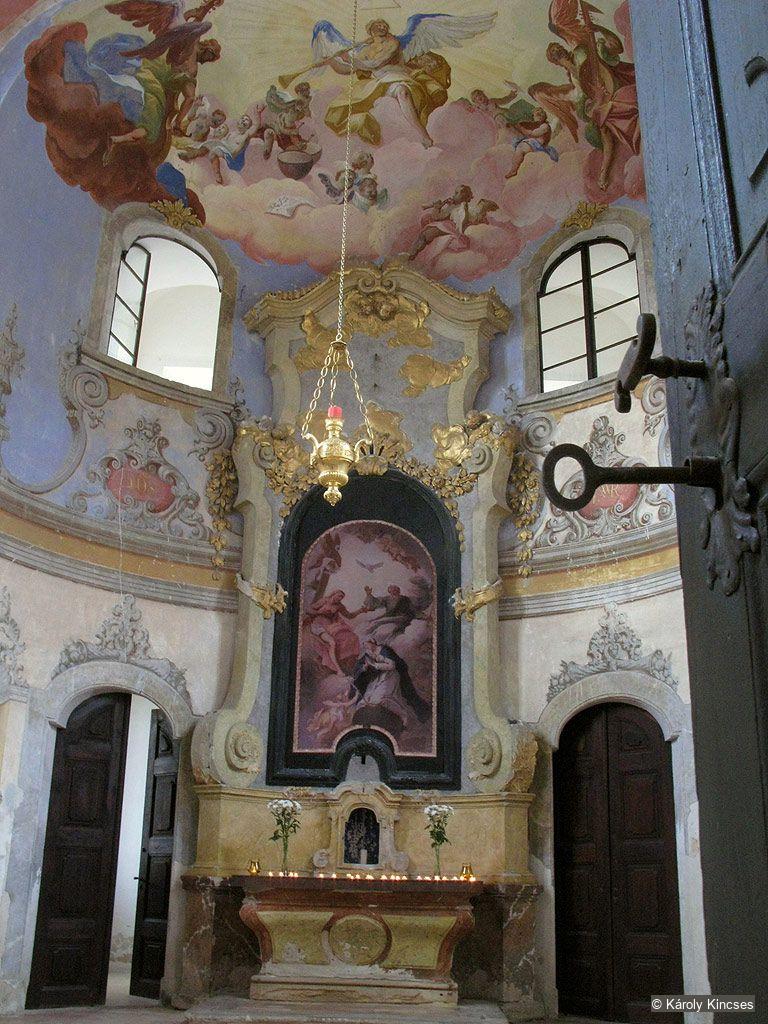
The chapel, two storeys high and half circle-shaped, is also adorned with wall paintings (angels with instruments of the Passion, the Cloth of Veronica, allegorical representations of the Four World Religions; all of which are the works of an unknown 18th-century master restored in 1861 by Ferenc Storno). A copy of the Ascension of the Virgin replaced the original altarpiece painting by the Viennese painter Sigismund Fritsch of 1745. The Rococo furnaces, adorned with gilding and green glaze, are the work of Károly Magner of Győr.
The marbling on the walls and the ceiling fresco in the bureau (bedroom) were commissioned by Bishop János Zalka at the end of the 19th century.
The Bishop's Palace is on two levels and surrounds a courtyard on four sides. It was built at several intervals and there are significant 18th-century paintings on the second floor. The estate was the preferred place of the Bishops of Győr.
How Monument was dated:
Based on written and visual resources and field research (archaeological excavation, wall inspection, wall-painting research).
Selected bibliography:
Mohl, A., Significant priests of the Györ diocese (Győregyházmegyei jeles papok), Győr, 1933.
Csatkai, E., (ed. With D. Dercsényi,) “Fertőrákos”, The Monumental Topography of Hungary (Magyarország műemléki topográfiája), Volume II: The Monuments of Győr-Sopron County (Győr-Sopron megye műemlékei), Part I: Monuments of Sopron and its surroundings (Sopron és környéke műemlékei), Budapest, 2nd edition, 1956, pp. 512—517, 672.
Nemes, A., “Fertőrákos – Műemlékek”, (“Fertőrákos – Monuments”) Tájak Korok Múzeumok Kiskönyvtára (Library of Landscapes, Eras and Museums), 445, Budapest, 1992.
Stefánka, l., Kroisbach (Fertőrákos) [German], Sopron, 1997.
Stefánka, L., Fertőrákos—Kroisbach [Hungarian], 2nd edition, Sopron, 1997.
Bán, J., The Political, Economic, Church and Cultural History of Fertőrákos (Fertőrákos politikai, gazdasági, egyházi és kulturális története), Fertőrákos, 2000.
Hárs, J., “Fertőrákos” in One Hundred Hungarian Villages (Száz Magyar falu), Budapest, 2000.
Kiss, T. (ed), One Thousand Years of the Győr Diocese (A győri egyházmegye ezer éve), Győr, 2000.
Nemes, A., The Bishop's Palace in Fertőrákos (A fertőrákosi püspöki kastély), research documentation, The National Trust of Monuments for Hungary (Műemlékek Nemzeti Gondnoksága), Budapest, 2006.
Szerdahelyi, Z., Fertőrákos Tourist Guide with Pictures (Fertőrákos–Képes–turistakalauz), Tájak Korok Múzeumok Kiskönyvtára (Library of Landscapes, Eras and Museums), Budapest, 2007.
Citation of this web page:
Terézia Bardi "Bishop’s Palace" in "Discover Baroque Art", Museum With No Frontiers, 2026.
https://baroqueart.museumwnf.org/database_item.php?id=monument;BAR;hu;Mon11;18;en
Prepared by: Terézia BardiTerézia Bardi
SURNAME: Bardi
NAME: Terézia Anna
AFFILIATION: National Trust of Monuments for Hungary
TITLE: Art Historian, Vice Director for Research at The National Trust of
Monuments for Hungary; MWNF DBA local co-ordinator (Hungary), author
and copy-editor
CV:
Terézia Bardi, Vice Director for Research at the National Trust of Monuments for Hungary since 2004, was awarded her MA in History and History of Art at the Eötvös Loránd University in Budapest. After a period of fellowships mainly in Italy, Terézia gained her PhD from the Faculty of Art History at the same university for her thesis Presentation and Representation – the European Reception of the Liberation of Buda in 1686: Feast and Public Opinion. Her main fields of research are 17th-and18th-century Baroque and Rococo: the spectacles, festival decorations and associated iconography – including theatre productions of the period – and interior decoration of historic houses. Since 1988, she has edited a number of art historical books that include some on Oriental art and architecture. She is MWNF DBA’s local (Hungarian) co-ordinator, author and copy-editor.
Copyedited by: Terézia BardiTerézia Bardi
SURNAME: Bardi
NAME: Terézia Anna
AFFILIATION: National Trust of Monuments for Hungary
TITLE: Art Historian, Vice Director for Research at The National Trust of
Monuments for Hungary; MWNF DBA local co-ordinator (Hungary), author
and copy-editor
CV:
Terézia Bardi, Vice Director for Research at the National Trust of Monuments for Hungary since 2004, was awarded her MA in History and History of Art at the Eötvös Loránd University in Budapest. After a period of fellowships mainly in Italy, Terézia gained her PhD from the Faculty of Art History at the same university for her thesis Presentation and Representation – the European Reception of the Liberation of Buda in 1686: Feast and Public Opinion. Her main fields of research are 17th-and18th-century Baroque and Rococo: the spectacles, festival decorations and associated iconography – including theatre productions of the period – and interior decoration of historic houses. Since 1988, she has edited a number of art historical books that include some on Oriental art and architecture. She is MWNF DBA’s local (Hungarian) co-ordinator, author and copy-editor.
Translation by: Emese Polyák, László Domoszlai
Translation copyedited by: Mandi GomezMandi Gomez
Amanda Gomez is a freelance copy-editor and proofreader working in London. She studied Art History and Literature at Essex University (1986–89) and received her MA (Area Studies Africa: Art, Literature, African Thought) from SOAS in 1990. She worked as an editorial assistant for the independent publisher Bellew Publishing (1991–94) and studied at Bookhouse and the London College of Printing on day release. She was publications officer at the Museum of London until 2000 and then took a role at Art Books International, where she worked on projects for independent publishers and arts institutions that included MWNF’s English-language editions of the books series Islamic Art in the Mediterranean. She was part of the editorial team for further MWNF iterations: Discover Islamic Art in the Mediterranean Virtual Museum and the illustrated volume Discover Islamic Art in the Mediterranean.
True to its ethos of connecting people through the arts, MWNF has provided Amanda with valuable opportunities for discovery and learning, increased her editorial experience, and connected her with publishers and institutions all over the world. More recently, the projects she has worked on include MWNF’s Sharing History Virtual Museum and Exhibition series, Vitra Design Museum’s Victor Papanek and Objects of Desire, and Haus der Kulturen der Welt’s online publication 2 or 3 Tigers and its volume Race, Nation, Class.
MWNF Working Number: HU 18