

 Back
Back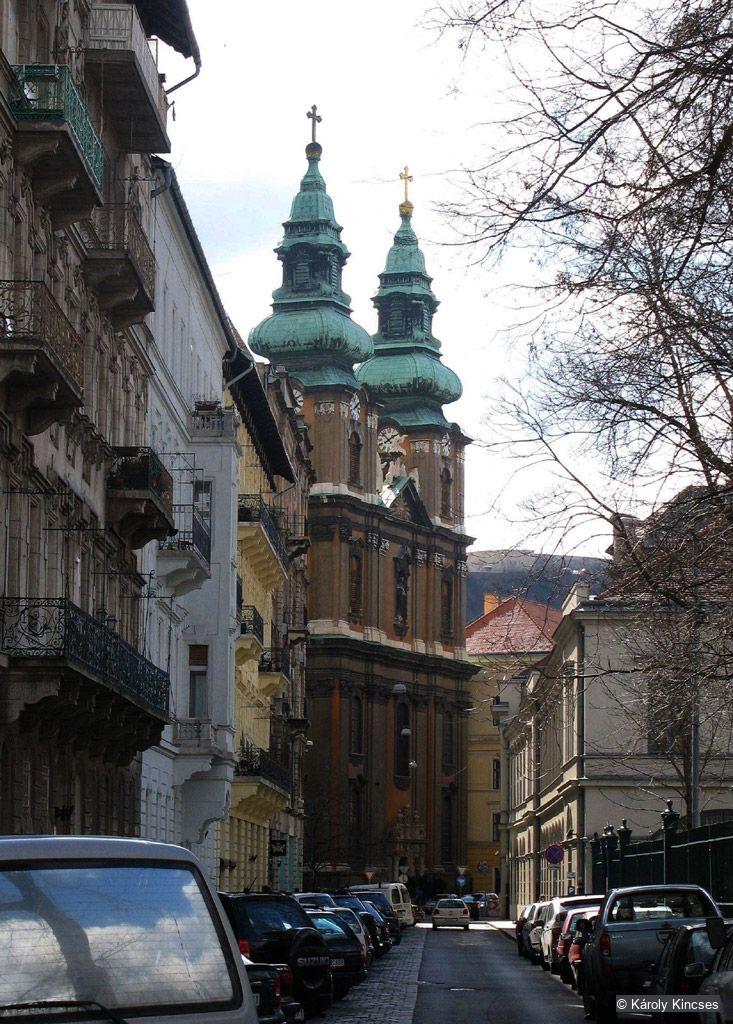
 Add to My Collection
Name of Monument:
University Church
Also known as:
The Pauline Church of Pest
Location:
Budapest, Közép-Magyarország / Central Hungary, Hungary
Papnövelde u. 5–7
1056 Budapest
T : +36 13 180 555
E : info@belvarosiplebania.hu
Catholic Church of Hungary, Archdiocese of Esztergom-Budapest, Main Parish of Our Lady in the City Centre (Responsible Institution)
Date:
8 April 1724
Artists:
Architect: unknown master; building masters/supervisors: Mátyás Drenker (1654—1729), Chief Guild Master of Pest, András Mayerhoffer (1690—1711), Márton Siegl, Johann Bergl, stone carver: Antal Lipót Conti; sculptor: József Hebenstreit
Denomination / Type of monument:
Religious building, church
Patron(s):
Doloczky, Mária Magdolna; Count Koháry, István (1649–1731); Count Grassalkovich, I. Antal (1694–1771)
History:
Two years after the united legions of Sacra Lega had liberated Buda from Ottoman rule (1686), the Pauline order, the only monastic order to be founded in Hungary, was granted the right to settle on the Pest side of the Danube in 1688. Acquiring a plot of land next to the Danube with some houses and a Turkish mosque on it in 1715, construction of a monastery began, only to be thwarted by financial difficulties. The mosque was then converted and consecrated to become a Christian church, which the Paulines made do with until 1720, when, with the help of a donation from Mária Magdolna Doloczky, they demolished the mosque and raised a chapel in its place, in honour of the Five Holy Wounds of Christ. As the significance of Catholic spirituality expanded, the chapel proved to be too small, and so the Paulines built a new church next to the chapel with the help of donations from Count István Koháry and Count Antal I. Grassalkovich.
The foundation stone of this church was laid on 8 April 1725. Researchers have not identified the architect to date, but the plans for the church and the monastery have survived in the archives of the Pauline order, although unfortunately, without a signature that might reveal the identity of the architect. The construction, which lasted for several decades, is linked to three great architect-master builders. The first phase of construction was supervised by Mátyás Drenker, a local master. After his death in 1729, András Mayerhoffer took control of the work. He was born in Salzburg, but was naturalised in Pest in 1724, and became a member of the Guild of Masons of Pest in 1729. Mayerhoffer – whose artistic style bore the influence of the great masters of the Austrian Baroque, J. B. Fischer von Erlach and J. L. von Hildebrand – erected the side walls of the church and the sanctuary. In 1735, he transferred supervision of the construction to Márton Siegl from Upper Silesia, who built the vaults and the facade. The church was consecrated by Gábor Patachich, Archbishop of Kalocsa on 8 September 1742, on the day of the Nativity of the Blessed Virgin Mary. At that time, the old chapel was still standing.
The interior of the church and the decoration of the facade was completed in the 1740s (1744 the main gate and pews; 1746–1748 main altar; 1748 the pulpit, choir pews and stalls; 15 June 1748 consecration of the main altar, organ loft and side altars).
The towers were completed in 1768 and 1771. The mural sequence illustrating scenes from the Life of the Virgin Mary was finished in the early 1700s.
In 1786 Emperor Joseph II dissolved the Pauline order and the church was obtained by the neighbouring university.
Description:
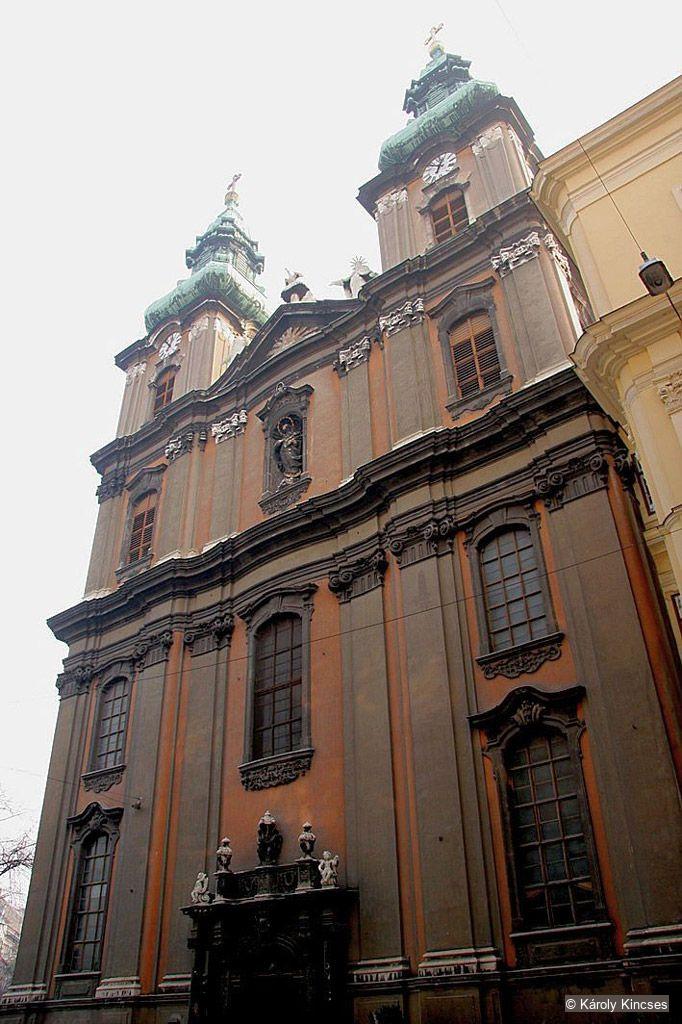
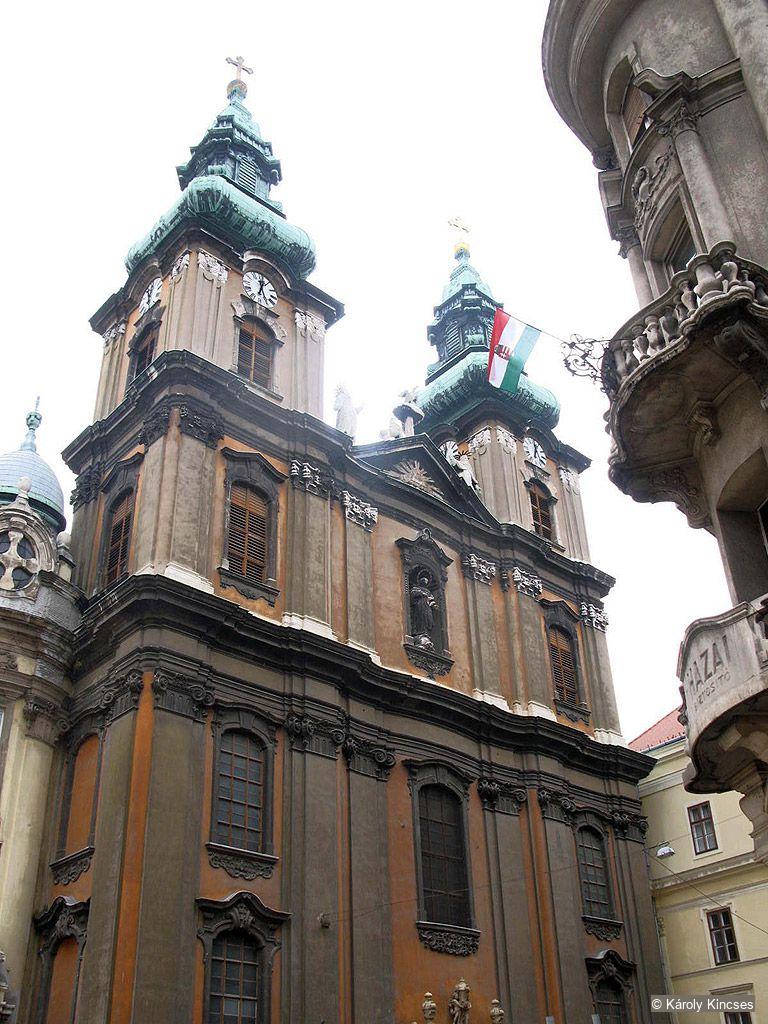
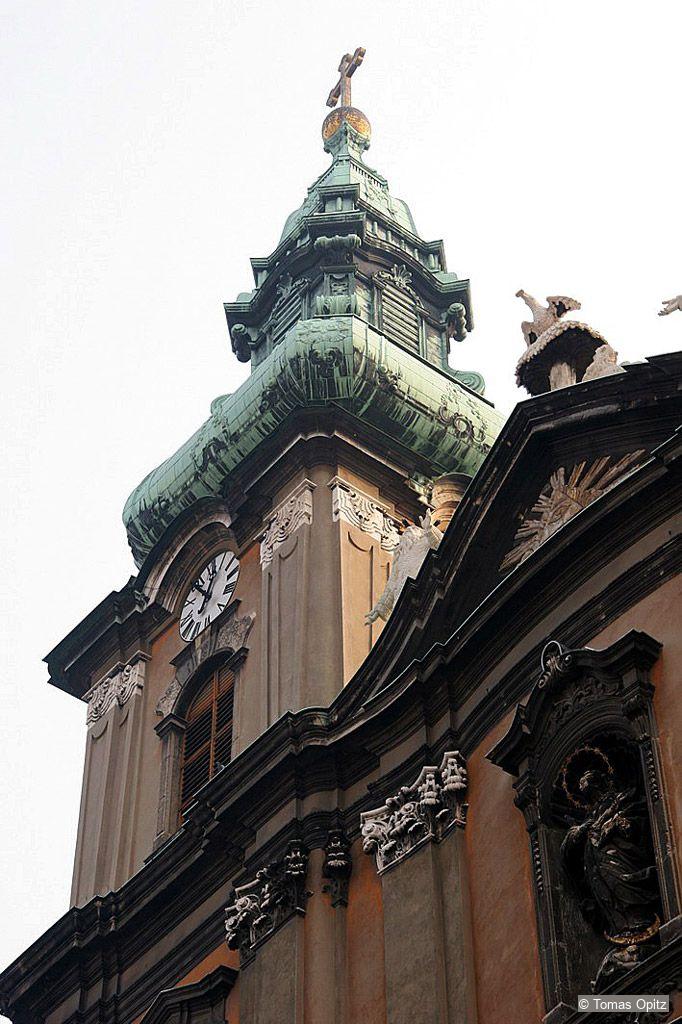
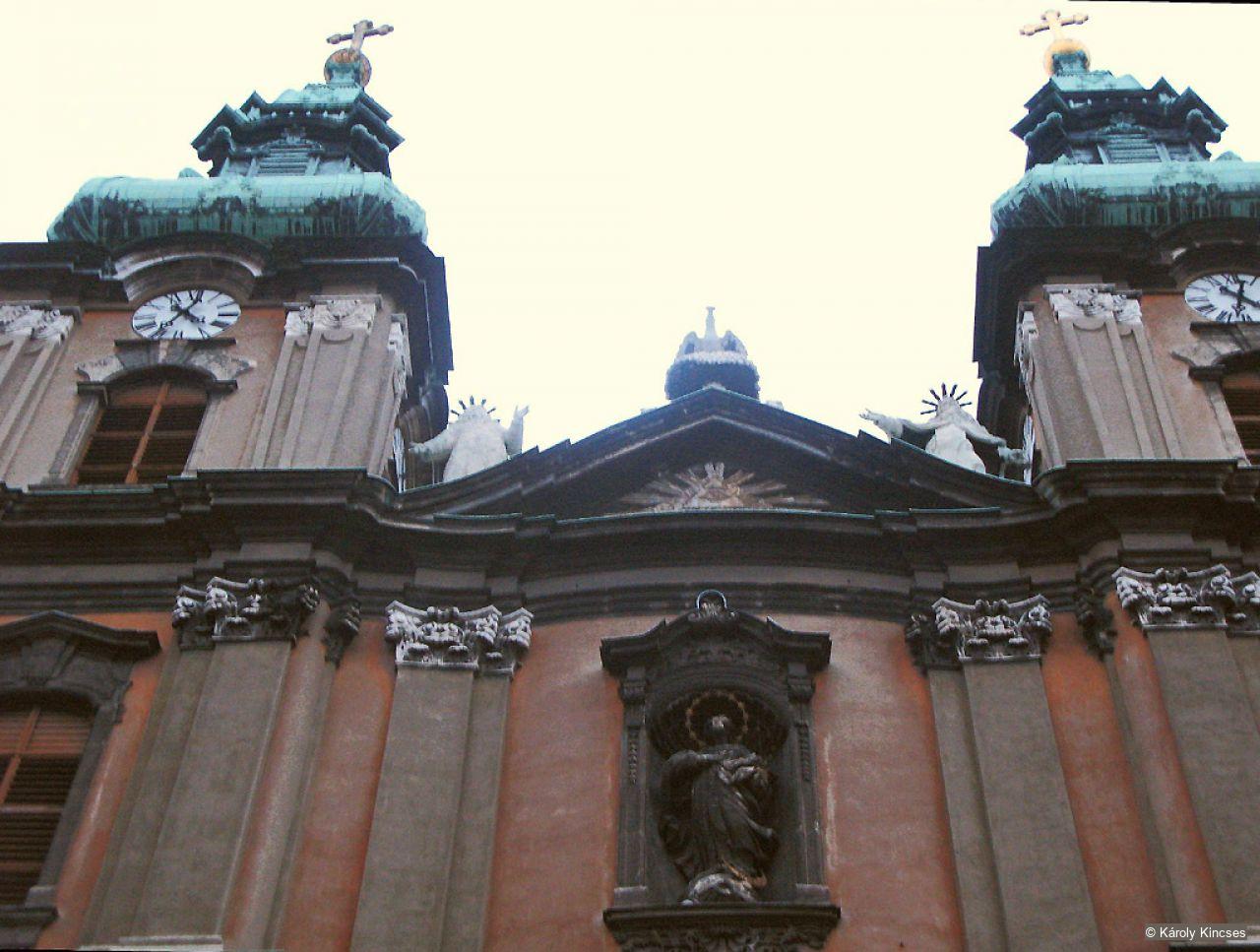
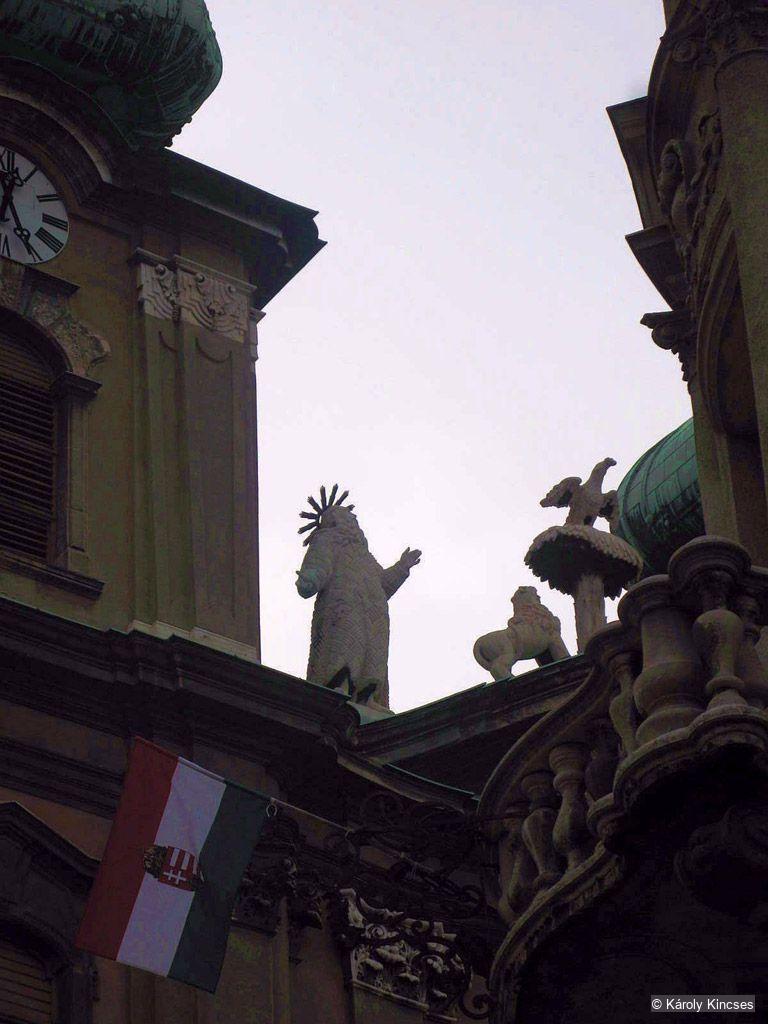
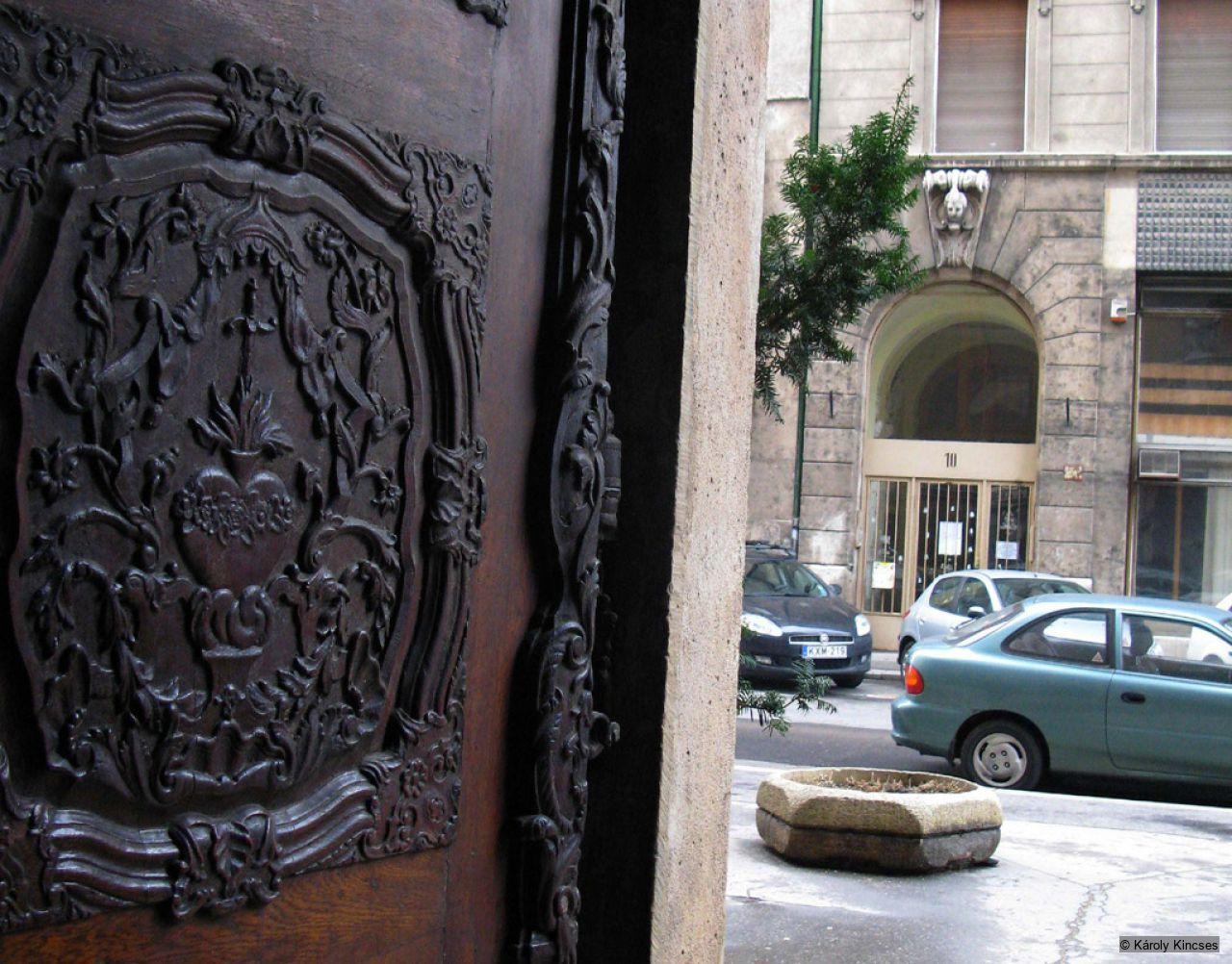
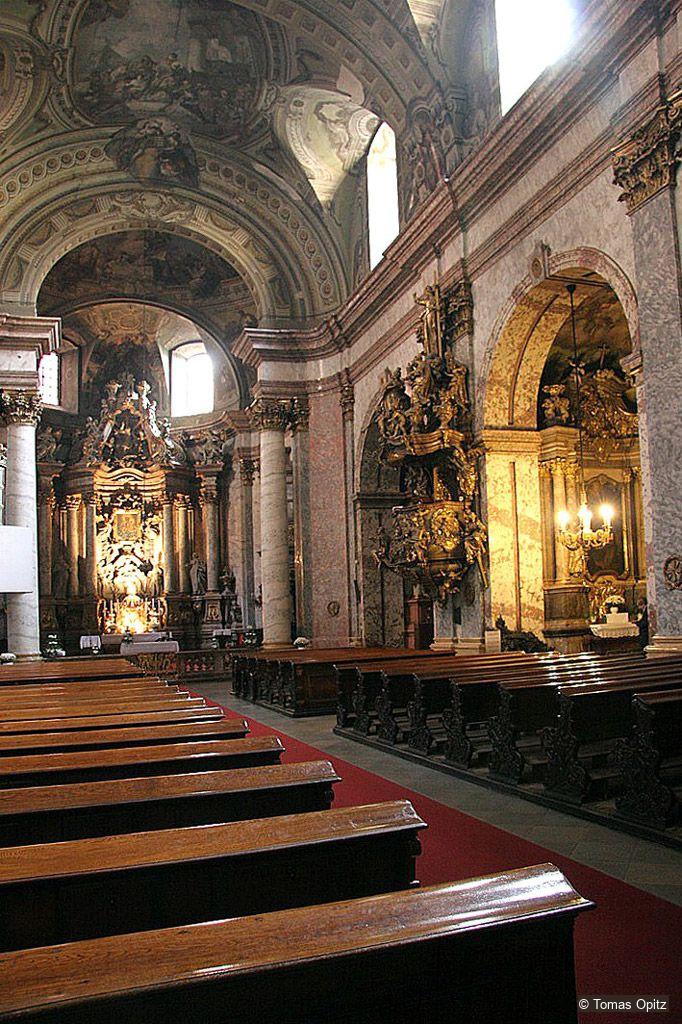
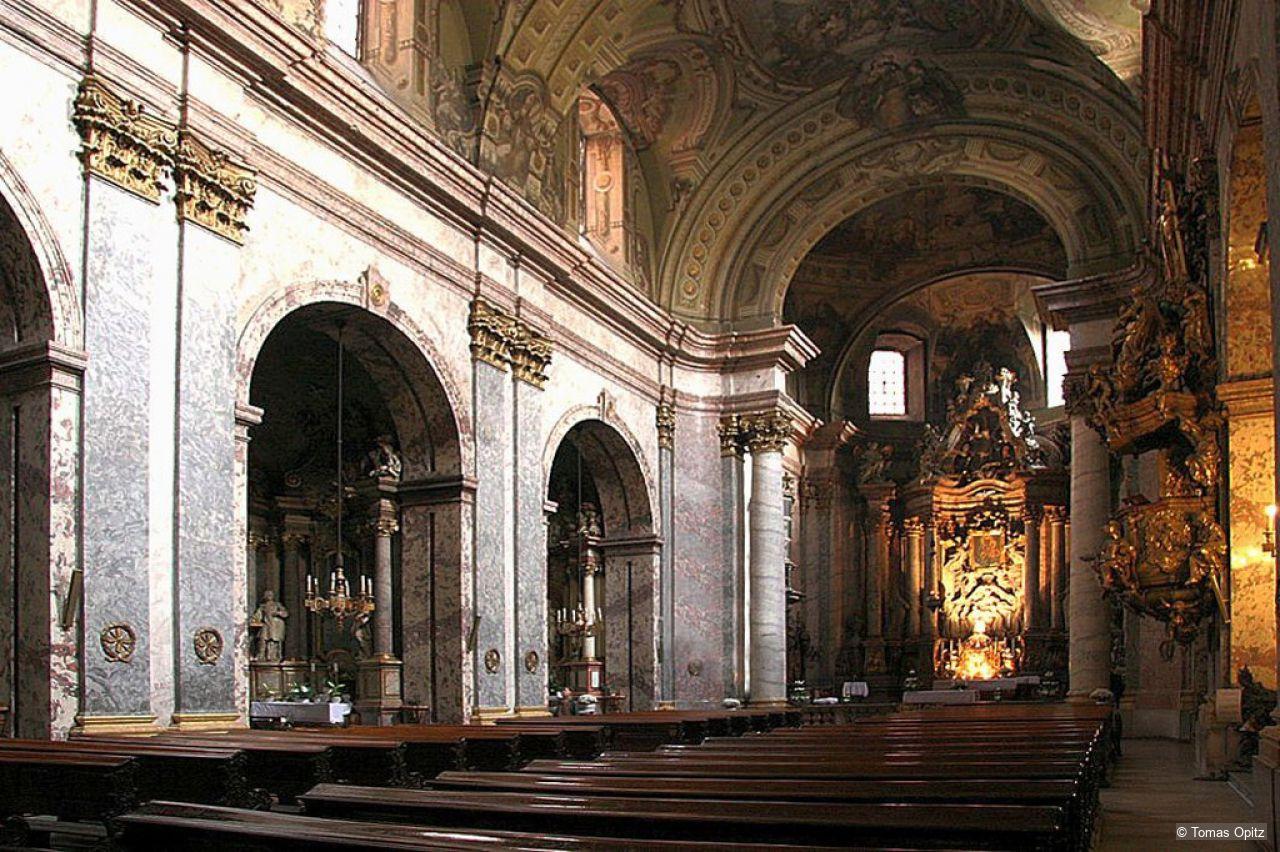
The church, which rises up into a sail vault, consists of a nave with three side-chapels on both sides and terminates in a sanctuary with a square layout. The mid-section of the two-tower facade (articulated by mouldings, pilasters and windows) is crowned by a tympanum, with the Eye of Providence in the middle and a statue of the Immaculate Conception in the niche underneath. On the gable, the coat of arms of the Pauline order is framed by statues of St. Paul the Hermit and St. Anthony the Hermit. The keystone of the main gate frame (decorated with vases, putti, and fine ornamentation) forms an empty shield. On the moulding above the gate, two angels hold aloft the letters of the name “Mary”.
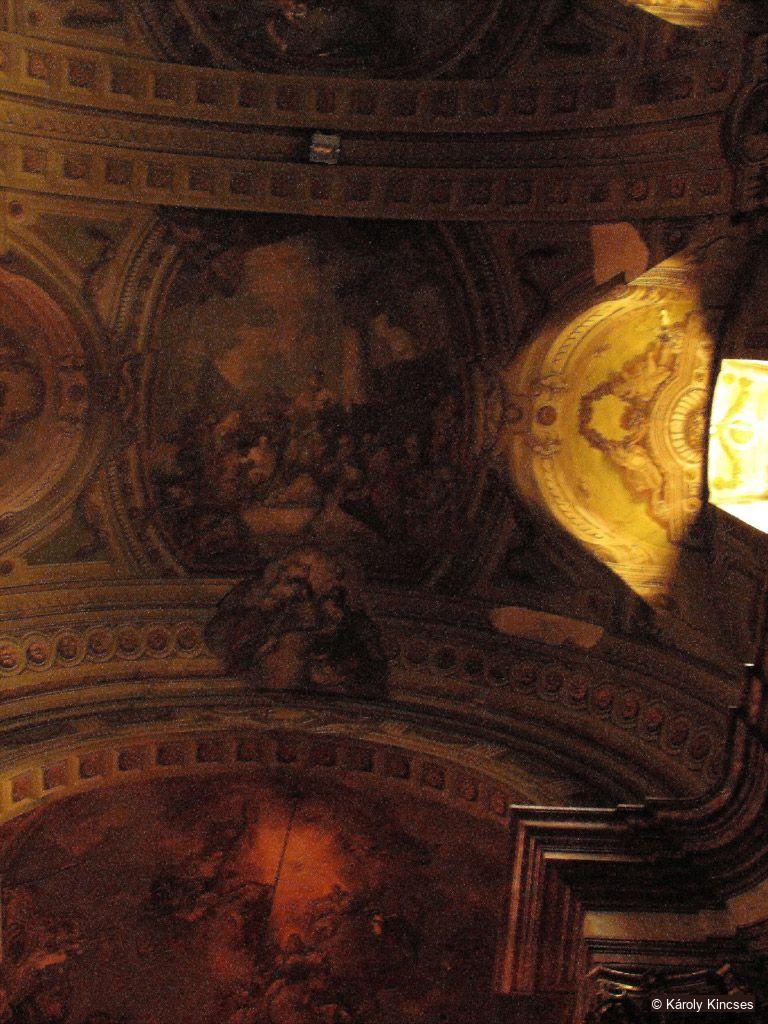
In 1776, Johann Bergl and his workshop completed a number of frescoes and murals: in the nave Presentation of Mary in the Temple, Annunciation and Immaculata; in the sanctuary Assumption of the Virgin Mary; at the side of the entrance The Lord Appears to Moses in a Flame; in the organ-loft The Visit of Mary to Elizabeth and for the two side altars Jesus on the Mount of Olives and St. John of Nepomuk.
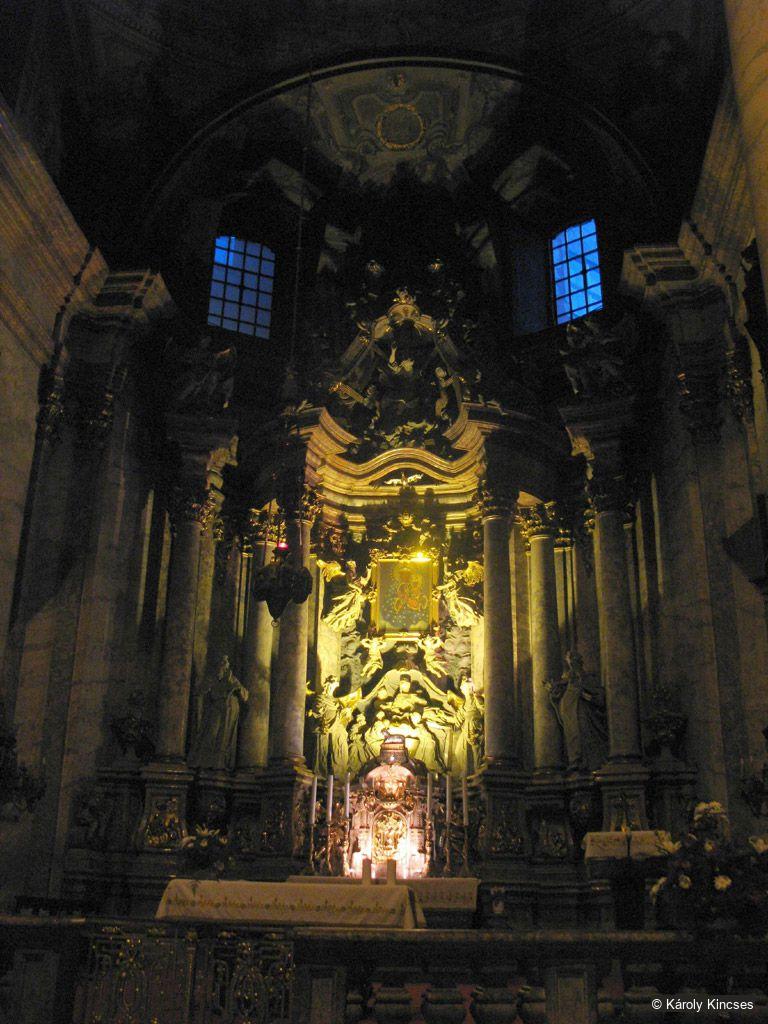
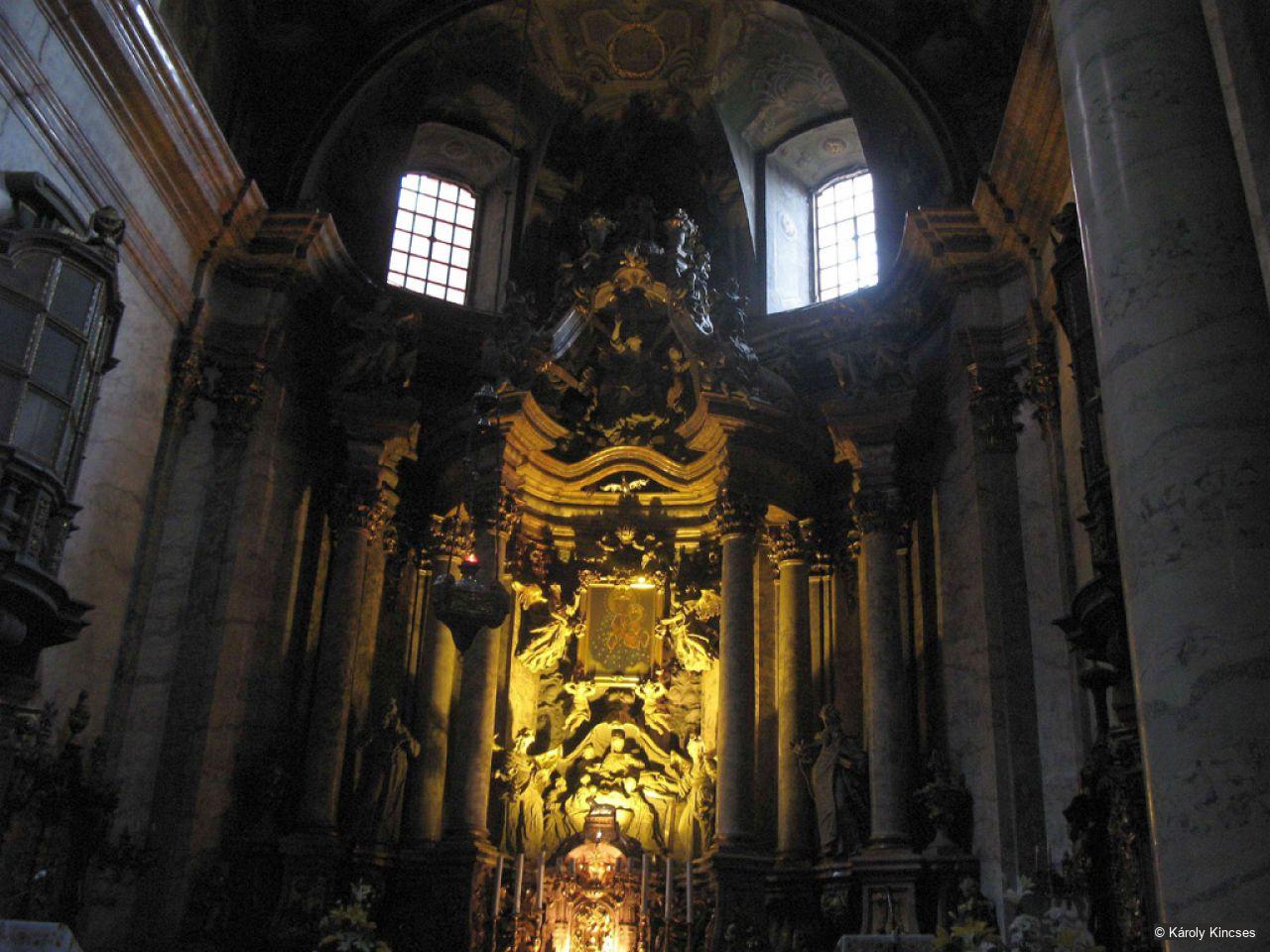
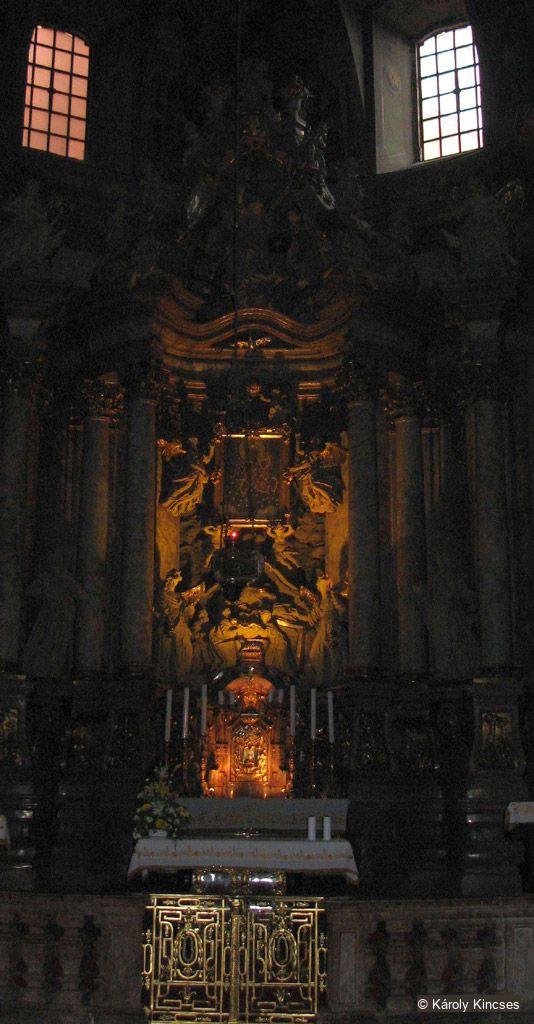
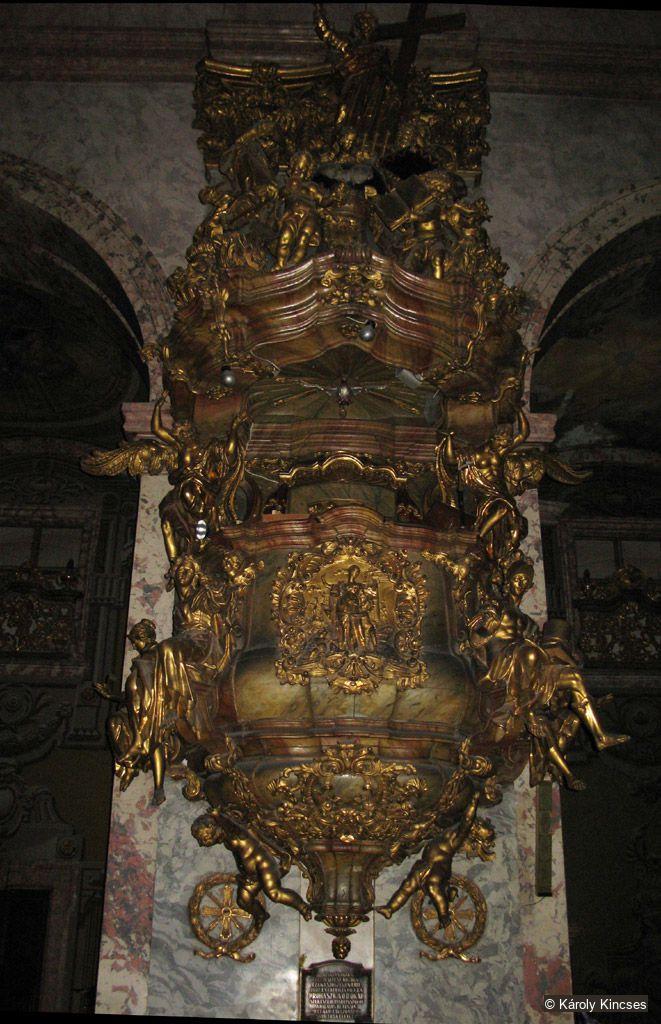
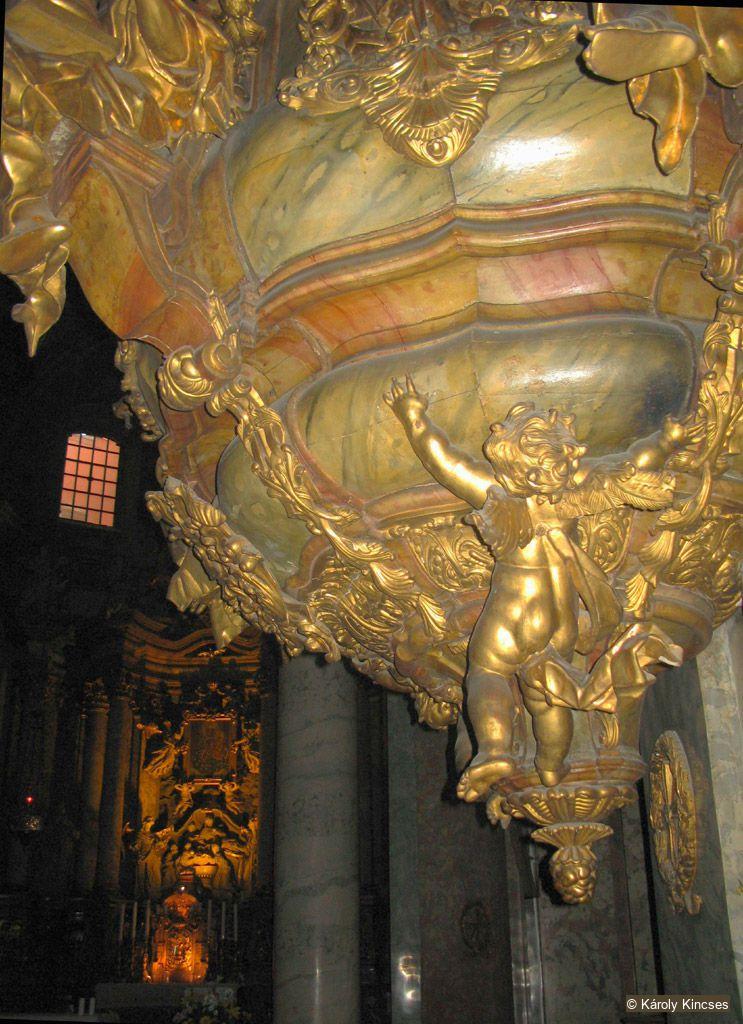
The pulpit and the main altar are thought to be by master stonemason, Antal Lipót Conti. The main altar is decorated with dynamic and vigorous artistic elements and columns and a central sculptural group of the Nativity of the Virgin Mary. Above the main altar is the copy of the miraculous image of the Black Madonna of Czestochowa (Poland), painted on copper plate. The two figures of St. Anthony the Hermit and St. Paul the Hermit stand either side of the main altar. They are the work of József Hebenstreit, a sculptor from Pest.
The carved church furniture represents an outstanding example of Hungarian Pauline woodcarving.
The interior walls of the church were decorated with a decorative paint finish resembling marble in the 19th century.
According to research, the interior design and arrangement of the church is related to that of Kalocsa Cathedral.
The two main sources for the architectural and decorative characteristics of the Pauline Church of Pest (today the University Church) are the architecture of the Hungarian Jesuit order – which derives from the traditions of Italian architecture – and the High Baroque style of Austria. The church, with its architectural layout and its rich and dynamic interior decoration, is an outstanding example of the High Baroque style in Hungary. In the centre of the main altar, the copy of the miraculous image of the Black Madonna of Czestochowa (Poland) can be seen, painted on copper plate.
How Monument was dated:
Based on written and visual sources and stylistic research.
Selected bibliography:
Révhelyi (Réh), E., A régi Buda és Pest építőmesterei Mária-Terézia korában (Building Masters of Buda and Pest under the Rule of Queen Mary Theresa), Budapest, 1932.
Eszláry, É., Hebenstreit József pesti szobrász (Joseph Hebenstreit a sculptor in Pest), Művészettörténeti Tanulmányok A Művészettörténeti Dokumentációs Központ Évkönyve (Studies in Art History, Almanach of the Documentary Centre for Art History), 1954/55, Budapest, 1957.
Mojzer, M., “Adatok Mayerhoffer András működéséhez” (“Information on the Works of András Mayerhoffer”), Művészettörténeti Értesítő, 5, 1956, 1, pp. 32–43.
Aggházy, M., A barokk szobrászat Magyarországon (Baroque Sculpture in Hungary), Vols 1–3, Budapest, 1959, Vol. 1.
Kuthy, S., A pesti egyetemi templom (University Church of Pest), Budapest, 1960.
Török, J., “Budapest. Egyetemi templom” (“Budapest University Church”), Tájak Korok Múzeumok Kiskönyvtára (Library of Landscapes, Eras and Museums), 230, s. l., Budapest, 1986.,
Komárik, D., “A 18. századi Pest szobrászairól, kőfaragóiról.” (“About the Sculptors and Stone Carvers of 18th-century Pest”), Détshy Mihály nyolcvanadik születésnapjára. Tanulmányok. (Studies in Honour of Mihály Détshy's 80th birthday), (eds I. Bardoly, A. Haris), Budapest, 2002, pp. 461–476.
Komárik, D., “A 18. századi Pest szobrászairól, kőfaragóiról.” (“About the Sculptors and Stone Carvers of 18th-century Pest”), Ars Hungarica, 2008, 1. sz., pp. 59–90.
Citation of this web page:
Terézia Bardi "University Church" in "Discover Baroque Art", Museum With No Frontiers, 2026.
https://baroqueart.museumwnf.org/database_item.php?id=monument;BAR;hu;Mon11;4;en
Prepared by: Terézia BardiTerézia Bardi
SURNAME: Bardi
NAME: Terézia Anna
AFFILIATION: National Trust of Monuments for Hungary
TITLE: Art Historian, Vice Director for Research at The National Trust of
Monuments for Hungary; MWNF DBA local co-ordinator (Hungary), author
and copy-editor
CV:
Terézia Bardi, Vice Director for Research at the National Trust of Monuments for Hungary since 2004, was awarded her MA in History and History of Art at the Eötvös Loránd University in Budapest. After a period of fellowships mainly in Italy, Terézia gained her PhD from the Faculty of Art History at the same university for her thesis Presentation and Representation – the European Reception of the Liberation of Buda in 1686: Feast and Public Opinion. Her main fields of research are 17th-and18th-century Baroque and Rococo: the spectacles, festival decorations and associated iconography – including theatre productions of the period – and interior decoration of historic houses. Since 1988, she has edited a number of art historical books that include some on Oriental art and architecture. She is MWNF DBA’s local (Hungarian) co-ordinator, author and copy-editor.
Copyedited by: Terézia BardiTerézia Bardi
SURNAME: Bardi
NAME: Terézia Anna
AFFILIATION: National Trust of Monuments for Hungary
TITLE: Art Historian, Vice Director for Research at The National Trust of
Monuments for Hungary; MWNF DBA local co-ordinator (Hungary), author
and copy-editor
CV:
Terézia Bardi, Vice Director for Research at the National Trust of Monuments for Hungary since 2004, was awarded her MA in History and History of Art at the Eötvös Loránd University in Budapest. After a period of fellowships mainly in Italy, Terézia gained her PhD from the Faculty of Art History at the same university for her thesis Presentation and Representation – the European Reception of the Liberation of Buda in 1686: Feast and Public Opinion. Her main fields of research are 17th-and18th-century Baroque and Rococo: the spectacles, festival decorations and associated iconography – including theatre productions of the period – and interior decoration of historic houses. Since 1988, she has edited a number of art historical books that include some on Oriental art and architecture. She is MWNF DBA’s local (Hungarian) co-ordinator, author and copy-editor.
Translation by: Judit Harangozó, Philip Barker
Translation copyedited by: Mandi GomezMandi Gomez
Amanda Gomez is a freelance copy-editor and proofreader working in London. She studied Art History and Literature at Essex University (1986–89) and received her MA (Area Studies Africa: Art, Literature, African Thought) from SOAS in 1990. She worked as an editorial assistant for the independent publisher Bellew Publishing (1991–94) and studied at Bookhouse and the London College of Printing on day release. She was publications officer at the Museum of London until 2000 and then took a role at Art Books International, where she worked on projects for independent publishers and arts institutions that included MWNF’s English-language editions of the books series Islamic Art in the Mediterranean. She was part of the editorial team for further MWNF iterations: Discover Islamic Art in the Mediterranean Virtual Museum and the illustrated volume Discover Islamic Art in the Mediterranean.
True to its ethos of connecting people through the arts, MWNF has provided Amanda with valuable opportunities for discovery and learning, increased her editorial experience, and connected her with publishers and institutions all over the world. More recently, the projects she has worked on include MWNF’s Sharing History Virtual Museum and Exhibition series, Vitra Design Museum’s Victor Papanek and Objects of Desire, and Haus der Kulturen der Welt’s online publication 2 or 3 Tigers and its volume Race, Nation, Class.
MWNF Working Number: HU 04