

 Back
Back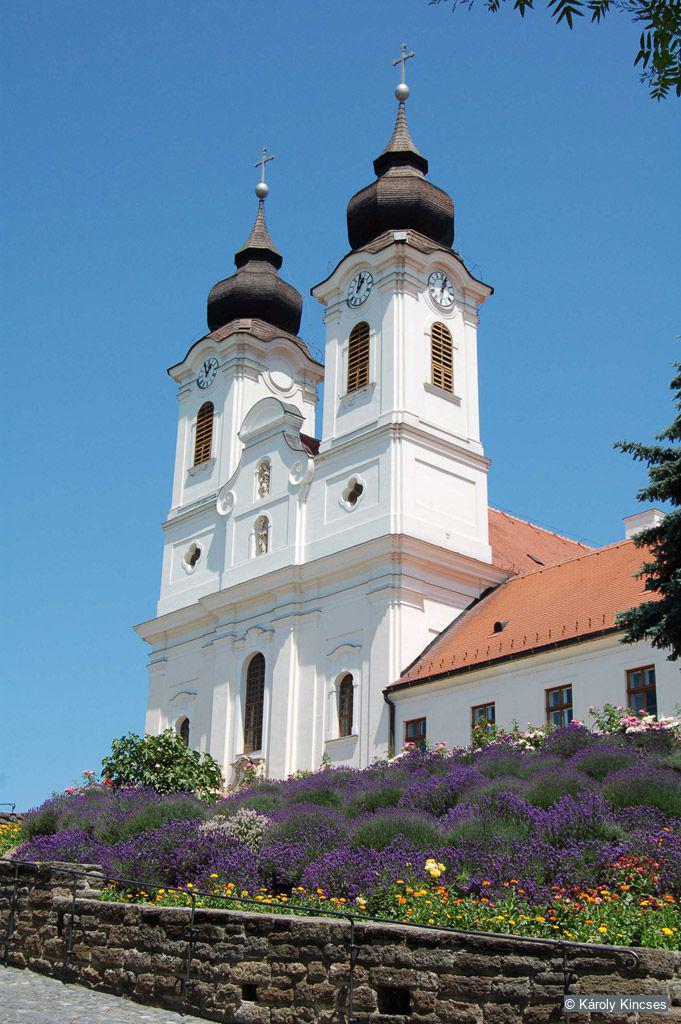
 Add to My Collection
Name of Monument:
Benedictine Abbey of St. Aignan in Tihany
Also known as:
Tihany Parish Church
Location:
Tihany, Nyugat-Magyarország / West Hungary, Hungary
I. András tér. 1
8327 Tihany
T : +36 87 538 200
F : +36 87 448 650
E : apatsag.tihany@canet.hu
Hungarian Benedictine Congregation, Ordo Sancti Benedicti (OSB) (Responsible Institution)
Date:
1720s to 1778
Artists:
Painter-gilders: József Cordelli, János Stern; fresco painter: Ambrosio Dornetti; master joiners/wood carvers: Sebestyén (Sebastian) Stulhoff (1723–1779); sculptor: József Hubert; painters (main altar) János Novák; renovation: Győző Cziegler and other unknown masters
Denomination / Type of monument:
Religious architecture, church
Patron(s):
Benedictine Arch Abbey of Pannonhalma; Abbot Villebald Grassó (1716–1740); Abbot Lécs Ágoston (1740–1760); Abbot Sámuel Vajda (1760–1795); Hungarian Benedictine Congregation, Ordo Sancti Benedicti (OSB)
History:
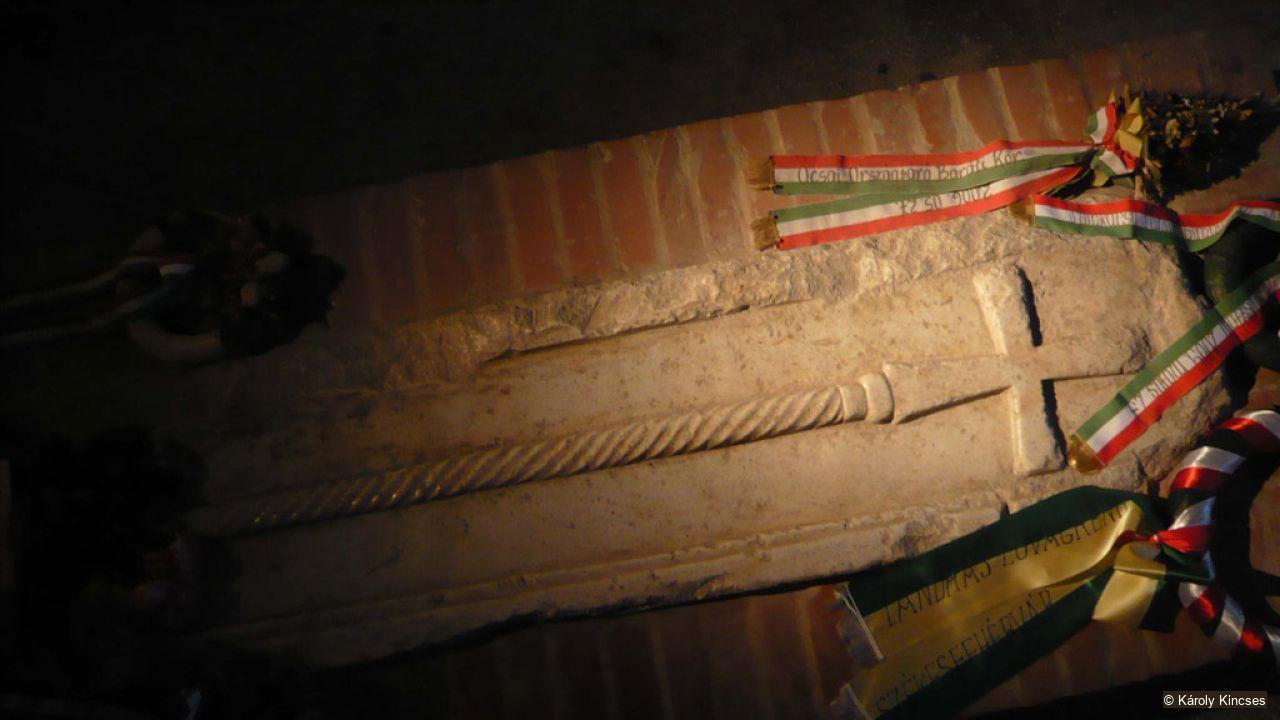
The Benedictine Abbey of Tihany was founded by King Andrew I of the Árpád dynasty in 1055. It was built in honour of the Virgin Mary and St. Aignan, and for the salvation of his closer family and the royal dynasty. King Andrew and his son were buried in the crypt of the church. During the Ottoman wars the monks deserted the monastery and it was converted into a border stronghold. After the Ottomans had retreated, the Hungarian Benedictine order was unable to pay the Royal Chamber the 10 percent land-tax due on the land at Tihany, and the abbey was obtained by the Austrian Benedictine Order of Alternburg in 1702. The Benedictine Arch Abbey of Pannonhalma repurchased the Abbey of Tihany in 1716, but only the crypt remained relatively intact as the other buildings were blown up by Austrian imperial troops after the end of the Turkish wars.
The reconstruction of the building complex in the Baroque style can be separated into three main phases. During the first phase in the 1720s, reconstruction of the church and the monastery commenced under the supervision of Abbot Villebald Grassó. In 1736, both the new church built on the medieval foundation walls, and the new monastery burned down. Reconstruction was resumed in 1737, but the Baroque building we see today was built later – under Abbot Ágoston Lécs in the 1740s – which marks the second reconstruction phase. In 1754, the church was consecrated for temporary use. The third phase of reconstruction marks the completion and interior furnishing, ending in 1778, with the consecration of the church. The Abbot at the time, Sámuel Vajda, was granted special permission by Pope Clement XIII to hold a celebration known as the Sacred Heart of Jesus (a celebration that became compulsory in the worldwide Roman Catholic Church in 1856).
In 1786, when Emperor Joseph II dissolved the Benedictine order, only one monk was allowed to stay in the monastery to complete parish duties, and the 18th-century furniture in the library was sold. The Benedictines were only able to return to Tihany in 1802.
In the late 19th century, Abbot Zsigmond Simon (1864–1891) entrusted Győző Cziegler with the renovation of the buildings, which by now were in poor condition. The altars were renewed and new murals and frescoes were painted (1889–1890). King Charles IV and Queen Zita spent their final days in Hungary under the roof of the monastery in Tihany (26–31 October 1921). The building complex was nationalised in 1950 and the monastery was converted into a workhouse; it finally became a museum in 1955. The books that were in the library have disappeared. The Benedictine order returned to Tihany in 1990, but the complex was only granted back to them in 1994. Today it functions as the Benedictine Abbey Museum. Between 1992 and 1996, the interior of the church was thoroughly restored. Reconstruction of the monastery resumed in 1996.
Description:
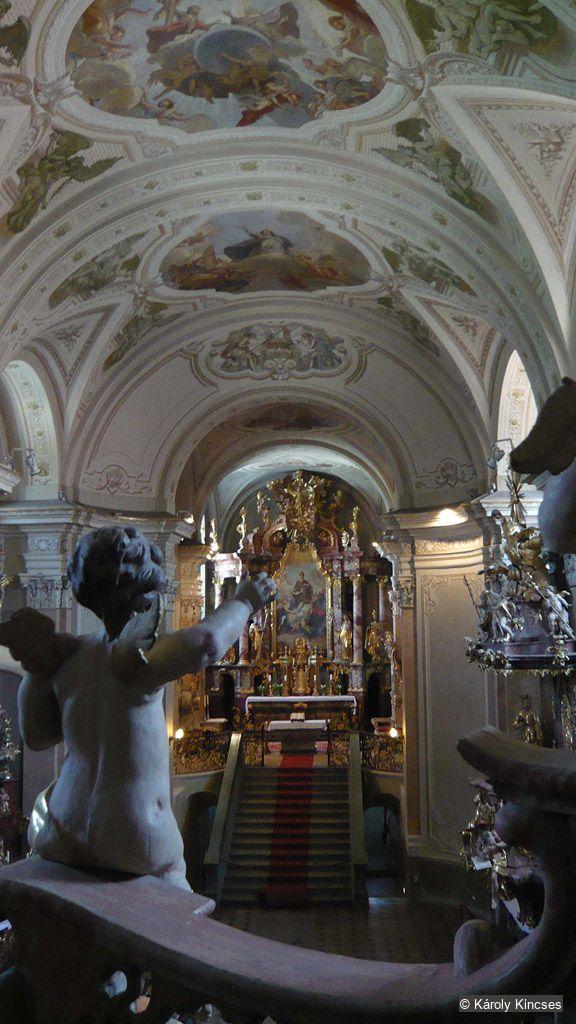
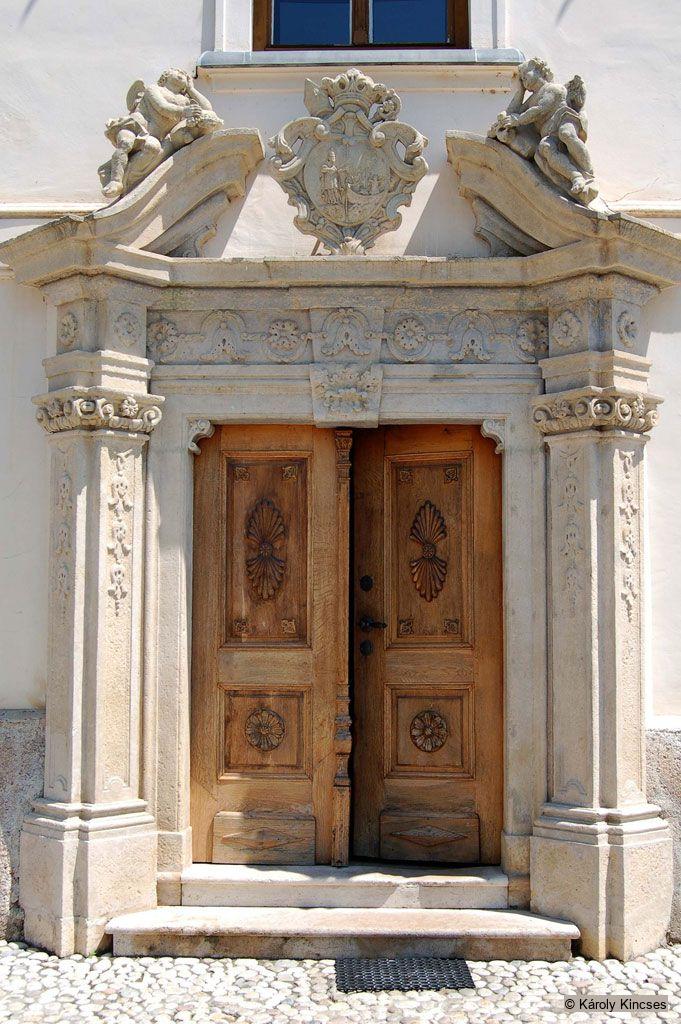
The one-nave church has a horizontal, elevated sanctuary with a crypt underneath. The main façade, embraced by two towers, is decorated with statues of the Virgin Mary and St. Aignan (by an unknown master from Veszprém, 1754) and floral ornaments. The main gate shows the initials of Archabbot Ágoston Lécs (“ALAT”: Augustinus Lécs Abbas Tihaniensis) with his coat of arms above it.
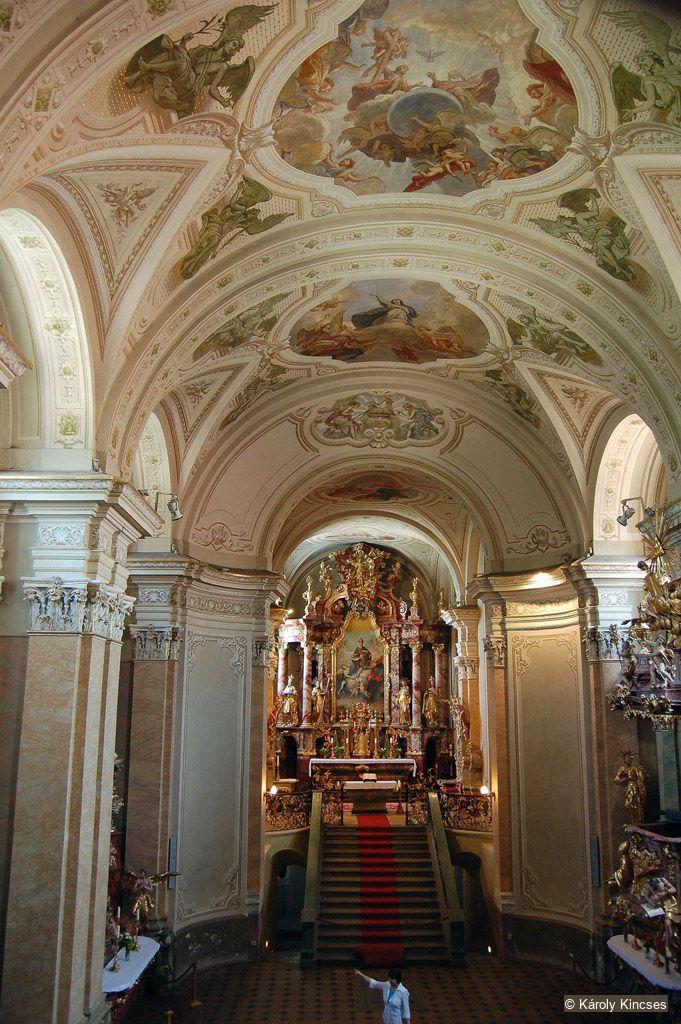
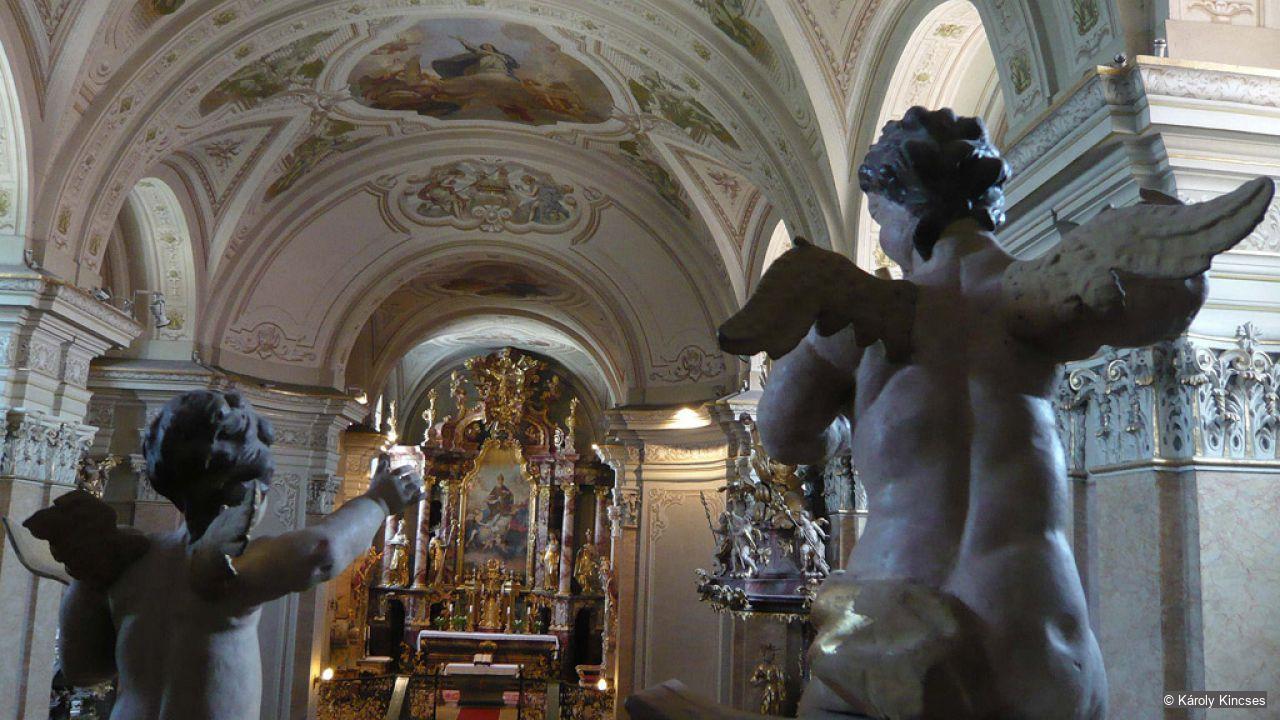
The richly carved furniture made for the church contrasted with the original modest, whitewashed walls (the murals seen today are 19th century).The furniture is an outstanding example of Hungarian Baroque wood carving, created by Sebestyén Stulhoff and his local assistants from Pápa and Veszprém (Stulhoff began work at Tihany Abbey in 1754). The altarpiece paintings are by artists from Pápa and Székesfehérvár.
The opulently gilded, high-standing main altar (1757) is framed by columns and crowned with a baldachin. Statues of Benedictine saints (St. Benedict, St. Scholastica) and the saints of the Árpád dynasty (St. Stephen and St. Ladislaus) can be seen in the column niches. On the main moulding decorated with vases, the statue of the Virgin Mary stands amidst a group of angels. The main altarpiece painting by János Novák from Sopron in 1822 – the Apotheosis of St. Aignan, with Tihany Abbey and its surroundings in the background – is a copy of the 18th-century original by an unknown master.
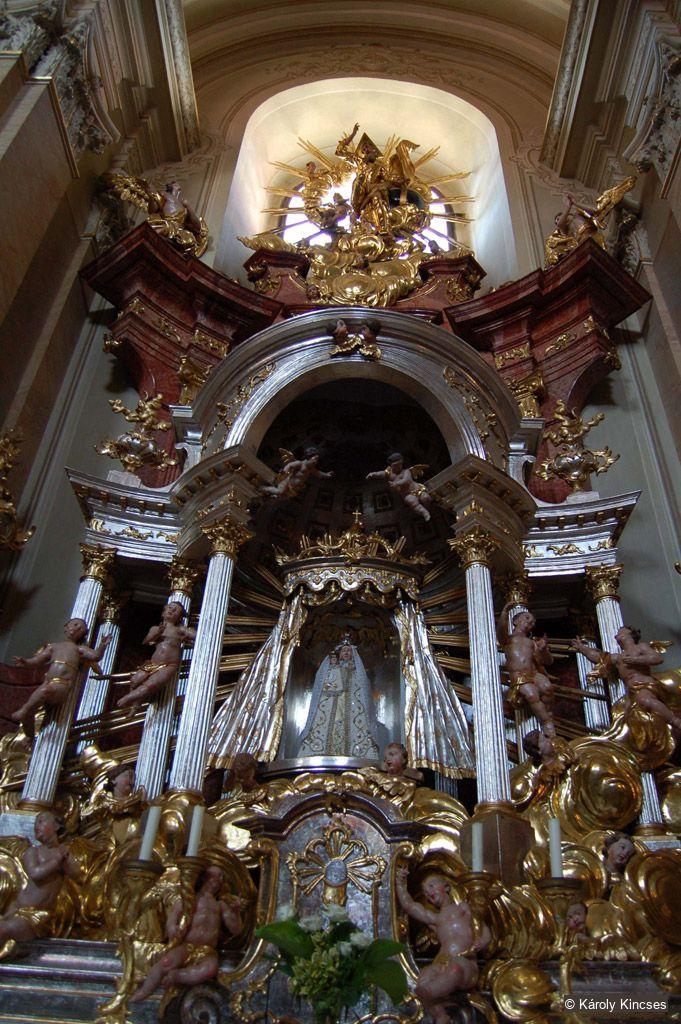
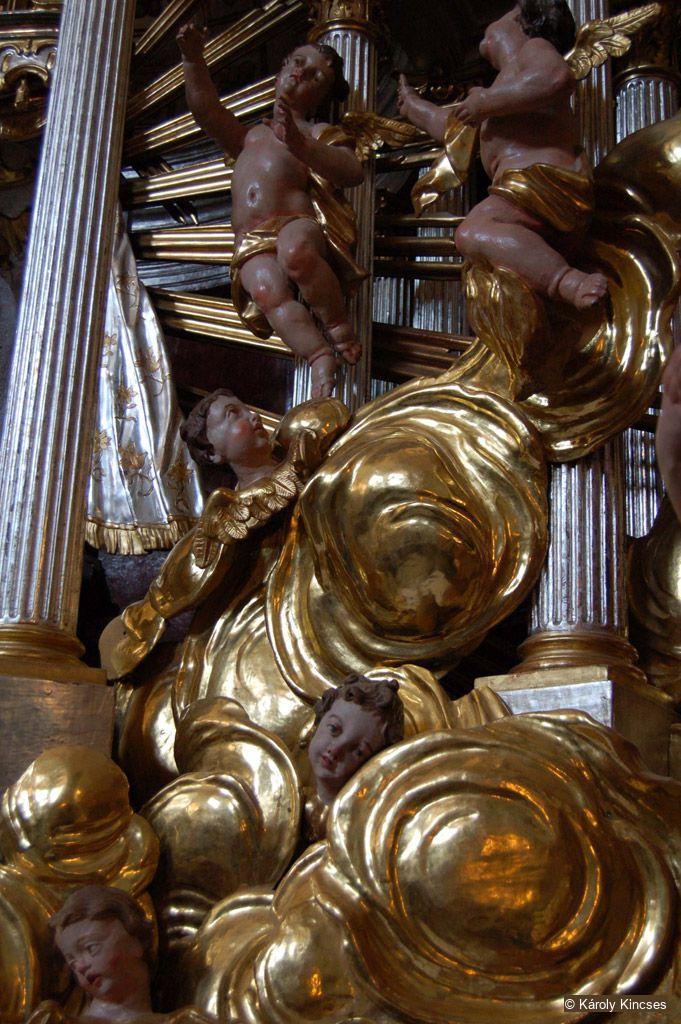
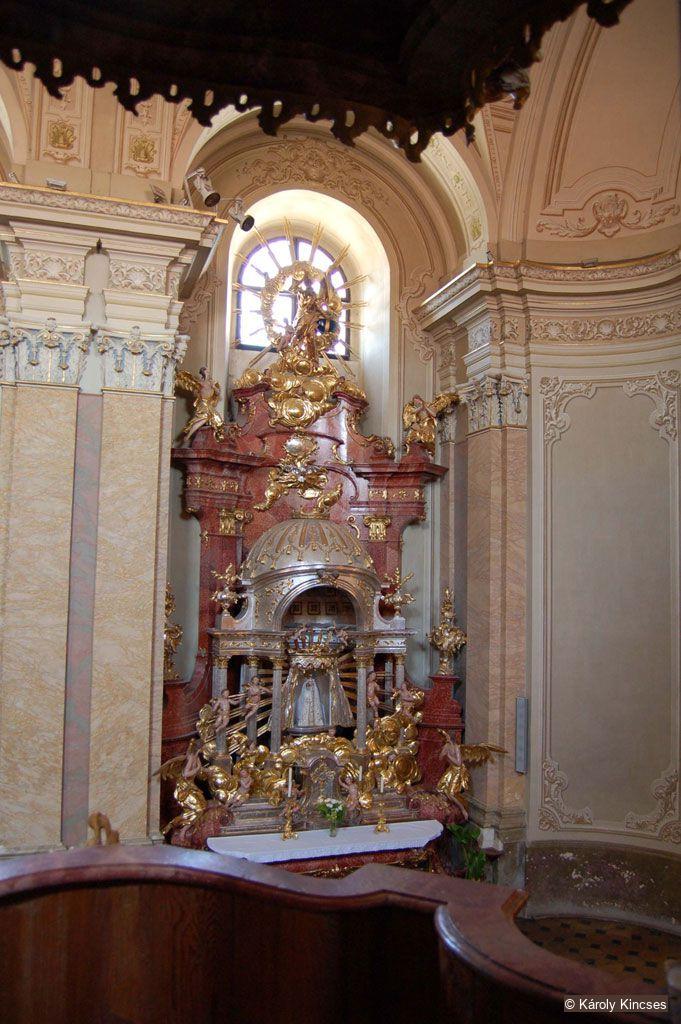
Abbot Sámuel Vajda had the Altar of Mariazell installed in 1762, and the Altar of the Sacred Heart of Jesus in 1771. On top of the Mariazell Altar God Enthroned looks down from a cloud surrounded by adoring angels. The sacred statue is placed in a silver-gilt, vaulted “sanctuary”, which stands in front of an arched superstructure that resembles red marble. The original clothed figurine of the Virgin Mary was replaced with one made in Tyrol in 1889. The altarpiece, carved by József Hubert from Pápa, was gilded and painted by József Cordelli from Székesfehérvár.
The statues on the Altar of the Sacred Heart of Jesus are also the works of József Hubert, and were painted and gilded by master Ambrosio from Székesfehérvár. At the centre, Jesus with a Crown of Thorns points at his gaping wound, his heart revealed. He is framed by a large heart composed of 12 flames and a smaller heart; underneath are the figures of Our Lady of Sorrows and a pelican feeding its young with its own blood. On either side of the altar, statues of saints display their affection towards Jesus (St. Augustine, St. Peter, St. Barbara and St. Paul).
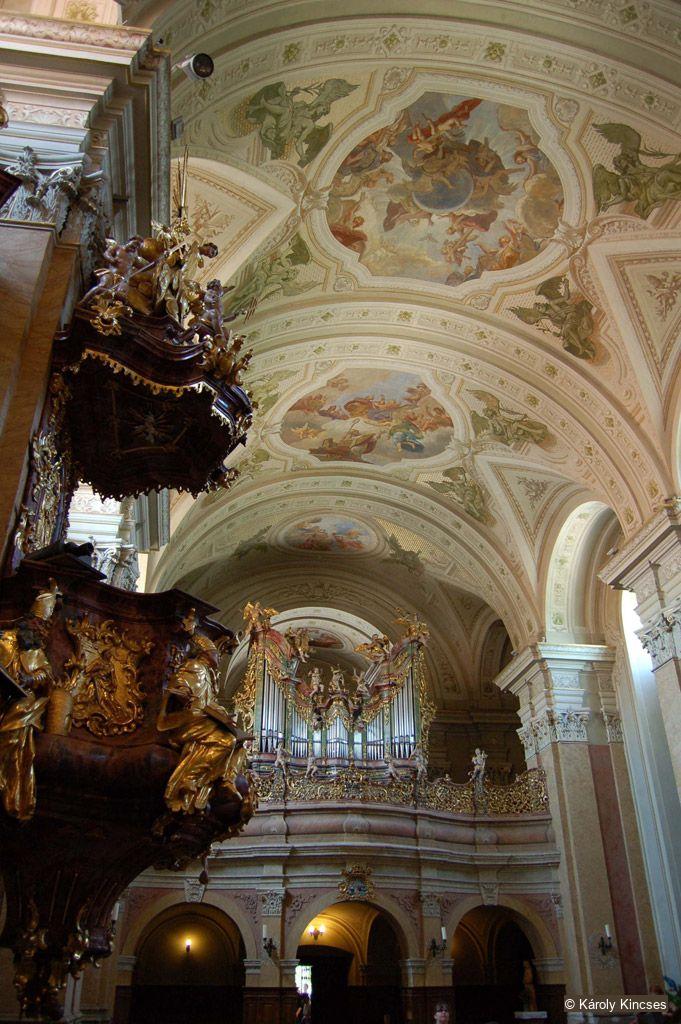
The opulently carved pulpit from 1715 depicts the Four Church Fathers (St. Ambrose, Pope Saint George, St. Jerome and St. Augustine) and their attributes, as well as those of the Four Evangelists (angel, ox, lion and eagle), the Eye of Providence, the figure of St. Paul the Apostle and allegorical figures of Faith, Hope and Love, all in high relief.
The altarpieces of St. Benedictine and St. Scholastica were painted by János Stern in 1759 (on one, St. Benedictine blesses the poisoned chalice that was given to him, on the other, the soul of St. Scholastica ascends to heaven in the shape of a dove). The Altar of St. Benedictine is decorated with the statues of his disciples, St. Maurus and St. Placidus. The Altar of St. Scholastica is adorned with the figures of female Benedictine abbots, St. Gertrude and St. Walburga.
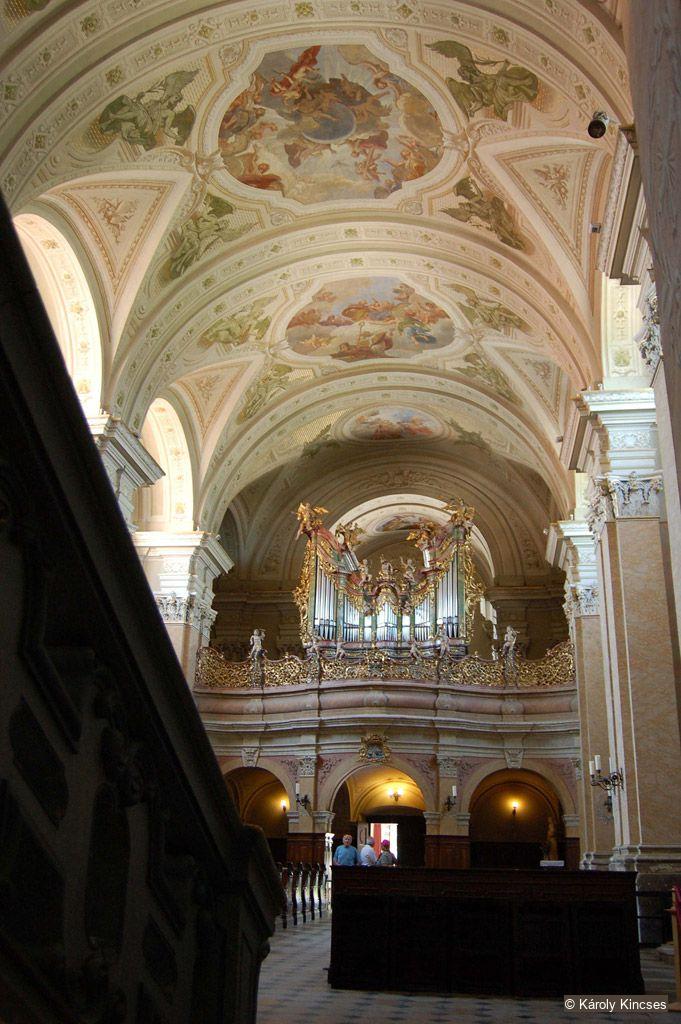
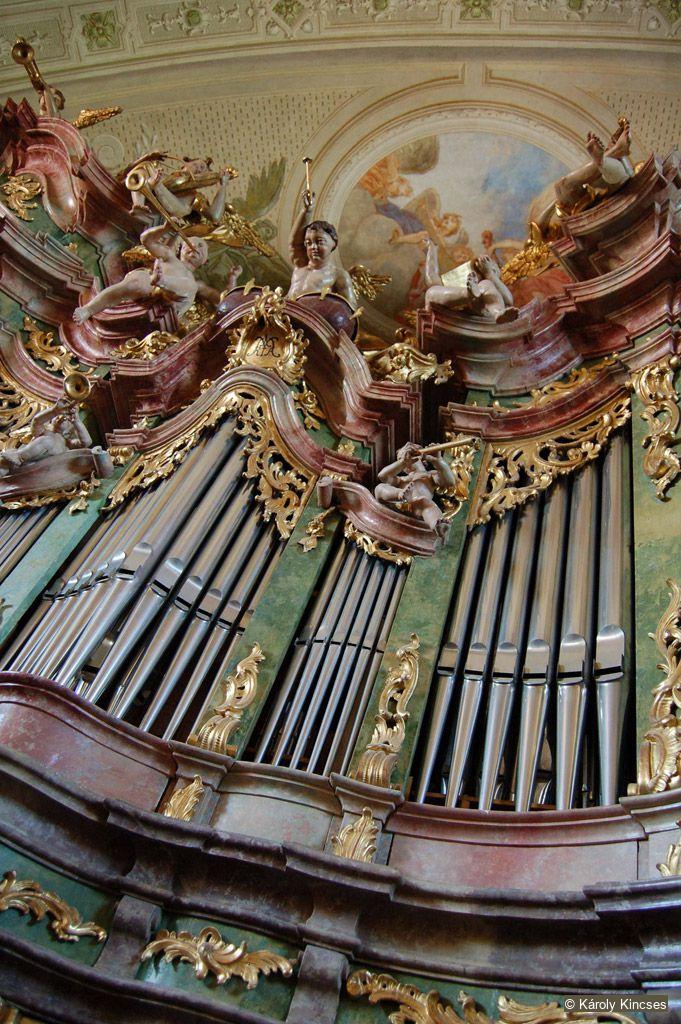
The carved pews were completed in 1760. The organ screen and the organ case are the works of József Huber, and József Cordelli did the painting and gilding in 1765; the paintings on the sides represent St. Cecilia playing the organ and King David playing the harp. The original 18th-century organ was restored in 1993.
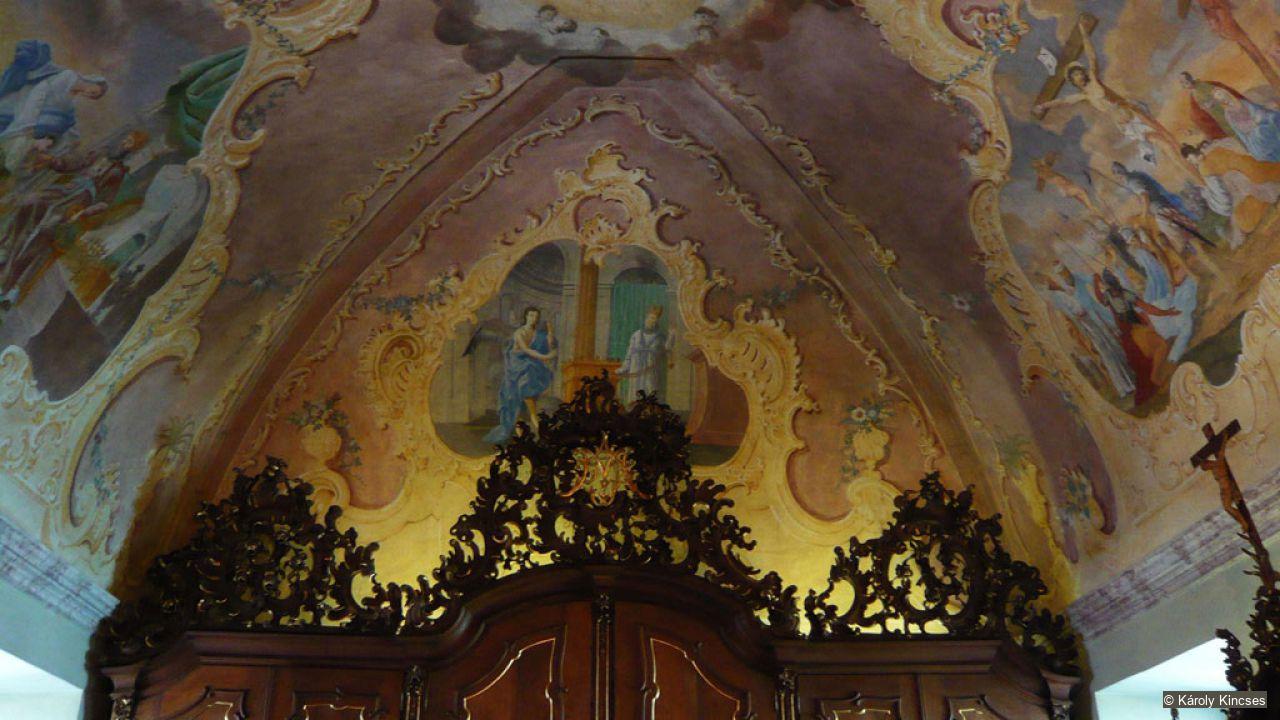
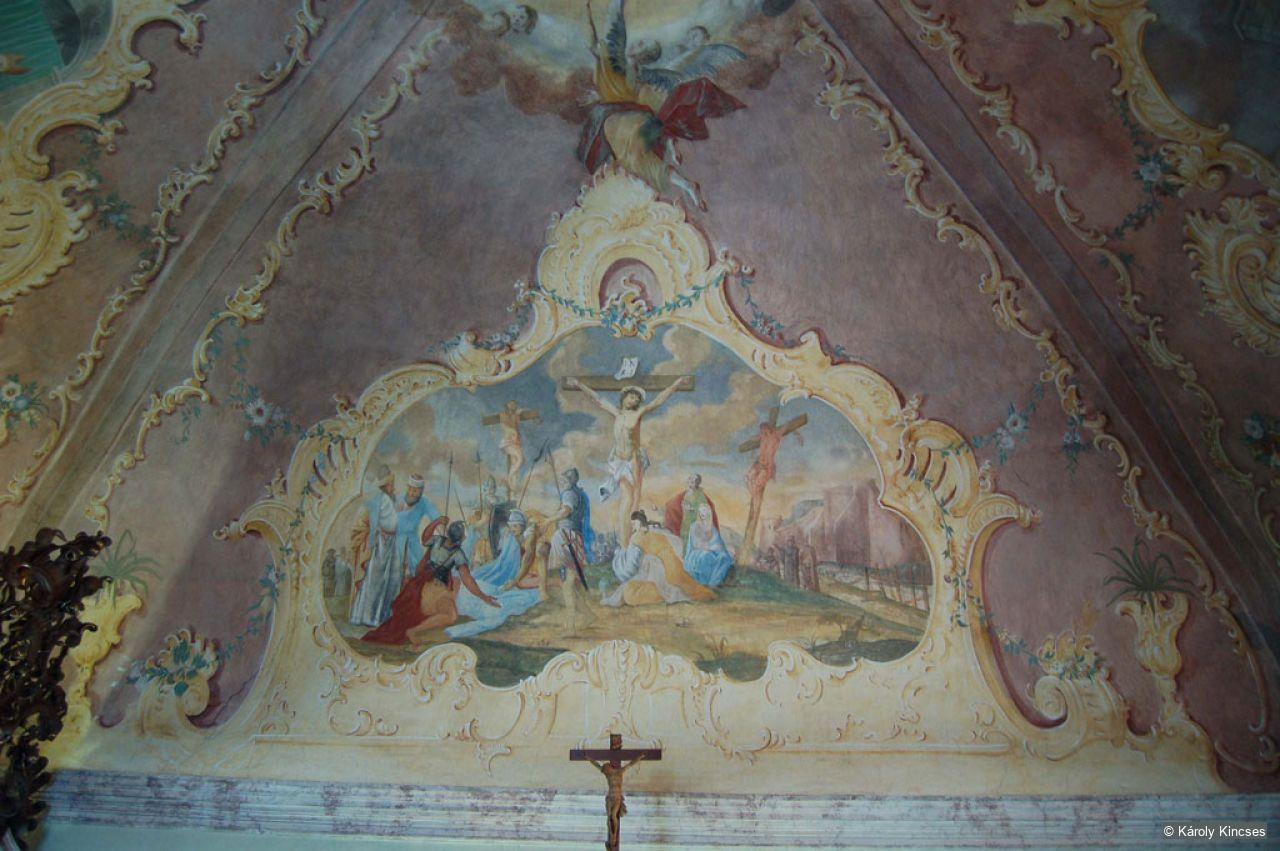
The furniture in the vestry is carved and partly painted (1768–mid-1770). The frescoes in the vault depict the Sacrifice of Melchizedek, Samuel with the Prelate Heli, Zachariah and the Angel Gabriel, the Crucifixion, and the Lamb of God. The Baroque paintings in the crypt were painted by Ambrosio Dornetti. The 11th-century crypt was re-painted in the 19th century, and renovated and restored in 1955.
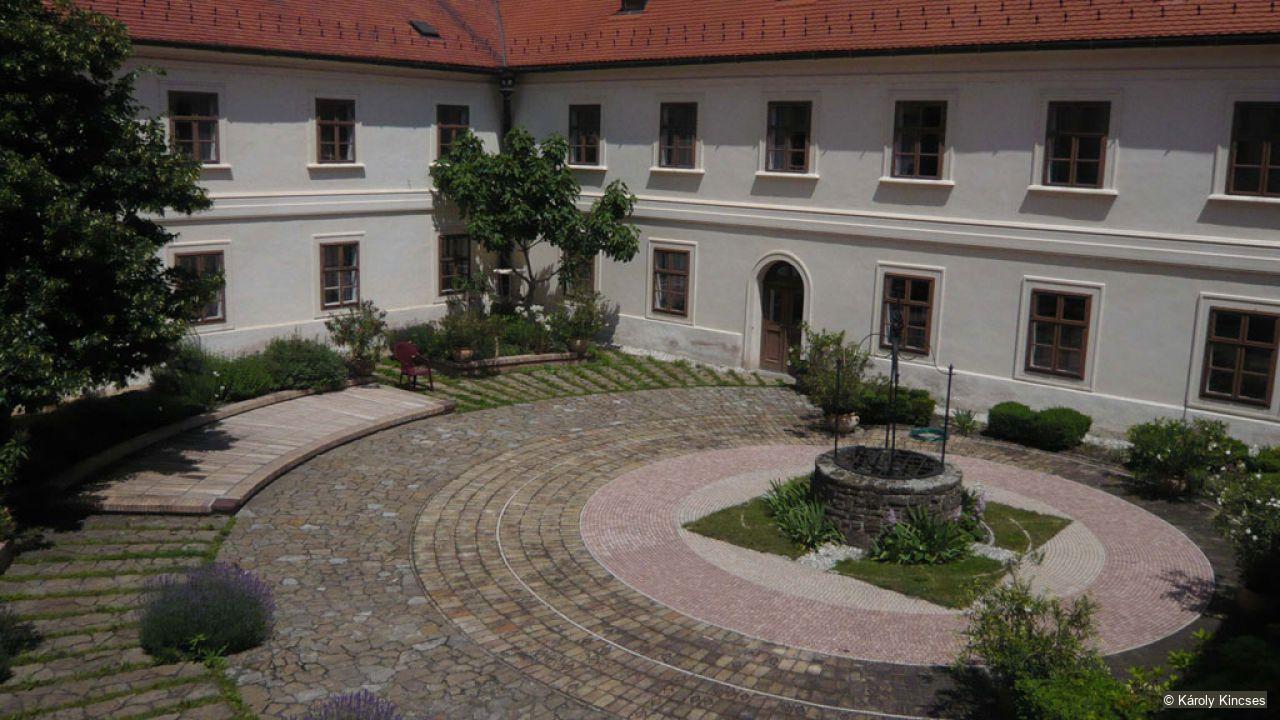
On the western facade of the monastery, a gate with a stone surround is similar to the main gate of the church. The refectory, on the ground floor of the southern wing, is decorated with murals illustrating Benedictine saints and saints of the Árpad dynasty framed with stuccoes. The library is on the first floor.
The Church and Monastery were built in the 18th century on the foundations of a former church and monastery founded by King Andrew I in 1055. The one-nave Baroque church was dedicated to the Virgin Mary and St. Aignan; their statues (dating from 1754) are visible on the two-tower facade of the church. The interior of the church was designed by local craftsmen: the master joiners Sebestyén Stulhoff and József Hubert made the richly carved furniture, Ambrosio Dornetti painted the ceiling frescoes of the vestry and János Stern and József Cordelli painted and gilded the carved furniture.
How Monument was dated:
Based on written and visual sources; archaeological finds; wall and mural restoration analysis.
Selected bibliography:
Erdélyi, L. OSB, A tihanyi apátság története (The History of the Tihany Abbey Vol. I, 1055–1701), A Pannonhalmi Szent Benedek Rend története (The History of the Benedictine Order of Pannonhalma), Pannonhalma, 1908.
Sörös, P. OSB, A tihanyi apátság története (The History of Tihany Abbey) Vol. II, 1701–[present], A Pannonhalmi Szent Benedek Rend története (The History of the Benedictine order in Pannonhalma), Pannonhalma, 1911.
Kampis, A., A tihanyi bencés apátság műemlékei (Monuments of the Benedictine Abbey of Tihany), Budapest, 1957.
Paradisum plantavit. Bencés monostorok a középkori Magyarországon (Benedictine Monasteries in Medieval Hungary), A Pannonhalmi Bencés Főapátságban rendezett kiállítás katalógusa (Catalogue of the Exhibition of the Benedictine Archabbey of Pannonhalma), Pannonhalma, 2001.
Uzsoki, A., A tihanyi apátsági templom (The Abbey of Tihany), Tihany, 1987.
Citation of this web page:
Terézia Bardi "Benedictine Abbey of St. Aignan in Tihany" in "Discover Baroque Art", Museum With No Frontiers, 2026.
https://baroqueart.museumwnf.org/database_item.php?id=monument;BAR;hu;Mon11;5;en
Prepared by: Terézia BardiTerézia Bardi
SURNAME: Bardi
NAME: Terézia Anna
AFFILIATION: National Trust of Monuments for Hungary
TITLE: Art Historian, Vice Director for Research at The National Trust of
Monuments for Hungary; MWNF DBA local co-ordinator (Hungary), author
and copy-editor
CV:
Terézia Bardi, Vice Director for Research at the National Trust of Monuments for Hungary since 2004, was awarded her MA in History and History of Art at the Eötvös Loránd University in Budapest. After a period of fellowships mainly in Italy, Terézia gained her PhD from the Faculty of Art History at the same university for her thesis Presentation and Representation – the European Reception of the Liberation of Buda in 1686: Feast and Public Opinion. Her main fields of research are 17th-and18th-century Baroque and Rococo: the spectacles, festival decorations and associated iconography – including theatre productions of the period – and interior decoration of historic houses. Since 1988, she has edited a number of art historical books that include some on Oriental art and architecture. She is MWNF DBA’s local (Hungarian) co-ordinator, author and copy-editor.
Copyedited by: Terézia BardiTerézia Bardi
SURNAME: Bardi
NAME: Terézia Anna
AFFILIATION: National Trust of Monuments for Hungary
TITLE: Art Historian, Vice Director for Research at The National Trust of
Monuments for Hungary; MWNF DBA local co-ordinator (Hungary), author
and copy-editor
CV:
Terézia Bardi, Vice Director for Research at the National Trust of Monuments for Hungary since 2004, was awarded her MA in History and History of Art at the Eötvös Loránd University in Budapest. After a period of fellowships mainly in Italy, Terézia gained her PhD from the Faculty of Art History at the same university for her thesis Presentation and Representation – the European Reception of the Liberation of Buda in 1686: Feast and Public Opinion. Her main fields of research are 17th-and18th-century Baroque and Rococo: the spectacles, festival decorations and associated iconography – including theatre productions of the period – and interior decoration of historic houses. Since 1988, she has edited a number of art historical books that include some on Oriental art and architecture. She is MWNF DBA’s local (Hungarian) co-ordinator, author and copy-editor.
Translation by: Judit Harangozó, Philip Barker
Translation copyedited by: Mandi GomezMandi Gomez
Amanda Gomez is a freelance copy-editor and proofreader working in London. She studied Art History and Literature at Essex University (1986–89) and received her MA (Area Studies Africa: Art, Literature, African Thought) from SOAS in 1990. She worked as an editorial assistant for the independent publisher Bellew Publishing (1991–94) and studied at Bookhouse and the London College of Printing on day release. She was publications officer at the Museum of London until 2000 and then took a role at Art Books International, where she worked on projects for independent publishers and arts institutions that included MWNF’s English-language editions of the books series Islamic Art in the Mediterranean. She was part of the editorial team for further MWNF iterations: Discover Islamic Art in the Mediterranean Virtual Museum and the illustrated volume Discover Islamic Art in the Mediterranean.
True to its ethos of connecting people through the arts, MWNF has provided Amanda with valuable opportunities for discovery and learning, increased her editorial experience, and connected her with publishers and institutions all over the world. More recently, the projects she has worked on include MWNF’s Sharing History Virtual Museum and Exhibition series, Vitra Design Museum’s Victor Papanek and Objects of Desire, and Haus der Kulturen der Welt’s online publication 2 or 3 Tigers and its volume Race, Nation, Class.
MWNF Working Number: HU 05