

 Back
Back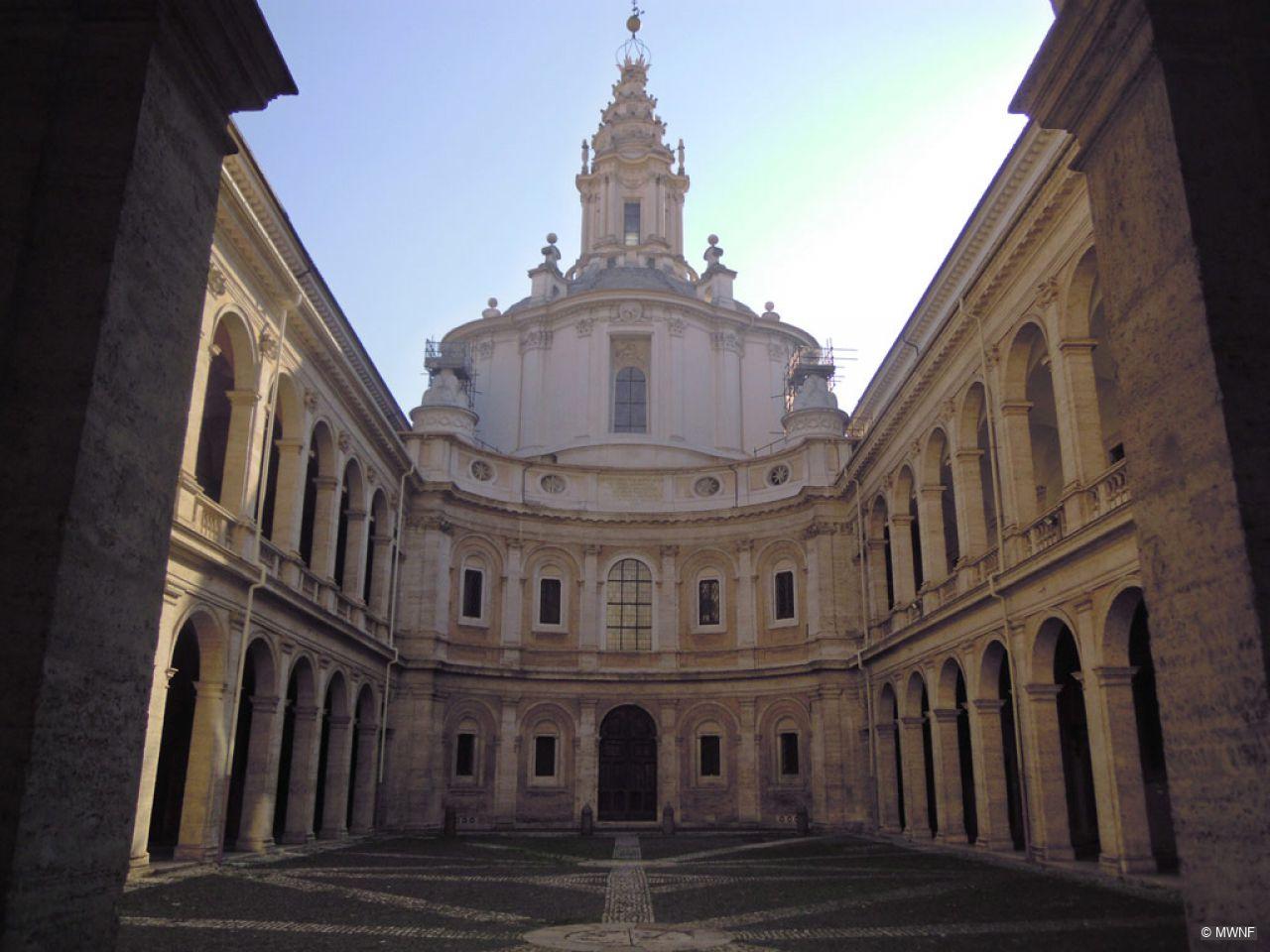

 Add to My Collection
Name of Monument:
Sant’Ivo alla Sapienza
Location:
Rome, Latium, Italy
Corso del Rinascimento 40
00186 Rome
Date:
1642–60 ca
Artists:
Francesco Borromini
Denomination / Type of monument:
Church
Patron(s):
Pope Urban VIII Barberini, Pope Alexander VII Chigi
History:
In 1642 Francesco Borromini, who had gained considerable fame with the construction of the Church of San Carlo alle Quattro Fontane, was appointed by Urban VIII Barberini official architect of the Archiginnasio della Sapienza, the historical university of Rome founded by Boniface VIII in 1303. On that occasion, he was commissioned to build the chapel of Sant’Ivo, patron saint of jurists, which should have (but had never) been built by Giacomo della Porta, responsible since 1577 for the construction of the new university building and its double loggia courtyard. Della Porta, however, had already established both the dimensions of the chapel and its position, east of the courtyard.
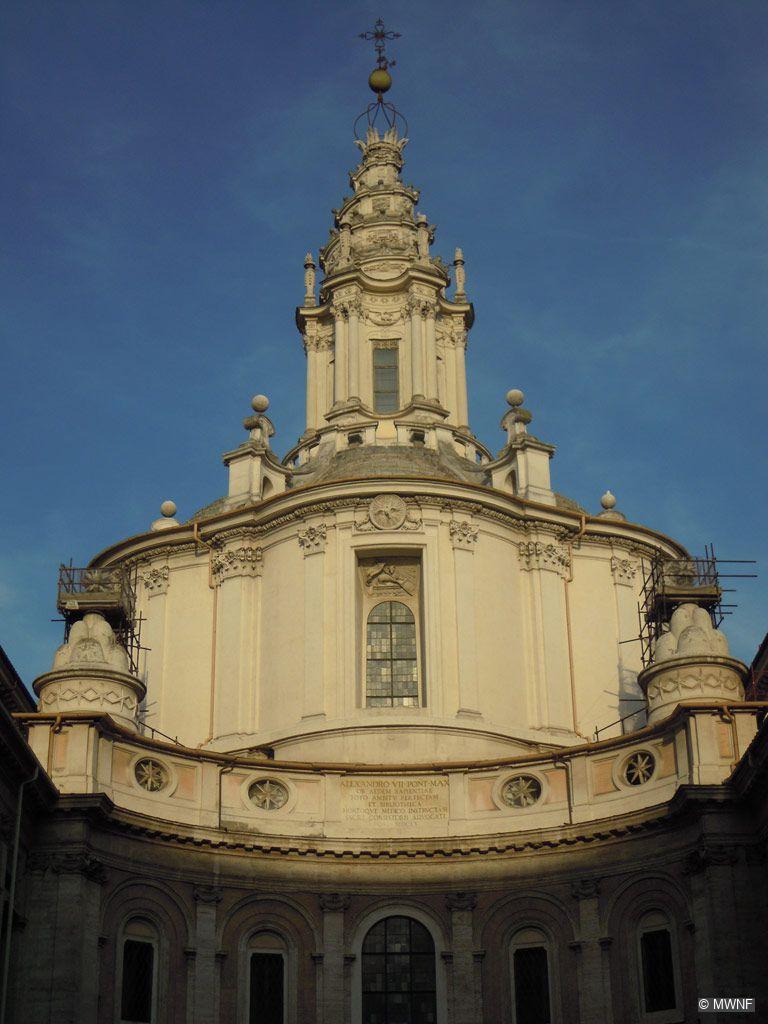
Borromini planned and followed the construction of Sant’Ivo down to the smallest detail, which caused the works to be particularly long: the wall structure was erected in 1650, while the decorative elements were completed only in 1660, under the pontificate of Alexander VII Chigi, to whom the inscription on the facade refers.
Description:
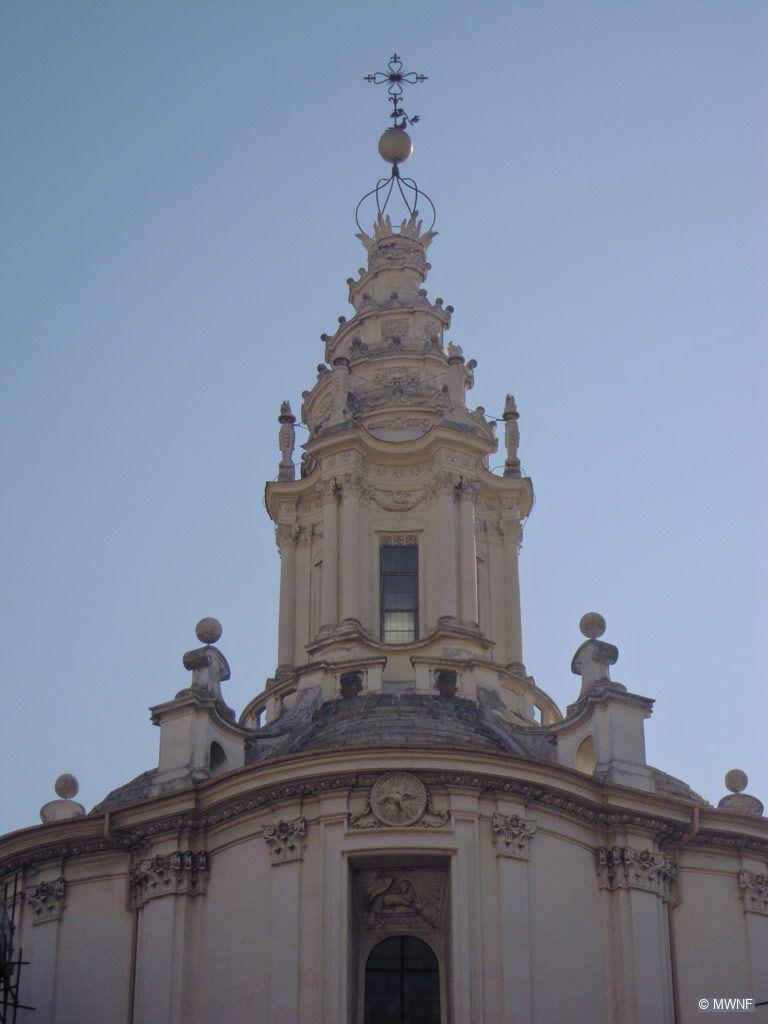
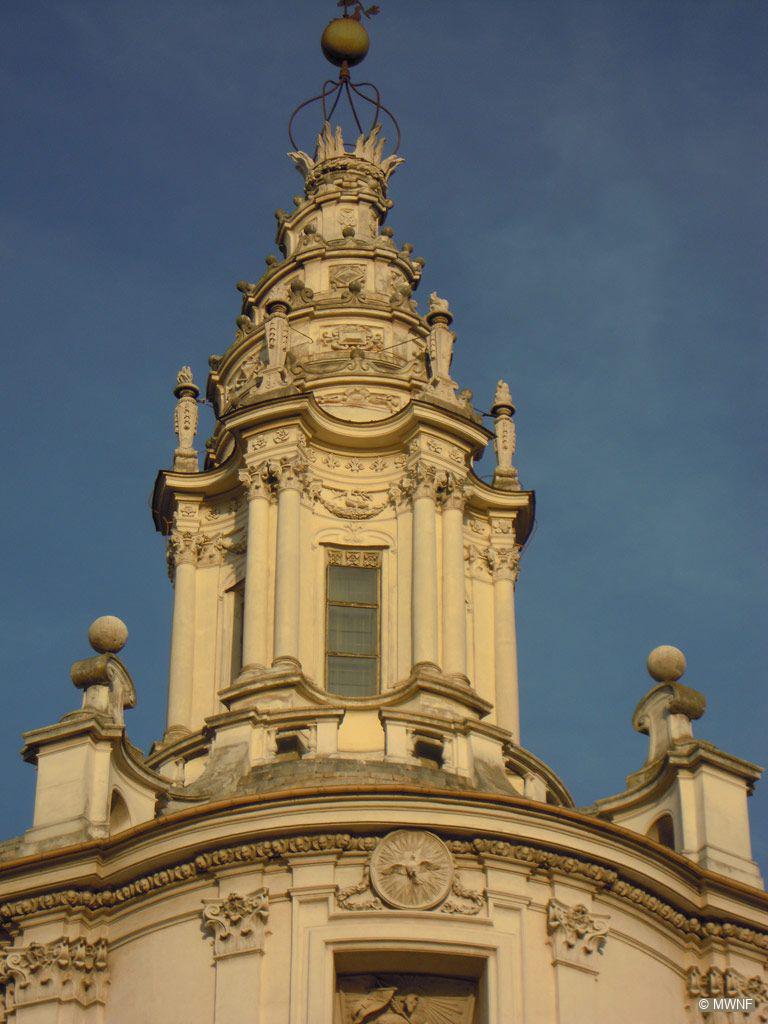
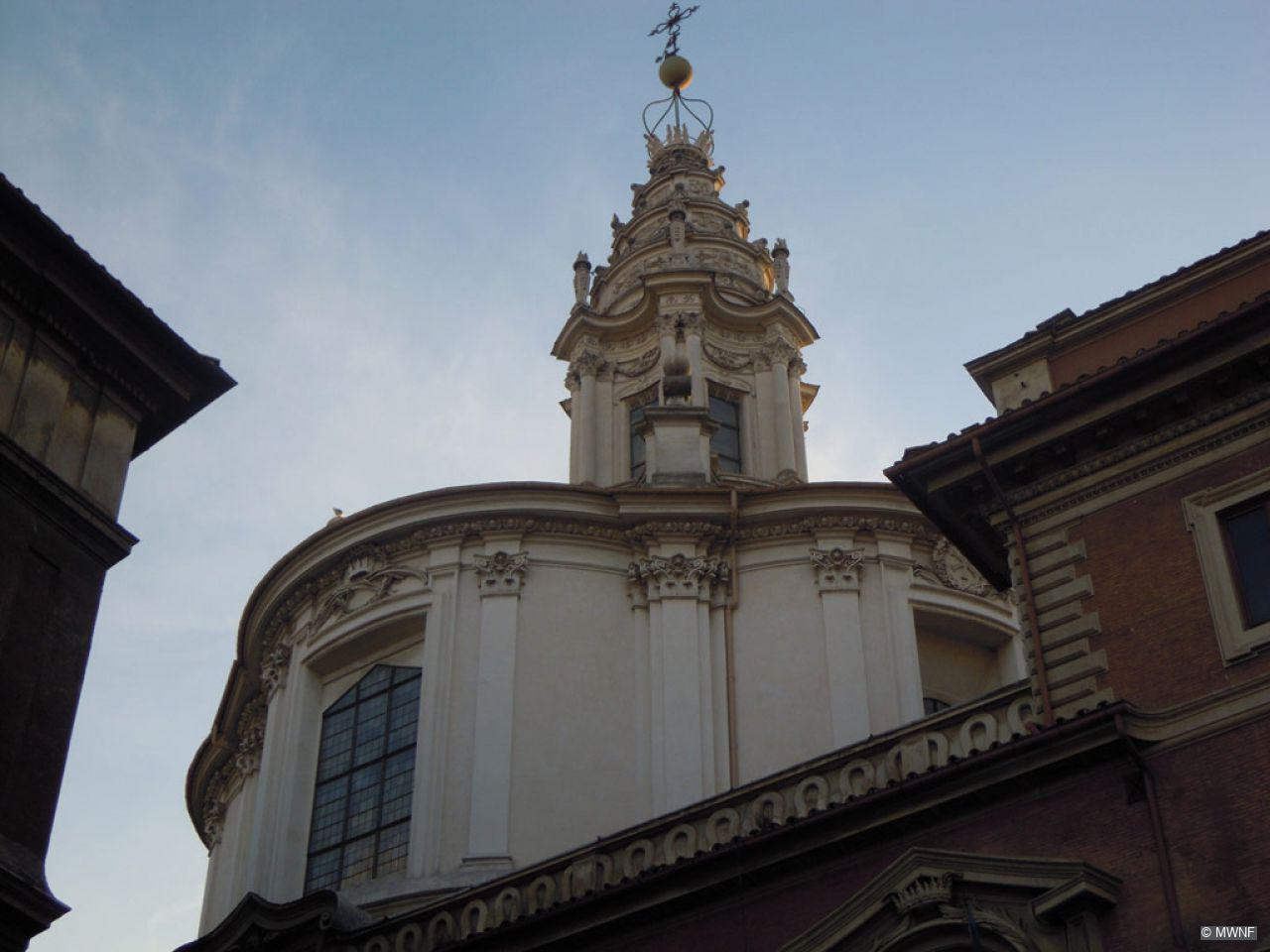
Having to intervene on a pre-existent project (as in the case of the renovation works in San Giovanni in Laterano in the occasion of the Jubilee of 1650) Borromini made a virtue of necessity: the facade of the church, already constructed by Della Porta, consisted of a sort of exedra on two levels, with five blind windows, which functioned as a visual extension of the double loggia in the courtyard. To this concave front Borromini opposed the convexity of the drum of the dome – the latter consisting of a low stepped pyramid – whose powerful pressure towards the outside is plastically defined by the overlapping corner pilasters. The roof lantern repeats with its coupled columns the same motif of centrifugal forces and ends at the top with the inventive spiral culminating in a flame, an iron crown, a sphere and a cross.
Various interpretations have been suggested on the unusual design of the roof lantern. They include a possible representation of the Tower of Babel; a papal tiara (due to the similarity with the three overlapping jewelled crowns of the tiaras); the Purgatory Mount as described by Dante Alighieri; and the path towards the glory of knowledge, exemplified by the crown that could refer to the laurel wreath used to crown the laureates.
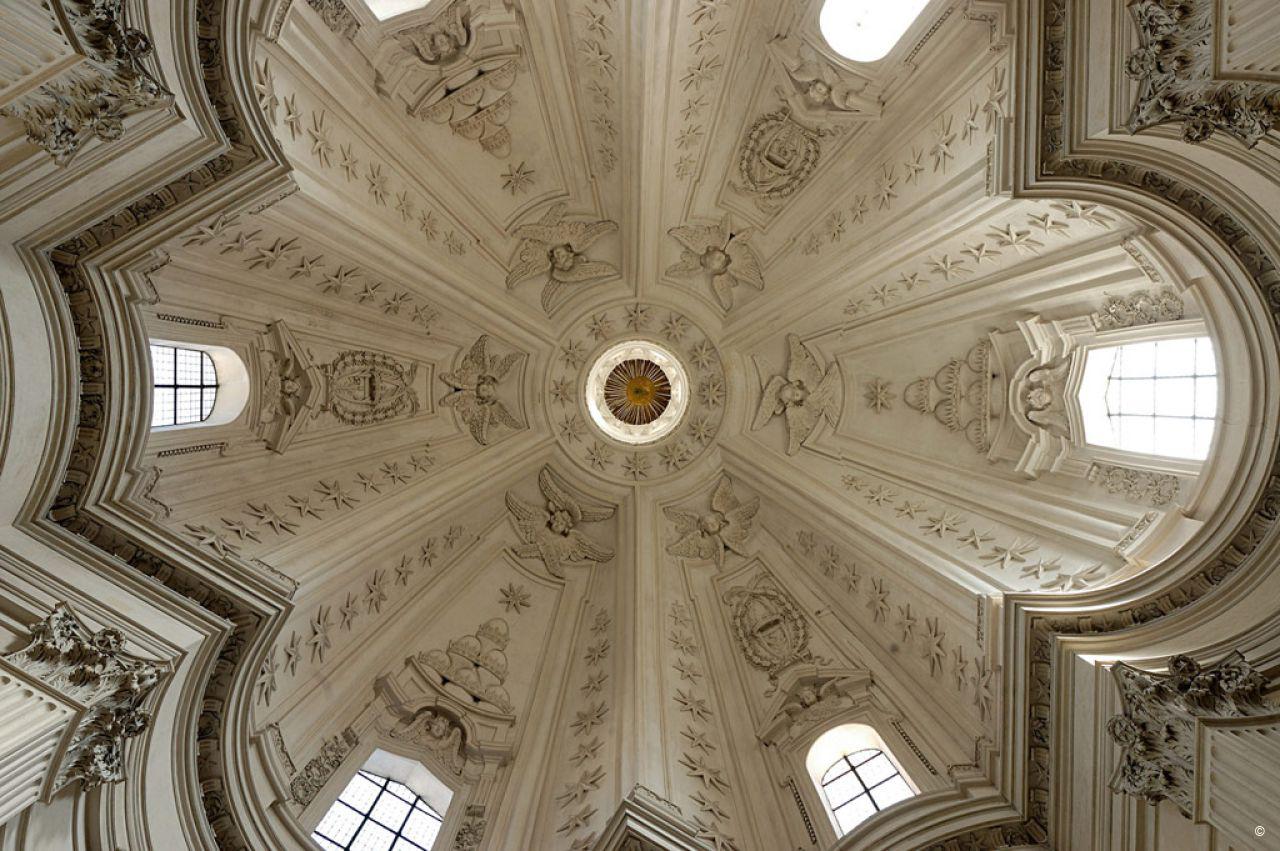
The interior is constructed on a six-pointed star hexagonal floor plan based on the juxtaposition of two equilateral triangles, symbols of the Trinity. Large portions of concave wall alternate with other shorter convex ones, marked by pilasters that form sharp edges. Overall, the interior, thanks also to the brightness of the white plastered surfaces and the gilded mouldings, gives a sense of spatial unity, albeit articulated through these series of broken lines of the walls. The entablature repeats the motif of the six-pointed star of the floor plan, a motif that is once again repeated in the dome. The dome is indeed divided in six segments before culminating in the simple circular base of the roof lantern.
The church was built next to the University La Sapienza. The plan is based on the interlacing of two triangles which form a six pointed star, with rounded corners. The Baroque language perfectly matches the rationalist geometry.
How Monument was dated:
Archival documentation.
Selected bibliography:
Rossi Pinelli, O., “S. Ivo alla Sapienza”, I principi della chiesa, Milan: Edizioni Charta, 1998: 164–165.
Scherner, A., “S. Ivo della Sapienza”, in Grundmann, S., (ed) The Architecture of Rome, Stuttgart/London: Edition Axel Menges, 2007: 213–214.
Citation of this web page:
Pier Paolo Racioppi "Sant’Ivo alla Sapienza" in "Discover Baroque Art", Museum With No Frontiers, 2026.
https://baroqueart.museumwnf.org/database_item.php?id=monument;BAR;it;Mon11;16;en
Prepared by: Pier Paolo RacioppiPier Paolo Racioppi
Laureato e specializzato in storia dell'arte presso l'Università di Roma “La Sapienza” sta conseguendo il dottorato di ricerca in Storia e conservazione dell'oggetto d'arte e d'architettura presso l'Università di Roma TRE. Ha svolto attività seminariali presso l'Istituto di Storia dell'Arte all'Università La Sapienza di Roma e attualmente è docente di storia dell'arte del Rinascimento presso la IES at Luiss (Roma).
Ha pubblicato diversi contributi sulla tutela artistica, il collezionismo e le accademie d'arte, ed ha collaborato al Dizionario Biografico degli Italiani dell'Enciclopedia Treccani.
Copyedited by: Janice MedinaJanice Medina
Janice Medina is an artist and educator based in Upstate New York. She studied interior design at Syracuse University and obtained her M.S. in Building Conservation in 2008 (Rensselaer Polytechnic Institute) and Master of Fine Arts in 2019 (University at Albany).
Janice is a former participant in the US/ICOMOS International Exchange Program and she has taught courses in the history of design and historic preservation. Her artwork is influenced by her experiences in historic preservation, as well as by building materials and the natural environment.
Janice has participated as a copy-editor with Museum With No Frontiers since 2019. In this role she has had the opportunity to work on a variety of projects including Discover Islamic Art, Discover Baroque Art and Discover Glass Art.
Translation by: Lavinia Amenduni
MWNF Working Number: IT1 16