

 Back
Back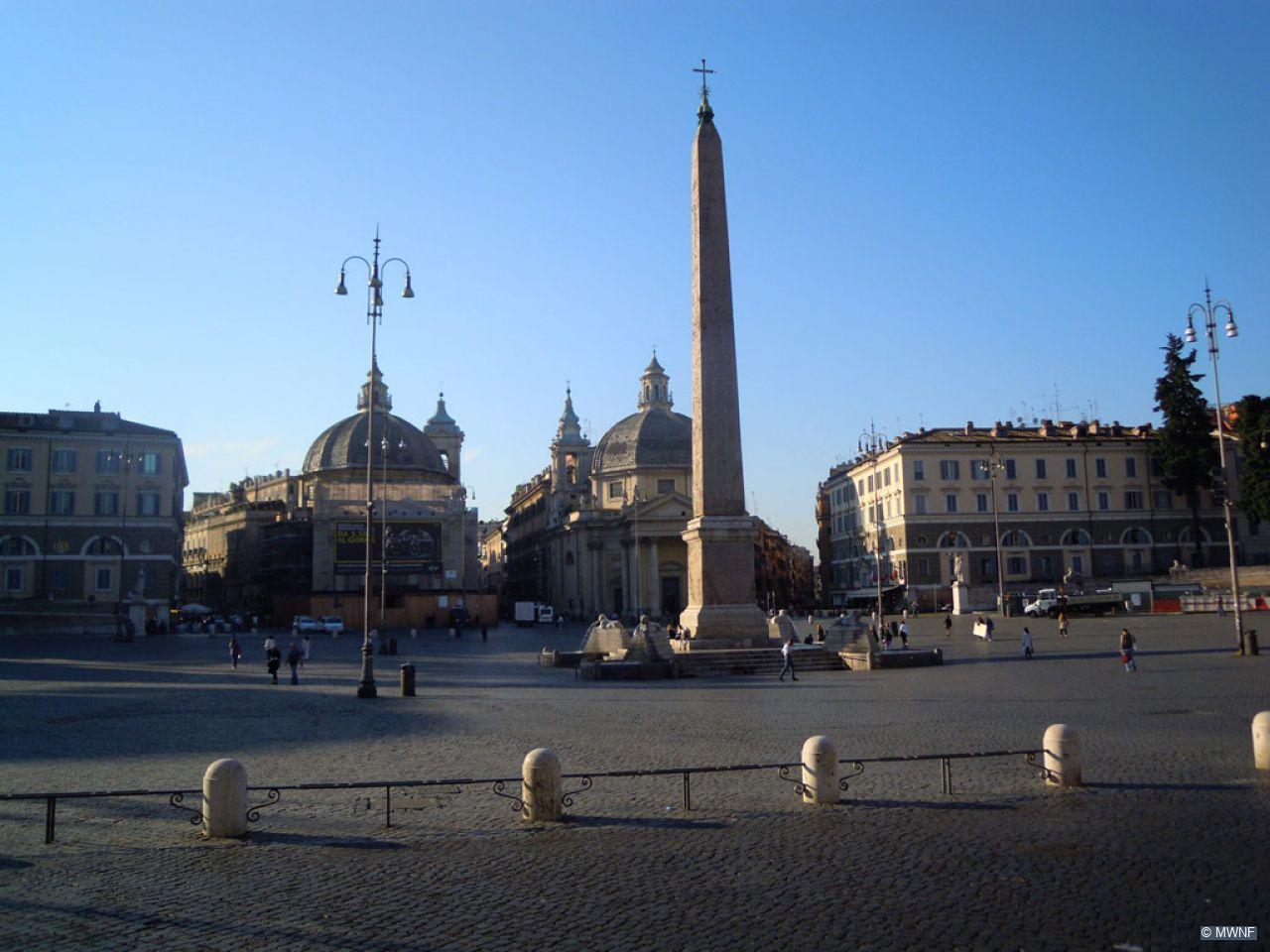
 Add to My Collection
Name of Monument:
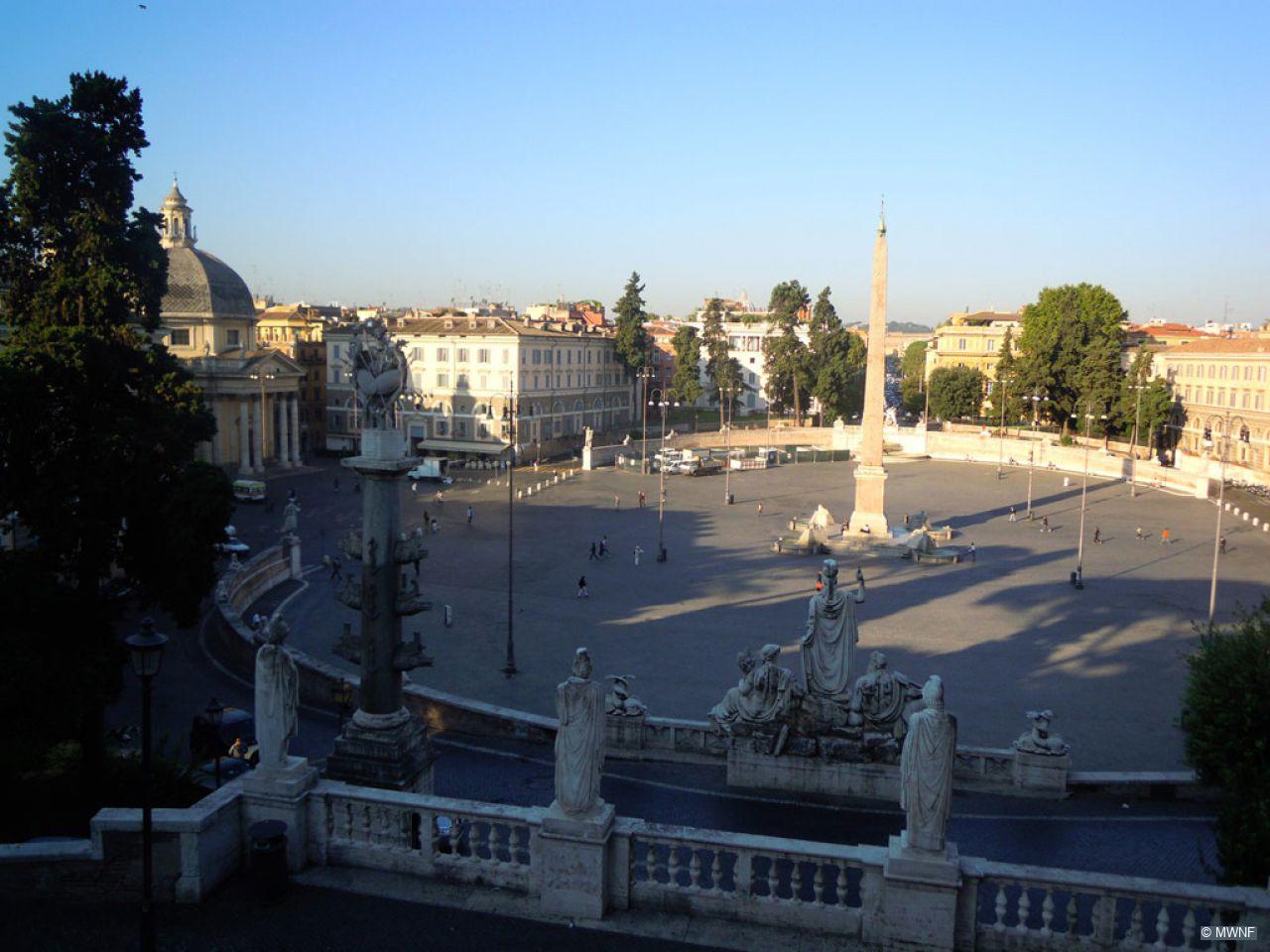
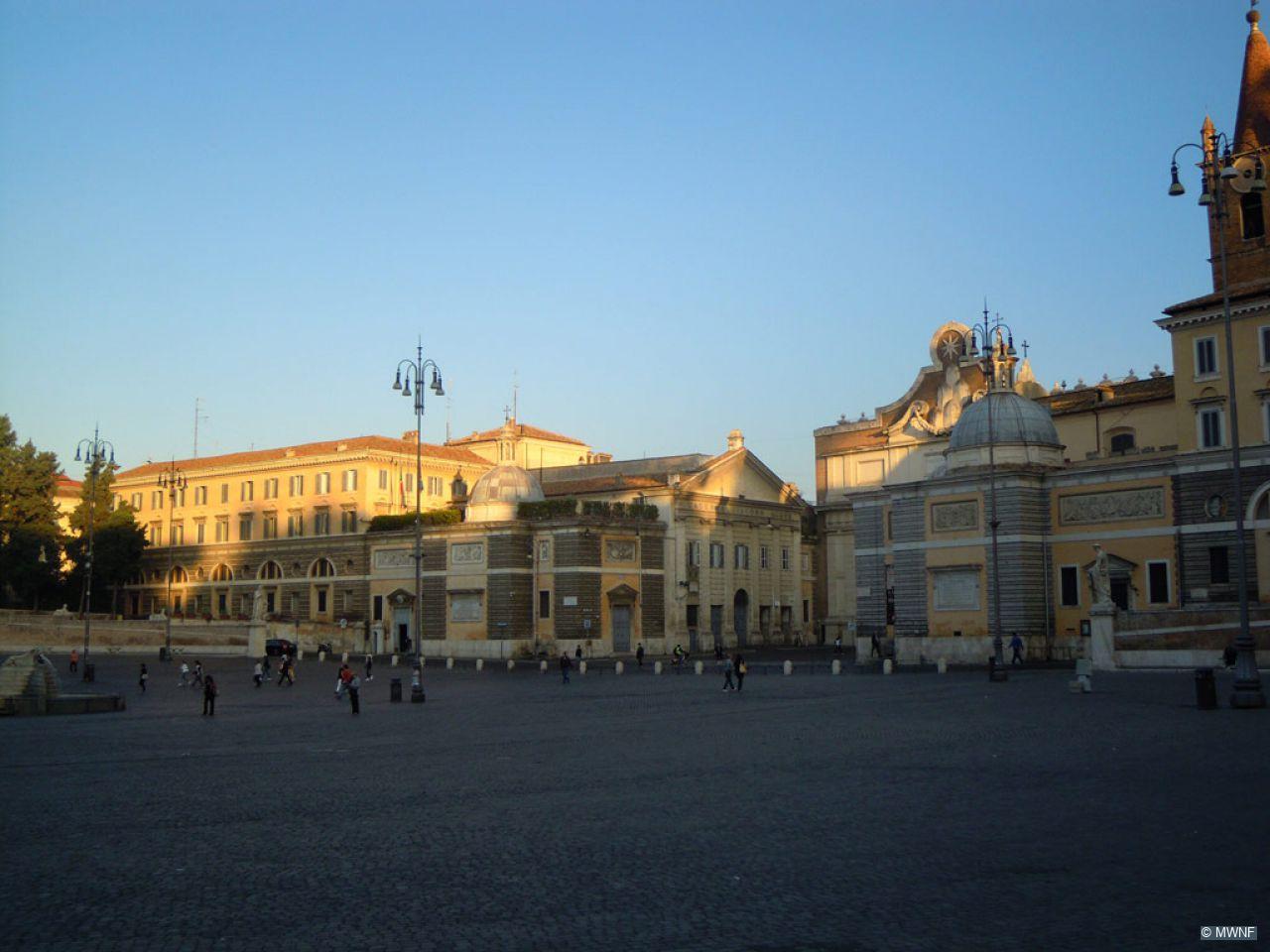
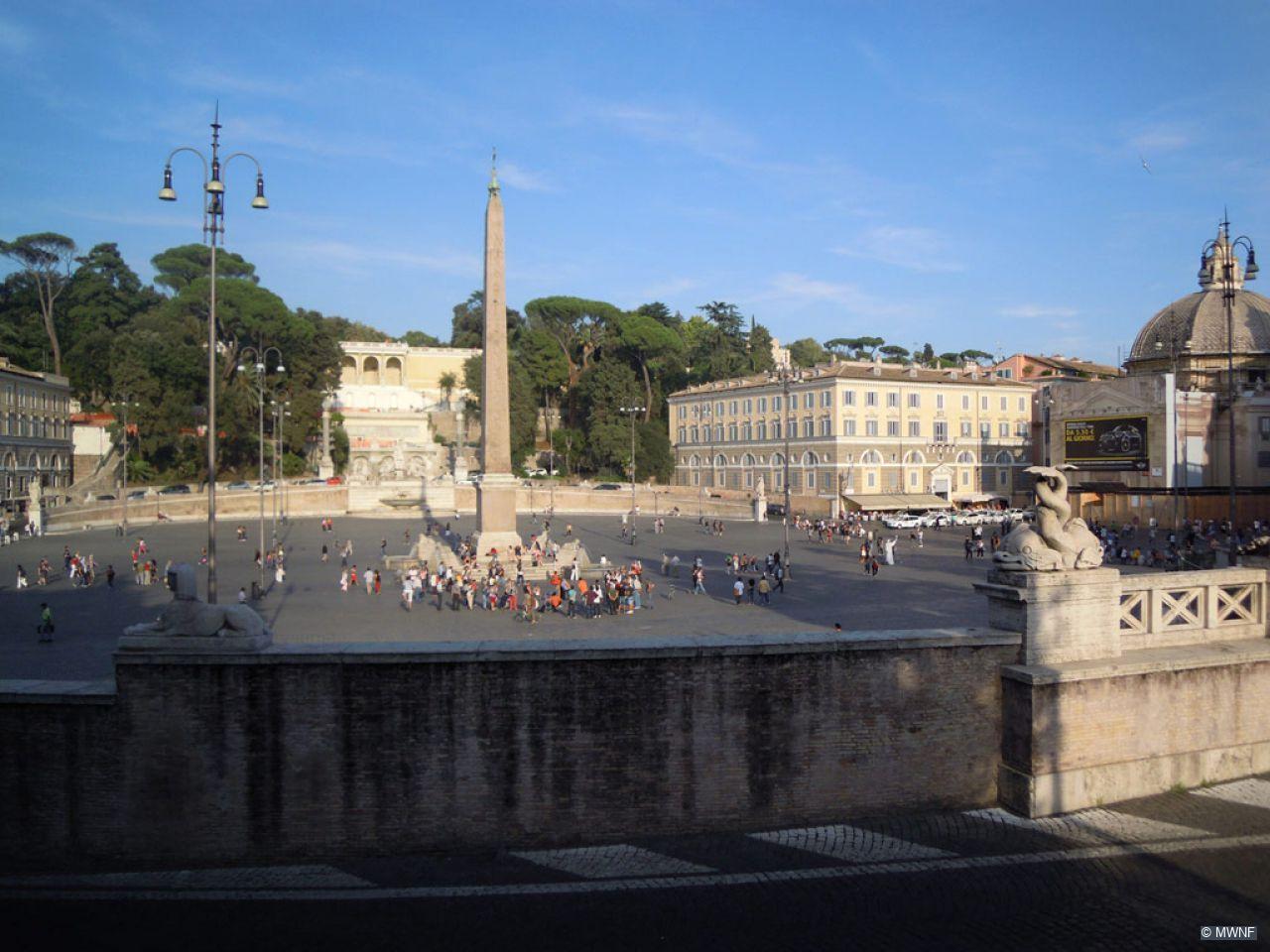
Santa Maria in Montesanto and Santa Maria dei Miracoli in Piazza del Popolo
Location:
Rome, Latium, Italy
Piazza del Popolo
Rome
Date:
1662–79
Artists:
Carlo Rainaldi; Gian Lorenzo Bernini; Carlo Fontana
Denomination / Type of monument:
Square
Patron(s):
Alexander VII Chigi
History:
Since ancient times, the area which would become Piazza del Popolo was the first place within the Aurelian Walls that travellers coming from north encountered when entering the city through Porta Flaminia (later called Porta del Popolo), located at the end of the homonymous consular road. At the time of Alexander VII, the square completely lacked the representativeness that one would have expected upon entering the Eternal City: it was a large irregular trapezoidal area with a single decorative element in the centre, the Egyptian obelisk from the Circus Maximus, erected by Sixtus V in 1589. The beginning of the three straight roads that together formed the so-called Tridente, namely Via del Babuino, Via del Corso (urban continuation of Via Flaminia) and Via di Ripetta were characterized by the presence of modest huts. Bernini had already tried to embellish the square on the occasion of Christina of Sweden’s visit in Rome (1655), redesigning, however, only Porta del Popolo and part of the facade of the Church of Santa Maria del Popolo. When the Carmelites, in 1658, asked for permission to build a new church at the end of the block of houses located between Via del Corso and Via del Babuino, Pope Alexander VII sensed the strong visual and architectural impact that the new building would have had on the general appearance of this entrance to the city. He thus ordered that an identical church between Via del Corso and Via di Ripetta be erected to balance it. In 1661 Carlo Rainaldi was commissioned to design them, but he would eventually complete only the Church of Santa Maria in Montesanto: Santa Maria dei Miracoli would in fact be redesigned by Bernini and built by Carlo Fontana between 1673 and 1675.
Description:
The two twin churches in Piazza del Popolo function as sacred propylaea that solemnly introduce the holy city. Both with a central plan, the two churches were designed using the Pantheon as a model, with a lowered dome and front portico surmounted by a triangular tympanum. Due to the presence of the domes, they also function as immediate visual reference to the dome of St. Peter's Basilica, the coveted final destination for pilgrims and travellers who have just arrived in Rome. However, there are differences in the floor plan, not perceptible from the outside: Santa Maria dei Miracoli is perfectly circular, while Santa Maria in Montesanto is elliptical. The bell towers were built in the 18th century and aimed at further emphasizing the central axis of Via del Corso. The symmetrical arrangement of the two churches on the same axis and at the entrance to three streets call to mind the so called ‘spyglass perspective’ typical of classical theatre, which Palladio, in the previous century, had brilliantly mastered in the Teatro Olimpico in Vicenza. Palladio has in fact designed a fixed stage backdrop where two straight roads branch off from the front providing a sense of depth. The sense of movement generated by the perspective of the three streets is thus counterbalanced by the marked centrality and immobility of the two domed churches, providing a strong and impactful visual effect.
View Short DescriptionArchitect Carlo Rainaldi was commissioned to design two Churches facing the piazza, to give the city an inner gate that celebrated the beginning of the "goosefoot" of three major streets fanning toward the city. A sort of scenographical welcome to the travellers.
How Monument was dated:
Archival documentation.
Selected bibliography:
Janowitz, E., “S. Maria di Montesanto e Santa Maria dei Miracoli”, in Grundmann S. (ed), The Architecture of Rome, Stuttgart/London: Edition Axel Menges, 2007: 239–241.
Rossi Pinelli, O., “Piazza del Popolo”, I principi della chiesa, Milan: Edizioni Charta, 1998: 202–203.
Citation of this web page:
Pier Paolo Racioppi "Santa Maria in Montesanto and Santa Maria dei Miracoli in Piazza del Popolo" in "Discover Baroque Art", Museum With No Frontiers, 2026.
https://baroqueart.museumwnf.org/database_item.php?id=monument;BAR;it;Mon11;24;en
Prepared by: Pier Paolo RacioppiPier Paolo Racioppi
Laureato e specializzato in storia dell'arte presso l'Università di Roma “La Sapienza” sta conseguendo il dottorato di ricerca in Storia e conservazione dell'oggetto d'arte e d'architettura presso l'Università di Roma TRE. Ha svolto attività seminariali presso l'Istituto di Storia dell'Arte all'Università La Sapienza di Roma e attualmente è docente di storia dell'arte del Rinascimento presso la IES at Luiss (Roma).
Ha pubblicato diversi contributi sulla tutela artistica, il collezionismo e le accademie d'arte, ed ha collaborato al Dizionario Biografico degli Italiani dell'Enciclopedia Treccani.
Copyedited by: Janice MedinaJanice Medina
Janice Medina is an artist and educator based in Upstate New York. She studied interior design at Syracuse University and obtained her M.S. in Building Conservation in 2008 (Rensselaer Polytechnic Institute) and Master of Fine Arts in 2019 (University at Albany).
Janice is a former participant in the US/ICOMOS International Exchange Program and she has taught courses in the history of design and historic preservation. Her artwork is influenced by her experiences in historic preservation, as well as by building materials and the natural environment.
Janice has participated as a copy-editor with Museum With No Frontiers since 2019. In this role she has had the opportunity to work on a variety of projects including Discover Islamic Art, Discover Baroque Art and Discover Glass Art.
Translation by: Lavinia Amenduni
MWNF Working Number: IT1 24