

 Back
Back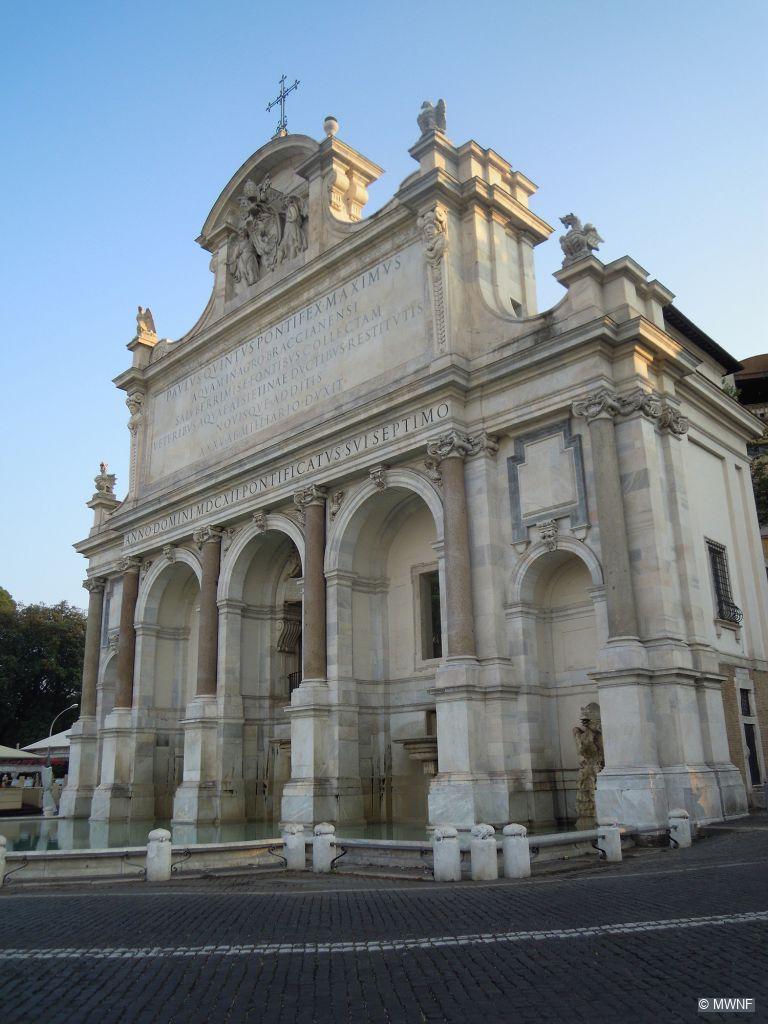

 Add to My Collection
Name of Monument:
Fountain of the Acqua Paola
Location:
Rome, Latium, Italy
Via Garibaldi (Gianicolo hill)
Rome
Date:
1610–12
Artists:
Flaminio Ponzio (architect); Giovanni Fontana (engineer); Ippolito Buzio (sculptor)
Denomination / Type of monument:
Fountain
Patron(s):
Pope Paul V Borghese
History:
Since the Middle Ages, the Trastevere area was the least supplied with water in the whole city. In the early seventeenth century, due to Pope Paul V Borghese having sponsored the reactivation of the Trajan aqueduct (built in 109 AD), a new source of drinking water, coming from Lake Bracciano, 64 kilometres north of Rome, was made available to the people living in the Janiculum as well as to the populous district of Trastevere. To meet the expenses of this grandiose enterprise, the pontiff was forced to institute new taxes.
Paul V also had another fountain inaugurated, located in front of the Hospice of Beggars, at the end of Via Giulia. Among his goals there was also that of rivalling Sixtus V, celebrated at the end of the sixteenth century for having the Felice Aqueduct repaired, thus providing water to the vast area of the Quirinale.
Description:
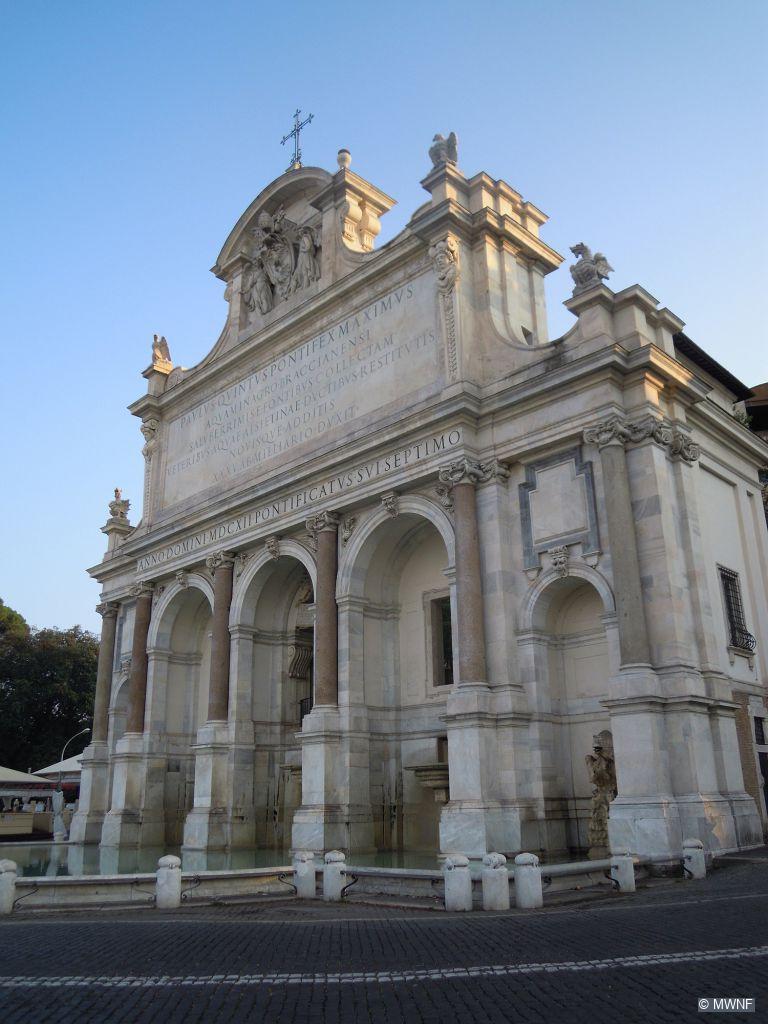
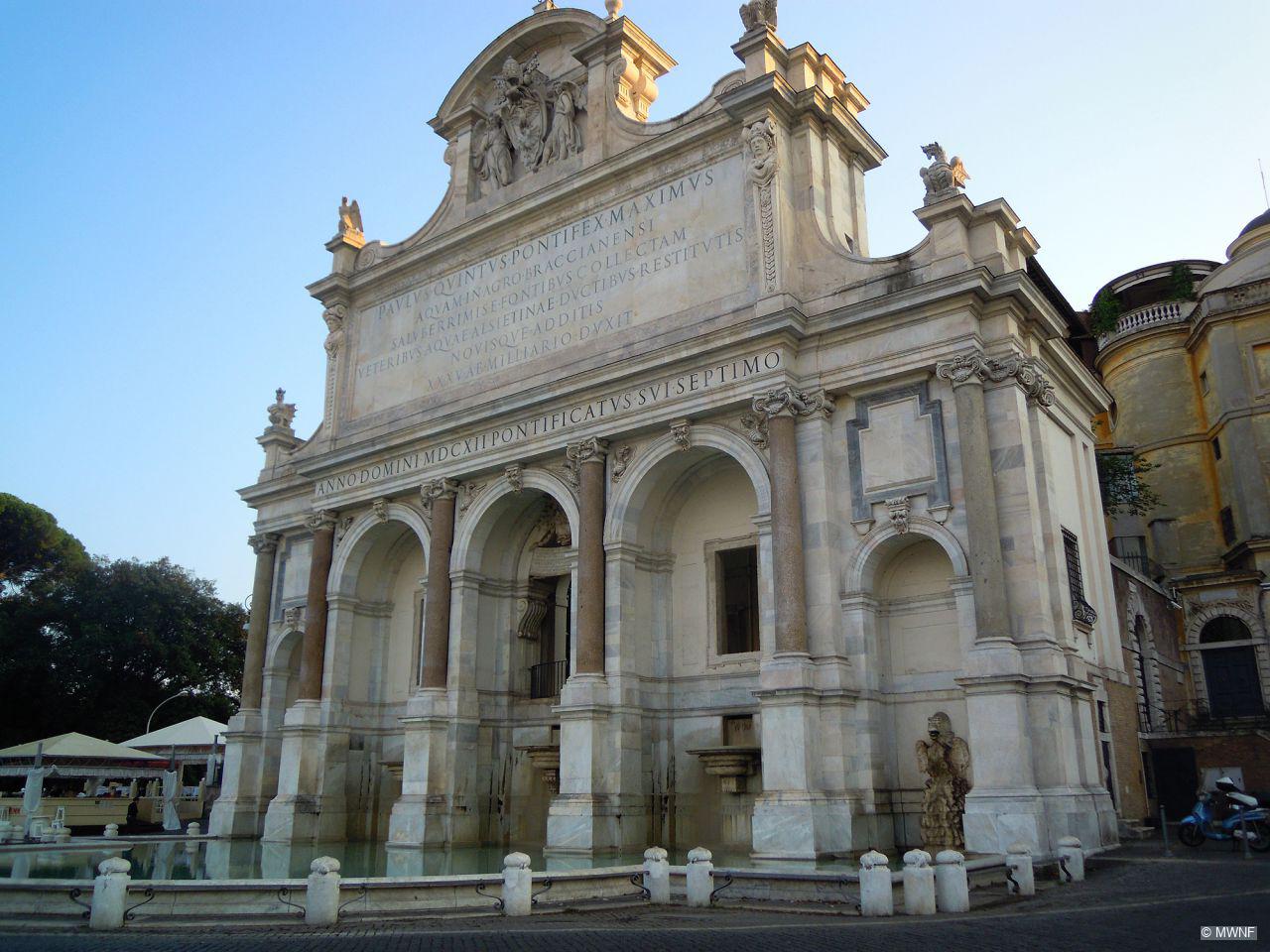
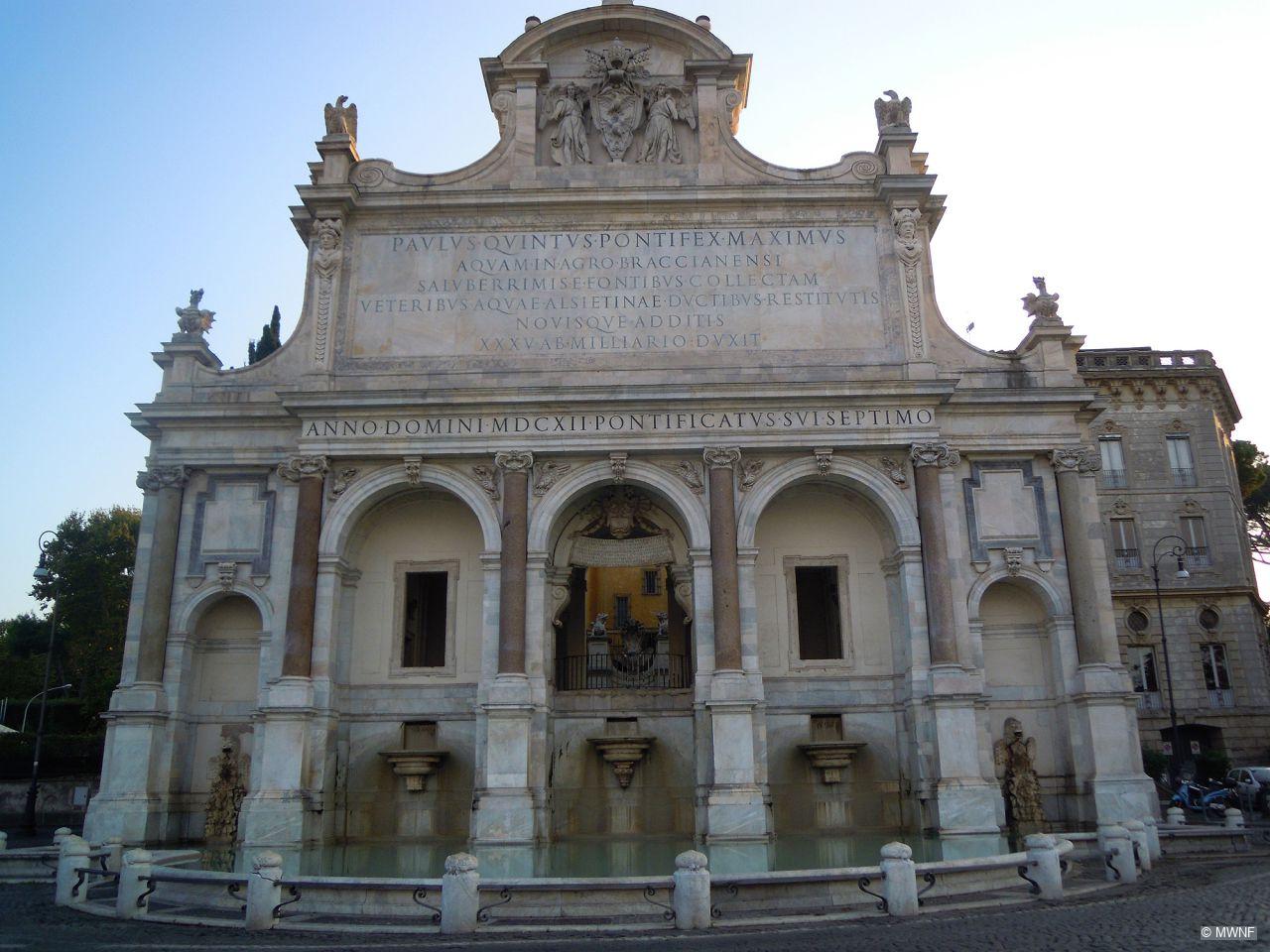
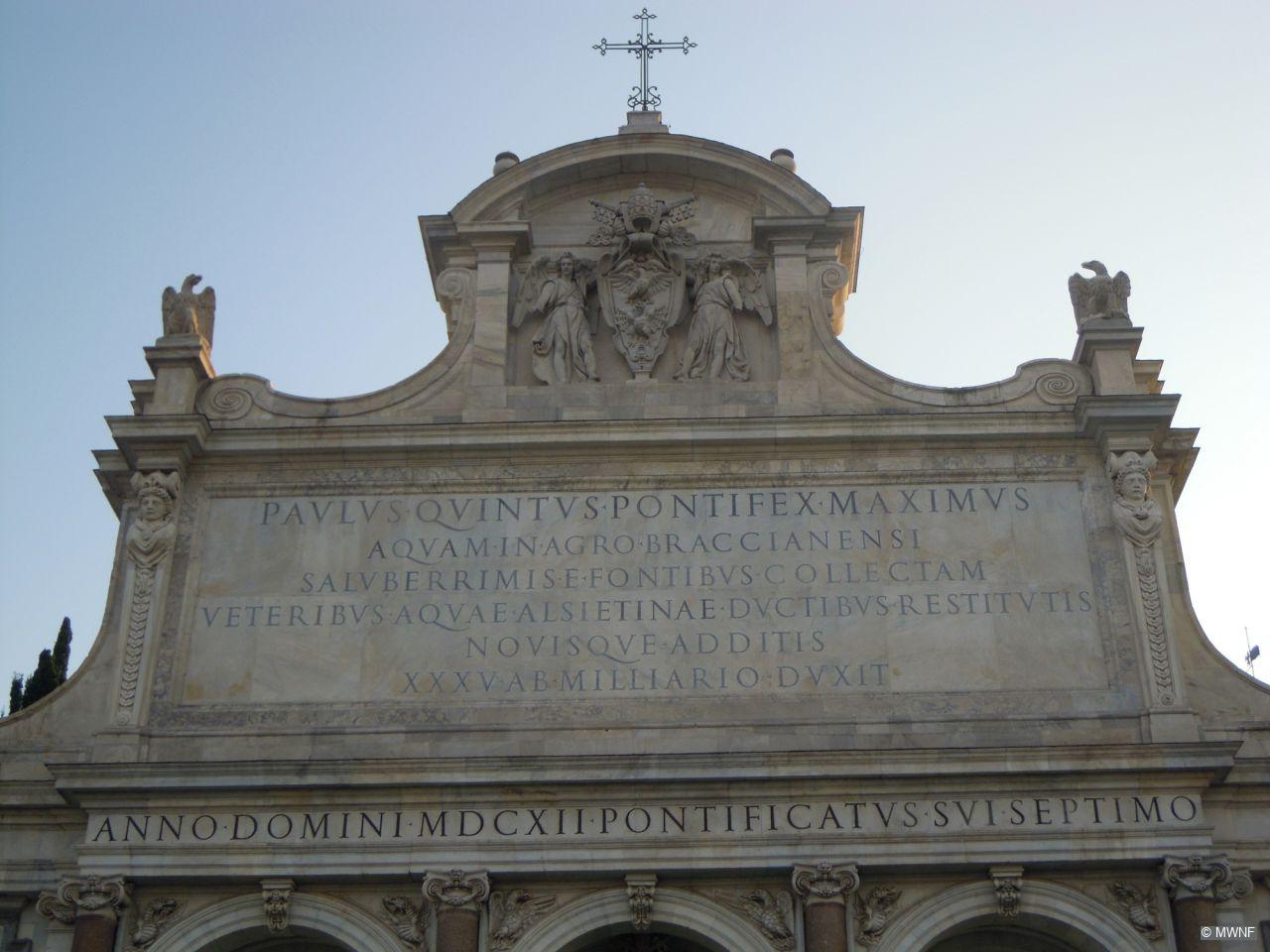
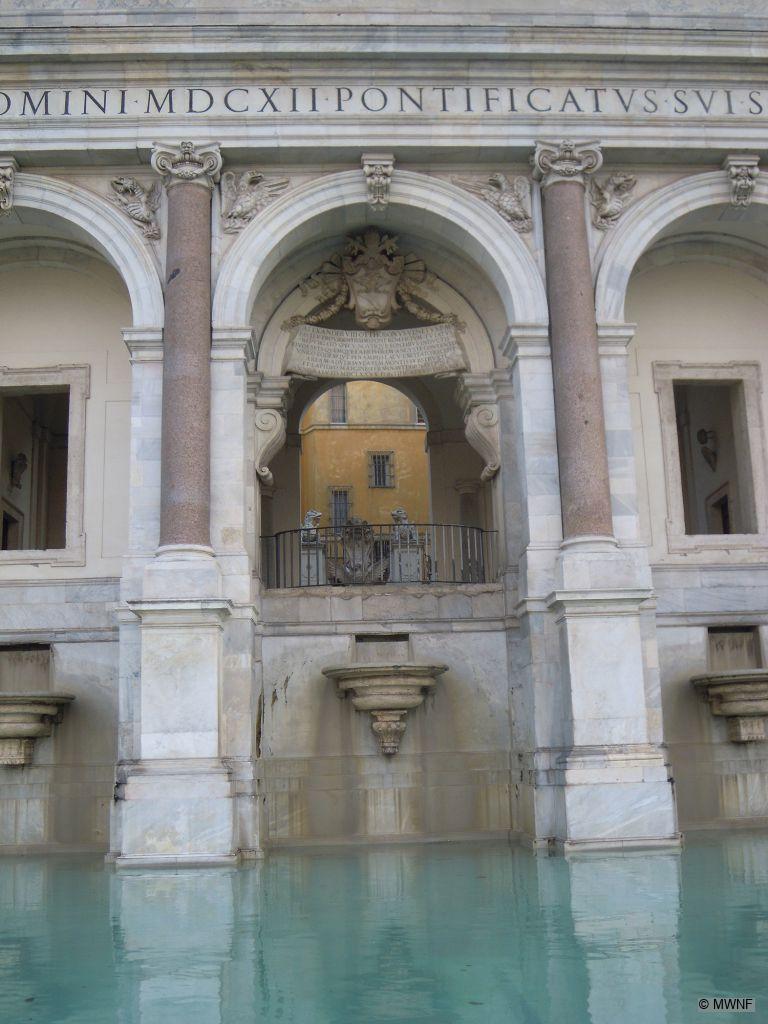
In ancient Rome fountains placed at the end of an aqueduct used to be embellished with spectacular architectures such as nymphaea, trophies or castella, which celebrated the complex hydraulic venture that provided water to the Urbe. In 1587 Sixtus V had inaugurated the first modern fountain, which intended to recall, in terms of style and magnificence, the ancient models. This was the Mostra dell’Acqua Felice, also known as the Fountain of Moses, on the Quirinale Hill. The great fountain at the Janiculum Hill, in a dominant position over the city, located at the end of the Trajan aqueduct restored by Paul V, took the name of Mostra dell’Acqua Paola, from the name of the reigning pontiff. The architect Flaminio Ponzio, with the collaboration of Giovanni Fontana, was commissioned to direct the works, which were carried out between 1610 and 1612, reusing, among other things, ancient marbles from the Imperial Forums. The model of the tripartite triumphal arch takes up the architectural scheme of the Mostra dell’Acqua Felice but, unlike that, the Janiculum fountain has two additional narrower and lower arches on the sides and is also located in an isolated naturalistic context. This is emphasized by the openings that allow the view of a garden behind. The three arches, enclosed by semi-columns, support the large celebratory inscription that can be read just under the tympanum. This shows the papal coat of arms flanked by two angels sculpted by Ippolito Buzio.
View Short DescriptionThe “show-fountain”, imitating a triumphal arch, was designed by Flaminio Ponzio and Giovanni Fontana, dedicated to Pope Paul V Borghese. It celebrates the great undertaking of bringing water from the Lake of Bracciano (about 40 km away) to Rome.
How Monument was dated:
Archival documentation.
Selected bibliography:
Rolfi, S., “Fontanone del Gianicolo”, I principi della chiesa, Milan: Edizioni Charta, 1998: 144.
Tolomeo, M.G., “La mostra dell'acqua Paola”, in Pisani Sartorio, F. and Liberati Silverio, A. (eds) Il trionfo dell'acqua: acque e acquedotti a Roma, Rome: 1986: 250–254.
Citation of this web page:
Pier Paolo Racioppi "Fountain of the Acqua Paola" in "Discover Baroque Art", Museum With No Frontiers, 2026.
https://baroqueart.museumwnf.org/database_item.php?id=monument;BAR;it;Mon11;8;en
Prepared by: Pier Paolo RacioppiPier Paolo Racioppi
Laureato e specializzato in storia dell'arte presso l'Università di Roma “La Sapienza” sta conseguendo il dottorato di ricerca in Storia e conservazione dell'oggetto d'arte e d'architettura presso l'Università di Roma TRE. Ha svolto attività seminariali presso l'Istituto di Storia dell'Arte all'Università La Sapienza di Roma e attualmente è docente di storia dell'arte del Rinascimento presso la IES at Luiss (Roma).
Ha pubblicato diversi contributi sulla tutela artistica, il collezionismo e le accademie d'arte, ed ha collaborato al Dizionario Biografico degli Italiani dell'Enciclopedia Treccani.
Copyedited by: Janice MedinaJanice Medina
Janice Medina is an artist and educator based in Upstate New York. She studied interior design at Syracuse University and obtained her M.S. in Building Conservation in 2008 (Rensselaer Polytechnic Institute) and Master of Fine Arts in 2019 (University at Albany).
Janice is a former participant in the US/ICOMOS International Exchange Program and she has taught courses in the history of design and historic preservation. Her artwork is influenced by her experiences in historic preservation, as well as by building materials and the natural environment.
Janice has participated as a copy-editor with Museum With No Frontiers since 2019. In this role she has had the opportunity to work on a variety of projects including Discover Islamic Art, Discover Baroque Art and Discover Glass Art.
Translation by: Lavinia Amenduni
MWNF Working Number: IT1 08