

 Back
Back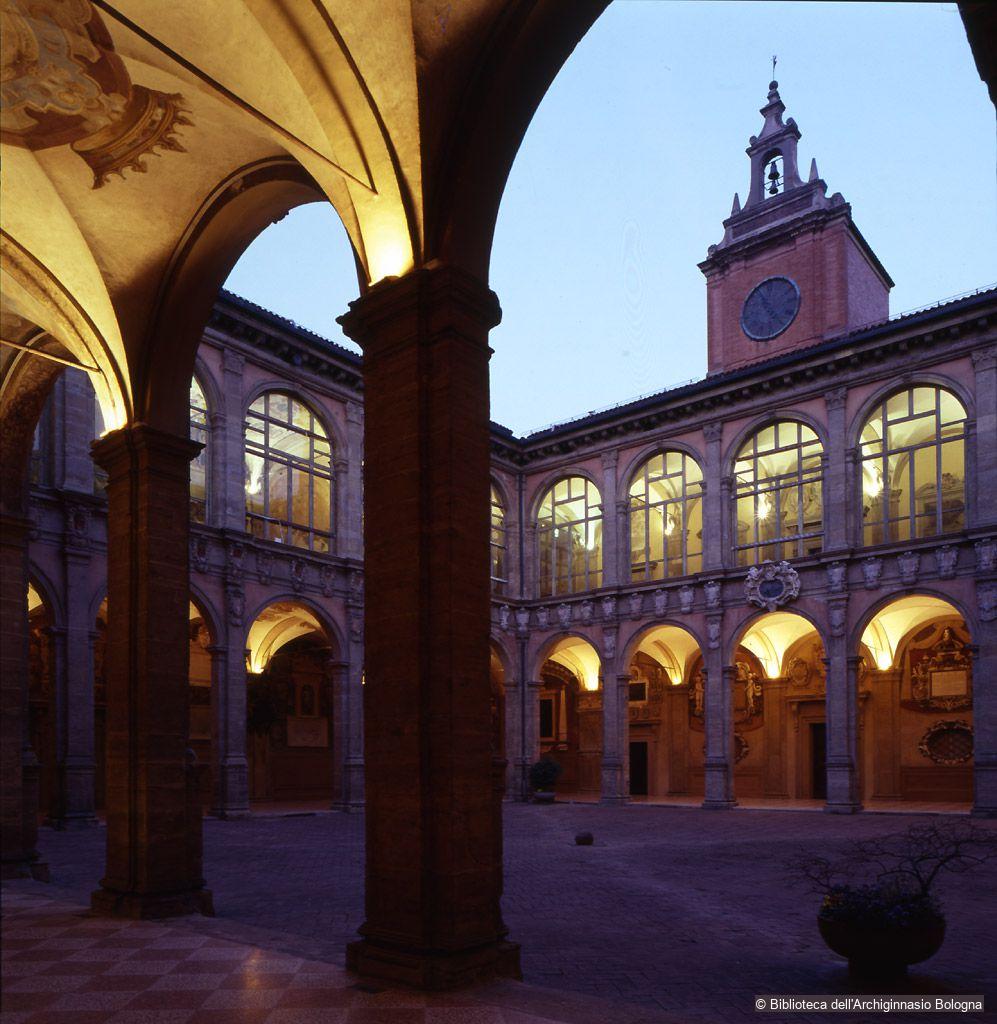
 Add to My Collection
Name of Monument:
Palazzo dell’Archiginnasio
Also known as:
Archiginnasio
Location:
Bologna, Emilia-Romagna, Italy
Piazza Galvani, 1
40124 Bologna
T : +39 051 276801
F : +39 051 261160
E : archiginnasio@comune.bologna.it
Comune di Bologna (Responsible Institution)
Date:
1563
Artists:
Architect: Antonio Morandi known as “Il Terribilia” (Bologna?–1568)
Denomination / Type of monument:
Public architecture (university)
Patron(s):
The papal estate
History:
The palace of the Archiginnasio was built between 1562 and 1563. At that time the university was scattered in various buildings around town. The papal legate, Cardinal Charles Borromeo and his vice legate Pier Donato Cesi built the palace to consolidate the university (“Studio”) into one building. It was designed by the Bolognese architect Antonio Morandi, known as Terribilia. In 1803 the University was moved, and since 1838 the building has housed the Archiginnasio municipal Library.
Description:
The Archiginnasio was built in a year and a half. It was inaugurated on the 21st of October 1563 to house the University of Bologna.
The architect Terribilia planned a façade on two levels with a portico. The bricks and the sandstone are local building materials.
The building stands on former houses, an irregular site with a mainly horizontal development. It faces the left side of the Basilica of San Petronio and Piazza Galvani.
The true core of the building is the courtyard, which features a double open arcade. It was strongly influenced by the architecture of university colleges (the Collegio di Spagna in Bologna is a stunning example). At the same time, it is reminiscent of the courtyards in residences of noble families.
The courtyard, and the rooms inside the building are entirely covered with coats of arms. The walls are painted or sculpted in groups of specific patterns. Most of the designs belong to the students that occupied places of responsibility in the Studio organization. The heraldic decoration stands by itself, it is dedicated in appreciation to the memory of professors who worked in the Archiginnasio or to ecclesiastic authorities involved with the Archiginnasio history.
In the middle of the east wing of the courtyard, facing the main entrance, stands the chapel dedicated to the Madonna and fragments of a cycle of stories on the life of the Virgin. The scenes were painted by the Bolognese painter Bartolomeo Cesi, one of the most significant artists of his age (1591–1594). Unfortunately, only some portions of these frescoes survive, as they were heavily bombed in 1944, when the whole wing was destroyed.
The former classrooms on the first floor, which occupy the whole length of the façade, are today occupied by the library oldest warehouses.
The University of Bologna was housed in this building from 1563 to 1803.
It is characterised by a long portico with 30 arches; the courtyard is framed on both floors by porticoes and decorated with memorial tablets and coats of arms surrounded by sculptured and painted decorations: some of these were executed by famous artists working in the baroque period. On the first floor is a wooden Anatomical Theatre, dating to the seventeenth-century, completely rebuilt after a severe second world war bombing. Most of the statues were carved by Silvestro Giannotti in the second half of the eighteenth century.
How Monument was dated:
Historical documents.
Special features
The staircase of the so called “Artists” (right branch), leading to the first floor
Palazzo of the Archiginnasio
From sixteenth to eighteenth century
Anonymous
The walls and ceiling are decorated with coats of arms and symbols of the memories which celebrate the most significant events of the history of the Studio.

Monument to the brothers Giovan Battista and Ippolito Fornasari
Palazzo of the Archiginnasio, ground floor
1679
Giovanni Antonio Burrini (Bologna, 1656–1727)
This double portrait depicts two brothers, both Law professors in the University of Bologna. It hangs over the door, on one side of the Bulgari chapel and dominates the great allegorical fresco representing Dawn and Sunset, Justice and Right, a typical expression of baroque complicated symbolism. It is a typical example of the variety of materials employed to build this sort of monument: pictorial decoration, plaster, metal and sandstone.

Anatomical Theatre
Palazzo of the Archiginnasio, first floor
1637
Antonio Paolucci known as Levanti (d. 1663)
This room, known as Teatro Anatomico, was built to house the lessons of anatomy. It is made of pine wood and decorated with wooden statues of the most celebrated medicine professors of the past. In the coffered ceiling are represented Apollo and the signs of the Zodiac. According to contemporary astrological beliefs these symbols were considered connected with the human body rhythms.

The so called Spellati (the Ripped off)
Anatomical Theatre
1734
Ercole Lelli (1702–1766); Silvestro Giannotti (1680–1750)
These two statues, from the original wax models by Ercole Lelli, were carved in limewood by Silvestro Giannotti. They represent two male figures naked and skinless in order to show their muscles. They hold a canopy standing over the anatomy professor while he is teaching. Over the canopy sits an allegorical female figure representing Anatomy. She is receiving her typical attributes, a bone and a scroll, from a genius.

Selected bibliography:
Le iscrizioni dell'Archiginnasio (eds. G. Forni and G. B. Pighi), Bologna, 1962;
Gli stemmi e le iscrizioni minori dell'Archiginnasio (eds. G. Forni and G. B. Pighi), Bologna, 1964;
L'Archiginnasio. L'Università, il Palazzo, la Biblioteca, I. Il Palazzo e l’Università, Bologna, 1987;
Delenda Bononia. Immagini dei bombardamenti a Bologna 1943-1945, (Exhibition catalogue) (eds. Bersani, C. and V. Roncuzzi Roversi Monaco), Bologna, 1995, tav. 342;
Biblioteca comunale dell'Archiginnasio, Bologna (ed. P. Bellettini), Fiesole, 2001.
Additional Copyright Information:
Copyright images: Biblioteca Comunale dell’Archiginnasio di Bologna.
Citation of this web page:
Cristina Bersani "Palazzo dell’Archiginnasio" in "Discover Baroque Art", Museum With No Frontiers, 2026.
https://baroqueart.museumwnf.org/database_item.php?id=monument;BAR;it;Mon12;8;en
Prepared by: Cristina BersaniCristina Bersani
SURNAME: Bersani
NAME: Cristina
AFFILIATION: Biblioteca dell’Archiginnasio, Bologna
TITLE: Curator of the Prints and Drawings Department
CV: Graduated and specialized in History of Art at theUniversity of Bologna. Since 1985 she is curator of the Prints and Drawings Department of the Archiginnasio Library.
She has written essays and organized exhibitions about drawings, prints and artistic literature of the eighteenth and nineteenth centuries, especially in Bologna. She has also studied photographic collections, as well as the iconographies of the poets Giacomo Leopardi and Giosuè Carducci. She has given lectures and conferences for several public and private institutions.
Translation by: Antonella MampieriAntonella Mampieri
SURNAME: Mampieri
NAME: Antonella
AFFILIATION: Musei Civici d’Arte Antica, Bologna
TITLE: Art Hitorian
CV:
Graduated and specialised at the University of Bologna. She is a specialist in Bolognese late Baroque art, namely sculpture. Among other subjects she has been studying nineteenth-century funerary art in the Bologna monumental cemetery, la Certosa. , Cristina BersaniCristina Bersani
SURNAME: Bersani
NAME: Cristina
AFFILIATION: Biblioteca dell’Archiginnasio, Bologna
TITLE: Curator of the Prints and Drawings Department
CV: Graduated and specialized in History of Art at theUniversity of Bologna. Since 1985 she is curator of the Prints and Drawings Department of the Archiginnasio Library.
She has written essays and organized exhibitions about drawings, prints and artistic literature of the eighteenth and nineteenth centuries, especially in Bologna. She has also studied photographic collections, as well as the iconographies of the poets Giacomo Leopardi and Giosuè Carducci. She has given lectures and conferences for several public and private institutions.
Translation copyedited by: Lisa Kelman
MWNF Working Number: IT2 08