

 Back
Back
 Add to My Collection
Name of Monument:
Chapel of the Rosary, basilica di San Domenico, Bologna
Also known as:
Guidotti chapel
Location:
Bologna, Emilia-Romagna, Italy
P.zza San Domenico, 13
Bologna
T : +39 051 6400411
F : +39 051 6400431
E : info@domenicani.bo.it
Dominican order (Responsible Institution)
Date:
1460–1737
Artists:
Architects: Francesco Dotti (1670–1759) and Francesco Martini; painters: Angelo Michele Colonna (1604–1687) and Agostino Mitelli (1609–1660)
Denomination / Type of monument:
Religious architecture (chapel)
Patron(s):
Guidotti family; the Brotherhood of the Rosary
History:
In 1460 Giovanni Guidotti asked the mason Giovanni del Lago di Como to build a chapel in the church of San Domenico imitating that dedicated to St. Thomas, in Gothic style. The chapel was named the Guidotti chapel. In 1575, with the Guidotti's permission, the confraternity of the Rosary started to use the chapel for its meetings and in 1589 paid for its total refurbishment. Among the most significant works of art of this period stand the sumptuous altar dedicated to the Virgin and the decoration of the vault. In 1601 the most celebrated workshops in Bologna commissioned 15 paintings that now surround the statue of the Virgin and represent the Mysteries of the Rosary. They are representative of Bolognese contemporary painting style. After the plague of 1630 the Madonna of the Rosary became the focus of a rejuvenated religious zeal. Many gifts were presented to the chapel from the people who had survived the epidemic. In 1654 the master Francesco Dotti and the architect Francesco Martini modified the whole structure by building a deep apse and a square antechamber with a decorated vault and a dome. The painters Mitelli and Colonna were asked to decorate the chapel; they finished the work in 1657. During Dotti's refurbishing of the whole church (1727–1737) the chapel was partially changed, mainly in the liturgical apparel.
Description:
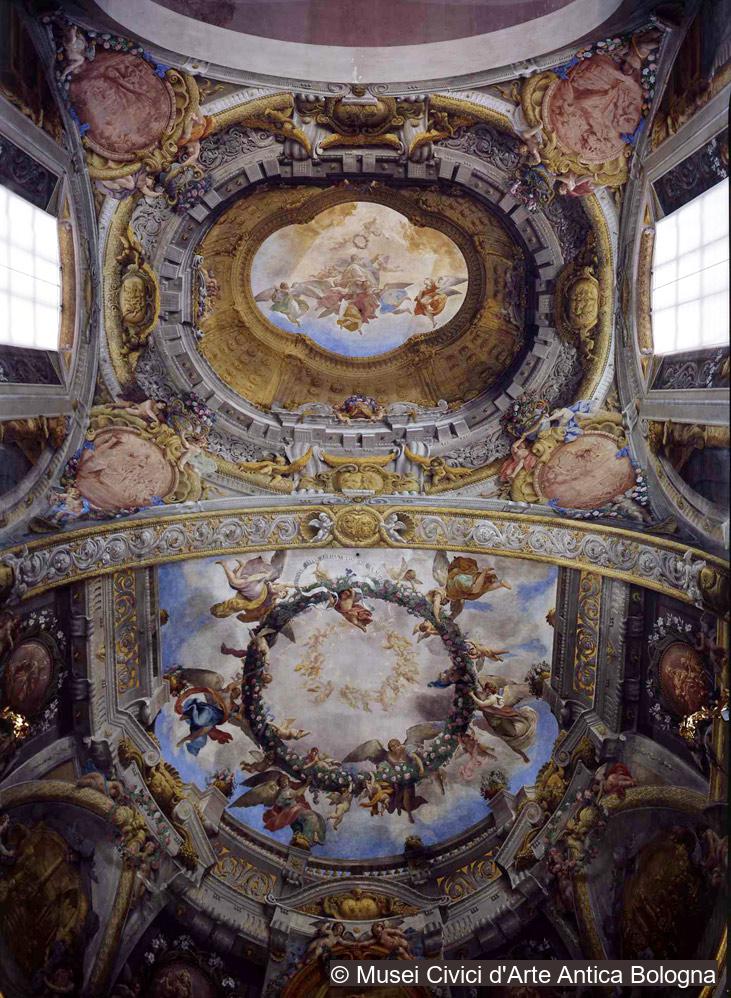
The complex painted decoration of Mitelli and Colonna involves four pilasters, two archivolts, the walls and the vaults of the whole chapel. The painters were helped by the sculptor Domenico Ottani, who made the stucco decorations, the capitals and the elegant friezes, and the gilders Alessandro Miselli and Carlo Veronese. The abundant use of gold leaf for the decorations gives the chapel its typical baroque sumptuousness and contributes to the diffusion of light. Mitelli and Colonna started working in February 1655, completing the painting in May 1657. The subject chosen was the glorification of the Blessed Virgin of the Rosary. The dome is decorated with a beautiful sky wherein the Madonna is carried up by the angels and crowned. In the roundels at the base of the dome are represented the merits of the Rosary handed by the Virgin to St. Dominic in order to defeat the plague of 1630. Putti, angels and Virtues celebrate the glory of the Virgin among flowers, in one of the most impressive scenes of Emilian baroque. The altar is framed by illusionistic architecture on the apse and crowned by two choirs of angels holding crowns, one of flowers and one of stars thus following the motto “Dat flores tellus, coelum dat sidera sertis”. Three great ovals frame episodes from the life of the Virgin (the Birth of Mary, Mary presented to the temple and the Marriage of the Virgin). This extraordinary fresco decoration ideally faces the Glorification of St. Dominic painted by Guido Reni in the chapel dedicated to the saint, just across the nave.
View Short DescriptionThe Chapel of the Rosary was created in 1589 when the Brotherhood of the Rosary refurbished the medieval chapel held by the Guidotti family.
Particularly striking is the altar framing the statue of the Madonna of the Rosary, surrounded by 15 small pictures with the mysteries of the Rosary, work of many celebrated Bolognese painters.
In the second half of the seventeenth-century the interior of the chapel was rebuilt with a new dome and a new apse, while the exterior held the polygonal late Gothic features. Between 1655 and 1657 the whole chapel was decorated by the painters Angelo Michele Colonna and Agostino Mitelli, who made the present rich scenographic decoration, glorifying the Blessed Virgin of the Rosary.
How Monument was dated:
Bibliography and historical documents
Special features
Choirs of angels with a double crown of flowers and stars
Semi dome of the chapel of the Rosary, Basilica di San Domenico, Bologna
1655–1657
Angelo Michele Colonna and Agostino Mitelli
Above the extraordinary altar containing the statue of the Virgin Mitelli, and Colonna painted a monumental baroque building, with courts, balconies, friezes and floral decorations. The sky opens over two choirs of angels holding a crown made of flowers, symbolizing earthly grace, and a crown made of stars, a symbol of divine glory. The skilled use of perspective, the vivid colours and the employ of gold leaf in the decorations lead to a strongly visual result.
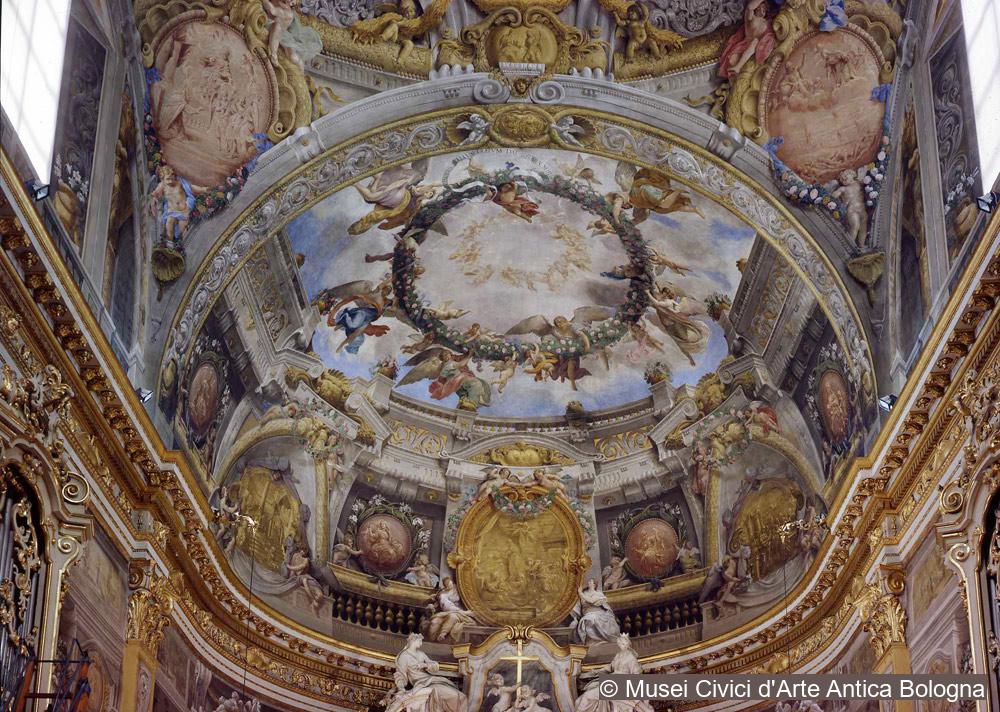
The Coronation of the Virgin
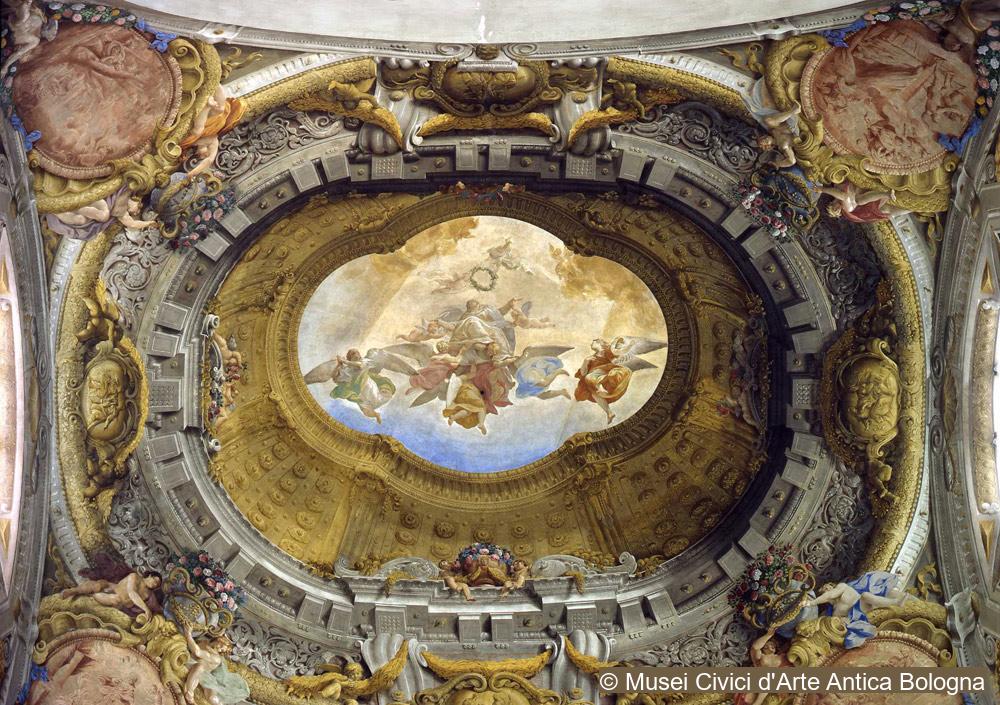
Dome of the square antechamber of the chapel of the Rosary, Basilica di San Domenico, Bologna
1655–1657
Angelo Michele Colonna and Agostino Mitelli
Above the frieze decorated with many golden stuccoes opens the dome, decorated with semi columns and rosettes. The open sky frames the Virgin as she is lifted to heaven to be crowned by the angels. The complex spatial articulation along with the violently vertical scene and the rapid succession of grounds achieves perfect foreshortening, a good example of the high level of Mitelli and Colonna’s achievements in decorative painting. The two painters are perfectly at ease working together so it is practically impossible to tell the different hands.
Monochrome roundel with the Birth of the Virgin
Dome of the square antechamber of the chapel of the Rosary, Basilica di San Domenico, Bologna
1655–1657
Angelo Michele Colonna and Agostino Mitelli
The use of monochrome painting in the roundels at the foot of the dome shows Mitelli’s and Colonna’s elegant taste together with their will to emphasise the contrast between the different worlds of the stories of the Virgin and the heavenly vision above. The scene represented in this roundel is strongly indebted to the classicizing style of Guido Reni.
Selected bibliography:
Alce, V., Il coro di San Domenico a Bologna , Bologna, 1969.
Alce, V., “La cappella musicale del Rosario in San Domenico a Bologna”, Strenna Storica Bolognese, II, Bologna, 1973, pp. 11-32.
Alce, V, “La cappella del Rosario in San Domenico a Bologna”, Il Carrobbio, II, Bologna, 1976, pp. 3-28.
Roli, R., Pittura bolognese 1650-1800. Dal Cignani ai Gandolfi, Bologna, 1977, p. 165.
D'Amato, A., I Domenicani a Bologna, (1600-1987), II, Bologna, 1988, pp. 637-669.
Additional Copyright Information:
Copyright images: Comune di Bologna, Musei Civici d'Arte Antica.
Citation of this web page:
Paolo Cova "Chapel of the Rosary, basilica di San Domenico, Bologna" in "Discover Baroque Art", Museum With No Frontiers, 2026.
https://baroqueart.museumwnf.org/database_item.php?id=monument;bar;it;mon12;9;en
Prepared by: Paolo CovaPaolo Cova
SURNAME: Cova
NAME: Paolo
AFFILIATION:
TITLE: Art Histiorian
CV: Graduated in DAMS at the University of Bologna, is specializing in History of Art at the same university. At present he is collaborating with the Musei Civici d’Arte Antica of Bologna.
He has collaborated to some exhibitions on contemporary and medieval art. His interests are about museography and Medieval, Modern and Contemporary art.
Translation by: Antonella MampieriAntonella Mampieri
SURNAME: Mampieri
NAME: Antonella
AFFILIATION: Musei Civici d’Arte Antica, Bologna
TITLE: Art Hitorian
CV:
Graduated and specialised at the University of Bologna. She is a specialist in Bolognese late Baroque art, namely sculpture. Among other subjects she has been studying nineteenth-century funerary art in the Bologna monumental cemetery, la Certosa.
Translation copyedited by: Lisa Kelman
MWNF Working Number: IT2 10