

 Back
Back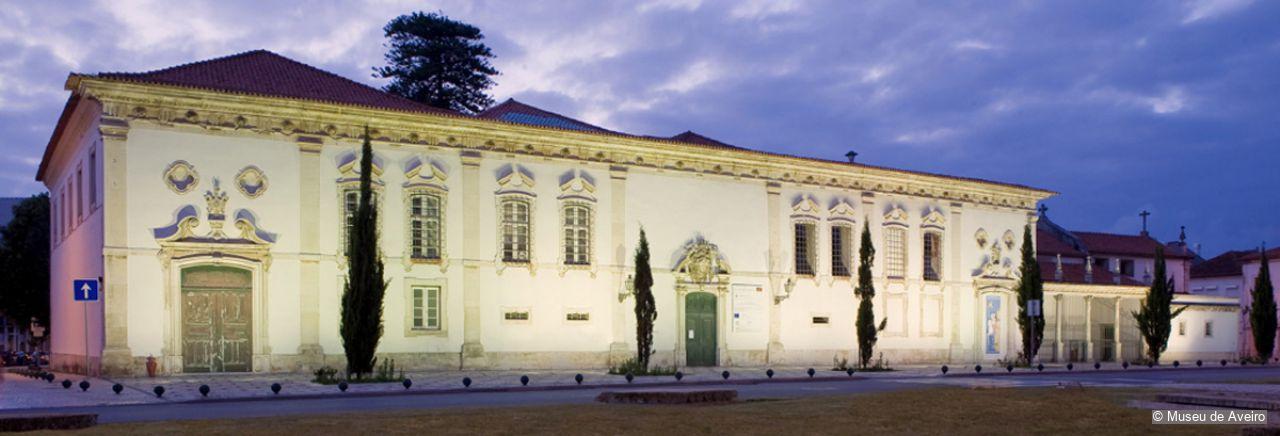
 Add to My Collection
Name of Monument:
Church and Convent of Jesus
Also known as:
Church of the Monastery of Jesus; Aveiro Museum
Location:
Aveiro, Aveiro, Portugal
Museu de Aveiro
Av. Santa Joana
3800 Aveiro
T : +351 234 423 297
F : +351 234 421 749
E : maveiro@imc-ip.pt
Museu de Aveiro (IMC, I.p.) (Responsible Institution)
Date:
1460/18th century
Artists:
Architect: João Antunes (1642–1712) – Tomb of Princess Santa Joana; main altarpiece carving: António Gomes [n.d.], José Correia (active 1725–1728/29); painter of main chapel: (Life of Princess Santa Joana cycle) Emanuel Ferreira e Sousa [n.d.]
Denomination / Type of monument:
Religious architecture, Church and Convent
Patron(s):
Founders: Brites Leitão, Mécia Pereira and Catarina de Ataíde; other patrons: King Afonso V, Francisco Tavares and Joana de Távora; the nobility of Aveiro, King Pedro II, King João V
History:
The Church and Convent of Jesus in Aveiro, which belonged to the Dominican Order, was founded in 1461 during the reign of King Afonso V, whose daughter Princess Santa Joana, lived there up until her death in 1490.
The plan of the church dates to the 16th century, under the patronage of Francisco Tavares and Joana de Távora.
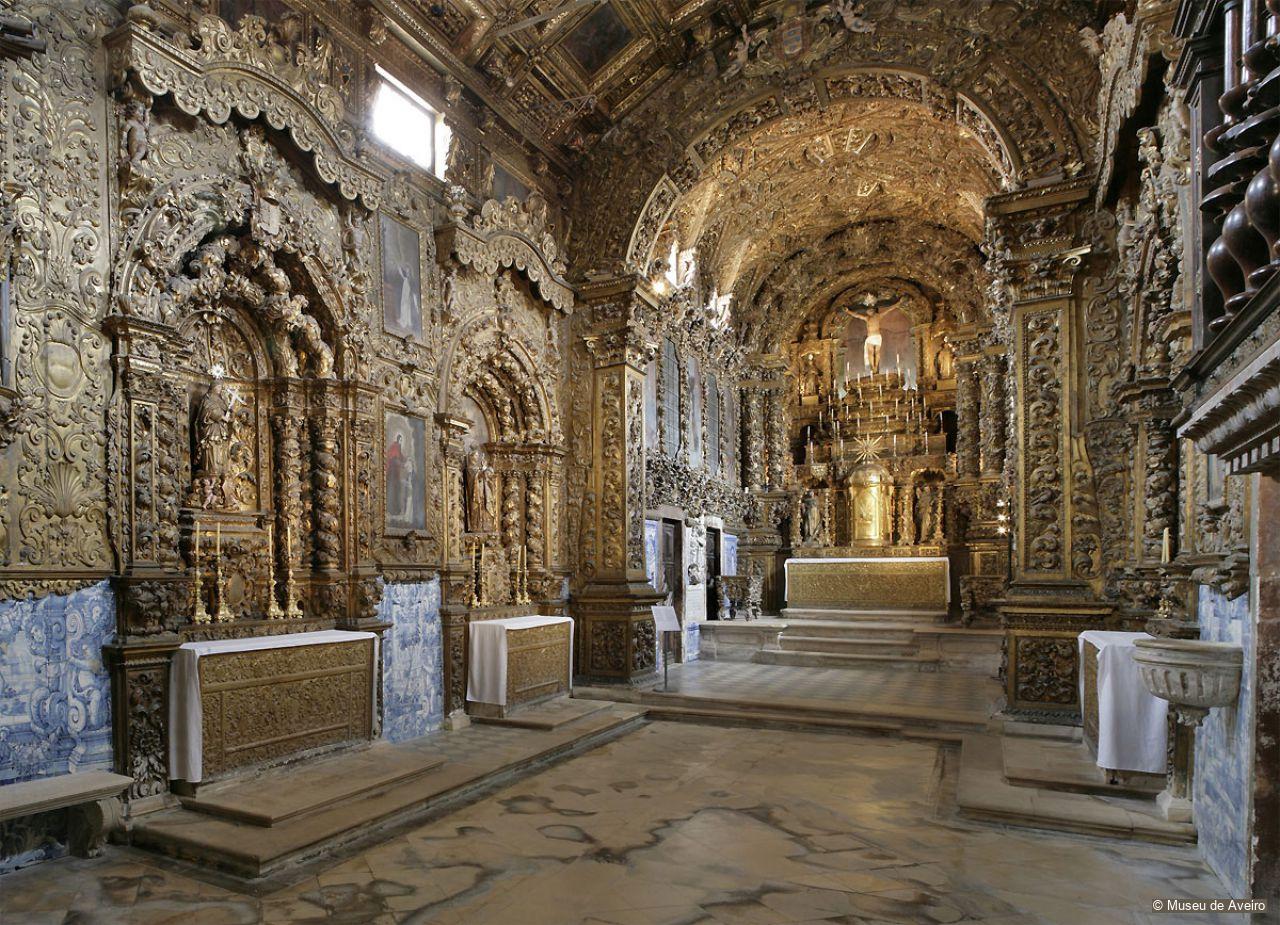
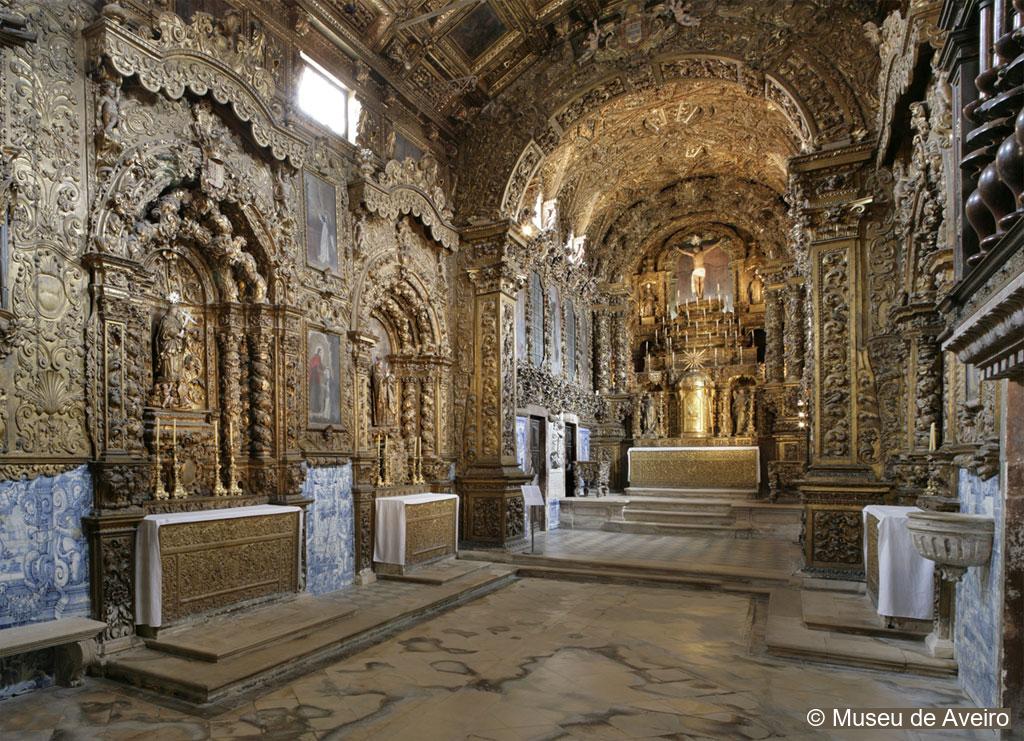
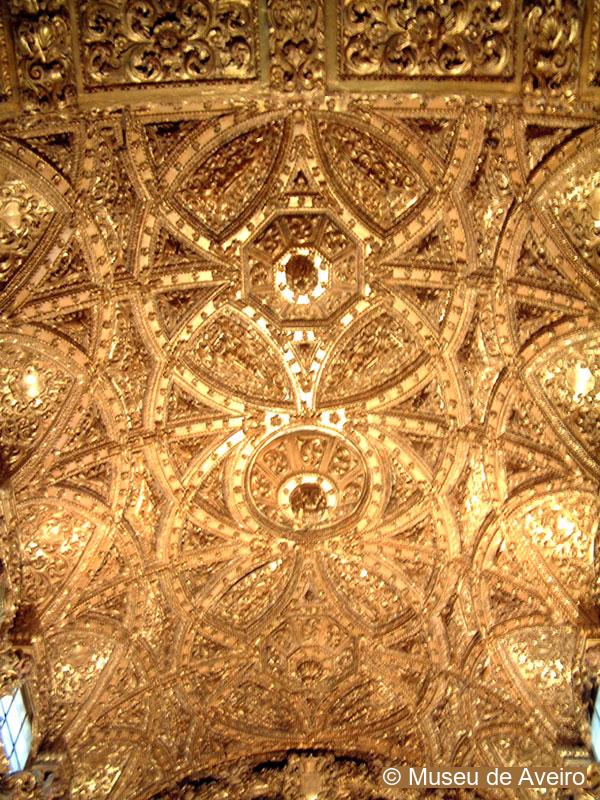
The church underwent complete redecoration in the Baroque style in the 17th and 18th centuries. Gilt wood carvings cover the major part of the church, nave and ceiling as well as the main and side altars, thus it is a true Golden Church.
From 1876 the Church and Convent of Jesus became redundant. In 1911, in the aftermath of the proclamation of the Portuguese Republic, the Museum of Aveiro was established in the Church and Convent.
Description:
The Church and Convent of Jesus date to the 15th century, though its simple architectonic plan is from the 16th century. Composed of one main chapel, it has a small rectangular nave with three secondary altars: Our Lady of the Rosary, Princess Santa Joana and St Dominic.
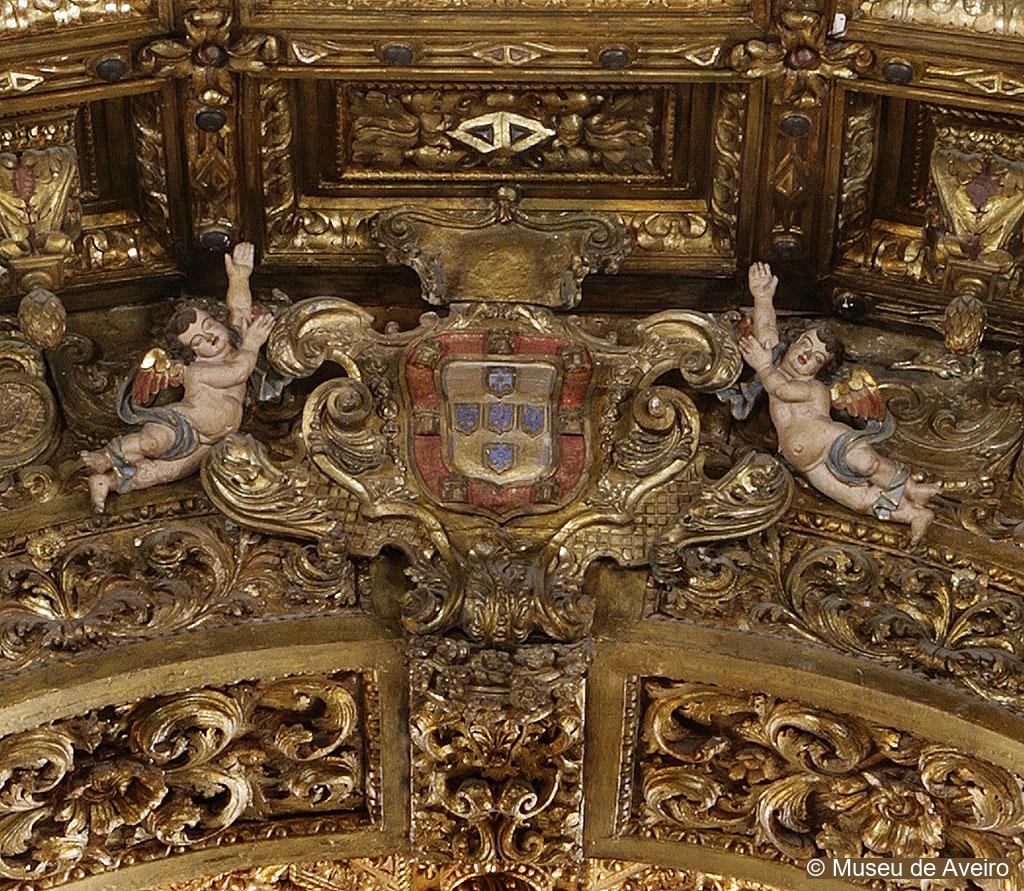
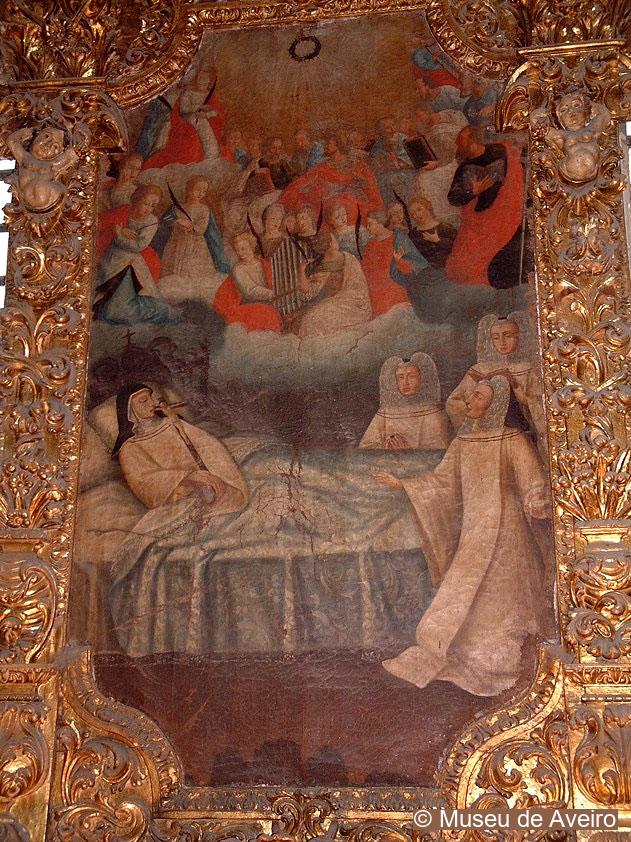
The main chapel, with the royal Portuguese coat of arms, dates from the beginning of the 18th century. The gilt wood carvings were made by Portuguese carvers, António Gomes and José Correia. The Life of Princess Santa Joana cycle, painted on the side walls, is signed by the Portuguese artist Emanuel Ferreira e Sousa.
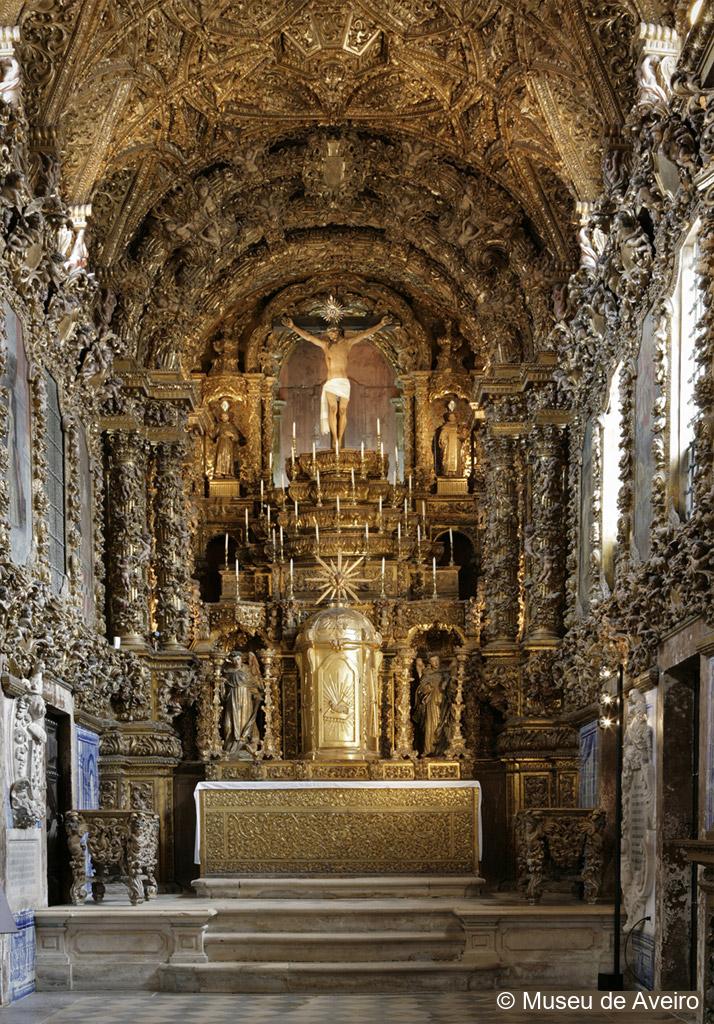
The main altarpiece is furnished with sculptures of St. Vincent Ferrer and St. Thomas Aquinas, St. Francis of Assisi, and St. Dominic. The altarpiece throne is surmounted by a 19th-century Christ Crucified.
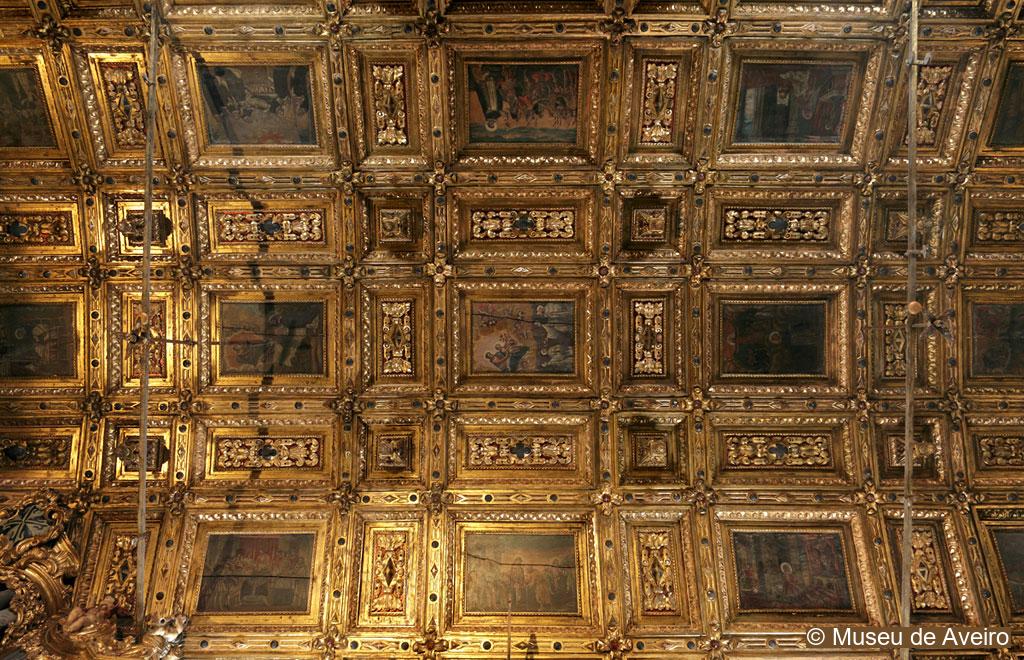
The walls and panel ceiling (1685), in both the main chapel and nave, are covered with gilt wood carvings; the inferior parts with blue and white azulejos (tile panels), making for a very Portuguese Baroque setting.
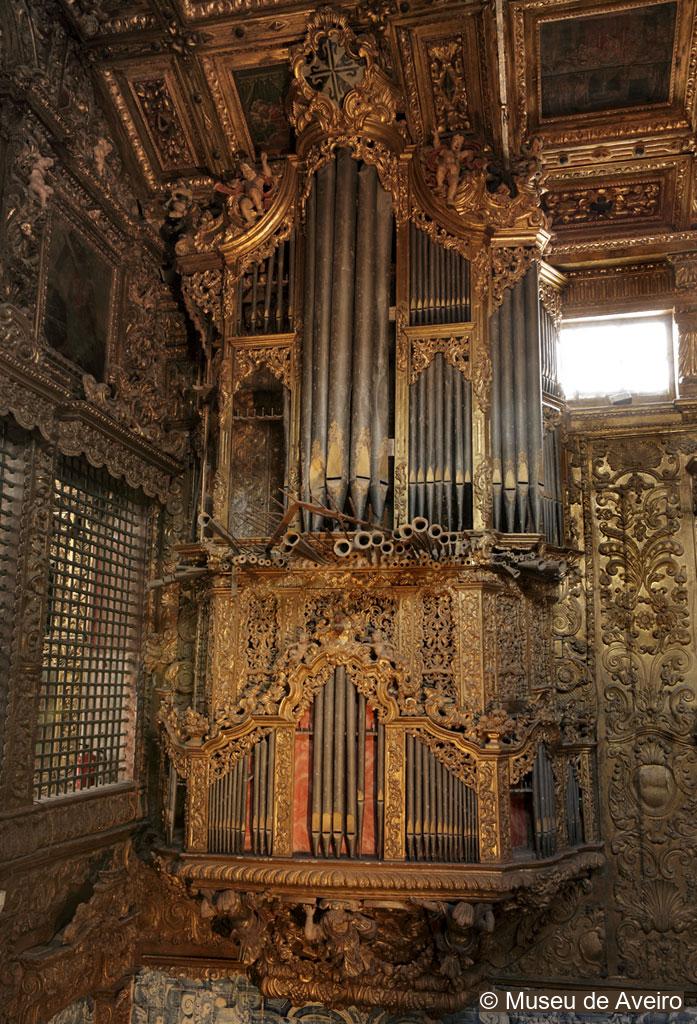
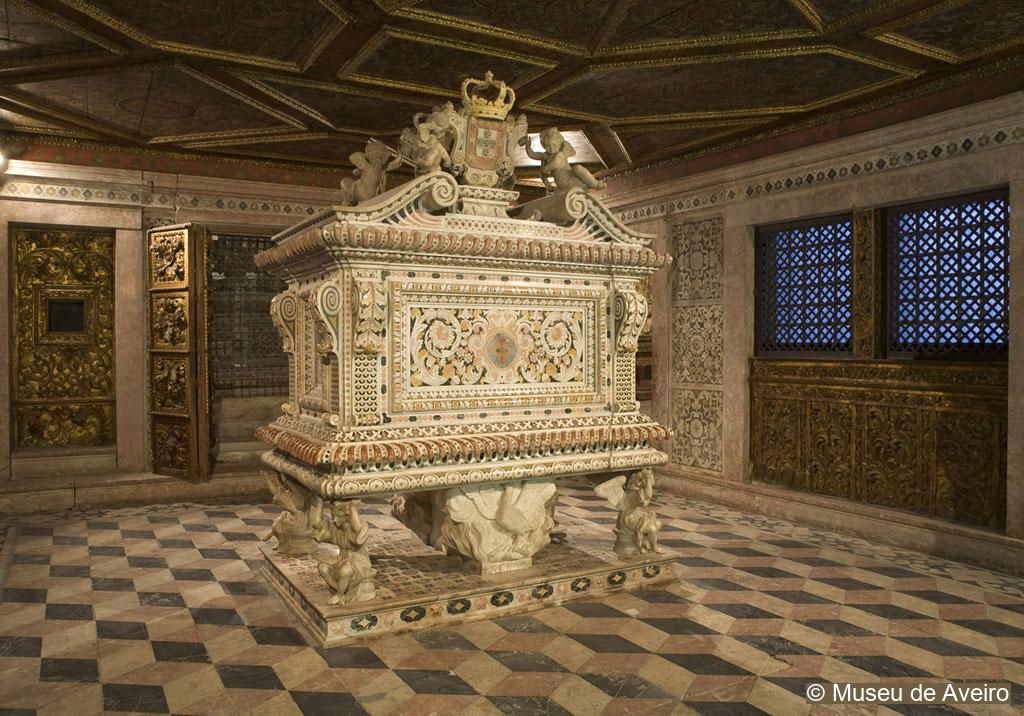
On the left, near the high choir, there is an 18th-century organ of polychrome wood supported by three male figures. The monumental marble tomb of Princess Santa Joana in the Low Choir was designed by the Baroque architect João Antunes.
The Church and Convent of Jesus in Aveiro were built in 1460. The single-nave church dates back to the 16th century, but its interior was redecorated during the reigns of Pedro II and João V.
The main and secondary altars, as well as the panel ceiling with paintings from the Life of St. Dominic, are masterpieces of 17th- and 18th-century gilt wood carving. In the monastery's low-choir stands the tomb of the Princess Santa Joana. In the main chapel her life is depicted in paintings by Ferreira e Sousa.
How Monument was dated:
Historical evidence and stylistic Analysis
Special features
General View, Church Interior
Interior
Late 17th century and first third of the 18th century
António Gomes [n.d.], José Correia (active 1725–1728/29)
One of the finest examples of a Portuguese Baroque Golden Church. The panel ceiling of the nave is adorned with paintings depicting the Life of St. Dominic.
Cycle: The Life of Princess Santa Joana
Church interior, main chapel side walls
1729
Emanuel Ferreira e Sousa [n.d.]
A cycle of Baroque paintings in the naïve style made in 1729 by Emanuel Ferreira e Sousa. They depict scenes from the Life of Princess Santa Joana with characters in 18th-century costume acting out episodes from the 15h century.
Church and Monastery Façade
Exterior
18th century
Unknown
The church façade is typical of the Late Baroque style, disguising the original volumes of the building and strictly unifying the front of the complex. The entrance to the church is through a porch with three Corinthian columns.

Main Chapel
Interior
1725–1728/9
António Gomes [n.d.], José Correia (active 1725–1728/29)
The main altar is composed of the tribune and the throne, it includes four figures: St. Vincent Ferrer and St Thomas Aquinas (inferior) and St. Francis of Assisi and St. Dominic (superior). At the top is Christ Crucified. The main chapel ceiling is of gilt wood, carved with geometric motifs based on circles and half circles.
Low-Choir, Tomb of Princess Santa Joana
Interior
1699–1711
João Antunes (1642–1712)
The monastery’s low choir is decorated with gilt wood carving, tiles and marble. Above is a painted Baroque ceiling. The monumental sarcophagus of Princess Santa Joana is made of multi-coloured inlaid marble.
Selected bibliography:
Gomes, J. A. M, História do Museu Regional de Aveiro (1911–1921), Aveiro, 1921.
Gonçalves, A. N, Inventário Artístico de Portugal – Aveiro – Zona Sul, Lisbon, 1959, pp. 114–117.
Santos, Domingos Maurício Gomes dos (s. j.), O Mosteiro de Jesus de Aveiro: C. D. Angola, Museu do Mundo, Vol. I–II, Lisbon, 1963.
“Museu de Aveiro”, in, Museus de Portugal, No X, 1991, pp. 330–360.
Citation of this web page:
Fernando A. Baptista Pereira, Madalena Cardoso Costa "Church and Convent of Jesus" in "Discover Baroque Art", Museum With No Frontiers, 2026.
https://baroqueart.museumwnf.org/database_item.php?id=monument;bar;pt;mon11;31;en
Prepared by: Fernando A. Baptista Pereira, Madalena Cardoso CostaMadalena Cardoso Costa
SURNAME: Cardoso da Costa
NAME: Maria Madalena
AFFILIATION: Aveiro Museum, Aveiro
TITLE: Senior Curator of the Sculpture Collection
CV:
Madalena Cardoso da Costa graduated in History of Art and has an MA in Educational Sciences. She is currently completing her PhD thesis on Museum Studies. Since 1988 she has been curator of the Sculpture Collection at Aveiro Museum, and has published several papers and articles about the art and historical collections of several museums. Her research focuses on museums, education and Portuguese museum studies.
Translation by: Fernando A. Baptista Pereira, Cristina CorreiaCristina Correia
SURNAME: Correia
NAME: Cristina
AFFILIATION: Eça de Queirós Public High School, Lisbon and MWNF
TITLE: Senior Teacher, Local Co-ordinator and Vice-President of MWNF
CV:
Cristina Correia is a History graduate and, since 1985, a Senior Teacher of History at the Eça de Queirós Public High School, Lisbon where she also lectures in Portuguese Language and Culture for non-native speakers. From 1987 to 1998 she was involved with youth affairs, primary prevention and the Camões Institute. She is Vice-President and Local Co-ordinator (Portugal) for MWNF.
Translation copyedited by: Mandi GomezMandi Gomez
Amanda Gomez is a freelance copy-editor and proofreader working in London. She studied Art History and Literature at Essex University (1986–89) and received her MA (Area Studies Africa: Art, Literature, African Thought) from SOAS in 1990. She worked as an editorial assistant for the independent publisher Bellew Publishing (1991–94) and studied at Bookhouse and the London College of Printing on day release. She was publications officer at the Museum of London until 2000 and then took a role at Art Books International, where she worked on projects for independent publishers and arts institutions that included MWNF’s English-language editions of the books series Islamic Art in the Mediterranean. She was part of the editorial team for further MWNF iterations: Discover Islamic Art in the Mediterranean Virtual Museum and the illustrated volume Discover Islamic Art in the Mediterranean.
True to its ethos of connecting people through the arts, MWNF has provided Amanda with valuable opportunities for discovery and learning, increased her editorial experience, and connected her with publishers and institutions all over the world. More recently, the projects she has worked on include MWNF’s Sharing History Virtual Museum and Exhibition series, Vitra Design Museum’s Victor Papanek and Objects of Desire, and Haus der Kulturen der Welt’s online publication 2 or 3 Tigers and its volume Race, Nation, Class.
MWNF Working Number: PT 31