

 Back
Back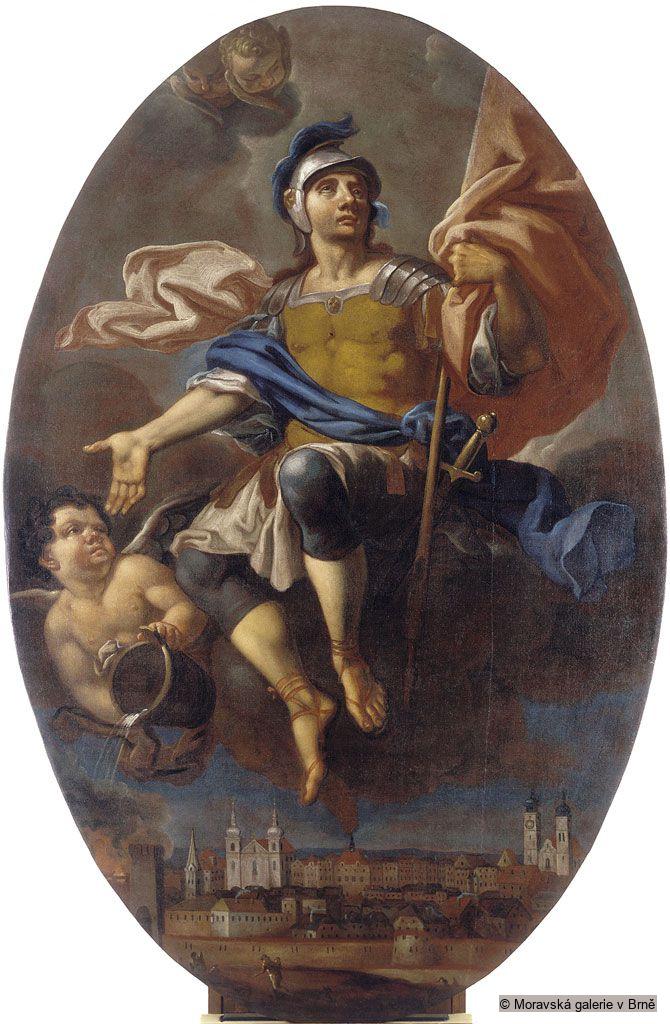
Name of Object:
St. Florian with a View of Jihlava
Location:
Governor’s Palace, Brno, Moravia, Czech Republic
Holding Museum:
Moravian Gallery, Brno
 About Moravian Gallery, Brno , Governor’s Palace, Brno
Original Owner:
Parish Church of St. James, Jihlava
Current Owner:
Moravian Gallery, Brno
Date of Object:
1725
Artist(s) / Craftsperson(s):
Václav Jindřich Nosecký (c. 1660, Prague-1733, Jihlava)
Museum Inventory Number:
A 1430
Material(s) / Technique(s):
Oil on canvas
Dimensions:
h: 209 cm; w: 133 cm
Provenance:
Highlands Museum, Jihlava
Type of object:
Painting
Place of production:
Jihlava
Description:
The picture is a typical example of a votive painting designed for a town environment. In their everyday prayers and pledges, people of the period turned to saints as protectors against the various perils of life. The promotion of saints in these roles was among the chief tools of re-Catholicisation in rural areas. St. Florian, protector from fire, was among the most worshipped. Here the saint is depicted as the protector of the town of Jihlava. Under Swedish siege during the Thirty Years' War the town suburbs were burnt down and the majority of the houses were destroyed. Only one-eighth of the Jihlava population survived.
Jihlava is the oldest mining town of the Czech lands, renowned in the Middle Ages for its silver mines. Mining law was codified there for the first time in Central Europe, alongside municipal law. This formulary law became a template for a number of other mining towns. The economic development of Jihlava was facilitated by trade and crafts, especially weaving. In the mid-18th century, Jihlava was the second largest manufacturer of cloth in the Habsburg monarchy. This veduta is dominated by the Jesuit Church of St. Ignatius, with the parish Church of St. James in the background, on the right; the whole town is encircled by its walls. The square is lined with stone buildings, with arcades and a town hall that feature different types of vaulting. The regular ground plan of the right-angled network of streets with a square in the centre, the largest in Moravia, was defined by a building order made by King Přemysl Otakar II in 1270.
The work of Václav Nosek has not yet been fully mapped as it has a relatively broad span. After settling in Jihlava in 1702, he worked for the town as well as for the Bishop of Olomouc (Kroměříž, 1711) and the Premonstratensian monastery in Louka u Znojma (Education of the Virgin Mary, side altar, 1712). In the 1720s, Nosek also produced templates for graphic illustrations of Episcopal prints.
The picture is a typical example of a votive painting. The promotion of saints as protectors was among the chief tools of re-Catholicisation in rural areas. St. Florian, protector from fire, is represented here as the patron saint of Jihlava, one of the largest and wealthiest Moravian towns.
How date and origin were established:
The archivist and historian Johann Peter Cerroni states that Nosek painted a picture of St. Florian with a veduta of Jihlava. By stylistic comparison the work may be associated with the painting in the Moravian Gallery.
How Object was obtained:
The painting from the Highlands Museum, Jihlava was transferred to the Moravian Gallery in Brno in 1962. It probably comes from the parish Church of St. James.
Selected bibliography:
Ivo Krsek, in Ivo Krsek – Zdeněk Kudělka (ed) – Miloš Stehlík – Josef Válka, Umění baroka na Moravě a ve Slezsku, Prague, 1996, pp. 113, 457.
Pavel Suchánek – Michaela Šeferisová Loudová, Barokní malířství a sochařství v Jihlavě, in Dějiny Jihlavy, Prague, 2009, p. 8.
Citation of this web page:
Zora Wörgötter, Petr Tomášek " St. Florian with a View of Jihlava" in "Discover Baroque Art", Museum With No Frontiers, 2026.
https://baroqueart.museumwnf.org/database_item.php?id=object;BAR;cz;Mus11;13;en
Prepared by: Zora WörgötterZora Wörgötter
SURNAME: Wörgötter
NAME: Zora
AFFILIATION: Moravian Gallery in Brno
TITLE: Museum Curator and Local Co-ordinator
CV:
Zora Wörgötter studied Applied Painting at the Secondary School of Applied Arts, Video Art (Faculty of Fine Arts) at the University of Technology in Brno and Art History and Ethnology (Faculty of Arts) at Masaryk University, Brno. She has worked at the Moravian Gallery since 1997 and was curator of the Ancient Art Collection up until 2008. Specialising in Dutch and Central European painting of the 17th and 18th centuries, she has participated in the preparation of several exhibitions, catalogues and research projects in the Czech Republic and abroad, and published in the Moravian Gallery Bulletin, Opuscula historiae artium, and other journals. She is co-ordinator of the Art History Database www.ahice.net for the Czech Republic., Petr Tomášek
Copyedited by: Jiří KroupaJiří Kroupa
SURNAME: Kroupa
NAME: Jiří
AFFILIATION: Department of the History of Art (Faculty of Arts) Masaryk
University, Brno
TITLE: Professor
CV:
Professor Jiří Kroupa studied Art History, History and Sociology Masaryk University, Brno. He was a curator at the Kroměříž Museum and the Moravian Gallery in Brno before joining the staff at Masaryk University in 1988 (Head of the Department 1992–2002; Professor 1999 to present). His particular fields of interest are in the history of architecture, 18th-century cultural history and the methodology of art history. His long list of publications includes an edition on the architect Franz Anton Grimm and an essay “The alchemy of happiness: the Enlightenment in the Moravian context”. He was contributing editor for the volume Dans le miroir des ombres. Moravie a la age baroque. 1670–1790 (2002).
Translation by: Irma Charvátová
Translation copyedited by: Mandi GomezMandi Gomez
Amanda Gomez is a freelance copy-editor and proofreader working in London. She studied Art History and Literature at Essex University (1986–89) and received her MA (Area Studies Africa: Art, Literature, African Thought) from SOAS in 1990. She worked as an editorial assistant for the independent publisher Bellew Publishing (1991–94) and studied at Bookhouse and the London College of Printing on day release. She was publications officer at the Museum of London until 2000 and then took a role at Art Books International, where she worked on projects for independent publishers and arts institutions that included MWNF’s English-language editions of the books series Islamic Art in the Mediterranean. She was part of the editorial team for further MWNF iterations: Discover Islamic Art in the Mediterranean Virtual Museum and the illustrated volume Discover Islamic Art in the Mediterranean.
True to its ethos of connecting people through the arts, MWNF has provided Amanda with valuable opportunities for discovery and learning, increased her editorial experience, and connected her with publishers and institutions all over the world. More recently, the projects she has worked on include MWNF’s Sharing History Virtual Museum and Exhibition series, Vitra Design Museum’s Victor Papanek and Objects of Desire, and Haus der Kulturen der Welt’s online publication 2 or 3 Tigers and its volume Race, Nation, Class.
MWNF Working Number: CZ 14