

 Back
Back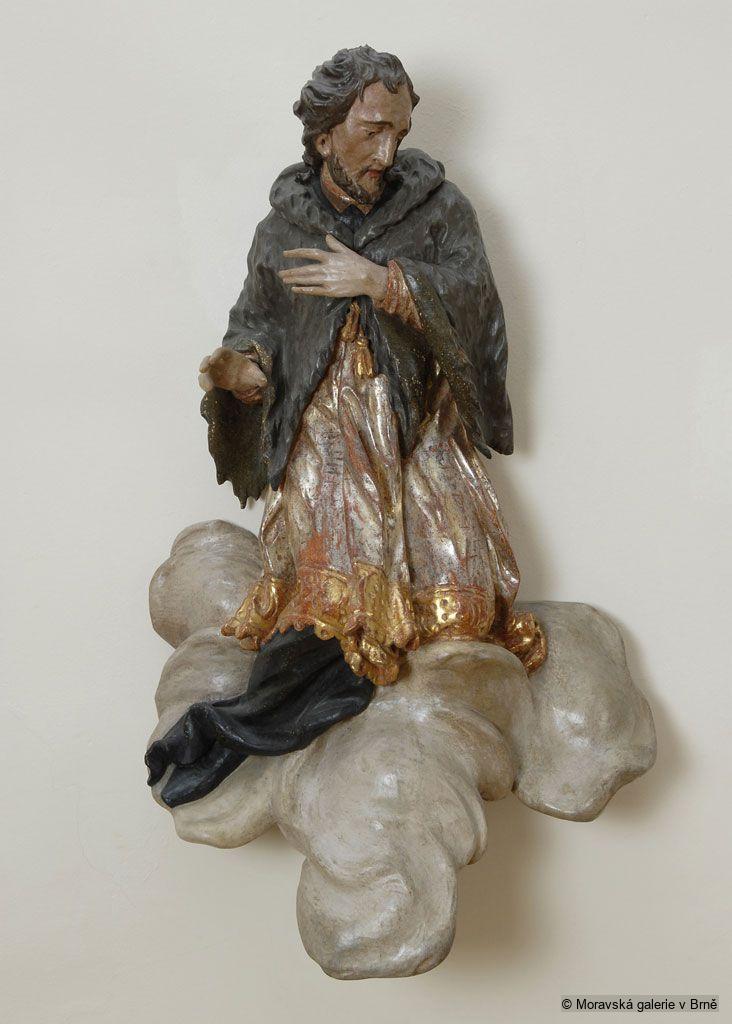
I. Lengelacher, St. John of Nepomuk
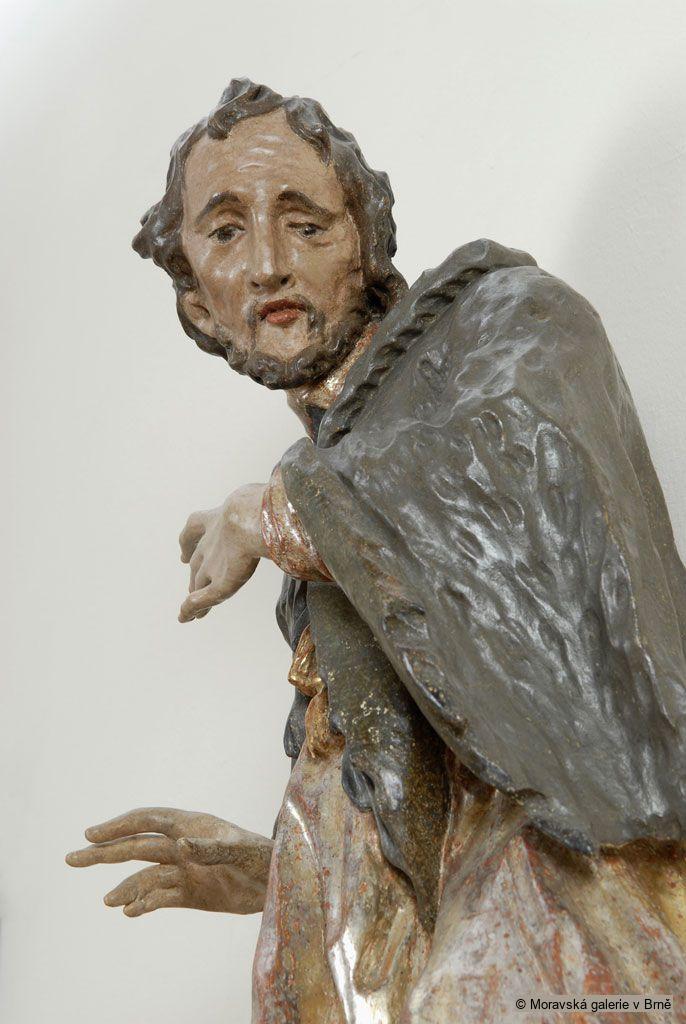
I. Lengelacher, St. John of Nepomuk, Detail of the face
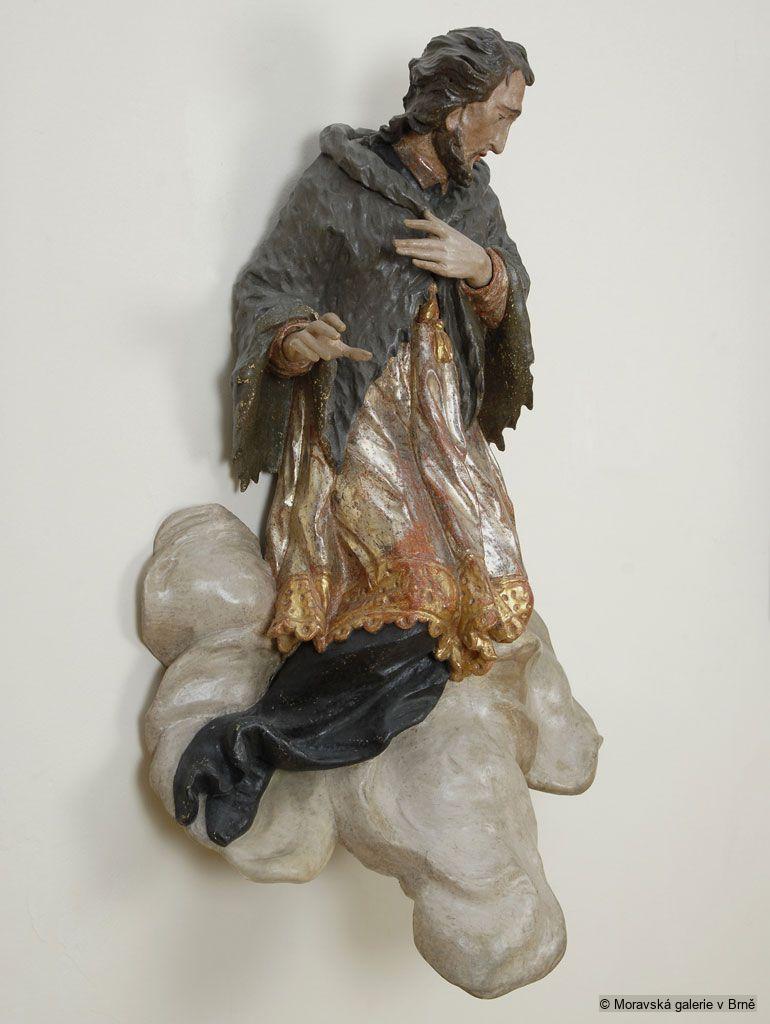
I. Lengelacher, St. John of Nepomuk, Profile
Name of Object:
St. John of Nepomuk
Location:
Governor’s Palace, Brno, Moravia, Czech Republic
Holding Museum:
Moravian Gallery, Brno
 About Moravian Gallery, Brno, Governor’s Palace, Brno
Current Owner:
Moravian Gallery, Brno
Date of Object:
c. 1740
Artist(s) / Craftsperson(s):
Ignaz Lengelacher (1698, Unter Peissenberg-1780(?), Baden)
Museum Inventory Number:
E 602
Material(s) / Technique(s):
Wood, polychromy
Dimensions:
H: 97 cm
Provenance:
Private owner, Moravia
Type of object:
Sculpture
Place of production:
Moravia
Description:
The Czech martyr John of Nepomuk became one of the major Moravian saints at the turn of the 17th century. The general vicar of the Archbishop of Prague was murdered in 1393. As a saint, his cult spread all over the Czech lands and Roman Catholic Europe and even overseas. John of Nepomuk was worshipped even before his canonisation and beatification in Rome in 1729. Today, one still encounters pilgrimage sites, pictures and statues erected in his honour in many places in Moravia.
Ignaz Lengelacher, sculptor to the Dietrichstein family, frequently devoted himself to St. John of Nepomuk as a subject for his work in Moravia, from the saint's figure on the Holy Trinity Column in Mikulov (1723–34) to his statue in Pouzdřany (1751).
In terms of composition, the subject appears in Lengelacher's oeuvre in a number of versions, manifesting the artist's fertile imagination and the inventiveness of his approaches to a single saint. St. John is alone in Lengelacher's statues, standing or kneeling, or sometimes accompanied by the standing figures of angels holding characteristic attributes.
Lengelacher paid particular attention to interpretation of the saint's mental state in the adoration of the cross which, as shown by the position of hands, he had initially been clasping in quiet, self-absorbed contemplation. The seriousness of the subject is accentuated by the strict emphasis placed on the plain physique of the statue. The cloud pedestal provides the figure with a compositional base and indicates a connection with the transcendent, as the figure is an apotheosis of a martyr, a patron saint of the Czech lands.
After 1750, Lengelacher left for Bavaria and then went to Bruchsal in the Baden region, where he entered the service of the Bishop of Styria. In 1758 he is recorded as the sculptor to the enlightened and art-loving Margrave Karl Friedrich of Baden (c. 1811) in Karlsruhe, whose court also hosted, among others, Voltaire, Lavater and Goethe.
John of Nepomuk became one of major Moravian saints at the turn of the 17th century. His cult spread all over Catholic Europe and even reached overseas. Today one still encounters pilgrimage sites, pictures and statues erected in his honour in many places in Moravia.
How date and origin were established:
Style analysis is supported by the sculpture’s origins as private property in South Moravia.
How Object was obtained:
Purchased in 1974 from a private owner.
Selected bibliography:
Vlasta Kratinová, Baroko, Brno, 1992, no. 10.
Miloš Stehlík, in Ivo Krsek – Zdeněk Kudělka (ed) – Miloš Stehlík – Josef Válka, Umění baroka na Moravě a ve Slezsku, Prague, 1996, pp. 99, 408, cat. 154.
Vlasta Kratinová, in Jiří Kroupa (ed), Dans le miroir des ombres. La Moravie a la age baroque 1760–1790, Brno–Paris–Rennes, 2002, pp. 94–95, cat. 8.
Annette Borchardt-Wenzel, Karl Friedrich von Baden–Mensch und Legende, Gernsbach, 2006.
Citation of this web page:
Zora Wörgötter, Vlasta Kratinová "St. John of Nepomuk" in "Discover Baroque Art", Museum With No Frontiers, 2026.
https://baroqueart.museumwnf.org/database_item.php?id=object;BAR;cz;Mus11;22;en
Prepared by: Zora WörgötterZora Wörgötter
SURNAME: Wörgötter
NAME: Zora
AFFILIATION: Moravian Gallery in Brno
TITLE: Museum Curator and Local Co-ordinator
CV:
Zora Wörgötter studied Applied Painting at the Secondary School of Applied Arts, Video Art (Faculty of Fine Arts) at the University of Technology in Brno and Art History and Ethnology (Faculty of Arts) at Masaryk University, Brno. She has worked at the Moravian Gallery since 1997 and was curator of the Ancient Art Collection up until 2008. Specialising in Dutch and Central European painting of the 17th and 18th centuries, she has participated in the preparation of several exhibitions, catalogues and research projects in the Czech Republic and abroad, and published in the Moravian Gallery Bulletin, Opuscula historiae artium, and other journals. She is co-ordinator of the Art History Database www.ahice.net for the Czech Republic., Vlasta Kratinová
Copyedited by: Jiří KroupaJiří Kroupa
SURNAME: Kroupa
NAME: Jiří
AFFILIATION: Department of the History of Art (Faculty of Arts) Masaryk
University, Brno
TITLE: Professor
CV:
Professor Jiří Kroupa studied Art History, History and Sociology Masaryk University, Brno. He was a curator at the Kroměříž Museum and the Moravian Gallery in Brno before joining the staff at Masaryk University in 1988 (Head of the Department 1992–2002; Professor 1999 to present). His particular fields of interest are in the history of architecture, 18th-century cultural history and the methodology of art history. His long list of publications includes an edition on the architect Franz Anton Grimm and an essay “The alchemy of happiness: the Enlightenment in the Moravian context”. He was contributing editor for the volume Dans le miroir des ombres. Moravie a la age baroque. 1670–1790 (2002).
Translation by: Irma Charvátová
Translation copyedited by: Mandi GomezMandi Gomez
Amanda Gomez is a freelance copy-editor and proofreader working in London. She studied Art History and Literature at Essex University (1986–89) and received her MA (Area Studies Africa: Art, Literature, African Thought) from SOAS in 1990. She worked as an editorial assistant for the independent publisher Bellew Publishing (1991–94) and studied at Bookhouse and the London College of Printing on day release. She was publications officer at the Museum of London until 2000 and then took a role at Art Books International, where she worked on projects for independent publishers and arts institutions that included MWNF’s English-language editions of the books series Islamic Art in the Mediterranean. She was part of the editorial team for further MWNF iterations: Discover Islamic Art in the Mediterranean Virtual Museum and the illustrated volume Discover Islamic Art in the Mediterranean.
True to its ethos of connecting people through the arts, MWNF has provided Amanda with valuable opportunities for discovery and learning, increased her editorial experience, and connected her with publishers and institutions all over the world. More recently, the projects she has worked on include MWNF’s Sharing History Virtual Museum and Exhibition series, Vitra Design Museum’s Victor Papanek and Objects of Desire, and Haus der Kulturen der Welt’s online publication 2 or 3 Tigers and its volume Race, Nation, Class.
MWNF Working Number: CZ 23