

 Back
Back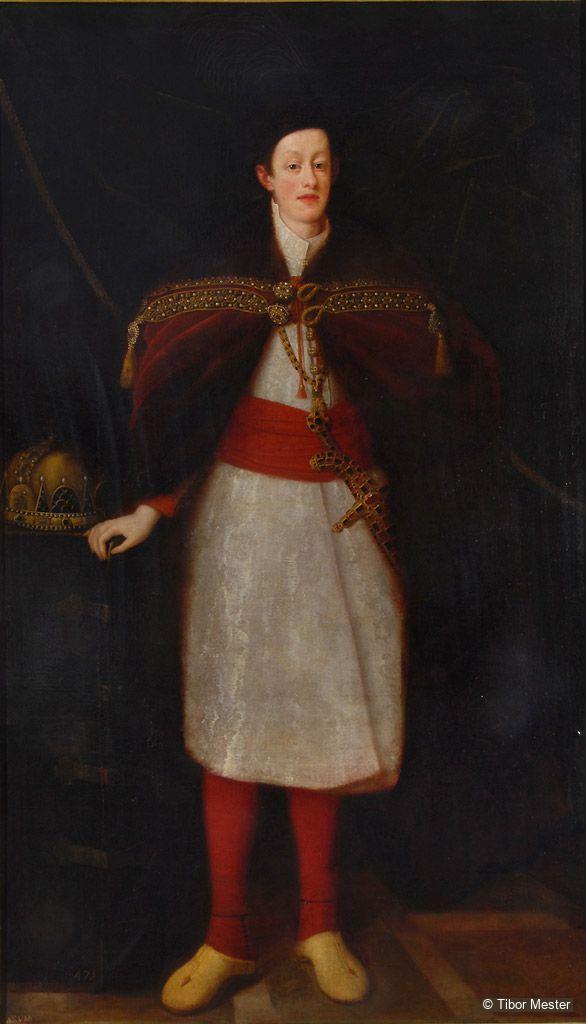
Name of Object:
Ferdinand III as King of Hungary
Location:
Budapest, Közép-Magyarország / Central Hungary, Hungary
Holding Museum:
Hungarian National Gallery
 About Hungarian National Gallery, Budapest
Original Owner:
Leganés Collection, Madrid
Date of Object:
1626
Artist(s) / Craftsperson(s):
Justus Sustermans and his workshop (1597, Antwerp-1681, Florence)
Museum Inventory Number:
92.20 M
Material(s) / Technique(s):
Oil on canvas
Dimensions:
H: 201 cm; w: 126 cm
Provenance:
Leganés Collection, Madrid (probably commissioned by Don Diego Da Messia, Marquis Leganés, Spanish art collector and connoisseur)
Type of object:
Painting (portrait)
Period of activity:
Early Baroque
Place of production:
Vienna / Madrid
Description:
The history of the painting is connected to the Diet of Sopron in 1625. In November 1625, the 18 year-old Habsburg heir was crowned King of Hungary in Sopron as Ferdinand III. Participating envoys reported that for the occasion the interior decoration of the Franciscan Church of Sopron consisted of the heraldic red, white and green of Hungary. The prospective ruler was also dressed for the ceremony in this vein: in the attire of a Hungarian nobleman, as seen in this portrait. The young king's first official portrait, the painting is an important document of the coronation, its authenticity seen in the faithful depiction of the Hungarian Holy Crown, rarely seen at the time. Such a detailed depiction, correct even in the colours used, would have been possible only by observation. As an object deprived of “publicity”, the crown was on display during coronation ceremonies only. This means that the artist must have attended the crowning ceremony. The portrait is attributed to the Flemish painter Justus Sustermans – court painter of the Medici in Florence – by analogy of his contemporaneous works, and by the fact that he had visited the Habsburg court on an earlier occasion and worked on commissions for the imperial family. There is probably more than one version of Ferdinand III as King of Hungary, this one becoming part of the collection of a notable Spanish art collector, connoisseur and collector of portraits, Marquis Leganés, Don Diego Da Messia. Leganés was busy at the time arranging the marriage of Ferdinand III and the Infanta, Maria Anna, sister of Philip III King of Spain, which was schedule for the spring of 1626.
View Short DescriptionThe history of the painting is connected to the Diet of Sopron in 1625. Participating envoys reported that for the occasion the interior decoration of the Franciscan Church of Sopron consisted of the heraldic red, white and green of Hungary. In this commemorative painting, the first official portrait of the 18 year-old Ferdinand III as King of Hungary, he is dressed in these colours. An important detail of the painting is the accurate depiction of the Hungarian Holy Crown, seen in every detail and accurately depicted enriched by the same colours.
How date and origin were established:
By historical data and stylistic analysis
How Object was obtained:
Leganés Collection Madrid; purchased from a European private collection
Selected bibliography:
Buzási, E., “III. Ferdinánd mint magyar király (Justus Sustermans ismeretlen műve az egykori Leganés gyűjteményből)” (“Ferdinand III as King of Hungary: a still unknown painting by Justus Sustermans from the late Leganés collection”), Annales de la Galerie Nationale Hongroise, Budapest, 1991, pp. 149–158.
Citation of this web page:
Enikő Buzási "Ferdinand III as King of Hungary" in "Discover Baroque Art", Museum With No Frontiers, 2026.
https://baroqueart.museumwnf.org/database_item.php?id=object;BAR;hu;Mus11;1;en
Prepared by: Enikő Buzási
Copyedited by: Terézia BardiTerézia Bardi
SURNAME: Bardi
NAME: Terézia Anna
AFFILIATION: National Trust of Monuments for Hungary
TITLE: Art Historian, Vice Director for Research at The National Trust of
Monuments for Hungary; MWNF DBA local co-ordinator (Hungary), author
and copy-editor
CV:
Terézia Bardi, Vice Director for Research at the National Trust of Monuments for Hungary since 2004, was awarded her MA in History and History of Art at the Eötvös Loránd University in Budapest. After a period of fellowships mainly in Italy, Terézia gained her PhD from the Faculty of Art History at the same university for her thesis Presentation and Representation – the European Reception of the Liberation of Buda in 1686: Feast and Public Opinion. Her main fields of research are 17th-and18th-century Baroque and Rococo: the spectacles, festival decorations and associated iconography – including theatre productions of the period – and interior decoration of historic houses. Since 1988, she has edited a number of art historical books that include some on Oriental art and architecture. She is MWNF DBA’s local (Hungarian) co-ordinator, author and copy-editor.
Translation by: Judit Pokoly
Translation copyedited by: Mandi GomezMandi Gomez
Amanda Gomez is a freelance copy-editor and proofreader working in London. She studied Art History and Literature at Essex University (1986–89) and received her MA (Area Studies Africa: Art, Literature, African Thought) from SOAS in 1990. She worked as an editorial assistant for the independent publisher Bellew Publishing (1991–94) and studied at Bookhouse and the London College of Printing on day release. She was publications officer at the Museum of London until 2000 and then took a role at Art Books International, where she worked on projects for independent publishers and arts institutions that included MWNF’s English-language editions of the books series Islamic Art in the Mediterranean. She was part of the editorial team for further MWNF iterations: Discover Islamic Art in the Mediterranean Virtual Museum and the illustrated volume Discover Islamic Art in the Mediterranean.
True to its ethos of connecting people through the arts, MWNF has provided Amanda with valuable opportunities for discovery and learning, increased her editorial experience, and connected her with publishers and institutions all over the world. More recently, the projects she has worked on include MWNF’s Sharing History Virtual Museum and Exhibition series, Vitra Design Museum’s Victor Papanek and Objects of Desire, and Haus der Kulturen der Welt’s online publication 2 or 3 Tigers and its volume Race, Nation, Class.
MWNF Working Number: HU 01