

 Back
Name of Object:
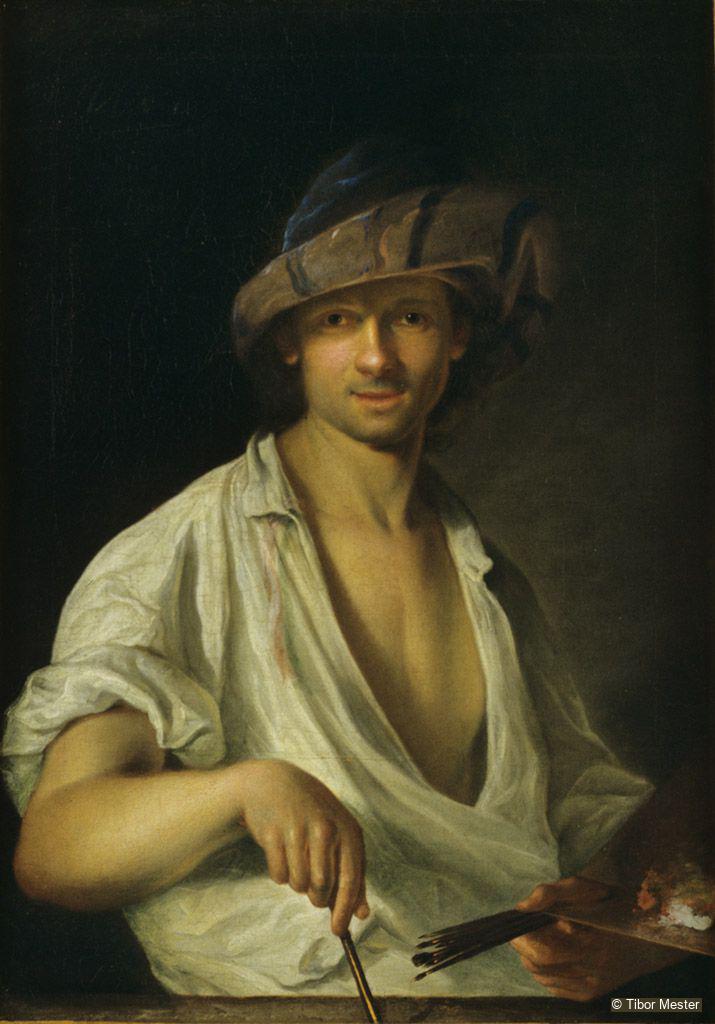
Self Portrait
Location:
Budapest, Közép-Magyarország / Central Hungary, Hungary
Holding Museum:
Hungarian National Gallery
 About Hungarian National Gallery, Budapest
Original Owner:
Ádám Mányoki
Date of Object:
About 1711
Artist(s) / Craftsperson(s):
Ádám Mányoki (1673, Szokolya-1757, Dresden)
Museum Inventory Number:
6508
Material(s) / Technique(s):
Oil on canvas
Dimensions:
H: 87 cm; w: 61.5 cm
Provenance:
Owned by Ádám Mányoki
Type of object:
Painting (self portrait)
Place of production:
Hungary
Description:
The portrait painter, Ádám Mányoki, was one of the most prominent figures of Baroque art in Hungary. His career began in Hanover and Hamburg and then, in the first decade of the 18th century, he worked for Frederick William at the Berlin court. From 1707 to 1712, he was court portraitist to Prince Ferenc Rákóczi II in Hungary, where he worked for a number of years before carrying out other assignments for the prince in the Netherlands and Berlin.
He painted the Self Portrait rendered with a captivating candour and self-assurance in Berlin. He used a trick of the self-portraitist that had been popular since Rembrandt: the soft velvet hat with its upturned rim casting a warm, brown shadow over the upper half of his face. The painting reveals a synthesis of the influence of Antoine Pesne, a French portraitist of the Prussian court, and of Mányoki's studies in northern Germany. The choice of colours and some formal details are clearly traceable to Pesne's work, while some characteristic features of the composition are rooted in 17th-century Dutch and German painting, including Johann Heinrich Roos' self-portrait. Mányoki may have known Roos' self-portrait from an engraving by Philip Kilian and taken inspiration from it in the figure's posture and the shirt loosely opening in front.
From 1713, Mányoki was employed by August II the Strong, King of Poland and Elector of Saxony; from 1717 he was portrait painter to the court. Thereafter he received an increasing number of commissions in Leipzig to portray the professors of the university, the well-to-do burghers and merchants and their families. In the mid-1720s, Mányoki, intent on repatriation, returned to Hungary for a short time. However, a lack of patronage and inability to make a living meant he left for Dresden again, this time for good. He adjusted his later work in the main to the expectations of 18th-century German middle-class art collectors.
The son of a Protestant clergyman in Szokolya, Mányoki studied art in Germany. Called back to Hungary by Prince Ferenc Rákóczi II in 1707, he remained there until 1712. Following the collapse of the struggle against the Habsburgs for independence led by the prince, he worked for the Polish-Saxon court in Dresden from 1713.
Painted in Berlin, the Self Portrait – rendered with captivating candour and self-assurance –represents an excellent “French-style” example of the artist's portrait painting.
How date and origin were established:
by historical documents and stylistic analysis
How Object was obtained:
Originally owned by Ádám Mányoki, the painting is documented in the Galerie Schleißheim from 1775. It was bought by the Association of Friends of the Art Museums, and from 1931 was on permanent deposit in museums with which the Friends were associated. From 1974 it has been in the Hungarian National Gallery.
Selected bibliography:
Crossroads: Baroque Art in Central Europe) exhibition catalogue, (ed. G. Galavics), Budapest, 1993.
Buzási, E., “Cat. Nr. 17”, In Europe's Princely Courts. Ádám Mányoki: Actors and Venues of a Portraitist's Career, exhibition catalogue, (ed. E. Buzási), Budapest, 2003.
Buzási, E., Ádám Mányoki (1673–1757). Monographie und Oeuvrekatalog, Budapest, 2003, cat. A. 92.
Citation of this web page:
Enikő Buzási "Self Portrait" in "Discover Baroque Art", Museum With No Frontiers, 2026.
https://baroqueart.museumwnf.org/database_item.php?id=object;BAR;hu;Mus11;5;en
Prepared by: Enikő Buzási
Copyedited by: Terézia BardiTerézia Bardi
SURNAME: Bardi
NAME: Terézia Anna
AFFILIATION: National Trust of Monuments for Hungary
TITLE: Art Historian, Vice Director for Research at The National Trust of
Monuments for Hungary; MWNF DBA local co-ordinator (Hungary), author
and copy-editor
CV:
Terézia Bardi, Vice Director for Research at the National Trust of Monuments for Hungary since 2004, was awarded her MA in History and History of Art at the Eötvös Loránd University in Budapest. After a period of fellowships mainly in Italy, Terézia gained her PhD from the Faculty of Art History at the same university for her thesis Presentation and Representation – the European Reception of the Liberation of Buda in 1686: Feast and Public Opinion. Her main fields of research are 17th-and18th-century Baroque and Rococo: the spectacles, festival decorations and associated iconography – including theatre productions of the period – and interior decoration of historic houses. Since 1988, she has edited a number of art historical books that include some on Oriental art and architecture. She is MWNF DBA’s local (Hungarian) co-ordinator, author and copy-editor.
Translation by: Judit Pokoly, Lara Strong
Translation copyedited by: Mandi GomezMandi Gomez
Amanda Gomez is a freelance copy-editor and proofreader working in London. She studied Art History and Literature at Essex University (1986–89) and received her MA (Area Studies Africa: Art, Literature, African Thought) from SOAS in 1990. She worked as an editorial assistant for the independent publisher Bellew Publishing (1991–94) and studied at Bookhouse and the London College of Printing on day release. She was publications officer at the Museum of London until 2000 and then took a role at Art Books International, where she worked on projects for independent publishers and arts institutions that included MWNF’s English-language editions of the books series Islamic Art in the Mediterranean. She was part of the editorial team for further MWNF iterations: Discover Islamic Art in the Mediterranean Virtual Museum and the illustrated volume Discover Islamic Art in the Mediterranean.
True to its ethos of connecting people through the arts, MWNF has provided Amanda with valuable opportunities for discovery and learning, increased her editorial experience, and connected her with publishers and institutions all over the world. More recently, the projects she has worked on include MWNF’s Sharing History Virtual Museum and Exhibition series, Vitra Design Museum’s Victor Papanek and Objects of Desire, and Haus der Kulturen der Welt’s online publication 2 or 3 Tigers and its volume Race, Nation, Class.
MWNF Working Number: HU 05
RELATED CONTENT
On display in
Exhibition(s)
MWNF Galleries
PortraitsDownload
As PDF (including images) As Word (text only)