

 Back
 Add to My Collection
Name of Object:
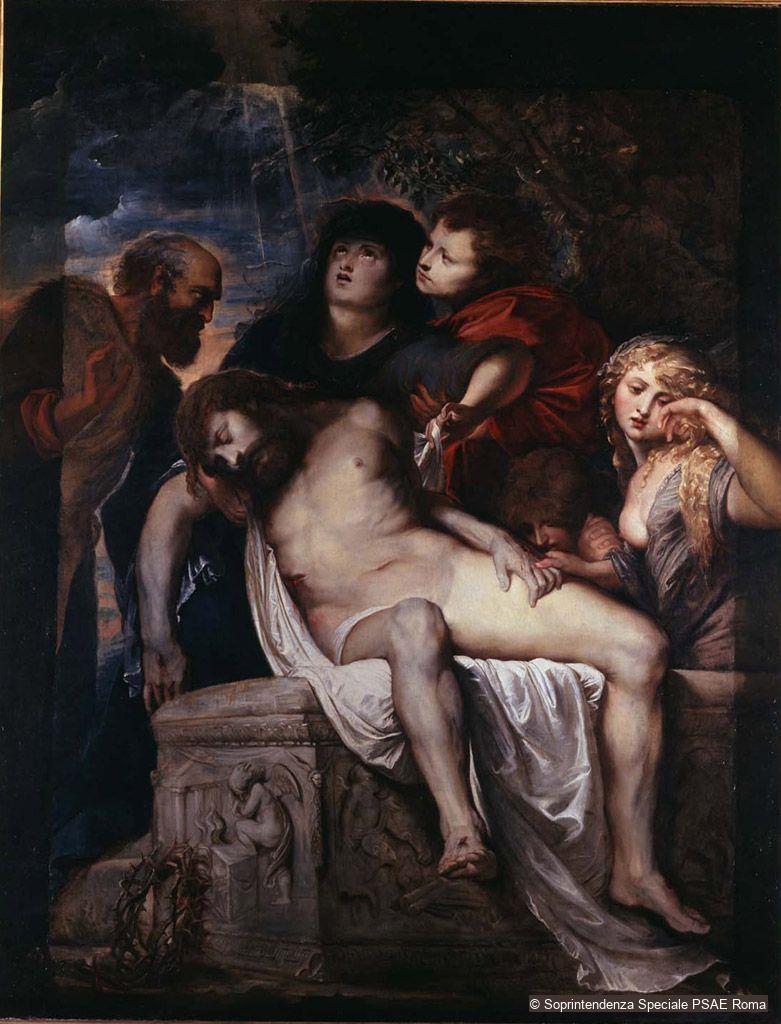
Lamentation of Christ
Location:
Rome, Latium, Italy
Holding Museum:
Borghese Gallery
Original Owner:
Cardinale Montalto (?)
Current Owner:
Italian State
Date of Object:
Early 17th century
Artist(s) / Craftsperson(s):
Peter Paul Rubens (1577, Siegen-1640, Antwerp)
Museum Inventory Number:
411
Material(s) / Technique(s):
Oil on canvas
Dimensions:
h: 180 cm; w: 137 cm
Provenance:
Camillo Borghese Collection (1827)
Type of object:
Painting
Description:
The canvas dates from the Flemish painter's first trip to Rome (1602), and is contemporaneous with his first Roman commission: the paintings for the Sant' Elena Chapel in the Church of Santa Croce in Gerusalemme.
The work was probably done for Cardinal Montalto and did not become part of the Borghese collection until 1827.
The scene shows the Lamentation of Christ according to the Gospels. In the centre of the picture, conforming to the dramatic style typical of Baroque art is the body of Christ in a bold foreshortened position, stretched out on an ancient sarcophagus and surrounded by different characters. Mary supports him with the shroud (in which he is wrapped) while looking to the heavens, where beams of light pierce dark clouds, accentuating the almost nocturnal setting of the subject. John the Evangelist, the young apostle loved by Jesus, stands opposite the elderly Joseph of Arimathea. The right side of the painting shows two female figures: one the pious woman, almost hidden, and Magdalene, in full light, in the act of drying her tears. The high drama of the composition and the richness of the colours perhaps come from the famous Deposition that Caravaggio completed for the Church of Santa Maria in Vallicella (1602–1604). The painting nonetheless reveals clear references to Dutch Mannerism, combined in this case with classical models copied by the artist in Rome, with brilliant colours and diagonal compositions taken from Venetian and Emilian painting.
This work was painted by Rubens during his first stay in Rome (1602). He matched Barocci's colours, the dense brushwork of the late Titian, and the roman statuary and the light and shadow of Caravaggio. The Baroque genius had blended, in an absolutely original way, this tradition with new experimentation.
How Object was obtained:
The Borghese Collection was acquired by the Italian State in 1902.
Selected bibliography:
Della Pergola, P., Galleria Borghese. I Dipinti, II, Rome, 1959, n.272, pp. 182–184.
Bodart, D., in Pietro Paolo Rubens, exhibition catalogue (Padua), Rome, 1990, pp. 42–43, cat. 4.
Costamagna, A., “La collezione di Camillo Borghese fra ricostituzione del patrimonio artistico e nuove acquisizioni”, in Villa Borghese. I principi, le arti, la città dal Settecento all'Ottocento, exhibition catalogue, Rome, 2003, pp. 99–105.
Vlieghe, B., Rubens, exhibition catalogue, Paris, 2004, p. 33, cat.6.
Additional Copyright Information:
Copyright image: Archivio fotografico Soprintendenza Speciale PSAE e Polo Museale della Città di Roma.
Citation of this web page:
Sofia Barchiesi "Lamentation of Christ" in "Discover Baroque Art", Museum With No Frontiers, 2026.
https://baroqueart.museumwnf.org/database_item.php?id=object;BAR;it;Mus11;14;en
Prepared by: Sofia BarchiesiSofia Barchiesi
SURNAME: Barchiesi
NAME: Sofia
TITLE: Author and Researcher
CV:
Sofia Barchiesi, a graduate and specialist in Art History and recipient of a scholarship from the School of Mediaeval and Modern Art History at Lumsa University, has been working with the Superintendency for Historical Artistic Heritage and the Museums of Rome since the late 1980s. She was responsible for cataloguing the art of the region and museums of Rome, studying the period of the Counter-Reformation particularly closely. She works with journals and writes essays, alternating her research and teaching work.
Translation by: Laurence Nunny
Translation copyedited by: Mandi GomezMandi Gomez
Amanda Gomez is a freelance copy-editor and proofreader working in London. She studied Art History and Literature at Essex University (1986–89) and received her MA (Area Studies Africa: Art, Literature, African Thought) from SOAS in 1990. She worked as an editorial assistant for the independent publisher Bellew Publishing (1991–94) and studied at Bookhouse and the London College of Printing on day release. She was publications officer at the Museum of London until 2000 and then took a role at Art Books International, where she worked on projects for independent publishers and arts institutions that included MWNF’s English-language editions of the books series Islamic Art in the Mediterranean. She was part of the editorial team for further MWNF iterations: Discover Islamic Art in the Mediterranean Virtual Museum and the illustrated volume Discover Islamic Art in the Mediterranean.
True to its ethos of connecting people through the arts, MWNF has provided Amanda with valuable opportunities for discovery and learning, increased her editorial experience, and connected her with publishers and institutions all over the world. More recently, the projects she has worked on include MWNF’s Sharing History Virtual Museum and Exhibition series, Vitra Design Museum’s Victor Papanek and Objects of Desire, and Haus der Kulturen der Welt’s online publication 2 or 3 Tigers and its volume Race, Nation, Class.
MWNF Working Number: IT1 17
RELATED CONTENT
On display in
Exhibition(s)
The Use of Colours in Art
Primary Colours and Emotions | The Basics – getting to know the Primary ColoursMWNF Galleries
PaintingsDownload
As PDF (including images) As Word (text only)