

 Back
Back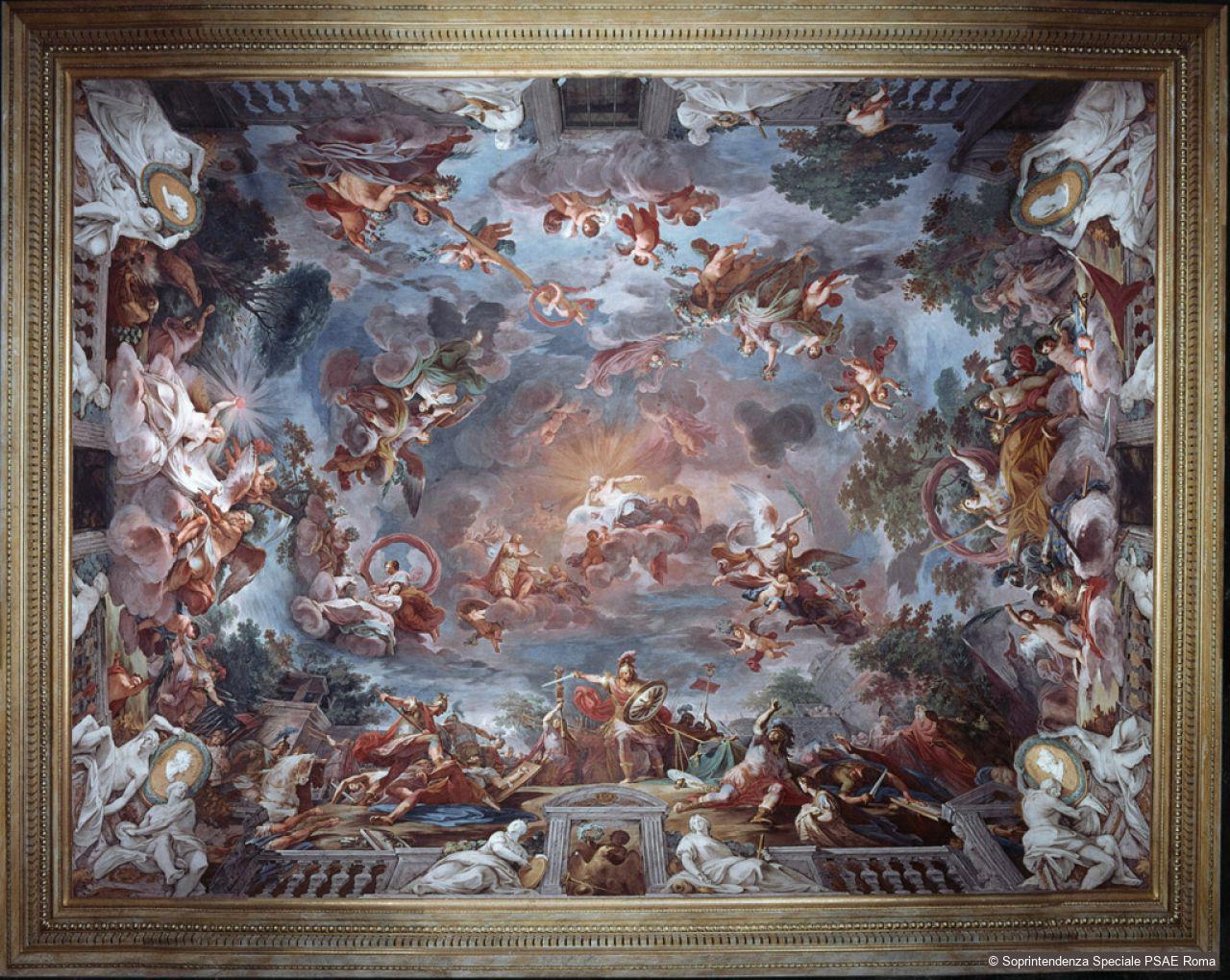
Name of Object:
The Apotheosis of Romulus
Location:
Rome, Latium, Italy
Holding Museum:
Borghese Gallery, vault of the Entrance Hall
 About Borghese Gallery, vault of the Entrance Hall, Rome
Current Owner:
Italian State
Date of Object:
1775–1779
Artist(s) / Craftsperson(s):
Mariano Rossi (1731, Sciacca (Agrigento)-1807, Rome)
Material(s) / Technique(s):
Fresco
Type of object:
Fresco
Description:
This extremely large fresco decorates the vault of the Entrance Hall of the Villa Borghese. It was carried out, along with decoration of the walls, during the renovation of the villa commissioned by Marcantonio IV Borghese, and directed by the architect Antonio Asprucci (1723–1808).
The fresco showing the Apotheosis of Romulus was painted on the vault between 1775 and 1779 by the Sicilian painter Mariano Rossi. The mythical founder of Rome appears twice: in an almost central position in front of Jupiter and on the right-hand side with a wolf, a reference to the legendary founding of the eternal city. Furio Camillo appears on the side of the vault opposite the main entrance, an important name in the victorious battle against the invading Gauls, led by Brennus. The allegorical significance of this representation celebrates the connection between these two figures: Romulus as the founder of Rome, and Furio Camillo whose heroic actions led him to be known as the “Second Romulus” and honoured in ancient sources (Eutropius) as a new founder of the Fatherland. Given that the fresco was completed shortly after the birth of Camillo (1775–1832), the first-born son of Marcantonio IV, it was clearly meant as a celebration of his birth, particularly as the name of the young heir was the same as the most prestigious member of the family: Camillo Borghese, who became Pope Paul V (1552–1621), and whose image as the re-founder of Christian Rome exalted the glory and Romanity of the family.
The extraordinary command of proportion and spatial background, the breadth and ease of the brushstrokes, and the magnificent scenery make this work one of the last splendours of Roman Baroque painting, by then influenced by 17th-century classicism, particularly in its Arcadian inspiration and clear, luminous colours.
The painting is a celebration of both Roman civilisation and the Borghese family, painted to mark the birth of Marcantonio IV Borghese’s first son, Camillo. The work, by the Sicilian painter Mariano Rossi, is representative of the development of the late Baroque style.
How Object was obtained:
Villa Borghese was acquired by the Italian State in 1902.
Selected bibliography:
Petereit Guicciardi, S., Das Casino Borghese: Dekoration und Inhalt, Wien, 1983, pp. 5–8.
Paul, C., Mariano Rossi's Camillus Fresco in the Borghese Gallery, in Art Bulletin, 74, 1992, pp. 297–326.
Additional Copyright Information:
Copyright image: Archivio fotografico Soprintendenza Speciale PSAE e Polo Museale della Città di Roma.
Citation of this web page:
Sofia Barchiesi, Marina Minozzi "The Apotheosis of Romulus" in "Discover Baroque Art", Museum With No Frontiers, 2026.
https://baroqueart.museumwnf.org/database_item.php?id=object;BAR;it;Mus11;28;en
Prepared by: Sofia BarchiesiSofia Barchiesi
SURNAME: Barchiesi
NAME: Sofia
TITLE: Author and Researcher
CV:
Sofia Barchiesi, a graduate and specialist in Art History and recipient of a scholarship from the School of Mediaeval and Modern Art History at Lumsa University, has been working with the Superintendency for Historical Artistic Heritage and the Museums of Rome since the late 1980s. She was responsible for cataloguing the art of the region and museums of Rome, studying the period of the Counter-Reformation particularly closely. She works with journals and writes essays, alternating her research and teaching work., Marina MinozziMarina Minozzi
SURNAME: Minozzi
NAME: Marina
AFFILIATION: Borghese Gallery, Rome
TITLE: Head Art History Co-ordinator
CV:
Marina Minozzi, a graduate and specialist in Art History, is currently the Head Art History Co-ordinator at the Borghese Gallery, where she curates the collections from the 18th and 19th centuries and heads the museum’s Documentation Centre. She has published a range of papers, including many on art-collecting in Rome and particularly the Borghese collection. She is currently involved with the Ten Great Exhibitions project underway at the Borghese Gallery, and has written essays on the work of Bernini, Raffaello, Canova and Correggio.
Translation by: Laurence Nunny
Translation copyedited by: Mandi GomezMandi Gomez
Amanda Gomez is a freelance copy-editor and proofreader working in London. She studied Art History and Literature at Essex University (1986–89) and received her MA (Area Studies Africa: Art, Literature, African Thought) from SOAS in 1990. She worked as an editorial assistant for the independent publisher Bellew Publishing (1991–94) and studied at Bookhouse and the London College of Printing on day release. She was publications officer at the Museum of London until 2000 and then took a role at Art Books International, where she worked on projects for independent publishers and arts institutions that included MWNF’s English-language editions of the books series Islamic Art in the Mediterranean. She was part of the editorial team for further MWNF iterations: Discover Islamic Art in the Mediterranean Virtual Museum and the illustrated volume Discover Islamic Art in the Mediterranean.
True to its ethos of connecting people through the arts, MWNF has provided Amanda with valuable opportunities for discovery and learning, increased her editorial experience, and connected her with publishers and institutions all over the world. More recently, the projects she has worked on include MWNF’s Sharing History Virtual Museum and Exhibition series, Vitra Design Museum’s Victor Papanek and Objects of Desire, and Haus der Kulturen der Welt’s online publication 2 or 3 Tigers and its volume Race, Nation, Class.
MWNF Working Number: IT1 36