

 Back
Back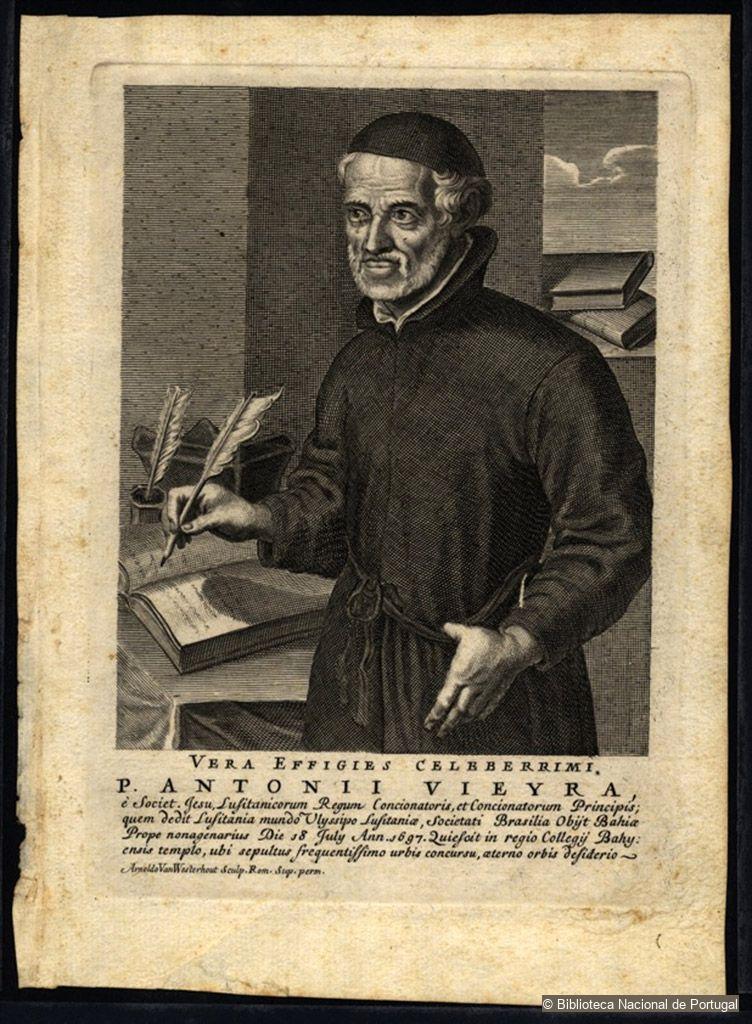
 Add to My Collection
Name of Object:
Portrait of Father António Vieira
Also known as:
Vera effigies celeberrimi P. Antonii Vieyra
Location:
Lisbon, Lisbon, Portugal
Holding Museum:
National Library of Portugal
Current Owner:
Biblioteca Nacional de Portugal
Date of Object:
c.1700–1721
Artist(s) / Craftsperson(s):
Arnold van Westerhout (1651-1725)
Museum Inventory Number:
FO/0555
Material(s) / Technique(s):
Aqua-fortis and burin (“cold chisel”)
Dimensions:
H: 17.5 cm; w:12.4 cm
Provenance:
Italy, Rome (?)
Type of object:
Engraving
Period of activity:
1655–1721
Place of production:
Italy, Rome (?)
Description:
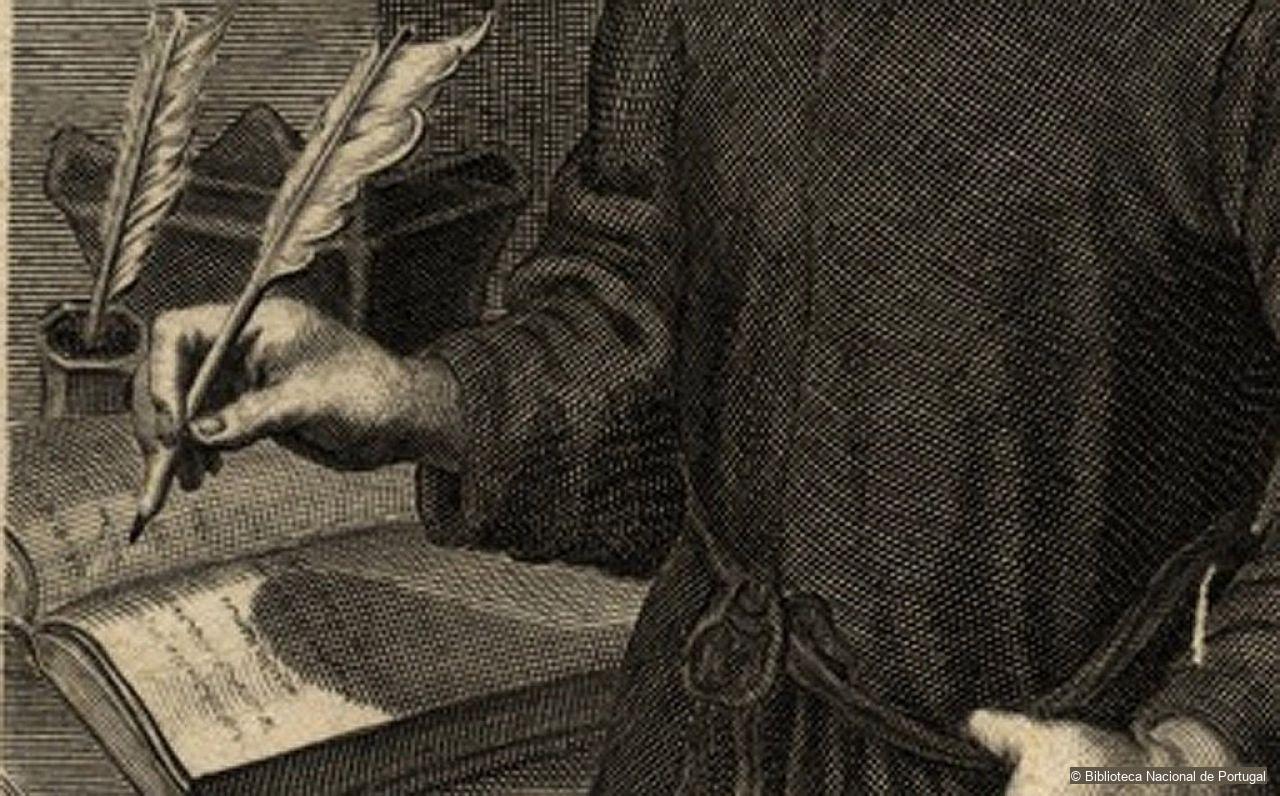
In this engraving Arnold van Westerhout represents the humanist, António Vieira, as a man of knowledge and a father of the Society of Jesus. His gaze extends beyond the horizon: whether towards Brazil where he grew up or to Lisbon, the home he always defended with the staunchness he employed to preach the Christian faith. The Flemish artist concentrates on António Vieira's facial expression to heighten his altruistic character which is shown in constant reflection about the human condition and his own experience of it.
This painting celebrates António Vieira's exemplary life dedicated to the defence of human rights, whether to those of Brazil's indigenous peoples or the Jews persecuted by the Inquisition.
Born in Lisbon in 1608, António Vieira departed to S. Salvador da Bahia with his parents at the age of six. He entered the Society of Jesus in 1623 and become a priest 12 years later. He played a fundamental role in the relationship between Jesuits, coloniser and the indigenous peoples of Brazil, exhibiting in his sermons an anxiety about the socio-political conditions that would characterise his missionary activity. With knowledge of the languages and costumes of the Brazilian Indians he was a missionary and a preacher with a humanistic vision.
Following independence from Spanish domination, Vieira returned to Lisbon where he became an important figure in the court of King João IV. He rapidly became a key player in state decisions and helped re-establish the Portuguese Empire's economic, political, diplomatic and religious profile in Lisbon and in the most important colony at the time, Brazil. In the latter, and at Vieira's advice, the Commercial Company of Brazil was instituted with two intentions: to resist Dutch invasion and to foment the recovery of local sugar production with the objective of export to Europe.
In Lisbon he proposed economic reforms that would force a change in the doctrine of the Inquisition. He terminated the distinction between 'new-Christians' and 'old Christians' in order to attract the investments of Jews who had fled the Kingdom. The idea generated a conflict with the Society of Jesus and the Dominicans, which resulted in António Vieira being persecuted by the Inquisition.
Later in his life he was one again accused of heresy. This was as a result of a letter he sent to the Bishop of Japan in which he outlined his Theory of the Fifth Empire. Here he predicted that Portugal was predestined to be the next grand empire following the Assyrian, Greek, Persian and Roman.
An engraving by Arnold van Westerhout of António Vieira, a Portuguese Jesuit Priest, writer and preacher. As a senior diplomat as well as a missionary in Brazil, he became both an influential figure in Portuguese culture and in the defence of human rights of indigenous peoples.
How date and origin were established:
Historical evidence and stylistic analysis
How Object was obtained:
Acquisition
Selected bibliography:
Frota, G. de Andréa, Padre António Vieira: ensaio bibliográfico relativo ao Brasil, Lisbon, 1966.
Cidade, H., Pe. António Vieira: a obra e o homem, 2nd edition, Lisbon, 1979.
Silva, M. M. da, Padre António Vieira [Texto policopiado]: génese do discurso oratorio, Tese doutoramento em Literatura Portuguesa, Universidade de Lisboa, 1987.
Borges, P. A. E, A plenificação da história em Padre António Vieira [Texto policopiado]: estudo sobre a ideia de "Quinto Império" na "defesa perante o Tribunal do Santo Oficio", Lisbon, 1988.
Citation of this web page:
Rui Oliveira Lopes "Portrait of Father António Vieira" in "Discover Baroque Art", Museum With No Frontiers, 2026.
https://baroqueart.museumwnf.org/database_item.php?id=object;BAR;pt;Mus11_A;50;en
MWNF Working Number: PT 53